CONTENT

In the era of AI and the Internet of Things (IoT), companies are under pressure to transform digitally while maintaining a laser-like focus on customer needs. One notable blueprint for customer-centric digital transformation comes from China’s Haier Group, through its innovative Rendanheyi model.
First introduced in 2005 by Haier’s visionary CEO Zhang Ruimin, Rendanheyi has evolved into a globally recognized management philosophy tailored for the IoT age. This model centers on “zero distance” to the customer – aligning every employee’s goals with user needs – and has been key to Haier’s transformation from a traditional appliance manufacturer into a nimble, high-tech ecosystem player.
In this comprehensive article, we examine the fundamental principles of the Rendanheyi model and its role in facilitating customer-centric digital transformation, drawing on real-world insights from Haier and other Chinese companies.
Rendanheyi (人单合一) literally means the unity of “Ren” (people) and “Dan” (orders or user value). At its heart, Rendanheyi is a management model that makes every employee directly accountable to the customer. Zhang Ruimin conceived Rendanheyi to cure “big enterprise disease” – the bureaucracy and internal focus that plagues large organizations.
The core idea is simple yet powerful: each employee (Ren) should be connected to a specific user need (Dan) such that value created for the user and value gained by the employee become one (“heyi”).
In practice, this means that every employee or team operates like an entrepreneurial unit, with end-to-end responsibility for an aspect of the customer experience, and their rewards (compensation) are tied to the user’s evaluation of the value delivered.
All innovation and operations start from user needs. Employees are encouraged to interact with customers, obtaining real-time insights and feedback directly. Haier describes this as achieving “零距离” (zero distance) with users.
Instead of viewing customers as one-time buyers, they are treated as long-term users and co-creators, whose evolving needs drive continual innovation.
Rendanheyi dismantles traditional hierarchy. Middle management is eliminated, and the organization is flattened into self-managed micro-enterprises. Zhang Ruimin famously asserted that in the Internet age, a CEO should “disappear” like a dinosaur, because holding all decision power at the top stifles agility.
In Haier’s model, power is “returned” to front-line teams – employees gain the “three rights”: decision-making power, personnel (hiring) power, and profit-distribution power. Each team or microenterprise has autonomy to make decisions swiftly in response to customer feedback, choose or attract its talent, and share in the profits it generates. This unleashes entrepreneurial vitality at all levels.
Under Rendanheyi, every employee is encouraged to think and act like an entrepreneur or “创客” (maker). Rather than being a cog in a machine, the employee is the CEO of their own initiative.
They even have the opportunity to become stakeholders in the business they drive – Haier has allowed entrepreneurs within micro-enterprises to hold equity-like shares in their ventures, aligning their incentives with long-term user value creation.
Failure is not punished but seen as learning, and success is richly rewarded through a “RenDanChou” mechanism where compensation comes from the user (the more value the user perceives, the more the team can earn). This replaces traditional top-down evaluation with customer-driven meritocracy.
A traditional company is often compared to a “walled garden” of silos, but Haier broke those walls. Rendanheyi encourages the firm to become an open platform that connects to external resources – whether customers, partners, or even competitors – to co-create value. In Rendanheyi 2.0 (an updated vision introduced in 2023-2024), Ruimin emphasizes “zero boundary” as a core concept.
This means Haier seeks to erase boundaries between departments, between the company and users, and even across industries. The goal is an open ecosystem where ideas, talent, and technology flow freely in and out, combating organizational “entropy” (decay) by constantly injecting fresh energy from outside.
Haier’s mission evolved to “创造负熵” – “create negative entropy” – by remaining open and adaptive, preventing the stagnation that kills closed companies.
Rendanheyi 2.0 reframes the mission as creating negative entropy—keeping the firm open and renewing. Zero boundaries remove product, data, and organizational walls so external partners can co-create value. Internally, chain-group contracts expand into ecosystem contracts: partners share revenue, data access, and IP under published rules. Users get scenario experiences; partners and teams share the gains.
Perhaps the most important principle is that Rendanheyi is not a static “management system” but a continuous journey of self-disruption. Haier reinvents its strategies roughly every few years, continually seeking ways to maximize human value and meet the evolving needs of its users.
Zhang Ruimin likens this to an infinite game: there is no final victory, only endless iteration to delight the customer in new ways. This mindset is crucial in the digital era, where technology and customer expectations are evolving rapidly. Rendanheyi creates an organization that can continually adapt – through empowered people and real-time user interaction – rather than getting stuck in past formulas.
What began as a bold experiment in a Qingdao factory is now regarded as a pioneering model for the IoT era. Business scholars note that while the 20th century gave us the Ford assembly line and Toyota lean production, Haier’s Rendanheyi is emerging as a 21st-century management paradigm suited for high uncertainty and connectivity.
Over the past 19 years, Rendanheyi has been studied by Harvard Business School (which has written multiple case studies) and lauded by global experts like Gary Hamel and the “father of IoT” Kevin Ashton, who called it “the closest approach to the essence of the Internet of Things” in a business model.
As of 2024, the model’s influence has spread worldwide: 14 Rendanheyi research centers have been established across continents, and in 75 countries, over 417,000 companies have studied the model, with approximately 82,000 actively implementing Rendanheyi-inspired reforms.
This global interest underscores that Haier’s customer-centric philosophy addresses universal challenges of digital transformation, not just those faced by Chinese management.

Haier’s evolution from a refrigerator factory into a “smart living” ecosystem brand is a showcase of Rendanheyi in action. Over the decades, Haier has systematically applied Rendanheyi’s principles to embrace digital technology, becoming an IoT trailblazer while keeping the customer at the center.
Got it. Here’s a tightened, fluff-free rewrite, along with a quick checklist you can reuse.
Haier moved in stages. After fixing quality and expanding globally, it entered the Internet era as a networked enterprise. Zhang Ruimin warned: a firm either owns a platform or gets owned by one.
In 2012, Haier began dismantling its hierarchical structure and built a platform company comprising entrepreneurial microenterprises. Teams gained authority to act on user feedback and ship fast. That shift let Haier plug into IoT and co-create with users and partners.
Haier reframed its offer from appliances to connected “net-devices” and, ultimately, an IoT ecosystem. Products became smart endpoints that generate data and feed larger lifestyle solutions. The company built cloud, connectivity, and analytics to support this flow, with one aim: to eliminate distance to the user and achieve mass personalization.
A pivotal move was COSMOPlat, an industrial internet platform for mass customization. It flips “make-then-sell” to “design-with-users-then-make.” Users submit requirements. The platform coordinates suppliers and factories to fulfill individualized orders with minimal inventory. International bodies, including the IEC, have highlighted this as a new user-centric manufacturing model.
In practice, a customer designs a refrigerator. COSMOPlat routes the request to the right microenterprise and partners. Production starts quickly. The user confirms choices, tracks progress, and suggests tweaks in the app. IoT data and analytics guide each step. Organizational agility plus digital tooling delivers personalization at scale.
Rendanheyi pushed Haier toward what Zhang Ruimin calls an ecological brand strategy for the IoT era. Unlike a product brand (quality) or a platform brand (traffic), an ecosystem brand centers on user experience and co-evolution. The goal is lifelong users, not one-off customers.
Haier saw that simply connecting devices wasn’t enough. The real aim was to integrate devices, services, and communities into ecosystems that cover broad “life needs.”
In 2025, Haier aimed to surround user needs in food, clothing, housing, entertainment, healthcare, and education (衣食住娱康养医教) with interconnected ecosystems. Microenterprises and partners co-evolve based on feedback. Users contribute data and ideas, drawing in more partners and expanding the ecosystem. Haier refers to this as the “infinite loop” of user experience and partner value sharing.
AI and IoT anchor this strategy.
Digital platforms, AI, and IoT enable scale, personalization, and speed. However, Haier demonstrates that true transformation occurs only when organizational design and technology work in tandem.
A key lesson from Haier is that digital transformation also requires organizational transformation. Rendanheyi’s structural changes built an organization designed for speed, customer intimacy, and innovation.
Haier “砸碎科层、去掉中层” – smashed the pyramid and removed middle layers. In the fast-moving IoT era, multilayered hierarchies proved too slow. Information and insights are stalled in silos.
Haier eliminated most management positions between the CEO and the frontline teams. Zhang Ruimin even said a CEO should make himself obsolete—like a “dinosaur”—so the company can self-govern in real time. Decision-making shifted to the people closest to customers, who gained authority to act without waiting for high-level approval.
To replace central control, Haier created the “链群合约” (chain-group contract). In this model, microenterprises link horizontally as needed to meet customer requests. For instance, a user-experience microenterprise (体验链群) identifies a need through direct customer interaction. Then a solution-delivery microenterprise (创单链群) assembles the right experts from appliances, software, and partners to deliver the solution quickly.
These chain groups form and dissolve dynamically, bound by mutual contracts rather than hierarchy. The only “boss” is user satisfaction. This shift embeds customer feedback directly into processes, making cross-functional collaboration the default and eliminating silos where R&D, manufacturing, and sales once clashed.
Haier reorganized into 2,000+ microenterprises, each run like a focused venture. Some face customers directly, while others provide internal services such as HR, IT, or finance. Each has a micro-CEO and a small team, often fewer than 15 people.
These teams operate with startup-like agility: setting goals, hustling to win users, and pivoting quickly. Unlike traditional structures, they interact directly with customers through co-design communities, beta testing, and user participation in the product development process. This embeds the voice of the customer into the organization’s DNA, not just in marketing.
The model is reinforced by intrapreneurial incentives. Microenterprises are responsible for ensuring user satisfaction and driving growth. Teams that exceed targets share in the gains through bonuses or equity in spin-offs. Those that fall short risk restructuring or closure. This discipline pushes teams to move fast, experiment, and adapt, creating the feel of a network of startups inside a corporation.
Haier turned its centralized finance function into a digital task platform. Every accounting task became an open “order” available to any qualified accountant. Staff competed to process invoices or audits under a “人人抢单” (everyone grabs orders) system, with performance tied to pay through RenDanChou.
The impact was dramatic: Haier’s global finance team dropped from 1,000+ employees to just over 200, while productivity increased several times. Support functions evolved into entrepreneurial and user-focused entities, treating internal units as customers. Instead of acting as back-office clerks, finance staff became agile service providers, helping front-line businesses operate more flexibly.
Rendanheyi ties every performance measure to customer value creation. Haier even added a “fourth balance sheet” – the Win-Win Value Added Statement (共赢增值表). While traditional accounting tracks financials, this statement records value created for users, employees, and partners.
The key metric is marginal gains. In Haier’s model, gains can be positive-sum: new ecosystems create fresh value instead of redistributing existing revenue. For example, when a microenterprise co-develops a solution with a partner, the user gets a better experience, the partner wins new business, and the team earns revenue.
Everyone gains, reinforcing that growth comes from user value, not internal politics. In practice, users “pay the salary” of employees, since bonuses and project funding flow directly from user payments and ratings.
Rendanheyi also rejects rigid KPIs. Zhang Ruimin criticized celebrating sales quotas while ignoring customer experience. At Haier, success means creating lifelong users, not hitting arbitrary numbers.
The company treats transformation as an “infinite game” – continuous improvement guided by evolving user needs. Zhang famously asked: “This 120% of target accomplishment you celebrate – does it matter if it wasn’t driven by user experience?” A company can meet internal goals and still fail if customers leave.
Instead of annual appraisals or fixed quotas, Haier uses real-time customer dashboards and adaptive OKRs, ensuring teams adjust goals in step with user feedback.
By 2025, Rendanheyi had proven resilient. Haier replaced top-down control with self-driven teams connected through digital platforms, keeping everyone aligned with users. The results are precise:
Rendanheyi is not a one-size-fits-all formula. Haier backed it with training and digital systems for self-management. Firms seeking similar flattening must adapt to their context. Still, the core principle holds: organize around the customer and unlock human talent to achieve agility and long-term resilience.
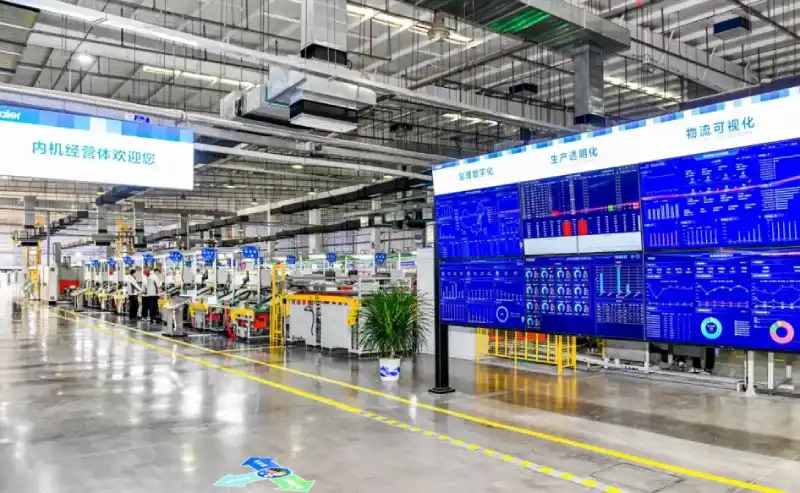
Haier’s success has inspired companies worldwide. Adoption varies by context, but the goal is the same: align structure and incentives with customer value.
After Haier’s 2016 acquisition, GE Appliances adopted Rendanheyi by decentralizing authority and empowering local teams in Louisville. The shift drove eight consecutive years of double-digit growth. GEA also accelerated innovation—smart kitchen products were developed faster through Haier’s global ecosystem.
Candy reorganized into entrepreneurial units and used COSMOPlat to drive customization in Europe. In Japan, AQUA applied Haier’s user-first culture. Empowered local teams helped the brand gain traction in a market typically resistant to foreign players.
In 2024, the ASA Group, based in San Marino, applied Rendanheyi. Its logistics department became a microenterprise and moved from a cost center to profit unit with margins above 10%. A new digital printing unit raised revenue by 120%, and an oil tank chain for olive producers improved efficiency by 15%. These results show how Rendanheyi principles travel beyond China.
Fujitsu’s Western Europe division worked with Haier’s research institute to dismantle silos. Customer satisfaction scores swung from negative to positive, highlighting Rendanheyi’s impact beyond manufacturing.
Bosch explored Rendanheyi in its mobility solutions division to adapt to electric and autonomous vehicle markets. The effort includes reorganizing divisions into microenterprises and testing ecosystem-style collaboration, reflecting growing European interest in Haier’s approach.
E-commerce fashion retailer Handu built 280+ micro-teams of two to three people. Each team monitors online trends, designs products, and manages profit independently. This structure enabled Handu to rival fast-fashion giants like Zara and Uniqlo by quickly capturing niche consumer preferences.
SOEs like COSCO Shipping and Sinopec study Haier’s model to improve efficiency and service. Adoption is selective, but key elements—such as profit accountability, user satisfaction, and flatter structures—are being piloted to modernize large, traditional organizations.
Rendanheyi now has 15 research centers worldwide, including one in Japan, and is studied across various industries. Some firms focus on structural reforms (microenterprises, fewer layers), others on cultural shifts (entrepreneurial mindset, customer-first values), and still others on technical platforms (open collaboration networks). The unifying theme is universal: become more customer-centric and digitally agile.
Rendanheyi provides the framework, but technology amplifies its impact. Chinese firms applying Rendanheyi—or similar models—use advanced tools to strengthen customer centricity.
IoT embeds users directly into the organization. By adding sensors and connectivity to products, companies gather real-time usage data and feedback. Haier connects appliances to monitor performance (with permission) and provide proactive service. IoT data also reveals how customers actually use products, pointing to new features or services.
At Haier, data flows instantly into microenterprises, enabling what it calls “全域触点的无穷交互” (infinite interaction through ubiquitous smart touchpoints). This ensures product innovation reflects real behavior, making offerings more relevant and successful.
AI supports customer centricity in two ways:
Alibaba uses AI to optimize search results, pricing, and logistics. Haier is advancing into Generative AI, which simulates product ideas and automates routine decisions. In 2024, Zhang Ruimin emphasized that generative AI accelerates Rendanheyi’s self-evolving engine, enabling teams to test strategies and designs at a rapid pace.
The lesson: AI is powerful for personalization and agility, but it must be guided by a human-centered strategy, such as Rendanheyi.
Platforms connect ecosystems, opening once-closed processes to users and partners. Examples include Haier’s COSMOPlat, Three Winged Bird app, Alibaba’s Taobao/Tmall, and Xiaomi’s Mi Home. These hubs collect input (reviews, customization choices, community feedback), enable transactions, and build user communities.
Strong platforms drive network effects: the more participants, the greater the shared value. Xiaomi famously invited fans to help design features in forums, ensuring products matched demand and building deep loyalty. This mirrors Haier’s approach of turning customers into lifelong participants in its ecosystem. Robust, user-friendly platforms are therefore essential to scale Rendanheyi principles.
China’s mobile-first market keeps companies connected to users 24/7. Firms utilize WeChat mini-programs and apps to collect feedback, provide updates, and offer services. Cloud infrastructure ensures decentralized teams share a unified pool of data and tools.
Haier’s global microenterprises utilize cloud-based platforms to collaborate, access AI, and work from shared databases in real-time. This digital glue prevents fragmentation: autonomy remains high, but everyone operates from the same source of customer truth.
If you want to understand how Rendanheyi reshaped Haier and why global firms are adopting similar customer-first models, ChoZan can provide valuable insights. Our team works directly with executives and strategy leaders who need to translate Haier’s principles into actionable frameworks for their own organizations.
Through ChoZan Learn for China, we guide global brands on how to succeed in the Chinese market by applying ecosystem thinking, scenario-based innovation, and zero-distance customer engagement. You can also join our China Learning Expedition Tour to experience these strategies firsthand through on-site visits and deep-dive sessions with leading Chinese innovators.
From microenterprise design to ecosystem platforms, we show how these lessons can be applied beyond China.
Our consulting programs and executive workshops provide:
If your business is ready to learn from China’s most advanced management model, ChoZan is the partner to translate Rendanheyi insights into your digital transformation journey. Explore our Digital Transformation Training to discover how we help global teams turn Chinese management innovation into measurable business impact.
Employees must think like entrepreneurs. Skills in user research, rapid prototyping, financial literacy, and ecosystem collaboration become essential. Since microenterprises are accountable for both customer outcomes and profit, individuals need cross-disciplinary awareness, digital literacy, and the ability to negotiate with partners. Soft skills like empathy and adaptability matter as much as technical expertise.
Yes, but it requires safeguards. In sectors like healthcare, energy, or aviation, regulations limit autonomy. Firms can still create microenterprises but must add strong compliance layers, controlled data access, and clear escalation paths. Rendanheyi’s principle of aligning incentives with user value remains useful, but execution demands industry-specific adjustments and governance rigor.
Because rewards link to customer value, earnings can fluctuate. Haier and adopters manage this with safety nets such as pooled reserves, phased payouts, or blended salary-plus-bonus structures. This balances entrepreneurial motivation with income stability. Firms tailor these mechanisms to local labor laws and workforce expectations, ensuring sustainability without losing the entrepreneurial spirit.
Partners become co-creators, not just suppliers. They join chain-group contracts, contribute data, and share in revenue from new scenarios. For example, a partner may provide design input or logistics capacity and receive a direct slice of returns. This transforms relationships into win-win ventures where mutual growth replaces transactional contracts.
Cultural fit matters. In Western firms, employees may expect more formal boundaries, while in Asian contexts, collective accountability resonates more. Successful adopters adapt practices to local norms, such as adjusting decision-making speed, communication styles, or reward mechanisms. The essence—linking people directly to user value—remains universal, even if cultural execution differs.
Beyond revenue, firms track decision latency, user scenario repeat rates, partner activation, and ecosystem churn. They also measure marginal value added across users, employees, and partners. A clear sign of success is when users renew services, employees feel empowered, and partners reinvest voluntarily—evidence of a healthy, renewing ecosystem.
Traditional promotions give way to entrepreneurial growth. Employees can spin off successful microenterprises, join new ventures, or become platform owners overseeing resources and standards. Careers become portfolio-like: workers may lead, collaborate, and restart across projects. Advancement is measured by user value created, not by climbing a hierarchy ladder.
It benefits both. Large corporations adopt Rendanheyi to fight bureaucracy. Startups use it to maintain agility as they scale. By defining clear user-value contracts early, startups prevent the growth of rigid structures. This prepares them to scale while staying close to customers, reducing the risk of losing speed and focus.
State-owned firms often struggle with bureaucracy. Rendanheyi offers a path to decentralization without abandoning accountability. By creating microenterprises with profit responsibility, SOEs can introduce entrepreneurial incentives. Pilot programs typically focus on service functions or logistics units, enabling reform without compromising core mandates. It becomes a bridge between efficiency and compliance.
Risks include income volatility for teams, conflicts over IP in open ecosystems, and misalignment with legal frameworks. Poorly defined contracts can cause disputes. Without digital infrastructure, microenterprises may fragment. To mitigate, firms need clear governance, staged rollouts, robust data platforms, and active cultural training to align employees with entrepreneurial roles.
Because user data fuels personalization, firms must prioritize privacy. Adopters establish transparent consent systems, tiered access for partners, and compliance with regulations like GDPR. Negative entropy only works if users trust the system. Protecting privacy while co-creating with customers ensures sustainability and builds long-term loyalty in open ecosystems.
Global Rendanheyi research centers function as hubs where firms study the model, run pilots, and share best practices. They train leaders, collect case studies, and refine metrics. By 2024, more than a dozen centers operated worldwide, helping diverse industries—from fashion to heavy equipment—adapt the model to their context.
In regions with strong unions, microenterprise autonomy must coexist with collective bargaining agreements. Firms integrate worker representatives into ecosystem contracts and align reward mechanisms with union standards. This allows employees to retain protections while participating in entrepreneurial models, ensuring labor rights and user-centric incentives remain balanced.
Over time, adopters report stronger resilience, faster innovation cycles, and deeper user loyalty. By eliminating silos and keeping structures flexible, companies can adapt to market shocks and technological shifts more easily. Employees remain engaged because they own outcomes. Customers stay connected because their needs directly shape products and services.