
CONTENT

China artificial intelligence in 2026 is no longer just about chatbots or benchmark races. It has evolved into a fully integrated innovation stack—foundation models, multimodal systems, platform ecosystems, and industry deployments operating together at scale.
Over the past 18 months, Chinese labs have accelerated open-weight releases, reduced inference costs, expanded long-context capabilities, and deeply embedded AI into dominant consumer and enterprise platforms.
For executives, the real question is no longer “Is China competitive in AI?” It’s where structural advantages exist—and how they affect cost, integration strategy, and long-term leverage.
This briefing maps the ecosystem, clarifies the difference between Chinese AI models and Chinese AI tools, and outlines a disciplined framework for enterprise evaluation.
In 2026, the Chinese AI ecosystem refers to a commercially scaled stack of foundation models, embedded tools, platform distribution systems, and industry-specific deployments.
For executives, the evaluation challenge isn’t about headlines or benchmark races—it’s about understanding how these layers interact and where durable value is created.
Failure to distinguish these layers leads to flawed comparisons and procurement decisions.
The most material change by 2026 is cost-performance optimization. Several leading Chinese AI models compete less on absolute benchmark leadership and more on inference efficiency, context scaling, and production affordability.
For high-volume enterprise workloads such as support automation, document generation, and code migration, marginal cost differences significantly affect the total cost of ownership. Model evaluation, therefore, shifts from “Which is smartest?” to “Which is sufficient at scale at acceptable cost?”
This is a procurement reframing, not a marketing shift.
A second defining feature is the normalization of selective open-weight releases among major Chinese LLM ecosystems.
This creates flexibility in:
It also increases the enterprise’s responsibility for governance, version control, and security reviews. China’s artificial intelligence in 2026 must often be evaluated as infrastructure, not simply as SaaS.
Multimodal capability has moved into production use cases:
The key change is operational embedding. In many cases, the model is invisible; the user interacts with a tool powered by a multimodal backend.
For industries with visual, training, or field components, multimodal capacity is now a procurement requirement.
Several Chinese AI systems are deployed inside large platform ecosystems rather than as standalone products. This accelerates:
For executives, the relevant question is not only model quality, but ecosystem leverage. A model embedded inside a dominant platform has different competitive dynamics than an isolated API provider.
Beyond generative chat interfaces, sector-specific AI systems are scaling in telecom, manufacturing, logistics, energy, and education. These systems emphasize:
This is where operational ROI is being captured. In 2026, china artificial intelligence should be understood as:
The executive question is no longer whether China is advancing in AI. It is where structural advantages exist and how they affect portfolio strategy.

To properly evaluate China’s artificial intelligence in 2026, leaders need a stack view. Looking at individual models or companies in isolation obscures where economic value is created — and where risk accumulates.
The China AI ecosystem can be understood as four interdependent layers. Each layer captures value differently, and each requires a different evaluation lens.
| Layer | What It Includes | Where Value Is Captured |
| Model Layer | Chinese LLMs, multimodal foundation models | Capability, cost efficiency, reasoning depth |
| Tool Layer | Enterprise copilots, creator tools, vertical AI apps | Workflow productivity and user adoption |
| Distribution Layer | Super-app ecosystems, cloud platforms, and developer networks | Scale, retention, data feedback loops |
| Integration Layer | Industry systems, enterprise data pipelines | Measurable ROI and switching costs |
Most global commentary focuses on the model layer. Most enterprise ROI is realized in the integration layer. That distinction matters.
The model layer includes large-scale Chinese AI models, text, multimodal, and reasoning-focused systems trained at scale.
In 2026, competitive differentiation at this layer centers on:
What is structurally different in China is the emphasis on economic efficiency and deployment pragmatism. Instead of pursuing purely benchmark dominance, several labs prioritize inference compression and ecosystem extensibility.
For enterprise leaders, this layer answers one question:
Does this model deliver the capability we need at the cost structure we can sustain?
It does not answer whether the value will be realized. That depends on the layers above it.
The second layer includes Chinese AI tools applications built on top of models. These range from enterprise copilots to content generation systems to industry-specific workflow software.
Here, competitive advantage is not determined solely by model sophistication. It is driven by:
A technically strong model embedded in a poorly integrated tool delivers limited value. Conversely, a slightly less advanced model embedded inside a deeply integrated workflow can drive measurable productivity gains.
This is why executives should evaluate tools and models separately.
One of the defining characteristics of the China AI ecosystem is platform-centric distribution.
Major technology ecosystems such as Alibaba, Tencent, Baidu, and ByteDance integrate AI capabilities directly into:
This creates three structural advantages:
For enterprise buyers, this introduces a strategic consideration: adopting AI inside a dominant ecosystem may accelerate deployment, but it can also increase platform dependency.
Distribution is not neutral. It shapes bargaining power and long-term switching costs.
The final layer is where AI connects to enterprise systems: CRM platforms, ERP systems, supply chain data, telecom infrastructure, and manufacturing controls.
This layer is often invisible in public discourse. It is also where capital efficiency is determined.
In 2026, industrial and sector-specific deployments across telecom, logistics, energy, and education increasingly rely on fine-tuned models embedded directly into operational systems.
This layer determines:
For senior leaders, this is the layer that justifies investment. A high-performing model without integration does not generate ROI. A moderately advanced model deeply embedded in core workflows often does.
When assessing AI companies in China, the wrong question is:
“Which company is winning?”
The right question is:
“At which layer does this organization create defensible value — and at which layer do we depend on them?”
An organization that is dominant at the distribution layer has different leverage than one that is dominant at the model layer. A specialized industrial AI provider carries different risk than a platform ecosystem.
Understanding the stack clarifies procurement, partnership, and portfolio strategy.
Confusion between models and tools leads to poor evaluation decisions.
A model is a foundational engine such as Qwen 3.5, DeepSeek V3, or GLM 5. It provides reasoning and generation capability.
A tool is an applied layer built on a model. Kling 3.0 generates video content. Kimi Code assists developers. MiniCPM operates at the edge. These products optimize for user experience, latency, and workflow design.
Enterprise buyers should evaluate models for flexibility and long-term control. Tools should be evaluated for reliability, integration quality, and deployment support. Benchmark scores alone do not predict workflow performance.
This section highlights relevant Chinese AI models grouped by functional orientation. The phrasing is intentionally varied to reduce structural repetition.
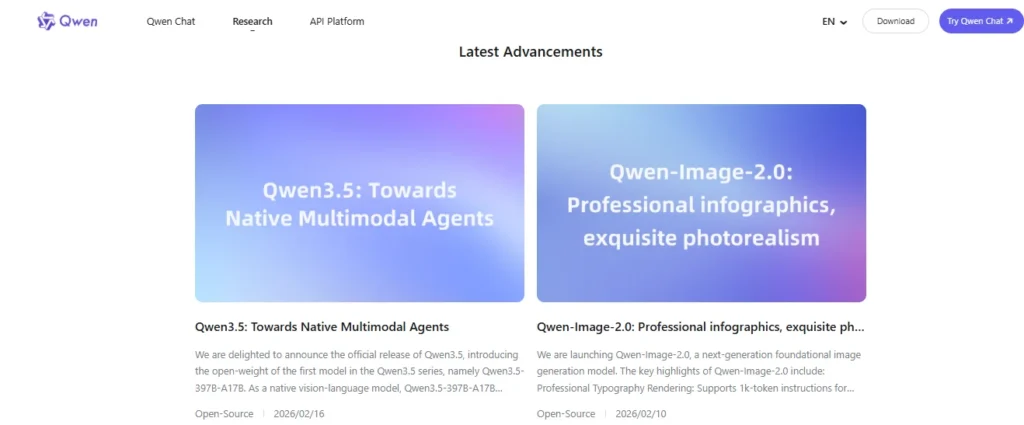
Best for: Enterprise coding productivity, multilingual business documentation, multimodal integration inside cloud ecosystems.
Qwen’s mixture-of-experts architecture emphasizes cost-efficient scaling and strong mathematical and coding performance. Its strength increases inside Alibaba Cloud environments where tooling, deployment, and data integration are streamlined.
Best for: Cost-sensitive reasoning workloads, experimentation with open-weight systems, agent prototyping.
A strong fit for cost-conscious developers seeking frontier performance in reasoning and coding. DeepSeek has emphasized efficient reasoning architectures and developer accessibility. For organizations running large-scale structured reasoning tasks, cost-performance tradeoffs are compelling.
Best for: Consumer AI interaction and high-scale chatbot use cases in China’s social ecosystem.
Doubao’s 2.0 version hit 100M+ daily users during peak usage, highlighting consumer adoption. Effective in consumer and commerce ecosystems where multimodal reasoning and task execution matter. Weekly active user numbers demonstrate scale. Enterprise customization remains secondary to platform integration.
Best for: Knowledge retrieval, search integration, enterprise documentation workflows.
ERNIE’s differentiation lies in its integration with search and knowledge systems, making it effective for structured enterprise use cases. It integrates deeply into Baidu’s search and cloud infrastructure. Developer ecosystem visibility is more limited compared to open models.

Best for: Business AI embedded in large communication and collaboration ecosystems.
Hunyuan benefits from integration with large-scale messaging and enterprise tools, making it relevant in environments where communication-driven workflows dominate. Turbo variants deliver fast response times. HunyuanImage 3.0 supports advanced multimodal image generation but requires significant compute.
Best for: Long-context reasoning, document-heavy tasks, advanced coding workflows.
Kimi is known for extended context windows, making it useful for analyzing lengthy contracts, reports, or codebases. The ability to deploy multiple reasoning agents expands the range of productivity use cases. Given that the platform is startup-driven, vendor stability needs to be evaluated.
Best for: High-performance open LLM use cases, cost-efficient deployment and developer-friendly experimentation.
Highly competitive in coding and search-related workloads. It emphasizes cost efficiency and open accessibility. Implementation often demands deeper engineering resources.
Best for: Agent-style execution and long-horizon task orchestration.
GLM models are well-suited for multi-step workflows that require sustained reasoning across chained tasks. Domestic chip deployment enhances strategic independence. Enterprise governance capabilities should be assessed during pilot phases.
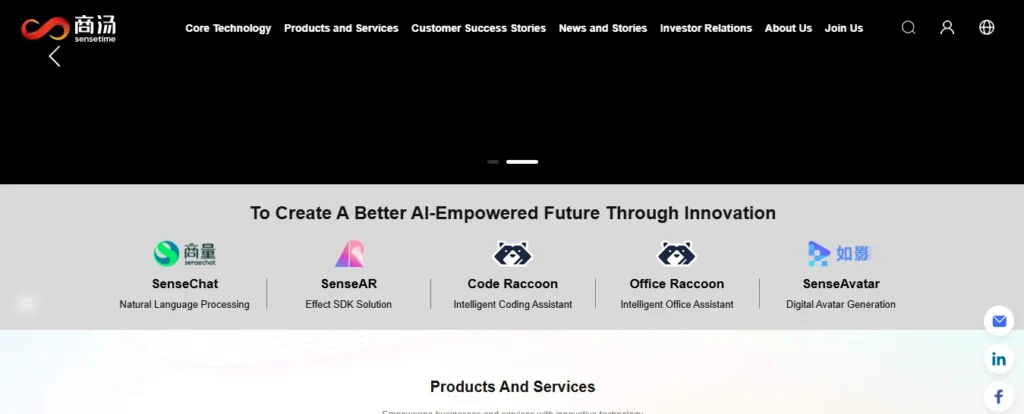
Best for: Advanced vision and multimodal interpretation, high-resolution context tasks.
Targets high-definition vision tasks and cross-device deployment. Context window expansion supports parsing large documents. Government and enterprise orientation define its market focus.
Best for: High-precision video generation, creator workflows, commerce-linked content production.
Engineered for high-quality short-form video generation with strong creator adoption. It fits marketing and social content workflows. Enterprise integration remains secondary.
Best for: High-fidelity video generation, physics-aware simulation, and commercial creative production pipelines.
Hailuo focuses on realistic motion synthesis and environment consistency, making it suitable for advertising, digital humans, and scenario visualization. Its rendering quality comes at the cost of heavier compute requirements, so deployments are typically centralized rather than edge-based.
Best for: On-device multimodal AI, embedded assistants, and edge inference in smart hardware.
Designed for real-time multimodal interaction at the edge. Suitable for hardware-integrated deployments such as smart devices. Early-stage maturity warrants pilot testing before scale.
Best for: Domain-focused bilingual applications and enterprise customization.
Positioned for bilingual reasoning and domain-specific sectors such as law and medicine. Offers quantized versions for flexible deployment. International brand recognition remains limited.
Best for: Multilingual open-foundation modeling and long-context research deployments.
Balances reasoning strength and moderate parameter size. Useful for multilingual workloads and developer environments. Documentation depth outside China varies.
Best for: Industrial AI and dense-model training on domestic Ascend hardware.
Focused on industry-specific reasoning and digital simulation. Strong candidate for sectors such as energy, telecom, and manufacturing. Access typically flows through Huawei Cloud partnerships.

Best for: Speech-centric AI, education technology, and human-machine interaction scenarios requiring advanced ASR/TTS integration.
Specializes in speech-driven applications and vertical deployments in education and healthcare. Domestic compute independence strengthens positioning in regulated sectors.
Searching for “AI companies in China” produces long, undifferentiated lists. That format is not useful for executive decision-making. In 2026, what matters is not who exists, but where value is created in the stack—because that determines procurement logic, switching cost, and risk exposure.
The China AI ecosystem is best understood across four capability categories.
Large technology ecosystems integrate AI directly into cloud platforms, collaboration environments, commerce systems, and consumer applications. Representative players include Alibaba, Tencent, Baidu, and ByteDance.
Their advantage is not purely a matter of model capability. It is distribution gravity.
AI deployed inside an existing platform benefits from:
For enterprise buyers, this typically means faster deployment and smoother integration — particularly if the organization already operates inside the ecosystem’s cloud or productivity stack.
The tradeoff is structural dependency. Once AI workflows are embedded inside a dominant platform, switching costs increase and negotiation leverage decreases.
The evaluation question at this layer is strategic, not technical:
Are we comfortable anchoring AI capabilities to this ecosystem long-term?
Model-focused companies concentrate on foundation model development rather than broad platform control. Examples include DeepSeek, Moonshot AI, Zhipu AI, and MiniMax.
These organizations compete on:
They matter because they provide optionality. Enterprises can diversify beyond a single platform ecosystem and negotiate pricing or deployment terms more flexibly.
However, model labs often require more integration work. They may offer strong raw capability but rely on partners or internal teams for workflow embedding.
The key evaluation dimension here is:
Does this provider strengthen our model portfolio strategy without creating operational fragility?
This category includes cloud AI stacks, orchestration layers, vertical AI vendors, and integration specialists. They convert model capability into usable systems inside enterprise environments.
Their differentiation lies in:
For most organizations, this layer determines measurable impact. A high-performing model without integration produces limited value. A well-integrated system built on a “good enough” model often drives stronger ROI.
Procurement at this layer should resemble enterprise software selection, not model benchmarking. Integration cost, support maturity, and roadmap transparency outweigh marginal benchmark differences.
A significant portion of China’s artificial intelligence deployment in 2026 is sector-oriented rather than consumer-facing.
Telecom optimization, smart manufacturing, logistics automation, energy forecasting, and education systems increasingly rely on domain-tuned AI.
Providers in this category emphasize:
For asset-heavy industries, this layer may present greater economic upside than general-purpose generative AI.
The evaluation question shifts from “How smart is the model?” to:
Can this system improve operational metrics under real-world constraints?
Understanding AI companies in China through capability categories clarifies procurement strategy:
The decision is not about choosing a “winner.” It is about deciding which layer of the stack you want to depend on — and where you need leverage.
Choosing the right model or tool is a high‑stakes decision. A systematic evaluation checklist helps cut through marketing claims. Consider these questions before adopting any model:
Executives should also run pilot tests with a small team, evaluating performance under real-world workloads while monitoring costs and user satisfaction. Use A/B testing to compare Chinese models with Western alternatives to avoid biases.
The phrase “best Chinese AI” invites clickbait comparisons, but the real question is: which model fits your use case and organization? Use the following decision path:
The journey from curiosity to deployment requires a structured set of steps. Here is a high‑level action plan for executives:
First 30 days: Discovery and shortlist
Next 60 days: Pilot and integration
Final 90 days: Scale decision and long‑term strategy
China’s AI ecosystem is advancing at a pace that affects global platform economics and competitive positioning. Leaders who treat this evolution as noise risk missing structural shifts that matter. The right approach requires discipline, context, and strategic clarity.
ChoZan is built to help leadership teams move beyond headlines and fragmented information toward real strategic insight. ChoZan offers services that align directly with enterprise decision-making and executive learning needs in the context of China’s AI landscape:
These immersive programs place leadership teams in China’s tech ecosystems, enabling firsthand insight into domestic AI labs, platform strategies, and commercial deployment patterns. Executives gain context that cannot be deduced from benchmark dashboards alone.
ChoZan provides tailored research, competitive benchmarking, and strategic planning support. This work includes a detailed analysis of technology trends, platform ecosystems, adoption challenges, and scenario-based recommendations that align with business objectives. These engagements are designed to inform investment decisions and strategic roadmaps.
ChoZan connects teams with both internal experts and external subject matter leaders to accelerate understanding of nuanced issues. This can be in the form of targeted expert calls, one-on-one sessions, or ongoing advisory arrangements. These dialogues are structured to reduce risk and quickly surface enterprise-relevant insights.
For teams investing in internal capability building, ChoZan delivers customized workshops and training sessions on digital transformation, platform strategy, innovation trends, and AI commercialization. These engagements are designed to elevate organizational literacy and alignment.
If AI developments in China are entering your strategic agenda, shift from reactive curiosity to structured evaluation. ChoZan’s services are specifically structured to equip decision-makers with clarity, context, and actionable insights.
Engage ChoZan for an executive briefing, AI ecosystem assessment, or innovation immersion tour to integrate China AI understanding into your strategic roadmap.
Strategic advantage begins with insight, not noise.
Chinese AI models are foundation systems, including Chinese LLMs and multimodal architectures, trained for reasoning, coding, language generation, vision, and speech tasks. They operate at the infrastructure layer and are evaluated on capability, cost, and deployment flexibility.
Chinese AI tools are applications built on top of foundation models. They embed AI into enterprise workflows, commerce systems, and industrial processes, prioritizing practical usability and measurable returns over raw technical capability.
The China AI ecosystem consists of four layers: foundation models, AI tools, distribution platforms, and enterprise integration. Value is typically realized at the integration layer, where AI systems connect to real operational workflows.
Several Chinese LLMs are competitive in reasoning, coding, and multilingual tasks, particularly when assessed on cost-performance ratios. Enterprise relevance increasingly depends on deployment economics rather than benchmark leadership alone.
Enterprises should conduct workload-specific benchmarking, assess governance and deployment architecture, and model long-term total cost of ownership. Evaluation must focus on production reliability and integration feasibility, not just demo performance.
Risks include vendor dependency, regulatory exposure, data governance complexity, underestimation of integration costs, and roadmap uncertainty. These risks vary significantly depending on the deployment architecture and the ecosystem's reliance.
There is no universal best Chinese AI. The optimal choice depends on workload requirements, cost constraints, governance standards, and infrastructure alignment within the organization’s broader AI portfolio strategy.
ROI is most visible in high-volume automation, multimodal content production, and industry-specific optimization, such as manufacturing and telecom, where AI is embedded into structured operational systems.
Executives should define priority workflows, establish governance boundaries, shortlist multiple providers, and run controlled pilots with predefined performance and cost metrics before committing to scaled deployment.