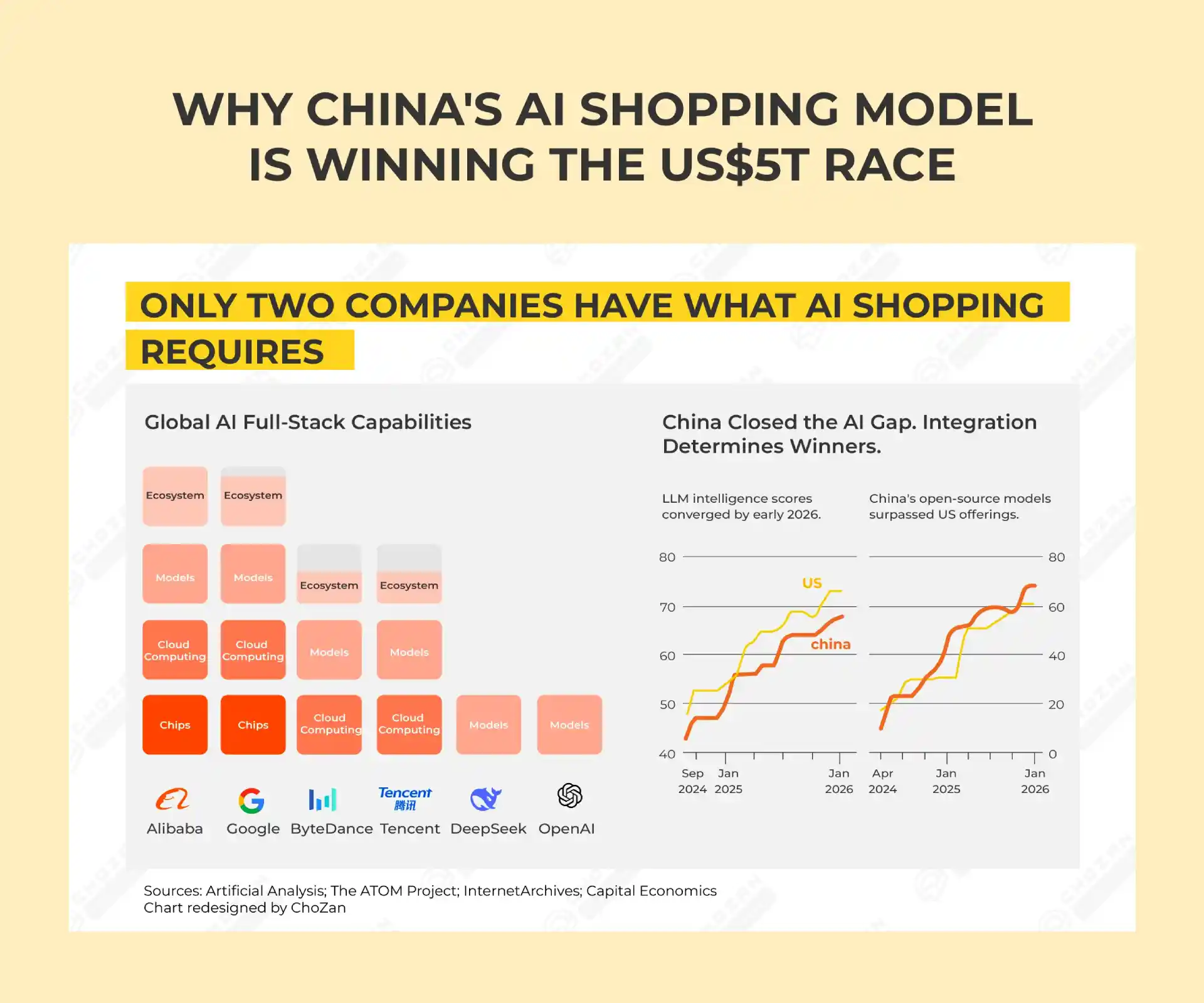
The integration bottleneck(left graph): Only Alibaba and Google possess complete AI stacks (ecosystem + models + cloud + chips), explaining why most AI shopping “announcements” remain surface-level. Companies with partial stacks must rely on partnerships, slowing deployment and limiting what’s possible—this structural gap won’t close quickly.
China’s ecosystem advantage (right graph): China’s top LLMs now match US performance, with open-source models leading some benchmarks. The advantage comes from infrastructure integration, connecting AI across payments, logistics, and e-commerce platforms that billions already use. This took 20 years to build and can’t be replicated through partnerships.
Between January 10-15, 2026, something changed in how AI shopping works, but Western coverage focused on the wrong story.
The headlines from the West: Google partnered with Walmart. Shopify integrated Microsoft Copilot. Amazon expanded Rufus. Standard partnership announcements.
On January 15, Alibaba Group President Wu Jia (who leads Alibaba’s consumer-facing businesses) did something different at a product launch. He asked Qianwen—Alibaba’s AI assistant—to order 40 bubble teas for guests. The AI found nearby shops, placed orders, processed payments through Alipay, and coordinated delivery. No human intervention. The drinks arrived during the event.
This wasn’t a demo. It was a live transaction across a billion-user platform.
The same day, Qianwen went live with 400+ capabilities: ordering food delivery, booking flights, processing visa applications, checking pension funds, and completing purchases. Not announced for “later this year”—deployed, at scale.
This matters because two different approaches to AI shopping are emerging. Western companies are testing features through partnerships. Chinese platforms have embedded AI into existing commerce infrastructure. The operational gap is 12-18 months, and it’s widening.
In this newsletter:
- How Western partnership models differ from China’s platform integration strategy
- Why China’s 20-year infrastructure investment creates an 18-month operational lead
- Strategic decisions to make in Q1 2026 before this market reaches US$5 trillion by 2030
TWO FUNDAMENTALLY DIFFERENT STRATEGIES
US - The US Approach:
Partnership Ecosystems
Western tech giants are building AI shopping through strategic alliances:
Google + Walmart: Integrating Gemini for conversational product discovery
Shopify + Microsoft Copilot: Enabling merchants to use AI for descriptions and customer service
OpenAI checkout: Experimental features allowing ChatGPT to complete purchases
Amazon’s Rufus expansion: Rolling out AI shopping assistant across categories
This approach reflects Western market realities: Fragmented platforms, regulatory scrutiny on big tech, and consumer privacy expectations that limit data sharing.
CN - The China Approach:
Full-Stack Integration
Qianwen connects directly to Taobao’s catalog, Alipay’s payment system, Cainiao’s logistics, and Alibaba Cloud’s APIs, enabling AI to execute transactions, not just recommend them.
The January update added 400+ capabilities:
Order delivery, book flights, process visa applications, check pension funds
Shop across categories in one conversation
Complete purchases without leaving the interface
Other Chinese platforms are racing to match:
Meituan: AI for food delivery and local services across 200+ cities
JD.com: AI logistics predicting inventory needs before customers order
Tencent: Social commerce AI embedded in WeChat’s 1.3 billion daily users
Why the Difference Matters
US companies ask: “How do we add AI to shopping?”
Chinese platforms ask: “How do we rebuild shopping around AI?”
For global brands, this distinction determines whether you’re enhancing existing processes or fundamentally rethinking customer engagement.
- CN - Why China's Infrastructure Lead Is Widening
🇨🇳 The Infrastructure Advantage
Alibaba built 20 years of connected infrastructure before adding AI, shopping, payments, logistics, and services already unified. AI amplifies what’s integrated.
Three layers working together:
- Data: Complete transaction history for 1+ billion users across shopping, payments, logistics, services
- Infrastructure: 90%+ mobile payment penetration, nationwide logistics, instant delivery systems
- Ecosystem: Qianwen operates across Taobao, Tmall, Alipay, Cainiao simultaneously
This creates a flywheel:
More data → Better AI → Better experiences → More users → More data. Western partnerships can’t replicate this quickly, each company owns different pieces.
Market Conditions Accelerating the Gap
China’s infrastructure advantage is amplified by regulatory and consumer dynamics that enable faster deployment.
Three accelerating factors:
- Government support: Active policy backing for AI commercialization with fast regulatory approvals
- Consumer expectations: 46.8% of Chinese shoppers now consider AI capabilities mandatory product features
- Deployment speed: Single ecosystems deploy features across all platforms simultaneously; partnerships require coordination across separate companies
The result:
Features that take Western companies 12 months to coordinate through partnerships can go live in China within weeks.
🇺🇸 US Response
Western players can’t replicate China’s unified ecosystems overnight, so they’re competing through alternative strategies.
Three competitive approaches:
- Amazon: Building proprietary models and infrastructure to reduce partnership dependence
- Google-Walmart: Moving toward deeper data sharing and joint product development
- Retail platforms: Leveraging first-party customer data for personalization without full ecosystem control
These strategies will narrow the gap over time.
China’s operational lead currently stands at 12-18 months and continues expanding as Chinese platforms add capabilities faster than Western partnerships integrate them.
- WHAT AI SHOPPING MEANS FOR CUSTOMERS
What Customers Want Today
US markets—exploratory adoption
(According to Capital One Shopping’s 2025 report)
- 76% of consumers want AI-powered shopping assistants
- 72% of AI shoppers use it as their primary product research tool
- 77% of online consumers are interested in AI-driven virtual try-on
China—default expectations
(According to data shared at the 2026 World Economic Forum)
- AI-related product searches increased 100-fold on JD in 2025
- 46.8% of consumers now consider AI capabilities mandatory product features
- AI digital hosts generated US$333 million in sales during JD’s Double 11 across 50,000 merchant livestreams
What AI Shopping Can Help With
Loyalty program optimization: 70% of shoppers worldwide are interested in using AI agents to maximize their loyalty benefits. AI can surface better redemption opportunities, track cross-program benefits, and automate reward claims.
Complex product discovery: AI excels at understanding multi-dimensional needs (“winter coat under $200, good for -10°C, sustainable brands”) and delivering relevant results.
Personalized recommendations: AI-driven recommendations boost consumer retention by 10-15% and increase positive product reviews by 60% when combined with virtual try-on.
What AI Shopping Cannot Help With
The fulfillment gap: AI can recommend products but can’t solve slow delivery, out-of-stock items, or return hassles. The last mile remains the hardest mile.
In-store preferences: Many customers still prefer touching products, trying on clothes, and immediate gratification. AI shopping won’t eliminate these needs.
Trust barriers: 82% of consumers worry about how AI collects and uses their data. 55% express distrust of AI chatbots. Privacy concerns remain the biggest adoption barrier.
AI shopping assistants are improving discovery and personalization, but they won’t drive an immediate shift from physical to digital retail. The impact will be incremental, not transformative, especially in Western markets where trust and fulfillment challenges remain unsolved.
- YOUR Q1 2026 STRATEGIC PLAYBOOK
What to Watch
What to Watch China’s ecosystem expansion:
- Track Qianwen integration beyond shopping (healthcare, education, government services)
- Monitor Meituan, JD, and Tencent AI deployments across categories
- Watch for Chinese platforms expanding internationally with AI-first experiences
Western partnership evolution:
- Google-Walmart integration depth and performance metrics
- Amazon’s Rufus expansion and conversion rates
- OpenAI’s checkout feature adoption and merchant partnerships
Regulatory developments:
- EU AI Act implications for AI shopping assistants
- US data privacy legislation affecting personalization capabilities
- China’s evolving AI governance and cross-border data flow policies
What to Test
Pilot AI shopping features in controlled markets:
- Start with low-risk categories and small customer segments
- Measure conversion rates, customer satisfaction, and support ticket reduction
- Compare AI-assisted vs. traditional shopping paths
Different messaging for different markets:
- Western markets: Emphasize privacy, transparency, opt-in features
- Chinese markets: Highlight convenience, speed, comprehensive integration
- Test which value propositions resonate with your specific customer segments
Integration with both ecosystems:
- Don’t commit prematurely to single platforms
- Build flexible technology architecture enabling rapid pivoting
- Test native Chinese platform integrations if operating in China
The AI shopping race comes down to deployment speed, not model size. The platforms that integrate AI into daily transactions first and prove the model works for customers, will define how this market develops by 2027.
China’s 12-18 month operational lead doesn’t guarantee long-term victory, but it does mean Western brands can’t afford to wait for perfect solutions. The companies positioning themselves now will lead their categories by 2027.
For executives, the question isn’t whether to act. It’s whether you’re moving fast enough to matter when this market hits US$5 trillion.