CONTENT

China’s FMCG (fast-moving consumer goods) market is not just “big”; it is structurally optimized for social commerce experimentation at a national scale in a way few other markets can replicate quickly. In 2025, China’s online retail continued to expand. Official statistics report total online retail sales of approximately $2.2 trillion, with physical goods sales at around $1.83 trillion, accounting for roughly a quarter of total retail sales.
At the same time, multiple forecasts converge on social commerce itself. The market is projected to reach about $450 billion in 2025, growing rapidly to around $1.82 trillion by 2030.
What makes 2025–26 especially important is that the “social” part of social commerce has become measurable, operationalized, and regulated. This shift moves FMCG companies away from one-off influencer campaigns and toward repeatable systems such as always-on content engines, private-domain CRM loops, instant fulfillment, and compliance-by-design.
As a result, FMCG discovery, education, trial, repurchase, and loyalty now happen inside a single attention flow, often without users leaving the app.

China’s advantage in social commerce stems from the combined impact of infrastructure, consumer behavior, and regulatory learning, rather than from any single platform feature.
Mobile dominance creates constant buying opportunities.
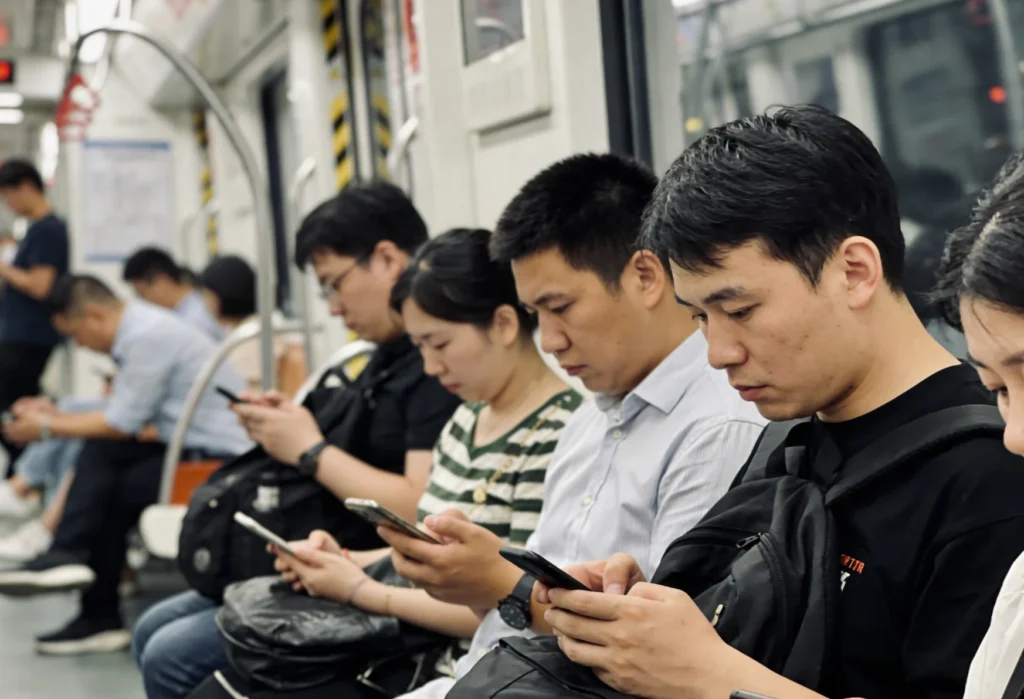
By the end of 2024, China had about 1.108 billion internet users, with mobile penetration at 99.7 percent. This means product discovery, evaluation, and payment all happen within the same mobile environment. For FMCG categories, where purchases are frequent and low-involvement, this reduces friction and supports habitual buying behavior.
Short video users exceeded 1.04 billion, while livestream audiences reached about 833 million. Online payment adoption among internet users stood at nearly 93%. As a result, consumers are highly familiar with video-based product explanations, peer comments, and in-app checkout. FMCG brands benefit because product education, social proof, and conversion occur within a single content flow.
Douyin drives rapid demand creation through algorithmic discovery and livestream conversion. Xiaohongshu supports peer validation and decision-making through community content. WeChat enables CRM, membership management, and repeat purchases through private domain systems. Successful FMCG strategies in China are designed for this multi-platform lifecycle rather than relying on a single channel.
The most important innovations in China’s FMCG social commerce are operational—mechanisms that enable brands to scale trust and conversion while maintaining unit economics and compliance.
The following 10 are the most consequential for 2026.
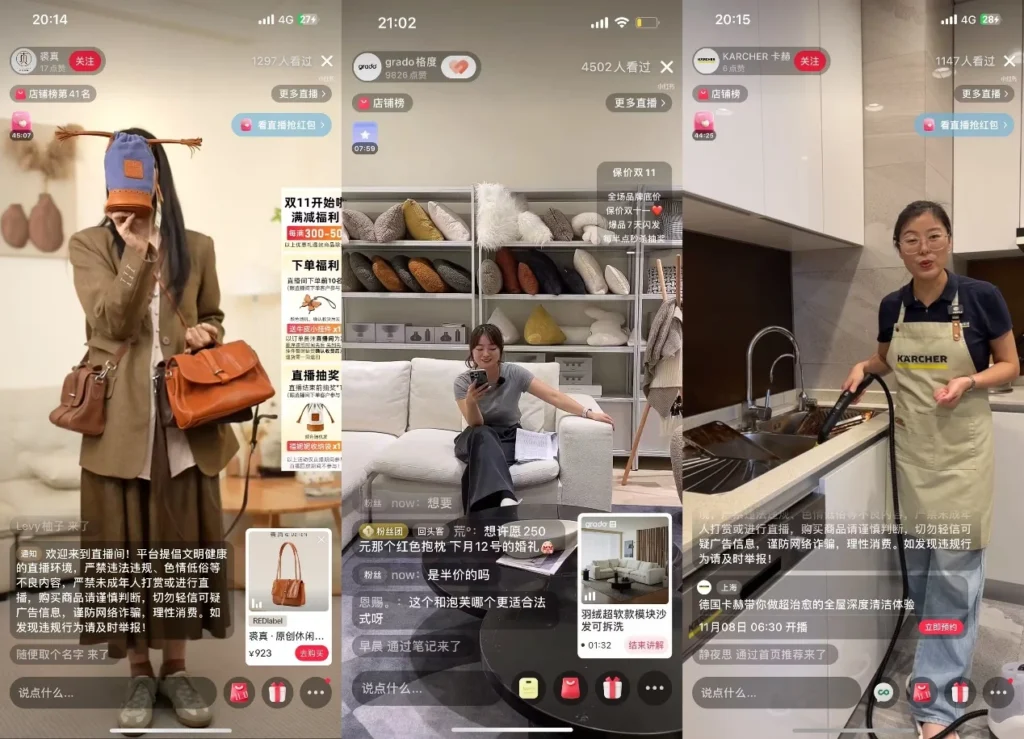
Livestream commerce has evolved from a promotional tool into a core revenue infrastructure for FMCG in China. In mid-2025, industry forecasts estimated total livestream commerce gross merchandise volume could exceed 6.5 trillion RMB (940 billion USD), underscoring its central role in digital retail.
The shift reflects operational normalization rather than short-term campaigns. Brands now run continuous “store broadcasts” instead of relying on occasional celebrity spikes. Platform data from 2025 showed that more than 80,000 new merchants surpassed 1 million RMB (140,000 USD) in livestream transaction volume, indicating that live commerce has become a scalable, repeatable revenue channel.
For FMCG companies, the value of livestreams extends beyond immediate conversion. These sessions enable real-time product explanation, interactive demonstrations, and instant objection handling. Brands can address questions about taste, texture, usage, and product quality while adjusting claims and messaging based on live audience feedback.
Livestream formats also support trial-driven consumption patterns. Brands bundle products for sampling, encourage replenishment cycles, and test offers dynamically. This combination of education, engagement, and rapid iteration has transformed livestream commerce into a persistent sales engine rather than a short-term marketing activity.
In 2025, Chinese social commerce platforms significantly advanced their use of artificial intelligence to personalize user experiences. Marketplaces and social channels used machine learning to analyze user interactions, shopping behavior, and content preferences across sessions.
AI recommendation systems refined product discovery by processing dozens of behavioral signals. Consumers increasingly received suggestions aligned with their interests and intent, improving relevance and shortening the path from browsing to purchase.
The role of AI has also expanded beyond recommendation. Platforms applied AI to generate commerce content at scale, optimize livestream operations, and automate customer interaction. A 2025 Douyin commerce report highlighted the use of AI across precise marketing, content creation, search and recommendation, assisted livestream management, and customer service during peak shopping periods.
China’s regulatory environment shaped this development. Algorithmic recommendation systems operate under governance rules, and generative AI services must comply with content accountability requirements.
For FMCG brands, the practical impact is operational. AI enables rapid content variation, allowing multiple creative angles for each product. It supports testing, performance measurement, and real-time optimization. However, it also increases compliance risk, requiring stronger claim verification and clearer content governance to prevent misleading messaging.
In 2025, Chinese FMCG brands placed greater emphasis on building customer relationships rather than relying solely on platform traffic. Rising acquisition costs and slower user growth have pushed companies to invest in private domain systems focused on retention and repeat purchases.
WeChat remains the central hub for this strategy. Brands use mini programs as in-app storefronts where consumers can browse products, join brand communities, and complete transactions without leaving the social environment. These systems allow companies to collect first-party data, enabling more precise targeting and personalized communication.
WeChat official accounts and group messaging support ongoing engagement. Brands send tailored updates, manage loyalty programs, and segment users based on purchase history and preferences. This structured communication strengthens customer relationships and improves repeat buying behavior.
Private domain commerce is particularly effective for FMCG because many products have high purchase frequency. According to a 2025 iResearch white paper, private domain users are more likely to buy daily consumables and generate stronger word of mouth. These systems also have lower marginal acquisition costs and higher conversion rates than public traffic channels.
For FMCG companies, the private domain functions as a replenishment engine. It supports post-purchase education, membership rewards, subscription-style purchasing, targeted product launches, and customer service feedback loops. These mechanisms increase lifetime value, which remains the primary source of profit in categories such as detergents, diapers, skincare basics, and functional beverages.
China’s social commerce platforms now connect consumer demand directly with regional manufacturing clusters known as industry belts. This model is widely used in the FMCG categories of personal care, household goods, pet products, and local specialties.
In 2025, platform data identified more than 23,500 interest-driven industry belts. Many merchants scaled from zero sales to the million-dollar level by targeting high-engagement niche communities. Reports also showed hundreds of belts exceeded 100 million RMB in GMV (about 14 million USD), with many located in county-level regions rather than major cities.
The key change is how these belts operate. They function as content-driven supply chains. Factories now design packaging, messaging, and product variations specifically for social platforms. Production cycles are shorter because products are adjusted in real time based on audience feedback.
At the consumer level, discovery is organized around interests rather than broad browsing. Platforms group content by themes such as skincare routines, home organization, pet care, and snack culture. Products appear within practical use contexts, which increases engagement and purchase intent.
For FMCG brands, this model improves targeting precision. Products embedded within interest communities, alongside reviews and tutorials, perform better than generic promotions. The result is a tightly connected loop between consumer demand, platform algorithms, and responsive supply networks.
In 2025, Chinese social commerce platforms expanded the use of story-driven video formats inside shopping environments. Short, scripted content, especially micro-dramas, appeared directly in feeds and discovery streams, presenting products in everyday life scenarios rather than in traditional advertisements.
These formats increased engagement and strengthened purchase intent. Viewers spent more time watching narrative content and could move directly from a story scene to product pages through integrated “watch-then-shop” links. This reduced friction in conversion and made discovery feel more contextual and purposeful.
Micro-dramas became a large-scale content ecosystem. Official briefings indicated that tens of thousands of micro-dramas were online in 2025, with user audiences approaching 700 million and total market value in the hundreds of billions of RMB. Regulatory authorities also promoted structured “micro-drama plus” programs to more systematically integrate branded content.
For FMCG brands, the key innovation is narrative-native product proof. Products are embedded into story conflicts such as stains, odor problems, health concerns, or social situations. This creates stronger recall because consumers associate the product with real-life use scenarios rather than abstract marketing claims.
Brands increasingly allocate content budgets toward these formats because they support deeper retention, clearer demonstration of product utility, and seamless conversion through in-app commerce links or adjacent livestream sessions.
In 2025, influencer strategy in China’s FMCG social commerce shifted from reliance on a few large creators to a structured multi-tiered network. Platform data showed that small and mid-sized creators accounted for a significant share of live-commerce sales, making the long tail of creators the primary driver of scalable outcomes.
Brands adopted a portfolio model. Large influencers raised awareness, mid-tier creators explained product use, and Key Opinion Consumers built trust and drove conversions through peer-style content. Research indicated more than 70 percent of users found social media promotions useful for purchase decisions, especially when presented as a real user experience.
Key Opinion Leaders remained important for product launches on platforms such as Douyin, RedNote, and WeChat Channels. However, everyday creators sustained demand through frequent reviews, demonstrations, and practical usage scenarios that influenced niche communities.
For FMCG companies, the main innovation is operational orchestration. Brands standardized briefs, compliance checks, content templates, and performance tracking systems. This enabled clear measurement of which creator content generated sales rather than engagement alone.
The result is a trust-based influence structure. Large influencers drive initial trials, while peer creators determine repeat purchases through credible product validation.
In 2025, cross-border social commerce expanded as Chinese consumers continued buying imported FMCG products through social platforms. Platforms integrated translation tools, logistics tracking, and cross-border checkout systems, allowing foreign brands to sell directly within social content environments.
Short videos and livestreams now include built-in purchase flows that handle customs, payment, and delivery. This enables consumers to discover, evaluate, and purchase imported products within a single interaction.
Official customs data shows China’s cross-border e-commerce trade reached about 1.37 trillion RMB (190 billion USD) in the first half of 2025. Full-year totals reached approximately 2.75 trillion RMB (about 380 billion USD).
Platforms also built onboarding systems for foreign brands. These include localization support, integrated logistics, and compliance guidance, allowing international FMCG companies to enter China without separate operational infrastructure.
Cross-border expansion also operates in reverse. Chinese platforms now support domestic merchants selling to overseas users through integrated content, payment, and logistics systems.
For imported FMCG brands, the key change is the building of trust through social interaction. Creator demonstrations, peer reviews, and community discussions establish credibility before conversion occurs through integrated cross-border checkout.
FMCG is often either urgent (buy now) or habitual (buy again). China’s instant retail and O2O infrastructure increasingly makes social commerce fulfill both. In late 2025, a report estimated that China’s instant retail market reached RMB 971.4 billion in 2025 and will exceed RMB 1 trillion in 2026; longer-term projections point to RMB 2 trillion by 2030.
More importantly for FMCG strategy, the same reporting provides “why” at the scenario level: in personal care and beauty, a majority of demand is driven by “last-minute social” or “gift/emergency” use cases that require half-hour fulfillment; health-oriented FMCG also shows willingness-to-pay signals for “cleaner” attributes.
Here, social commerce serves as the demand trigger, and O2O serves as the reliability layer: QR codes, offline displays, and live-local promotions create intent; instant fulfillment prevents intent decay.
A notable counter-trend to high-tempo sales livestreams is the rise of slower formats that emphasize companionship, lifestyle coherence, and long-form browsing—often associated with the “slow live” style that became distinctive in parts of RedNote’s livestream ecosystem.
Industry reporting highlights how certain creators’ livestreaming styles shaped platform expectations and helped define a slower, more lifestyle-oriented approach, rather than aggressive discounting stereotypes.
This is especially relevant for premium or “identity” FMCG (skincare, wellness, pet nutrition, home scent), where perceived fit and taste matter as much as price. The innovation is psychological: slow formats reduce “ad resistance,” let audiences self-select into deeper engagement, and create space for storytelling, ritual, and values—turning FMCG consumption into a form of self-expression rather than pure utility.
Search is becoming a core conversion layer inside China’s social commerce platforms. While discovery still begins with feeds and livestreams, more users now actively search within apps like Douyin, Xiaohongshu, and WeChat to validate products, compare options, and move toward purchase.
This shift reflects a deeper behavioral change. Users no longer rely only on passive discovery. Instead, they combine content exposure with active intent signals such as keyword searches, product queries, and scenario-based exploration. For FMCG, this is critical because it shortens the decision cycle for routine purchases.
Platforms are responding by integrating search directly into the commerce journey. Search results now blend short videos, creator content, reviews, and product listings in a single interface. This creates a unified “content plus commerce” environment where users can move from intent to transaction without friction.
For FMCG brands, the implication is operational. Content must now be optimized not only for algorithmic feeds but also for in-platform search visibility. Product naming, keyword tagging, and scenario-based content become essential for capturing high-intent demand.
In practice, leading brands align content creation with search behavior. They produce videos and posts that answer specific queries such as product comparisons, usage scenarios, and problem-solving demonstrations. This ensures visibility both in discovery feeds and in search-driven journeys.
As a result, search-led social commerce acts as a bridge between awareness and conversion. It captures users at the moment of intent and converts that intent into immediate purchase, making it one of the most important emerging drivers of FMCG performance in China.
The 10 innovations above look diverse, but they converge into a single operating system. The core Chinese FMCG social-commerce model in 2025–26 is best understood as a closed-loop engine with multiple coordinated surfaces:
Three “mechanics” make this operating system unusually hard to copy quickly.
The algorithm is treated as a distribution partner rather than a black box. “Interest” models work because supply and content are engineered to produce signals the system can amplify (watch time, saves, comments, search follow-ups).
The industry belt model shows this at the supply-cluster level: producers adapt what they make and how they present it to match discoverable interests.
The flip side: shifts in “traffic policy” can quickly change unit economics, so mature operators run ongoing content testing and keep creative pipelines stocked rather than betting on a single hero ad.
Measurement is moving from “GMV stories” to systemized effectiveness. The current phase is shaped by traffic pressure and higher expectations. A key trend in 2025 was that platforms (and large advertisers) emphasized full-chain measurement—connecting content exposure, engagement, search, and purchase.
This is evident in platform narratives about tracing behavior, from “seeing” to “searching” to “buying”. For FMCG, the high-value “China lesson” is to measure beyond the event spike: repurchase rates, cohort retention, customer-service outcomes, and private-domain migration matter more than one livestream peak.
Logistics and consumer needs are built into the content strategy. Instant retail data illustrates why: in some FMCG subcategories, user demand is driven by last-minute social plans and gifting or travel emergencies, so content that triggers intent must be paired with fulfillment that preserves it.
In practice, top operators build content calendars around moments (social gatherings, festivals, travel, weather shifts) and design bundles that support immediate delivery (small sizes, gift packaging, multi-pack variety) rather than relying solely on “warehouse-friendly” SKUs.

Reckitt implemented a highly expanded content and livestream strategy in China across 2025. The company produced over 1 million short videos and supported more than 100,000 hours of livestreams featuring influencers, AI-generated avatars, and its own sales hosts. This consistent content output drove measurable customer acquisition.
In 2025 alone, Reckitt acquired about 40 million new consumers in China through these social commerce initiatives. The focus was on continuous content presence rather than one-off promotions, and the approach contributed to sustained growth across nine consecutive quarters in the country.
This work showed how disciplined content investment and real-time digital interaction can meaningfully affect FMCG visibility and sales.
Platforms are reporting dramatic results for highly curated livestream content called “爆单内容直播间” on Douyin in 2025. Brands such as 东方树叶 and 云南白药 used this format to generate exceptionally high sales growth.
For example, 东方树叶 reported more than 120 times its typical sell-through rate on a single pre-sale day. 云南白药 achieved a 400% increase in livestream GMV compared with previous benchmarks.
Other brands, such as OPPO and various FMCG sellers, also recorded growth rates above 100 percent by leveraging content-rich livestream formats rather than generic sales broadcasts. This case illustrates how structured, personality-driven livestream content directly impacted revenue.
RedNote’s 2025 switch to livestream commerce provided smaller FMCG and lifestyle sellers with a new discovery and sales path. A seller named Feng shifted to livestreaming on RedNote and achieved significant traction in just a few months.
This included selling high-value apparel and everyday consumables, such as rice, via livestream to predominantly urban, financially independent female consumers.
These outcomes demonstrated that livestream commerce worked not only for mainstream branded products but also for niche and mixed-category FMCG when presented in authentic storytelling contexts.
Alibaba and RedNote (commonly known as Xiaohongshu outside China) entered a strategic partnership in China in 2025 to strengthen FMCG exposure across content and commerce integration.
Through this tie-up, RedNote’s lifestyle content feeds connect directly to Alibaba’s Taobao commerce infrastructure, allowing consumers who click on social content to complete transactions within Alibaba’s e-commerce environment.
These integrated experiences help FMCG brands extend reach by combining lifestyle discovery with streamlined checkout, illustrating how ecosystem partnerships can drive social commerce performance.

China introduced new measures for livestream e-commerce supervision in January 2026. These rules target false claims, misleading promotions, and compliance duties for livestream operators. FMCG teams will need tighter script review and proof-ready product claims.
Instant retail accelerated in 2025 and carries into 2026. Alibaba reported ten million instant retail orders in five days through Taobao workflows. FMCG brands will win more often when delivery speed matches content-driven demand windows.
NielsenIQ reported content-driven platforms grew 27 percent as of September 2025. This trend continues into 2026 as shoppers rely on creator-led discovery for routine purchases. FMCG planning will shift toward always-on social retail calendars.
Reckitt used AI-generated avatars in its 2025 China livestream. More brands will use avatars for coverage, testing, and language consistency at scale. Expect tighter governance on disclosure and claims under the 2026 rules.
China fined Kuaishou in February 2026 for failures in livestream content control. This signals higher operational risk for FMCG campaigns tied to live rooms. Brands will demand stronger partner controls and incident response processes.
China’s FMCG social commerce ecosystem is evolving at a structural pace. Platform architecture shifts. Regulation adapts. Consumer behavior recalibrates around new formats. Interpreting this environment requires systematic research and contextual expertise.
ChoZan focuses on analyzing China’s digital retail infrastructure and translating those insights into strategic understanding for global leadership teams.
ChoZan works with multinational FMCG brands, retailers, and innovation leaders seeking structured clarity on how China’s digital commerce system functions and what it signals for the future of global retail.
Book a consultation to explore how these insights can inform your strategy.
How do FMCG brands measure ROI in China’s social commerce ecosystem?
FMCG brands measure ROI by tracking revenue directly tied to social commerce campaigns. They analyze conversion rates, repeat purchase behavior, customer acquisition cost, and lifetime value. Linking platform analytics with CRM data gives a clearer picture of profitability and sustainable growth.
What KPIs matter most for FMCG livestream campaigns in China in 2025?
The most important KPIs for FMCG livestream commerce include conversion rate, average order value, retention after livestream exposure, and cost per acquisition. Engagement metrics matter, but brands prioritize measurable sales lift and repeat-customer momentum over vanity metrics.
How does China’s social commerce infrastructure differ from Western social selling models?
China’s social commerce infrastructure integrates content, payments, logistics, and checkout into a single ecosystem. Western social selling often relies on external redirects. In China, seamless in-app purchasing and real-time interaction compress the journey from discovery to transaction.
What are the main cost components of running a social commerce campaign for FMCG brands in China?
A typical FMCG social commerce campaign budget includes content production, influencer fees, livestream operations, paid amplification, and fulfillment coordination. Brands should also account for CRM management and compliance costs, which increasingly influence total investment requirements.
How do lower-tier cities influence FMCG social commerce growth in China?
Lower-tier cities are a significant driver of China’s FMCG growth, driven by rising digital adoption and strong livestream engagement. Consumers in these markets respond well to value-driven messaging and interactive formats, which expand demand beyond traditional Tier One urban centers.
What role do instant retail and on-demand delivery play in FMCG conversion performance?
Instant retail in China shortens the gap between impulse and delivery. Fast fulfillment strengthens trust and increases the likelihood of repeat purchases. For FMCG brands, delivery speed directly supports higher conversion rates during livestream and short video campaigns.
How can foreign FMCG brands localize content effectively for Douyin and Xiaohongshu?
Foreign brands succeed by adapting storytelling to the platform culture within Douyin marketing strategy and Xiaohongshu content marketing norms. Local creators, culturally relevant narratives, and clear product demonstrations improve resonance and reduce friction in consumer decision-making.
What regulatory risks should FMCG brands monitor in China’s 2026 livestream commerce environment?
FMCG companies must closely monitor evolving livestream regulations in China. Compliance now includes stricter review of advertising claims, greater transparency in disclosures, and content supervision. Brands benefit from proactive legal audits and structured script verification processes to avoid penalties.
How does data privacy regulation affect FMCG CRM and private domain strategies in China?
China’s data rules shape how brands manage private domain commerce and first-party customer information. Companies must collect, store, and use data transparently. Clear consent practices protect brand reputation while supporting personalized engagement strategies.
What emerging social commerce technologies will shape China’s FMCG sector beyond 2026?
Emerging technologies such as AI-generated avatars, predictive recommendation engines, and immersive video formats will redefine future social commerce in China. Brands that test automation and real-time personalization early are better positioned for sustained competitive advantage.