CONTENT

China’s retail and logistics landscape has entered a phase in which infrastructure, not interfaces, defines competitive advantage across the ecosystem. The companies that win are the ones that control fulfillment, delivery, and inventory as a unified system.
JD Logistics sits at the center of this shift. This reflects a broader shift in how China builds integrated technology and infrastructure systems at scale.
This matters because JD did not scale by optimizing marketing or traffic alone. It scaled by building a tightly integrated supply chain system that connects warehousing, delivery, technology, and merchant services into a single operating layer. That system now powers both JD’s retail business and a growing external logistics platform.
JD Logistics is the logistics and supply chain arm of JD.com, designed to manage end-to-end fulfillment across warehousing, transportation, and last-mile delivery. It operates as an independent business while remaining deeply integrated into JD’s broader retail ecosystem.
In 2025, the scale of this operation became clear. JD Logistics generated full-year revenue of RMB 217.1 billion, growing 18.8 percent year on year.
That growth reflects more than logistics demand. It reflects JD’s ability to turn supply chain infrastructure into a standalone service. Merchants, brands, and enterprises now rely on this network for fulfillment, distribution, and inventory management across China and beyond.
Most e-commerce platforms rely on third-party logistics providers. JD made a different decision early in its development. It invested heavily in building its own infrastructure, even when margins were under pressure.
To meet rising demand, JD Logistics built a fulfillment network spanning the entire supply chain:
It now operates over 1,600 warehouses covering more than 32 million square meters. This distribution network enables same‑ or next‑day reach to more than 90 percent of China’s population.
Revenue diversification includes:
JD Logistics maintains control over its core assets—warehouses, sorting centers, vehicles, delivery workforce, and proprietary software—to provide consistent service quality.
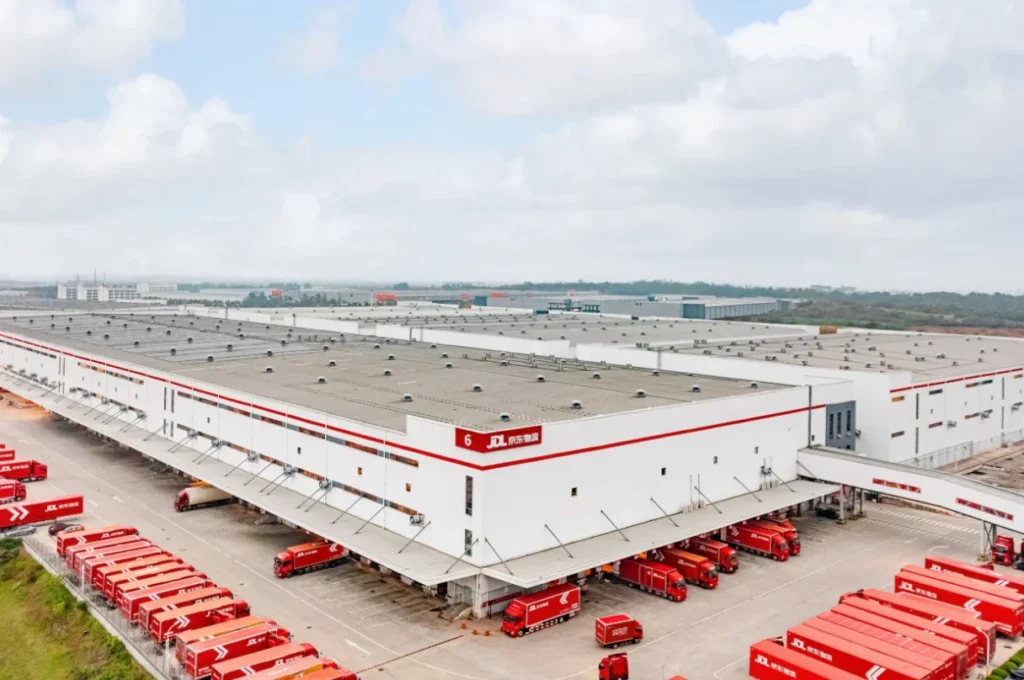
JD Logistics builds its advantage on a dense supply chain infrastructure that keeps inventory close to demand. This approach supports localized stocking and faster order fulfillment. AI-driven demand forecasting and algorithmic replenishment guide inventory placement. Dynamic slotting positions high-velocity items near picking zones, improving inventory control and reducing processing time.
The network spans the entire logistics chain, mirroring how China’s logistics and e-commerce infrastructure operates in practice. Inbound transportation moves goods from manufacturers to warehouses.
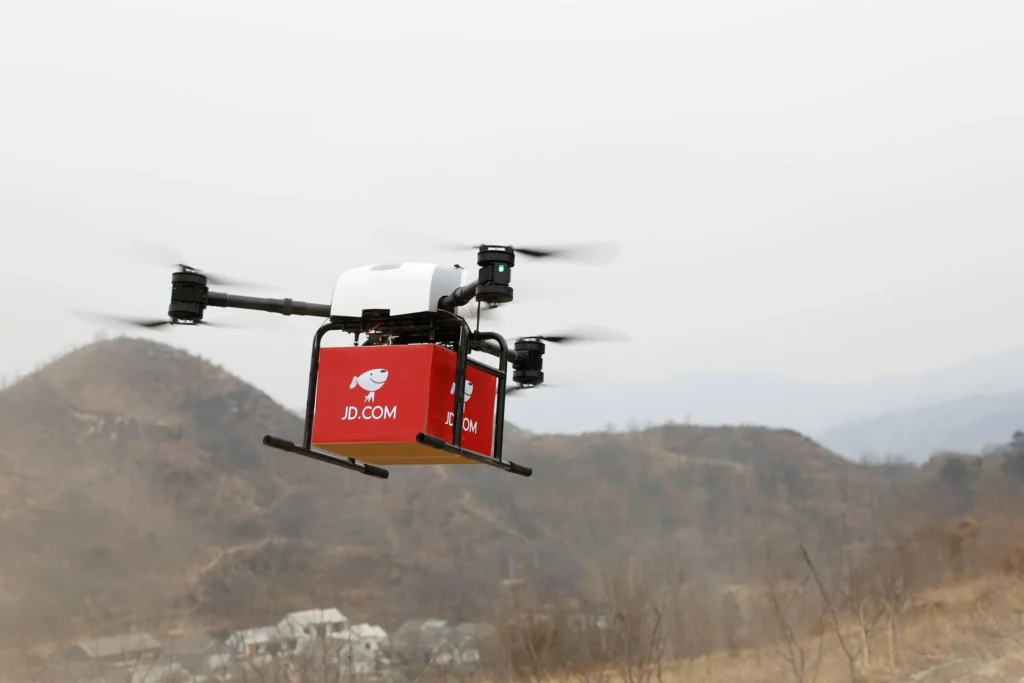
Middle-mile linehaul uses rail, road, and air to balance cost and speed. JD Logistics also operates its own cargo airline to improve flexibility and reduce reliance on third-party capacity.
For last-mile delivery, it uses a self-operated fleet supported by crowdsourced drivers, which enables consistent delivery windows. High delivery density supports services such as installation for large items, premium delivery handling, and cold-chain distribution.
Reverse logistics is fully integrated into this system. The “Simplified Reverse Returns Service” standardizes returns by processing them for pickup, inspection, resale, or disposal within 72 hours. Route integration lowers costs while maintaining a smooth customer experience.
Automation drives JD Logistics’ operational efficiency through AI, robotics, and digital transformation at scale. Its LangzuTech goods-to-person systems integrate autonomous guided vehicles, lifting robots, high-density racking, automated picking stations, and centralized charging into a closed-loop workflow.
These systems use vertical space up to 12 meters to increase storage density and improve space utilization. Multi-SKU storage within a single tote reduces consolidation time and speeds up order assembly.
The system uses a modular design. Warehouses deploy it in phases and scale capacity by adding robots and workstations as demand changes. This structure allows capacity expansion without disrupting operations.
JD Logistics complements hardware with software. Its Intelligent Warehouse Management System integrates with automation to increase efficiency and provide real-time visibility into inventory, orders, and equipment.
Digital twins and IoT data support AI-driven routing, demand prediction, and inventory optimization. The company holds over 4,000 patents, with more than half focused on automation and unmanned technology, reflecting its focus on logistics innovation.
JD Logistics is building an international network to support growth beyond China, aligning with broader trends in China’s technology and logistics expansion. Its overseas warehouses are located in markets such as the United States, Germany, the Netherlands, France, the U.K., Vietnam, the UAE, Australia, and Malaysia, enabling localized fulfillment for global clients and Chinese brands.
The company plans to double its overseas warehouse space by 2025, increasing total floor area by 100 percent. It is also expanding transfer centers, cross-border transport routes, and express delivery services. JD Express now offers “International Express” and “International Standard Express,” with coverage expanding to about 80 countries and regions.
A core initiative is the 2-3 Day Delivery Circle. By using self-operated overseas warehouses, JD Logistics aims to deliver within two to three days across 19 countries.
To support this model, JD Logistics is developing its own air freight network, including a global hub, a primary airline base, multiple regional hubs, and dedicated cargo stations. This infrastructure improves delivery reliability and reduces dependence on third-party carriers.
The company also offers specialized services such as overseas bulky-item delivery and installation. Partnerships with cross-border e-commerce platforms support thousands of merchants and strengthen its position as a global logistics technology provider.
Understanding companies like JD Logistics at a surface level is not enough for strategic decision-making. The real advantage comes from seeing how these systems operate in practice and how they shape competitive outcomes.
ChoZan works with senior executives, strategy leaders, and transformation teams through China innovation learning expeditions, executive briefings on China’s innovation systems, and digital transformation training programs to decode these models into clear, actionable insights.
If your goal is to translate integrated supply chain systems into strategic advantage, explore how your team can engage directly with China’s innovation ecosystem and apply these insights in your business.
Book a consultation to explore how your team can engage directly with China’s innovation ecosystem and apply these insights in your business.
JD Logistics differs in that it operates a fully owned, end-to-end supply chain rather than relying on third parties. This control improves delivery speed, service consistency, and inventory visibility, making it closer to infrastructure than a standard logistics provider.
JD Logistics provides fulfillment, warehousing, transportation, and inventory management services to external merchants. Businesses can use JD’s infrastructure without selling on JD.com, allowing them to scale operations while maintaining control over branding and customer relationships.
JD Logistics has moved toward profitability by diversifying revenue streams beyond JD.com. Growth in external clients, contract logistics, and value-added services has strengthened margins, although profitability depends on operational efficiency and scale.
JD Logistics focuses on self-operated infrastructure, while Cainiao Network uses a platform-based, asset-light model. JD prioritizes control and speed, whereas Cainiao emphasizes coordination across third-party logistics partners.
Industries such as e-commerce, FMCG, electronics, pharmaceuticals, and cold-chain food benefit most. These sectors require fast fulfillment, strict quality control, and reliable inventory management, which JD Logistics delivers through its integrated infrastructure.
During events like Singles’ Day, JD Logistics scales capacity using automation, workforce expansion, and optimized routing. Its integrated system allows faster processing and reduces bottlenecks compared to fragmented logistics networks.
Data plays a central role by enabling demand forecasting, route optimization, and inventory planning. JD Logistics uses real-time analytics and AI to improve operational efficiency, reduce costs, and maintain high delivery accuracy across its network.
Yes, international companies can use JD Logistics through its cross-border services and overseas warehouses. This allows brands to enter China or serve global customers without building their own logistics infrastructure locally.
JD Logistics acts as a core infrastructure layer within China’s supply chain ecosystem. It connects manufacturers, merchants, and consumers through a unified logistics network, supporting faster commerce and more efficient distribution nationwide.
JD Logistics is expanding through overseas warehouses, cross-border transport routes, and international delivery services. Its strategy focuses on localized fulfillment and faster global delivery, helping Chinese brands and international clients operate across multiple markets efficiently.