CONTENT

In early 2026, the boundary between digital intelligence and physical machines is dissolving. Under the concept of embodied AI, robots are leaving the lab and entering warehouses, hospitals, and even public spaces. Unlike chatbots or image generators, which operate in cyberspace, these systems are embedded in the world around us and must cope with gravity, friction, and unpredictable human behavior.
A recent report from Chozan profiling top humanoid robots shows how quickly this field is moving from demonstrations to real deployments. This article builds on that research and explores how embodied intelligence and physical AI are reshaping robotics, what drives the current surge in development, and which challenges remain.
Embodied AI differs from pure software AI in one critical way. Physical AI systems must operate in the physical world through robots, autonomous vehicles, or drones. These systems do not simply predict the next word in a sentence. They predict the next motor command and manage the irreversible consequences of each action.
The Robotics & Automation Magazine defines embodied artificial intelligence as a closed loop interaction. Intelligence emerges from the continuous coupling between physical bodies, learned representations, and real world feedback.
NVIDIA describes physical AI as technology that allows autonomous systems to perceive, understand, and perform complex actions in the real world.
Some researchers use the terms physical AI, embodied AI, or embodied machine intelligence interchangeably. The core idea remains consistent. The perception-action loop is central, and world knowledge must be grounded in sensorimotor experience.
Closed-loop control distinguishes physical AI from digital AI. A robot must complete four steps in sequence:
Robot perception processes multimodal sensing from cameras, depth sensors, and tactile arrays to build an environmental representation. Planning relies on algorithms or vision language action models that convert high-level goals into movement sequences. The action layer produces motor commands to actuate joints, grippers, or wheels.
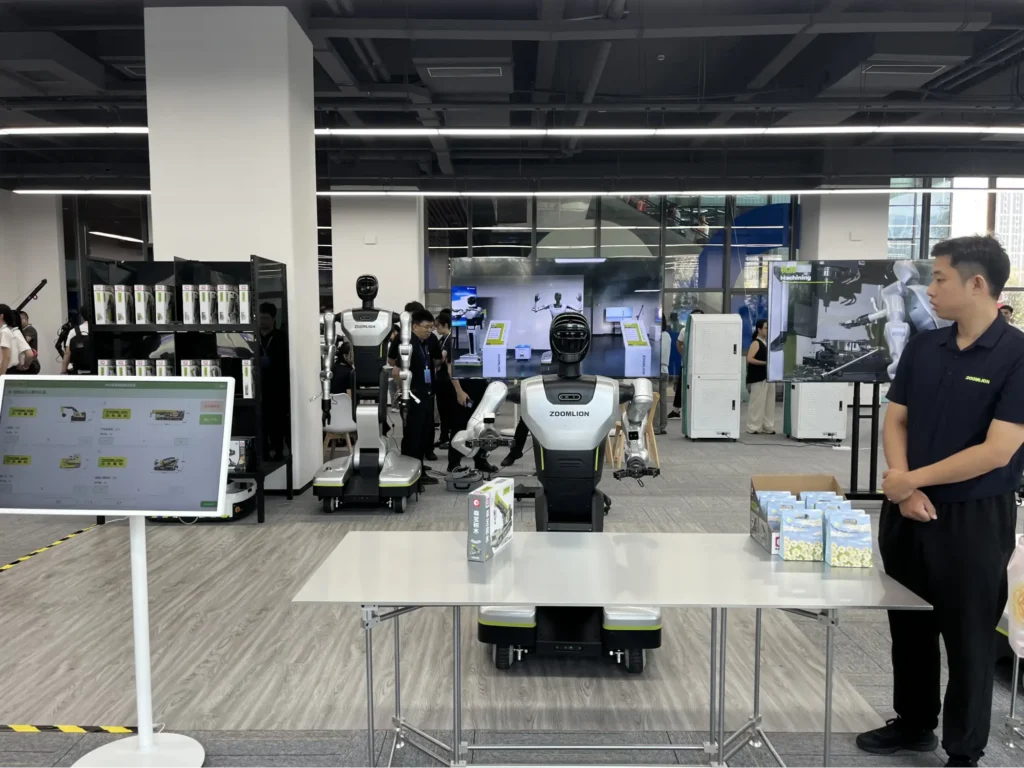
Modern robotics foundation models are turning embodied AI from scripted automation into adaptive physical intelligence. Instead of treating perception, reasoning, and action as separate systems, newer architectures connect them through vision, language, and action models. This allows robots to interpret instructions, understand their surroundings, and translate decisions into movement.
| Model | Developer | Key Characteristic |
| Pi0 | Physical Intelligence | Scaling data and computing produce emergent generalization |
| GR00T N1 | Released early 2026 | Dual system architecture with slow reasoning plus fast motor control |
| OpenVLA | Research consortium | 7 billion parameter language model trained on 22 robot embodiments |
| Octo | Academic lab | Smaller, efficient model for fast deployment |
| SmolVLA | Academic lab | Lightweight alternative to OpenVLA |
These models show the field’s main direction. Some prioritize full-body humanoid control, while others focus on manipulation, faster inference, or easier fine-tuning. The shared goal is clear: help robots transfer skills across tasks, bodies, and environments with less custom programming.
Data remains the main constraint. Task-specific robot policies still require many demonstrations, while foundation models can reduce that burden through prior learning. Yet quality matters more than volume. Smooth, consistent demonstrations improve performance faster than large datasets filled with failed or unstable actions.
This is why deployment matters. Every robot placed in a warehouse, lab, factory or service environment can generate interaction data. Over time, that feedback improves perception, motion control, and task planning.
For embodied robotics, the strongest advantage will come from companies that combine better models with real-world learning at scale.
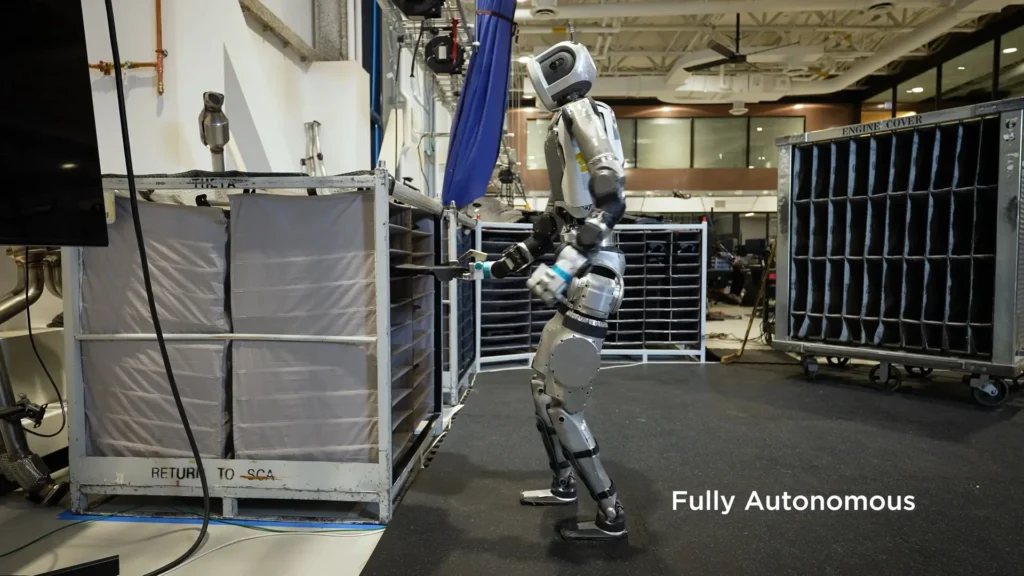
Humanoid robots are the clearest physical expression of embodied AI because they can enter environments already designed for people. They can move through warehouses, climb stairs, handle tools, and work near human teams without major facility redesign. That makes the humanoid form valuable for factories, logistics sites, care settings, and public service spaces.
Boston Dynamics’ all-electric Atlas shows the high-performance end of physical AI. After decades of work in dynamic movement and whole body control, Atlas now demonstrates real-time motion planning, balance, and coordinated manipulation.
Its importance goes beyond one robot. Atlas gives the industry a reference point for advanced mobility, reliable body control, and physical intelligence in action.
Chinese startups are moving humanoids toward faster experimentation and practical use. EngineAI’s PM01 and SE01 make full-body robot learning more accessible for universities, developers, and early service pilots. Its T800 uses high-stress motion scenarios to generate data for industrial, retail, and service applications.
Deep Robotics takes a different path with DR02, an all-weather industrial humanoid built for inspection, logistics yards, and emergency response. Fourier Intelligence’s GR 3 focuses on care and public interaction, using soft surfaces, tactile sensing, and multimodal interaction to support safer contact with people.
Humanoid robotics still faces clear limits. China produced 12,800 humanoids in 2025, roughly 90% of global output, yet that number remains small compared with the 556,000 industrial robots produced that same year. Scale is growing, but the category is still young.
Current systems also face challenges in cost, dexterity, precision, and autonomy. Many robots can impress in demonstrations, but real operations require repeatable performance across long shifts, varied tasks, and imperfect environments.
The important shift is not the mass replacement of human workers. The real signal is that humanoids are moving from controlled demos to repeatable tasks in factories, warehouses, exhibition spaces, and care environments.
That is where embodied AI becomes commercially meaningful. It turns intelligence into movement, tests learning through real-world feedback, and brings AI into the physical systems where businesses actually operate.

China views physical AI robotics as a strategic technology for labor shortages, industrial upgrading, and national competitiveness. Its edge comes from the world’s largest installed base of industrial robots, a strong EV supply chain, and dense manufacturing capacity across batteries, sensors, motors, and components.
Policy support is accelerating this shift. Robotics receives funding, R&D backing, and industrial planning support, while many Chinese EV companies are expanding into humanoid robots. Physical AI appeared in the 2025 government work report and features in the Fifteenth Five-Year Plan. At CES 2026, more than half of the humanoid robotics exhibitors came from China.
Still, China faces real constraints. Its humanoid sector depends on Nvidia AI chips and simulation platforms, while manufacturers must localize high-end components to reduce cost and supply risk. Large-scale deployment could also disrupt parts of the labor market. For Europe and other regions, China’s rapid scaling creates a serious competitive challenge.
Embodied AI still faces three hard constraints:
Robotics components such as batteries, motors, sensors, and actuators do not scale as easily as software. They require manufacturing capacity, standardized parts, quality control, and long investment cycles.
Hardware fragmentation adds cost. Many companies build around proprietary robot architectures, which limits component reuse and slows supply chain maturity. This makes production harder to scale and raises maintenance complexity for enterprise buyers.
The AI stack also remains unfinished. Current language and vision models do not fully understand three-dimensional space, contact dynamics, object handling, or continuous motion. Robots need high-quality real-world data to improve across different environments, yet teleoperation remains slow and labor-intensive. Simulation helps, but it cannot fully reproduce the messiness of physical settings.
Cost remains the biggest commercial barrier. Humanoid prices must fall sharply before mass adoption becomes realistic. Service robots also face strict safety expectations, while industrial humanoids must prove they can beat cheaper fixed automation on uptime, precision, and ROI.
Business models such as robots-as-a-service, task-automation bundles, retail engagement, healthcare support, and developer platforms can reduce adoption friction. Still, each model must prove a clear payback period before physical AI becomes a scalable enterprise investment.
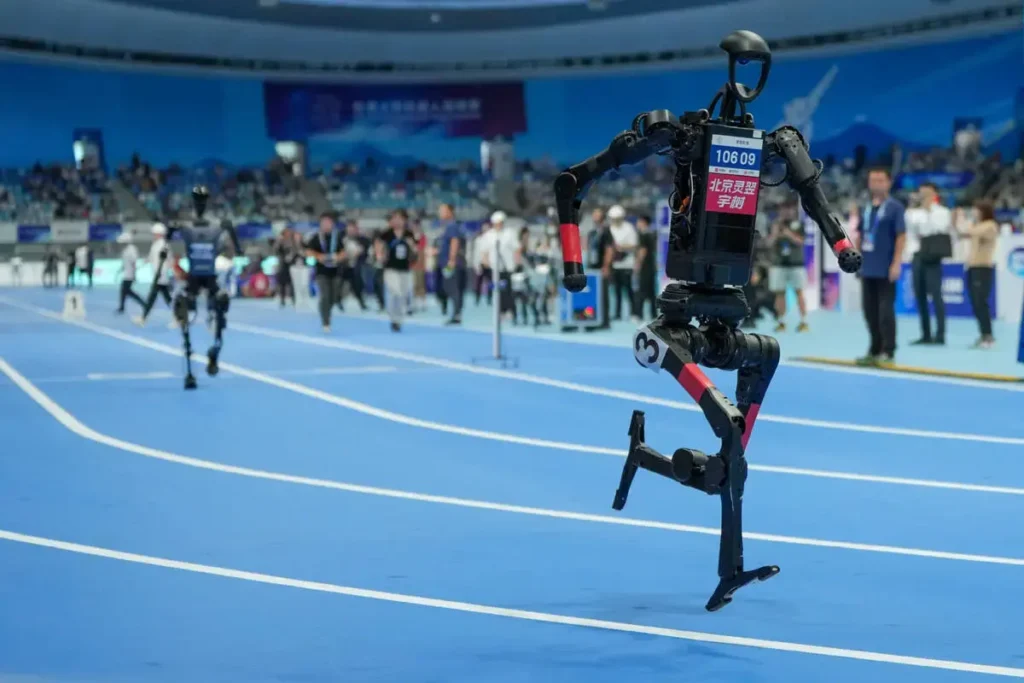
The next phase of embodied robotics will focus on reliability. World models will help robots test actions before execution. Reinforcement learning and adaptive control will improve movement, balance, and safety in real environments.
Large language models will support high-level planning. Low-level controllers will handle grip, motion, and balance. Stronger systems will integrate robot perception, motion control, multimodal sensing, and task planning into a single practical operating layer.
Near-term adoption will stay concentrated in logistics, manufacturing, and inspection. Palletizing, machine tending, parts movement, and quality checks offer clearer ROI than broad autonomy.
Healthcare and eldercare will grow through mobility support, monitoring, and companionship. Retail robots will combine generative AI with physical presence to provide customer guidance and branded interactions.
The long-term goal is clear: embodied AI systems that adapt to unstructured environments and work safely alongside people with less scripting.
Humanoid robots and embodied AI are moving fastest in markets where policy, supply chains, pilots, and real-world demand connect. ChoZan helps leadership teams understand these shifts from inside China’s innovation ecosystem, not from headlines alone.
Through China learning expeditions, executive briefings, custom research, and expert dialogues, ChoZan connects global teams with the companies, technologies, and market forces shaping physical AI. This helps decision-makers see how robotics is being tested, commercialized, and scaled in real-world operating environments.
If your team wants to understand what China’s robotics momentum means for your industry, ChoZan can help you turn observation into strategy.
Book a consultation with ChoZan to explore embodied AI, humanoid robotics, and China’s next wave of industrial innovation.
Companies should check task clarity, site conditions, safety rules, data access, maintenance support, and vendor reliability. A strong pilot starts with one measurable workflow, not a broad automation ambition.
Edge computing lets robots process sensor data close to the machine. This reduces latency, supports faster decision-making, and limits reliance on cloud connections during time-sensitive physical tasks.
Embodied AI must scale across hardware, safety, maintenance, real environments, and physical wear. Software can update instantly, while robots need parts, testing, repairs, and operational support.
Businesses should measure saved labor hours, uptime, error reduction, task completion rate, safety impact, and maintenance cost. ROI depends on repeatable performance, not impressive demonstrations.
Embodied AI robots may collect video, audio, location, and interaction data. Companies need clear rules for storage, consent, access control, and monitoring of sensitive environments before deployment.
Multimodal sensing helps robots understand space through cameras, depth sensors, touch, sound, and motion feedback. This improves navigation, object handling, and safer interaction with people.
Yes, embodied AI can power drones, robotic arms, autonomous vehicles, and mobile robots. The key requirement is physical interaction with the real world, not a human-shaped body.
Teams will need skills in robotics operations, safety supervision, data labeling, maintenance planning, and workflow design. The strongest users will combine knowledge of automation with practical site experience.
Simulation lets robots practice tasks virtually before real deployment. It reduces early testing risk, speeds model training, and helps teams explore rare or unsafe scenarios more safely.
Hospitality, agriculture, construction, mining, facilities management, and public safety may adopt embodied AI next. These sectors have physical tasks, labor gaps, and environments where automation can create measurable value.