CONTENT

Among the 2026 humanoid challengers, Fourier Intelligence deserves attention because its bet is on care systems. The Chozan 2026 humanoid robotics report focuses on the Shanghai company, healthcare, rehabilitation robotics, aging populations, and the GR3 Care Bot. That gives Fourier a different strategic path from factory-first humanoid brands.
The important point is the market sequence. Many humanoid companies chase logistics, manufacturing, or public spectacle first. Fourier starts with clinical trust, therapy data, physical support, and close human interaction. In care settings, these strengths matter before speed, payload, or dramatic movement.
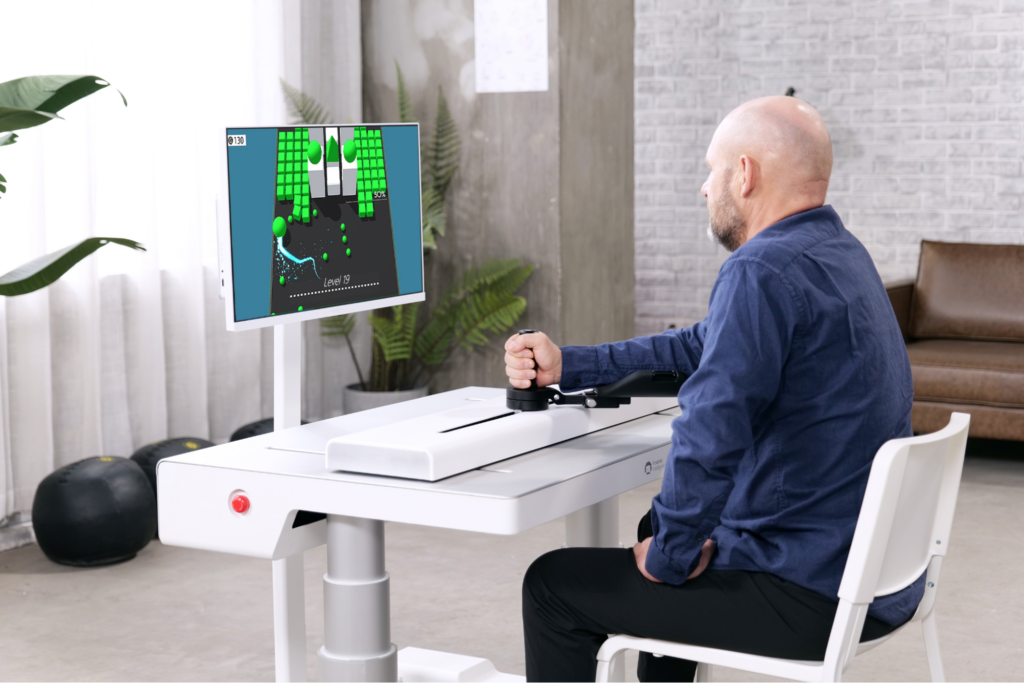
Fourier Intelligence has a stronger healthcare foundation than many of its humanoid competitors because its rehab arm already sells into institutional settings. Fourier Rehab says it serves more than 2,000 organizations and hospitals across over 40 countries. It also positions RehabHub as an AI-driven rehabilitation solution that connects multiple robotic systems for neurological, orthopedic, and pain management therapies.
The Fourier has already worked inside clinical procurement, therapist workflows, patient recovery, and data-based rehabilitation. This matters because healthcare robotics does not scale through curiosity alone.
Hospitals and rehabilitation centers need safety, maintenance support, training logic, measurable outcomes, and confidence from therapists. Fourier’s existing footprint gives the broader Fourier robotics portfolio a more credible entry point into care environments.

The strongest part of Fourier’s position comes from rehabilitation robots, not from humanoid theater. In 2025, Fourier Rehab presented intelligent rehabilitation and human-centered robotics at RehabWeek in Chicago, with clinical audiences focused on neurorehabilitation. The company also demonstrated how embodied AI can be integrated into therapy practice.
At MEDICA 2025, Fourier Rehab showed systems for upper limb rehabilitation, neurological recovery, musculoskeletal therapy, stroke, spinal cord injury, and Parkinson’s care. Its portfolio included ArmMotus M2 Pro, ArmMotus EMU, CycleMotus A4, and data management platforms for therapy environments.
This gives Fourier a clear learning advantage in robotic rehabilitation. Therapy robots already need precise motion control, safe physical assistance, patient feedback, repeatable training, and therapist oversight. Those capabilities transfer naturally into humanoid robots in healthcare, where touch, balance, motion, and trust shape adoption.
The company also benefits from China’s medical device ecosystem. Shanghai gives Fourier access to engineering talent, hospital networks, AI partners, supply chains, and city-level robotics momentum. Within Shanghai robotics, Fourier’s care-oriented approach adds a differentiated lane alongside industrial humanoid startups.
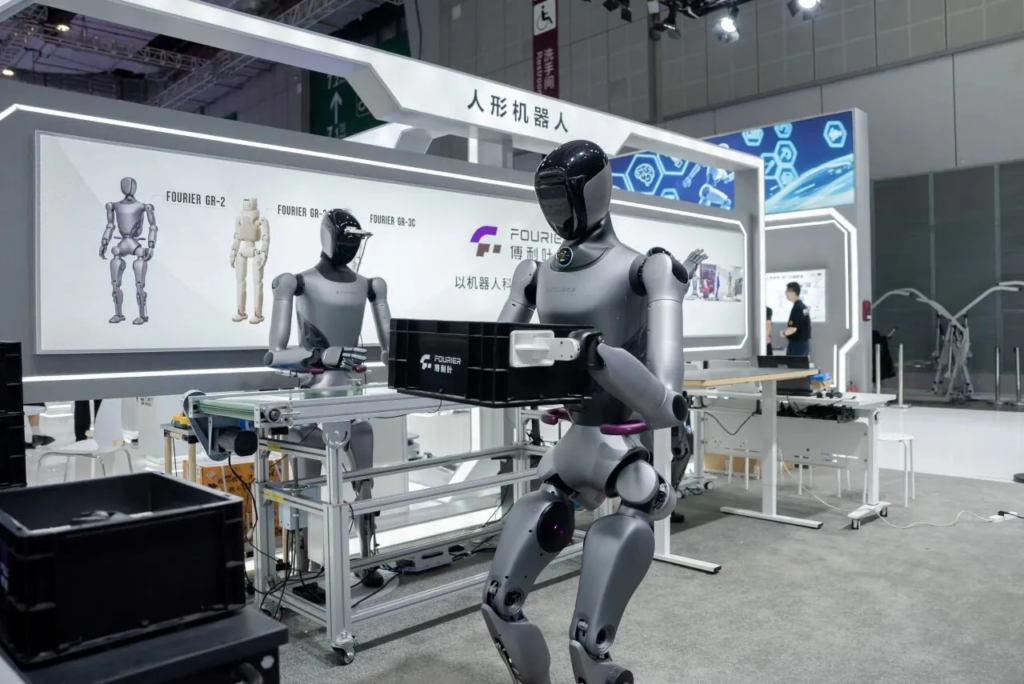
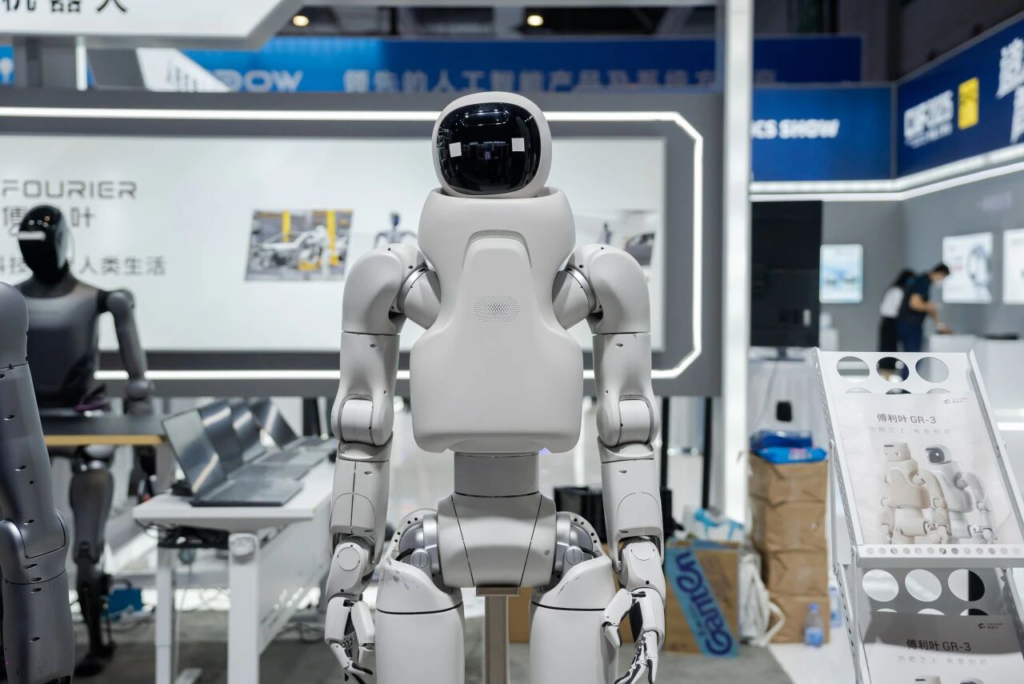
The Fourier GR3 humanoid robot is the clearest expression of this dual market bet. Fourier introduced GR3 in August 2025 as its first full-size care robot. The company described its roles as a social companion, a service assistant, a comforting presence for children, and a responsive companion for older adults. It is also referred to as future assistive care applications, including mobility support, health monitoring, physical rehabilitation, eldercare, and clinical settings.
This makes the Fourier humanoid robot story different from industrial humanoids that optimize for lifting, parts movement, or inspection. GR3 focuses on the interaction layer. Its value lies in approachability, emotional response, safe proximity, and future care assistance.
The technical design supports that positioning. GR3 stands 165 centimeters tall, weighs 71 kilograms, offers up to 55 degrees of freedom, and uses a compact, modular architecture with sensors and computing units housed in a softer exterior. Fourier also cites hot swappable batteries and intelligent power management for continuous operation in practical environments.
For executives evaluating a Fourier Intelligence humanoid, the key is to avoid the wrong comparison set. GR3 should not be judged like a warehouse robot. It should be judged as a care interface that connects sensing, movement, communication, and institutional service design.
GR3 matters because human-robot interaction becomes a commercial value in care environments. Fourier’s GR3 page describes a soft shell with premium automotive-grade upholstery and foam padding. The aim is a more approachable presence that still protects durability for regular use.
The Fourier Intelligence robot also carries a multimodal interaction system that combines vision, audio, and tactile feedback. Fourier describes a response architecture that supports quick reflex actions and large-language-model-based dialogue for more complex situations.
Touch is central to the design. GR3 uses 31 distributed pressure sensors for real-time touch detection. It also uses micro expressions, facial recognition, sound source localization, and voice activation to respond with social cues.
That matters for eldercare robots because older users, caregivers, and families will reject machines that feel unsafe or emotionally cold. Fourier’s bet assumes that comfort, predictability, and response quality will shape adoption as much as autonomy.
The Fourier GR3 CES 2026 moment gave the company international visibility without changing the product’s core message. GR3 appeared at CES 2026 with visual recognition, sound source localization, haptic feedback, and an attention management mechanism for sensing, decision logic, and motion planning.
The CES booth also used public interaction scenarios. GR3 challenged visitors to tic-tac-toe, responded through facial expressions, speech, and movement, and performed dance routines demonstrating whole-body motion control and balance.
This visibility matters because care robots need social proof before institutional acceptance. CES did not prove hospital-scale deployment. It showed how the Fourier robot can be presented as approachable technology in public, clinical, wellness, and service settings.
Fourier’s longer-term opportunity sits in platforms. Official materials say the GR3 Series builds on two generations of innovation and supports motion control, whole body teleoperation, modular sensors, and computing integration. The platform also supports algorithm development for researchers, automation engineers, and AI developers.
This opens a second market besides direct care deployment. Fourier can sell robots to research labs, universities, healthcare innovation centers, and developer programs. That matters because open-source robot development and embodied AI research require access to physical platforms, not simulations alone.
The GR2 documentation reinforces this direction. Current support materials describe GR2 as a 1.75-meter, 63-kilogram general-purpose humanoid with up to 53 degrees of freedom, FSA 2.0 actuators, dexterous hands, and experimental applications in guidance, consultation, academic research, industrial manufacturing, and medical rehabilitation.
That is why search demand around the Fourier GR1 robot, the Fourier GR1 humanoid robot, GR2, and the Fourier GR3 should be read as platform interest.
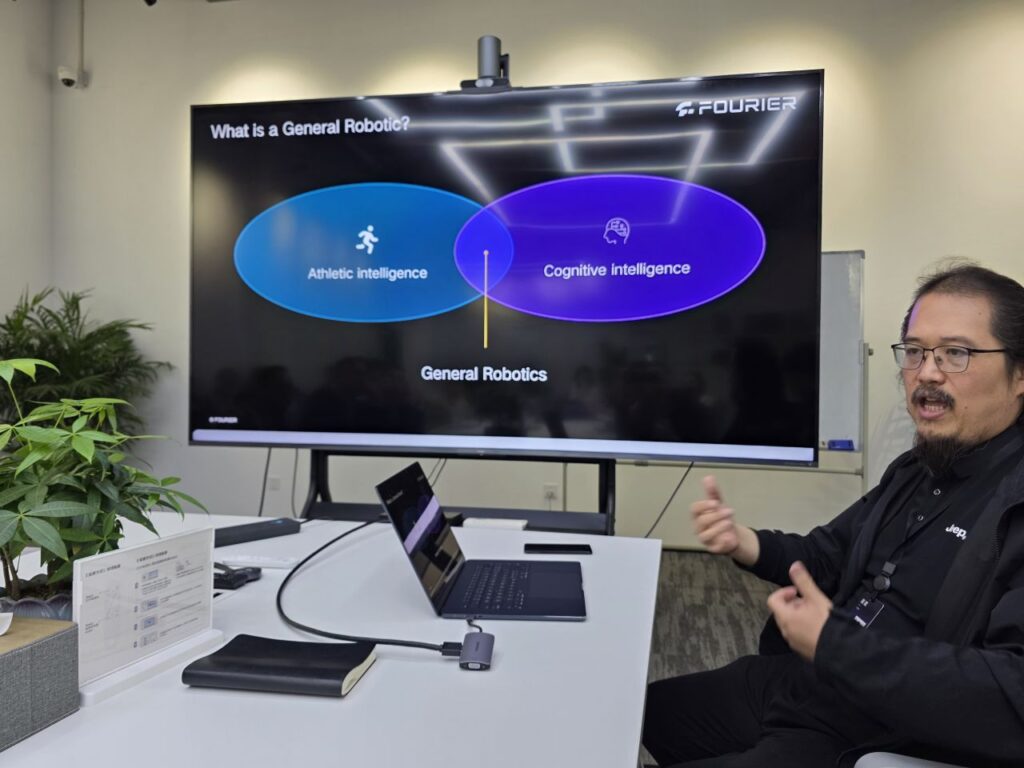
The next question is the commercialization discipline. Fourier has visible technology, a healthcare base, and a clear care-focused identity. It still needs to prove repeatable procurement, service economics, safety protocols, maintenance operations, and measurable care outcomes for humanoid deployment.
The company’s best path may start with controlled environments. Rehabilitation centers, hospital innovation units, public service venues, eldercare pilots, academic labs, and wellness facilities offer structured settings. These buyers can test interaction, motion, data capture, and caregiver support before broader deployment.
This is why Fourier Intelligence deserves executive attention in 2026. It is not competing only on humanoid motion. It is testing a dual-market strategy in which rehab credibility supports humanoid adoption, and humanoid interaction expands the future of care.
If your leadership team is tracking humanoid robotics, China cannot stay a headline topic. ChoZan helps executives understand China’s innovation ecosystem through learning expeditions, innovation tours, executive briefings, custom research, and expert dialogues with market insiders.
The organization operates in Hong Kong, Shenzhen, and Shanghai, with a focus on helping global leaders learn from China’s digital and technological transformation.
For teams studying healthcare robotics, embodied AI, or China’s humanoid supply chain, ChoZan can turn outside observation into direct understanding.
Book a consultation to explore a tailored China innovation program, competitor research project, or expert briefing for your leadership team.
Fourier Intelligence develops humanoid and rehabilitation robotics through Fourier and Fourier Rehab. It’s 2025 and 2026, focus connects embodied AI, care robotics, therapy systems, and human-robot interaction.
GR3 targets clinical, wellness, research, and service environments, but hospital adoption will likely begin through pilots. Buyers should evaluate safety procedures, training support, data handling, service terms, and integration needs.
Many searchers use Fourier Health when looking for Fourier’s healthcare and rehabilitation work. The more accurate brand context is Fourier Rehab, which develops therapy robots and rehabilitation systems.
GR3 focuses on social response, touch feedback, approachable design, and care settings. Industrial humanoids often prioritize payload, inspection, factory navigation, or repetitive task automation.
Use cases include patient guidance, companionship, rehabilitation support, mobility assistance, wellness engagement, therapist support, and future monitoring. Each use case needs a strict safety review before clinical deployment.
Robotic rehabilitation teaches companies how people move, recover, respond to assistance, and interact physically with machines. That knowledge helps humanoid teams design safer care-focused robots.
The Fourier GR3 humanoid robot has long-term relevance to personal spaces, but current positioning focuses on public services, research, rehabilitation, wellness, clinical use, and controlled service environments.
Executives should ask about safety testing, caregiver workflows, maintenance support, privacy rules, resident consent, staff training, measurable outcomes, and total operating cost across daily use.
Shanghai robotics matters because the city connects engineering talent, AI development, healthcare institutions, supply chains, and commercialization support. Fourier benefits from this local ecosystem while serving global rehab markets.
The story of the Fourier Intelligence humanoid robot is promising, but scale depends on pilot results, service support, procurement cycles, and clear outcomes in healthcare, rehab, service, and eldercare environments.