
When one person is the unit of consumption, what should change in your product, price and service?
Design for an occasion involving one person, not a stereotype of a single customer. Make the value of a smaller offer clear, remove unnecessary barriers to buying alone, and test whether the change creates profitable demand. Chinese small-portion initiatives provide useful examples, but they do not establish a universal price premium, higher loyalty or guaranteed returns from redesign.
A family pack can be poor value for someone who cannot finish it. A smaller pack can be convenient, yet still feel expensive. A restaurant may welcome solo guests while its booking system, menu and seating make them feel like an exception.
Living alone and consuming alone are different. Someone in a family household may buy lunch for one. Someone who lives alone may regularly host friends. Start with the occasion you want to serve, then identify the people who encounter it.
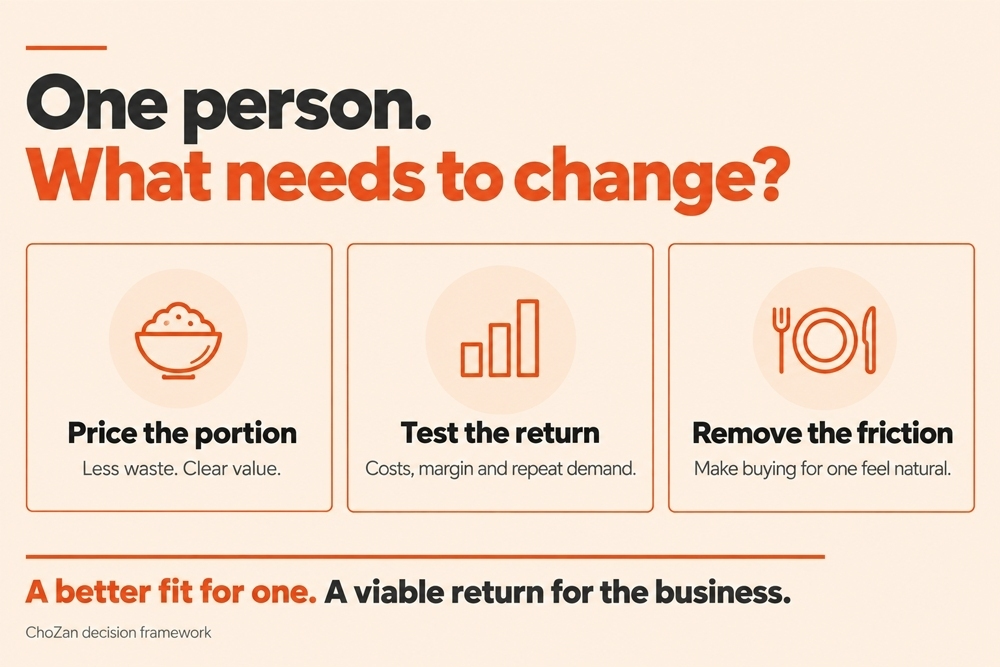

How do you price a smaller pack without making it feel like less for more?
Make the smaller format a clear choice, with a visible benefit and an honest price comparison. Adding an explicitly labeled option is different from quietly reducing the contents of an existing product.
Compare the total outlay, unit price and likely amount used. Customers may value less waste, easier storage or a portion that fits their needs. Those are reasons to investigate willingness to pay, not permission to assume it.
China case: smaller portions on Meituan
In November 2024, Meituan reported that almost 1.68 million merchants offered more than 9.09 million small-portion dishes as of October that year. Its account described smaller rice portions and initiatives to help customers order appropriate quantities.
This shows that portion choice can be offered across a large platform. It does not show how many buyers lived alone, whether each listing generated additional sales or whether a smaller portion earned a better margin.
For your business, the useful starting point is the decision customers face: can they buy the amount they need without being forced into excess?
- Show the difference. State quantity, servings and price clearly. Keep unit-price comparisons easy to understand.
- Test the benefit. Ask whether the format solves waste, storage, preparation or budget concerns.
- Check the cost. Include packaging, handling, shelf space and channel fees, not just the ingredients or product inside.
- Keep an alternative. Where practical, compare a smaller format with resealable packaging or individually portioned contents inside a larger pack.
There is no universal acceptable premium for a solo format. Test your category and channel rather than applying a fixed percentage. Reduced food waste also does not automatically mean a lower environmental impact: packaging and delivery matter too.
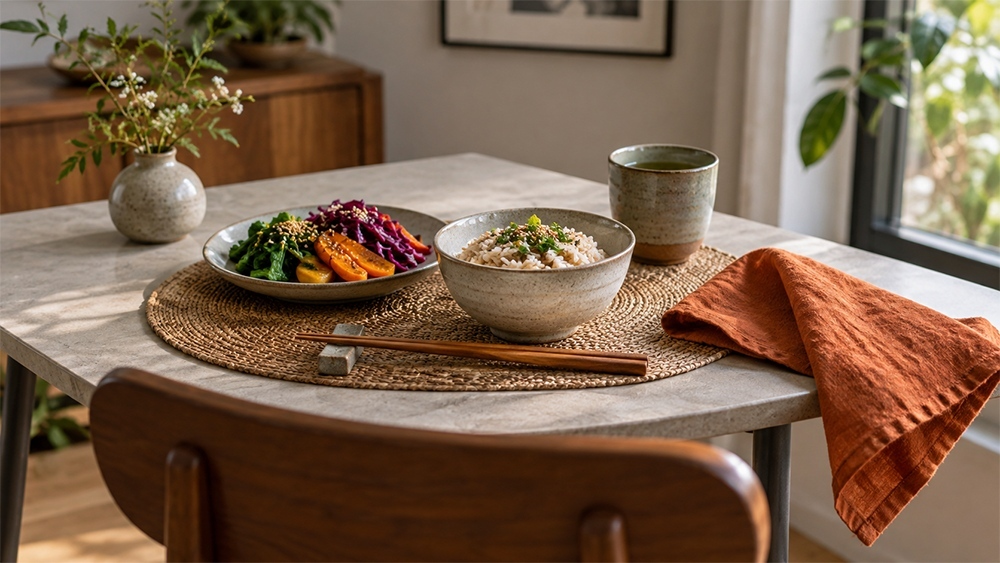
Will repeat purchases pay for the redesign?
Treat loyalty as something to measure, not a benefit that comes with the word “solo.” A new package, menu or seating arrangement only makes commercial sense if the added contribution can support its costs.
Start with a bounded change. A restaurant could test a smaller menu option before rebuilding its dining room. A packaged-goods brand could test one format in one channel before adding it across the range.
China case: read Bear Electric’s results at the right level
Bear Electric’s 2024 financial report recorded company-wide revenue growth of 0.98%, while net profit attributable to shareholders fell 35.37%. Those figures do not isolate customers living alone or the performance of miniature appliances.
They illustrate an important evidence limit: a company associated with a product opportunity is not proof that the opportunity delivers higher repeat purchase or better margins. To evaluate a compact appliance, your team needs product-level costs, returns and customer behavior, not a company-wide growth story.
The right repeat-purchase measure also depends on the category. Frequent restaurant visits may be relevant. Buying the same durable appliance again soon may not be a desirable outcome. For appliances, consider product reliability, returns, recommendations and purchases across categories instead.
Decision
Smaller pack or portion
Include in the cost
Packaging, preparation, waste and channel fees
Look for in the result
Additional contribution, not just more units
Decision
Solo-friendly service
Include in the cost
Training, service time and seating capacity
Look for in the result
Satisfaction and profitable return visits
Decision
Compact product
Include in the cost
Development, inventory, support and returns
Look for in the result
Useful demand at a sustainable margin
Compare the test with a similar unchanged offer or location where possible. Track whether the new option attracts additional purchases or mainly replaces a more profitable existing choice.

What would you want to learn from China?
Bring your question about portions, products or customer experience. Talk to Jemma about a tour focus that fits your team.
Where do family-first defaults quietly exclude customers buying for one?
Audit the full purchase journey, not just the product size. An appropriate portion can still be difficult to buy if minimum orders, promotions or booking rules assume two or more people.
China case: change the ordering rules as well as the menu
Meituan’s November 2024 account also described changes to minimum-order and promotion mechanisms, including not displaying staple foods on a page used to add items toward discount thresholds. The stated purpose was to avoid unnecessary staple-food orders and waste.
That is a useful example of looking beyond the portion itself. It is not evidence of a measured reduction in customer abandonment or a guaranteed sales uplift.
For your team, try completing a purchase for one. Can someone order a reasonable meal without adding unwanted products? Can they reserve a table without changing the party size? Can they choose comfortable seating rather than being automatically directed to a high counter?
Hospitality consultant Marlo Fogelman’s public discussion of solo dining covered menu portions, seating, service and booking systems. A visible customer comment challenged the assumption that bar seating suits everyone. Treat that as a design question to test, not a representative survey of solo diners.
Avoid equating dining alone with wanting silence, conversation or special attention. Offer choices and train staff to ask without making the customer feel unusual.
Start with one occasion, not a whole new range.
Remove one barrier to buying for one. Then track additional demand, contribution after costs and customer experience before expanding.
What should your team look for in China?
Use China to compare ways of serving an occasion, then test the relevant idea in your own market. A shelf or menu can show how a business presents choice. It cannot, by itself, show the profitability of that choice.
In stores, compare portion sizes, resealability, unit-price visibility and placement. In restaurants, examine the menu, booking process, seating options and service pace. On ordering platforms, follow the journey through minimum spend, delivery charges and promotional thresholds.
Ask what operating changes sit behind the offer: preparation time, replenishment frequency, waste handling or staff training. Where commercial data is unavailable, record the gap rather than inferring success from a busy location.
Bring home one proposal tied to a real customer problem. It might be a smaller portion, a flexible bundle or a booking option for one. Define the local test before treating the idea as a growth strategy.
See how retail makes room for one.
Bring your team’s question about portions, pricing or service. Explore how a China learning expedition could help you compare the choices customers encounter and the operations behind them.
Specific visits and access are subject to confirmation.
Frequently asked questions
Is the solo-living market the same as the singles market?
No. Household composition, relationship status and purchase occasion are different. A customer can live with others and still need a meal or service for one. Segment around the task and occasion rather than assuming one demographic profile.
Is a smaller pack always shrinkflation?
No. An additional, clearly labeled format can offer a useful choice. Reducing the quantity of an existing product while keeping its price unchanged or higher raises a different concern. Be transparent about size and unit price, and test whether customers understand the value.
Are smaller portions automatically more sustainable?
No. They may reduce unused food, but packaging, production and delivery also affect the outcome. Compare the whole offer and avoid an environmental claim based only on portion size.
Should we redesign the entire store for solo customers?
Not before testing the need. Start with a specific friction, such as a menu option, booking rule or seating choice. Measure customer experience and commercial results before committing to a larger redesign.


Consumer Growth & Retail Innovation
Premium vs. Value

What to Investigate in China
Sign Up to Our Bi-weekly Newsletter
You’re almost there!
Check your inbox and click the link to confirm.
Don't see it? Check spam or promotions.
Design preview only. Open newsletter signup ↗
Editorial preview: final image rights, service scope and publication checks are pending. No form data is collected. Navigation retains the existing ChoZan prototype links.