
Make the entry offer easier to buy, not harder to trust. Give it a clear role, preserve your brand’s core promise and make the benefits of upgrading visible. Use a separate brand only when the audience or proposition genuinely differs. Judge success by additional profitable customers, not just more orders or a higher average price.
Your team wants a more affordable product to bring in new customers. But what happens if existing customers buy it instead? What if the cheaper option becomes the product your brand is known for?
The decision is not simply whether to charge less. It is what to change, what to protect and how to tell whether the new offer creates additional business. A smaller product, a simpler specification, a separate brand and a temporary discount solve different problems.
China offers useful cases to examine. Xiaomi provides a way to think about distinct product propositions. NIO illustrates the choices involved in serving different audiences through several brands. Three Squirrels provides a reminder to judge growth by more than revenue or order size.
These are not universal formulas. They are starting points for deciding what your team should test.
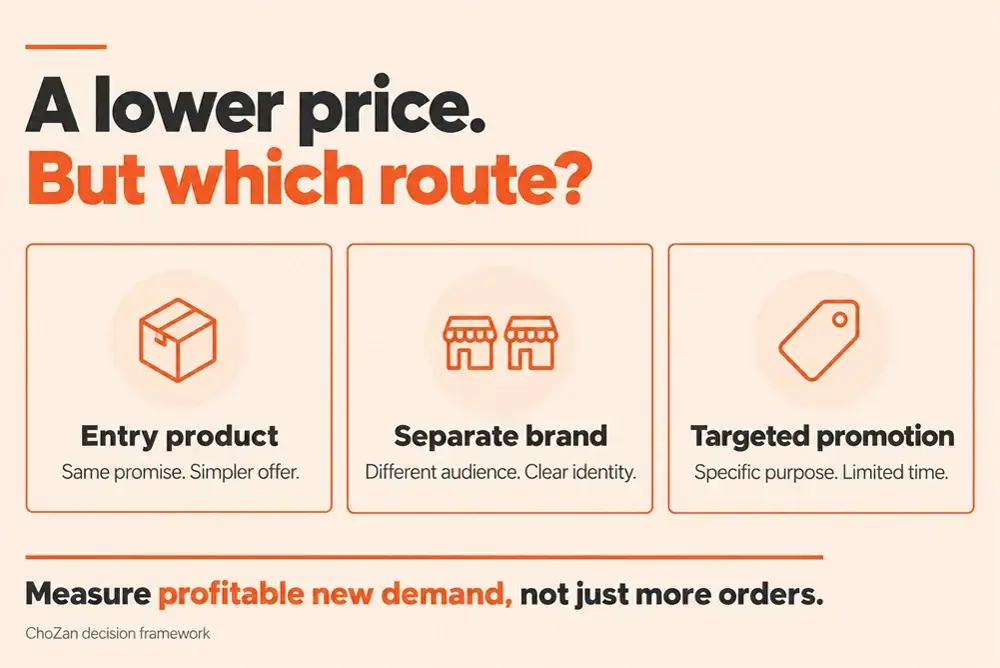

How can an entry-level product attract customers without weakening your premium offer?
Give the entry product a clear purpose, while making the reason to pay more visible. A lower price should reflect an understandable difference in the offer, not an unexplained reduction in the quality customers expect from your brand.
Start with the barrier you are trying to remove. Is the customer unable to afford the full-size product? Unsure whether it is right for them? Or unwilling to pay for features they do not need?
Those situations call for different responses. A smaller pack can lower the first purchase cost. A simpler model can remove unnecessary features. Neither requires reducing the price of your flagship product.
China case: Xiaomi and Redmi
Xiaomi describes a dual-brand strategy. Its 2024 second-quarter announcement presented Xiaomi foldable phones alongside Redmi performance-focused models. Both offered substantial technology, but with different product propositions. This is a more useful distinction than treating one brand as simply the cheaper version of the other.
In Q2 2026, Xiaomi reported that its global smartphone average selling price rose 25.9% year over year, while smartphone gross margin was 8.5%. A rising average price is therefore not a complete measure of commercial health. It does not, by itself, show whether Redmi buyers moved to Xiaomi or whether customers became more willing to pay for the brand.
For your range, make the upgrade concrete. Can customers see what they gain in performance, convenience, design or service? And does the entry product remain a satisfactory purchase in its own right?
What to test: Compare new-customer acquisition, repeat purchases and switching between tiers. Do not assume every entry-level customer must eventually upgrade. A customer who stays at the entry tier can still be valuable if that relationship is profitable.

Would a China tour help your next pricing decision?
Tell Jemma what your team is weighing up. Discuss whether the tour fits your goals and what would be useful to explore.
Should you launch a cheaper product under the same brand or create a separate brand?
Keep the same brand when the new offer can credibly deliver the same core promise. Consider a separate brand when the audience, use case or experience needs to be meaningfully different. A second name adds complexity; it does not automatically prevent customers from comparing prices.
Before deciding, write down the promise your main brand cannot afford to break. For one business, it may be durability. For another, specialist advice or a distinctive experience. Identify which elements can change without undermining that promise.
China case: NIO, ONVO and firefly
NIO describes three distinct propositions: premium smart electric vehicles under NIO, family-oriented vehicles under ONVO, and small smart high-end electric cars under firefly. Notably, firefly is not described simply as a budget brand. The distinction includes customer needs and vehicle format, not just price.
NIO reported a group vehicle margin of 18.5% in Q2 2026, compared with 10.3% a year earlier, attributing the improvement primarily to a more favorable product mix. That is evidence of improved group vehicle economics, not proof that separate branding caused the improvement or eliminated competition between the brands.
For a global brand, the transferable question is whether separation helps customers understand the offer. It is not whether you can copy an automotive group’s structure.
Option
Entry product within the main brand
When it may fit
Same core promise, simpler specification or smaller format
What to watch
Existing buyers switching down; weaker quality perceptions
Option
Separate brand
When it may fit
A distinct audience or proposition needs its own identity
What to watch
Added operating costs; confusion; competition between brands
Option
Targeted promotion
When it may fit
A defined purpose such as trial or inventory clearance
What to watch
Margin after costs; whether demand depends on continued discounts
What to test: Ask customers to explain the difference between the offers without using price. If they cannot, a new name or a wider price gap may not solve the underlying problem.

Will cheaper products bring new customers or just smaller baskets?
A lower average order value is a warning to investigate, not an automatic failure. The important question is whether the new offer improves total customer contribution after acquisition and servicing costs, or replaces purchases that would have been more profitable.
A low first-order value may be acceptable when customers return profitably. A high order value may be unattractive when it depends on expensive advertising, heavy discounts or frequent returns.
China case: Three Squirrels
Three Squirrels’ first-half 2026 report shows why revenue alone is an incomplete scorecard. Revenue declined 3.61% year over year, while net profit attributable to shareholders, excluding non-recurring items, rose 276.94%. Operating cash flow improved but remained negative. These are company-level results, not proof that a particular low-priced product succeeded or failed.
The lesson for your team is to connect the product decision to the economics. Do not judge an entry offer only by the number of orders it generates, and do not attribute a company’s profit improvement to that offer without supporting evidence.
Compare customers acquired through the entry product with customers acquired through the core range over the same period. Track:
- Contribution after discounts, product costs, fulfillment, returns and acquisition costs.
- Repeat purchase and cumulative contribution over a period suited to your category.
- Whether existing customers switch to the cheaper product.
- Whether the wider range still sells without deeper promotions.
For a stronger test, compare a limited launch with similar customers, stores or regions where the offer has not changed. Account for seasonal and channel differences before claiming incremental growth.
What to test: Is the entry offer adding profitable demand, or moving existing demand into a less profitable product? Set limits from your own economics rather than copying a universal percentage of sales.
What should your team investigate firsthand in China?
Use a visit to understand how the proposition is delivered, then decide what needs testing at home. Public reports show selected outcomes. Stores and product demonstrations can reveal how customers encounter the choices behind those outcomes.
For this topic, build your observation around four questions:
- What makes the entry offer credible? Compare product quality, presentation and the claims made at the first price point.
- What makes the upgrade understandable? Examine the demonstration, packaging and explanation of benefits, not just the price label.
- How are different audiences served? Compare the role of product ranges, brand identities and customer experiences.
- What cannot be learned by looking? Customer movement between tiers, acquisition costs and contribution require data or informed conversations. Do not infer them from a busy store.
Then choose one test for your own business. It might be a smaller format, a clearer comparison between tiers or a revised product bundle. Define the result you want and the signal that would make you stop.
The goal is not to return with a list of Chinese brands to copy. It is to return with a better-supported decision about your own offer.
Bring your next pricing decision to China.
Bring a real business question. Compare how brands present value, make upgrades visible and serve different customers. Then decide what deserves a test in your own market.
Specific visits and access are subject to confirmation.
Frequently asked questions
Does a cheaper product always weaken a premium brand?
No. A smaller format or simpler specification can make the brand accessible while preserving its core promise. The risk is an unexplained quality reduction or a cheaper offer that makes the premium version seem unnecessary. Test how customers understand the difference.
Do entry-level customers have to upgrade for the strategy to work?
No. Customers who stay with an entry product can still contribute profitable repeat business. Measure the value of the relationship after acquisition and servicing costs. Upgrading is one possible outcome, not the only definition of success.
Is a falling average order value a reason to stop an entry offer?
Not on its own. Check contribution, repeat purchase and whether existing customers are switching down. A smaller basket can be worthwhile if it adds profitable demand. It is less attractive when it replaces a purchase the customer would otherwise have made at a higher contribution.
Do we need to enter China to use these lessons?
No. Start with a decision in your own market. Use Chinese examples to compare product ranges, value communication and retail experiences, then test what fits your customers, costs and channels. Observing a practice does not prove it will transfer.


Consumer Growth & Retail Innovation

China’s Solo-Living Market

What to Investigate in China
Sign Up to Our Bi-weekly Newsletter
You’re almost there!
Check your inbox and click the link to confirm.
Don't see it? Check spam or promotions.
Design preview only. Open newsletter signup ↗
Editorial preview: images and publication checks are pending. No form data is collected. Navigation retains the existing ChoZan prototype links.