CONTENT

Hunyuan AI marks Tencent’s shift from single-model releases to a full generative infrastructure layer. Instead of competing on isolated benchmarks, the company is building systems that generate video, images, 3D assets, and interactive content within the same stack.
This shift is happening at scale. By 2025, Tencent reported over 150 enterprise integrations of its Hunyuan 3D API alone, while its video models moved from research demos to production use across gaming, e-commerce, and media workflows. The focus is no longer on capability. It is a deployment.
The focus is no longer on capability. It is a deployment—something most companies still struggle to operationalize without China digital transformation consulting.
In 2026, the real challenge is evaluation. Teams must measure output quality, latency, cost, and control before integrating these systems into live environments.
Tencent is moving beyond standalone models toward systems that can execute tasks across workflows. This shift reflects a broader transition in AI, where the focus is no longer on generating content but on coordinating actions across multiple steps.
For businesses, this changes how AI should be evaluated. A model that produces strong outputs in isolation may still fail when asked to handle real processes, such as customer service flows, compliance checks, or multi-step content production.
China’s digital ecosystem accelerates this transition. Platforms are already structured around integrated systems where content, commerce, and interaction operate together. Hunyuan AI is being developed to fit into that environment, not operate outside it.
| Modality | Representative Hunyuan model | Capabilities | Evidence |
| Text → Video | hunyuan video | Generates cinematic videos with high physical accuracy, scene consistency, and concept generalization; supports real‑style and virtual‑style shots; native camera cuts; continuous actions; voice control and dubbing | Tencent’s official HunyuanVideo portal. |
| Text → Video (Compact) | Hunyuan video 1.5 | A step‑distilled model with only 8.3 billion parameters that enables high‑quality video generation on consumer GPUs; reduces generation time by 75%, allowing 75‑second output on RTX 4090 GPUs. | Tencent’s open‑source repository (2025). |
| Image/Audio → Video | Hunyuan video avatar | Multimodal diffusion transformer that injects character images and audio to create dynamic, emotion‑controllable multi‑character videos; uses a character image injection module, an audio emotion module, and a face‑aware audio adapter to maintain character consistency and fine‑grained emotion control. | HunyuanVideo‑Avatar paper (2025). |
| Text → Image/3‑D | Hunyuan image 3.0 | Mixture‑of‑experts model with 80 billion parameters (13 billion active per token); unifies multimodal understanding and generation in an autoregressive framework; produces high‑quality images and supports image‑to‑image editing. | Tencent’s HunyuanImage 3.0 technical report (2025). |
| Image/Text/Sketch → 3‑D | Hunyuan 3d | Engine and API that generate commercial‑grade 3‑D models from text, images or sketches in minutes; reduces production time from days or weeks to minutes; launched globally with API integration options and 20 free generations for individuals, enterprise API credits available | Tencent Cloud press release (Nov 2025). |
| Compressed model | HY‑1.8B‑2Bit | Low‑storage compressed version of the Hunyuan model for mobile devices; released Feb 2026 to run on consumer hardware. | Reuters report (Feb 2026). |
Tencent is not positioning Hunyuan AI as a closed system. The company has begun releasing key components, including video frameworks and inference optimization tools, to encourage developer adoption and improve performance at scale.
This strategy matters because it reduces dependency on proprietary systems and allows companies to adapt models to their own workflows. It also accelerates ecosystem growth, as third-party developers build tools, integrations, and optimizations on top of the core models.
In China, this ecosystem approach is critical. AI systems rarely operate in isolation. They are embedded into platforms, tools, and services that define how businesses actually use them.
HunyuanVideo is built on a 13-billion-parameter diffusion transformer designed for temporal generation tasks. The model integrates a 3D causal VAE that encodes video data over time rather than treating frames independently. This allows the system to maintain continuity across sequences.
In addition, Tencent uses a selective and sliding tile attention (SSTA) mechanism to efficiently manage long video sequences. This reduces memory load while preserving relationships between distant frames, which is critical for handling longer scenes without degradation.
The architecture also incorporates training strategies that combine large-scale multimodal data with reinforcement learning alignment. This improves how the model interprets prompts.
Together, these components define how HunyuanVideo handles motion, temporal dependencies, and prompt execution at scale.
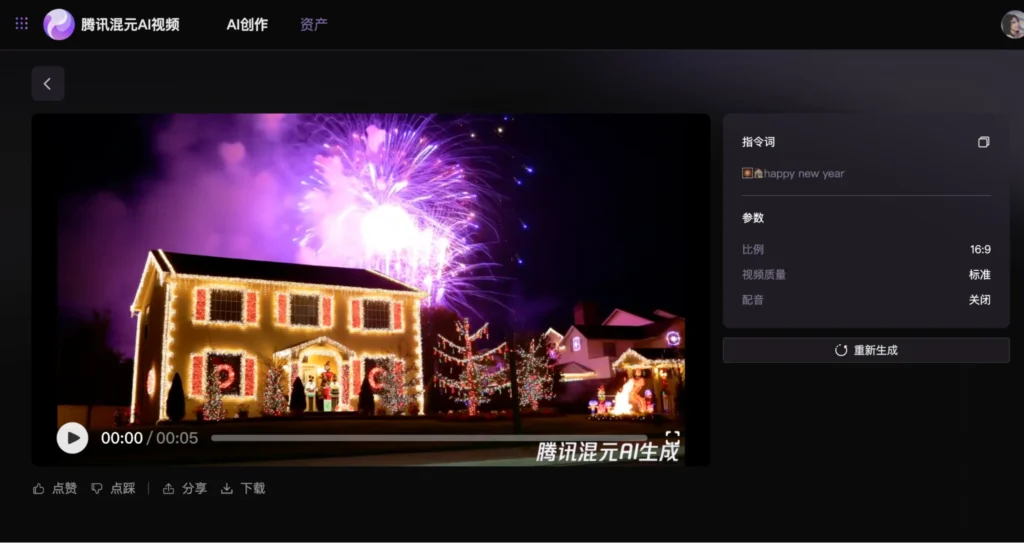
Hunyuan Video 1.5 reduces the model size to 8.3 billion parameters while cutting generation time by about 75%. It can produce short videos in roughly 75 seconds on a single RTX 4090, making it viable for regular production use rather than isolated testing.
This shift enables faster iteration. Teams can generate multiple variations, test different prompts, and refine outputs within tight campaign timelines. Instead of waiting for long render cycles, content creation becomes continuous and responsive.
The lower latency also allows video generation to fit directly into existing workflows. Creative teams can produce video assets alongside images and copy, keeping production cycles aligned across formats without adding bottlenecks.
Support for LoRA fine-tuning provides controlled customization. Teams can adapt outputs to specific styles or domains without retraining the full model, reducing both cost and setup time.
Hunyuan Video 1.5 is not positioned as the most powerful version of the model. It is designed for consistent, repeatable use where speed, iteration, and integration matter more than maximum output quality.
Hunyuan’s image-to-video feature turns a single image into a short video. Instead of creating content from scratch, it builds motion around an existing visual.
This is useful for product content. A product image can become a rotating view, a lighting variation, or a short demo clip. Teams can reuse existing assets instead of producing separate videos. This aligns with how brands approach digital marketing in China, where content reuse and speed directly impact performance.
It also helps maintain visual consistency. Because the video is based on the original image, branding and design details stay accurate.
This reduces production time. Teams can create multiple video variations from the same image and quickly adapt content for different platforms.
The HunyuanVideo‑Avatar model extends the base video generator to produce dynamic and expressive talking heads. The research team introduced three modules:
These innovations allow the model to generate high‑dynamic talking‑head videos with controllable emotions across styles—photorealistic, cartoon, 3‑D, or anthropomorphic. The system supports arbitrary resolutions and scales, enabling HD streaming or mobile‑friendly outputs.
HunyuanVideo‑Avatar has immediate use cases in e‑commerce, social media, online streaming, and education. Merchants can deploy virtual spokespeople who explain product features, make eye contact, and respond to audio prompts.
Live streamers can create animated personas that lip‑sync to their voice and display complex expressions, freeing them from on‑camera appearances. Education platforms can produce multilingual lecturers by combining translated scripts with recorded voices. The ability to support multiple characters in one shot opens opportunities for interactive storytelling and customer support scenarios.
These formats reflect broader shifts in China’s consumer behavior, where users expect interactive, responsive content experiences.
In November 2025, Tencent Cloud announced the Hunyuan 3D Creation Engine and the Hunyuan 3D Model API. The press release highlighted that users can generate commercial‑grade 3‑D assets from text, images, or rough sketches in minutes, dramatically reducing production time.
The engine includes models such as Hunyuan 3D 3.0 (for high‑quality asset production), Hunyuan3D World (for large‑scale interactive environments), and subsequent iterations. It supports tasks like game development, e‑commerce promotion, film production, advertising, social media content, and even 3‑D printing.
Tencent’s announcement offered 20 free generations per day to individual users and 200 credits to enterprises that integrate the API. Over 150 enterprises—including Unity China, Bambu Lab, and Liibli—had already integrated the API by late 2025.
The engine uses a credit system to manage cost; the ability to input sketches reduces the need for skilled 3‑D modelers, and the outputs include geometry, textures, and rigging.
Later updates (reported by independent reviewers) mention generation modes (Normal, LowPoly, Geometry, Sketch) and improved Rapid versions that produce models in under one minute with 8K physically based rendering (PBR) textures.
While such claims come from third‑party blogs rather than official sources, they hint at continuous improvements heading into 2026. These developments are consistent with wider China innovation trends, where rapid iteration and ecosystem integration define product evolution.
In February 2026, Reuters reported that Tencent’s Hunyuan team released a low‑storage compressed model, HY‑1.8B‑2Bit, designed for consumer hardware, including mobile phones.
This indicates Tencent’s intention to make 3‑D and other modalities accessible on lightweight devices, opening opportunities for augmented reality applications and on‑the‑go creativity.
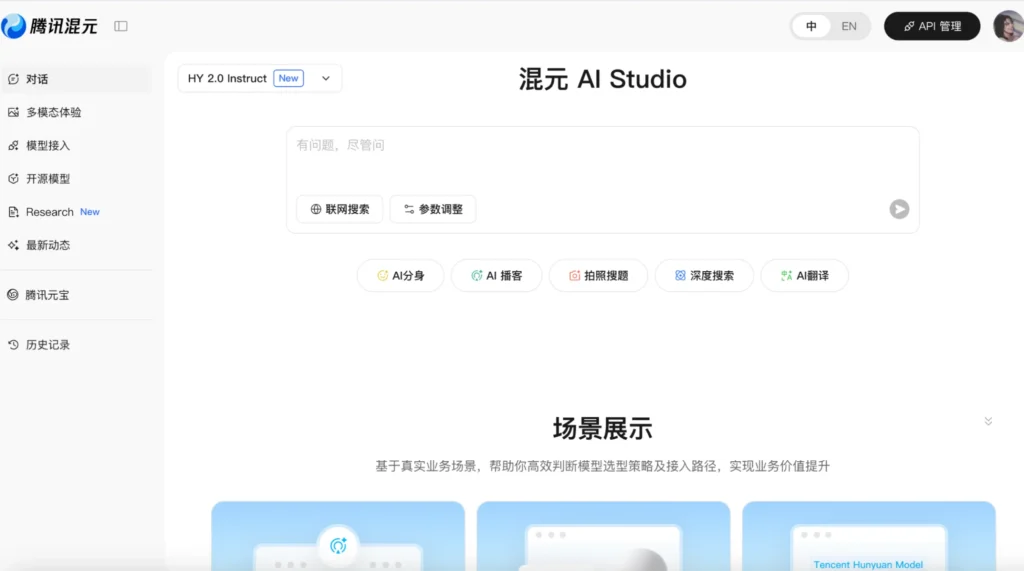
The Hunyuan 3D Model API allows enterprises to programmatically generate 3D assets for a wide range of scenarios:
Tencent’s AI stack relies on strong language models for reasoning, planning, and control. In February 2025, Tencent released Turbo S, a fast‑thinking model that halves response time compared with earlier models like Hunyuan T1.
According to Pandaily, Turbo S reduces initial latency by 44% and doubles output speed while maintaining high accuracy across knowledge, math, and reasoning tasks. It uses a hybrid Mamba‑Transformer architecture: the Mamba component excels at long‑sequence processing, while the Transformer handles complex contextual reasoning.
This fusion lowers training and inference costs and allows the model to scale to high token throughput. Turbo S is available through Tencent Cloud’s API, with pricing at 0.8 yuan per million tokens input and 2 yuan per million tokens output.
Turbo S acts as the backbone for Hunyuan’s downstream models. It orchestrates prompt understanding, cross‑modal reasoning, and user interaction.
For instance, when a user asks for a 3D object via natural language, Turbo S interprets the request and coordinates with Hunyuan 3D to deliver the asset. The speed improvements ensure conversational experiences feel immediate, which is crucial for real‑time creativity and interactive avatars.
Deploying multimodal generative models requires structured evaluation. Visual quality alone is not enough. Teams must assess output accuracy, generation speed, cost, and governance before production use.
Evaluate motion, consistency, and alignment with prompts. Metrics like FVD (Frechet Video Distance) measure temporal consistency but may favor low-motion outputs. The DEVIL protocol (NeurIPS 2024) improves this by assessing motion across multiple time scales and aligning better with human judgment.
Check physical accuracy. Objects should move naturally, lighting should behave correctly, and scenes should remain stable. Include domain experts where needed.
Assess concept accuracy. Test prompts that combine multiple elements and verify whether outputs match intent.
For images and 3D assets, review structure and detail. Check for visual artifacts, mesh integrity, topology, and texture quality.
Measure total generation time from input to output. For reference, Hunyuan Video 1.5 can generate a short clip in about 75 seconds on an RTX 4090, but performance depends on workload and hardware.
Evaluate infrastructure needs. Larger models may require multiple GPUs, while smaller or compressed versions can run on a single GPU or mobile devices.
Multi-GPU parallel inference using xDiT can reduce this to under 6 minutes on 8 GPUs. For text generation, the HPC-Ops optimizations should deliver sub-second responses for typical queries.
Test concurrency. Measure how many requests the system can handle simultaneously and monitor queue times during peak load.
Track API usage and credit consumption. Tencent provides free credits for testing, but production costs scale with usage.
Include customization costs. Fine-tuning with LoRA or training on proprietary data requires GPU time and engineering effort.
Account for storage and delivery. High-resolution videos and 3D assets increase storage and bandwidth costs. Compression can reduce cost but may affect quality.
The Hunyuan 1.5 architecture uses MagCache optimization, which delivers 2 to 4 times the speedup through magnitude-based caching strategies. The recently open-sourced HPC-Ops library improves inference throughput by up to 30% for Hunyuan models, with attention operators achieving more than double the performance of competing libraries
For interactive systems, measure task success rate, tool call error rate, and containment rate. These indicate whether the system completes tasks correctly without human intervention.
Also track task latency and cost per task to understand operational efficiency.
Define the use case clearly. Identify the business goal, whether it is marketing, training, or design. Establish data governance. Confirm ownership of training data and review how providers handle storage and retention.
Set up human oversight. Assign reviewers to validate outputs before public use. Plan system integration. Ensure compatibility with existing tools such as CRM systems or content platforms.
Review regulatory requirements. Check compliance with frameworks such as the EU AI Act or local regulations. Maintain documentation and audit trails where required.
Train internal teams. Staff must understand how to prompt models and evaluate outputs. Lack of skills remains a major barrier to adoption.
A pilot should validate real business value, not just produce impressive demos. The goal is to test performance, cost, and workflow fit before scaling. Many teams use expert AI strategy guidance at this stage to avoid scaling inefficient workflows.
Start with a specific, high-impact scenario, such as creating product videos or training content for a single team. Align the pilot with a clear business goal and define success metrics upfront.
Collect prompts, images, scripts, or sketches relevant to the use case. Clean and organize the data, and remove sensitive information where required.
Match the model to the task. Use Hunyuan Video 1.5 for video generation, Hunyuan 3D for asset creation, and Hunyuan Video Avatar for interactive content. Use Turbo S for prompt handling and coordination.
Generate multiple outputs using different prompts and settings. Record configurations, generation time, and cost for each run to ensure consistent comparison.
Apply structured evaluation metrics. Review output quality, task success rates, latency, and cost. Include safety checks and confirm outputs meet brand and compliance standards.
Share results with internal teams or target users. Gather feedback on usability, clarity, and relevance to real workflows.
Adjust prompts, fine-tune models where needed, and improve outputs through repeated testing. Compare results using the same metrics to track progress.
If results meet expectations, prepare for production. Define governance policies, train teams, integrate with existing systems, and set cost controls such as credit usage limits.
Access to tools like Hunyuan AI is no longer a constraint. The challenge is turning them into systems that fit real workflows, teams, and markets.
That is where ChoZan operates. As a China-focused digital transformation consultancy, ChoZan works with global companies to translate fast-moving technologies into practical strategies and execution models.
Their work focuses on applying China’s digital ecosystem as a reference point, not just a market. This includes understanding platform behavior, consumer dynamics, and how integrated systems—from content to commerce—actually operate in practice.
ChoZan supports companies across three core areas:
The goal is not to introduce more tools. It is to shorten the path from insight to execution.
If you are evaluating systems like Hunyuan AI, the key question is not which model performs best. It is how those models fit into your content, product, and operational workflows.
You can book a consultation with ChoZan to assess where these technologies create a measurable impact in your business.
Start by looking at where your team loses time or money in content production, not where AI looks impressive. If your workflows already run efficiently, adding Hunyuan may create complexity rather than value. It becomes useful when you have repeatable content needs, clear output formats, and enough volume to justify system integration.
Small teams without structured workflows should be cautious. If your content process is still informal or inconsistent, adding a system like Hunyuan will not fix that. It works best in environments where inputs, outputs, and approval processes are already defined. Without that structure, the outputs become difficult to manage or scale.
It shifts the role from creating assets to directing systems. Instead of producing content manually, teams focus on defining prompts, reviewing outputs, and maintaining quality control. This requires a different skill set. The bottleneck moves from execution to judgment, which many teams underestimate when adopting AI tools.
The hidden cost is not API usage. It is the time spent aligning outputs with brand standards. Teams often generate large volumes of content but spend significant time correcting inconsistencies. Without clear guidelines and review processes, the cost savings from automation can be offset by manual fixes and internal revisions.
Repetition happens when teams reuse the same prompts or structures without variation. To avoid this, you need a system for prompt rotation, style variation, and periodic resets. Treat prompts as evolving inputs, not fixed templates. Without this discipline, outputs quickly lose originality and start to feel automated.
Not fully. It can reduce reliance on external production for routine content, but strategy, positioning, and high-level creative direction still require human input. Companies that try to replace everything often end up with generic output. The better approach is to use AI to handle volume while keeping strategic work human-led.
The most effective setup includes three roles: someone defining inputs, someone reviewing outputs, and someone managing system performance. These roles do not need to be separate people, but they must exist. Without clear ownership, outputs become inconsistent, and accountability breaks down.
You need controlled comparisons, not assumptions. Test AI-generated content against existing formats using the same channels, audience, and timing. Measure engagement, conversion, or completion rates depending on the use case. Without structured testing, it is easy to mistake novelty for actual performance improvement.
The main risk is subtle inconsistency rather than obvious errors. Small deviations in tone, product details, or visual accuracy can affect trust. These issues often pass unnoticed in internal reviews but become visible to customers. This is why human validation remains necessary even when outputs look technically correct.
If not managed carefully, it can weaken it. When content is generated at scale without strict guidelines, brand voice and visual identity start to drift. Over time, this creates inconsistency across channels. To avoid this, teams need clear rules for tone, style, and output structure before scaling production.
It becomes less effective when audiences start recognizing patterns. This happens faster than most teams expect. Once content feels predictable or overly polished, engagement drops. The solution is not more output, but better variation and stronger creative direction behind what is generated.
Experimentation focuses on generating outputs. Deployment focuses on integrating those outputs into workflows that produce consistent results. Many teams stop at experimentation because it feels productive. Real deployment requires process design, performance tracking, and ongoing adjustment, all of which are significantly more demanding.