CONTENT
The global excitement around humanoid robotics has grown quickly since 2025. At the same time, this momentum reflects broader shifts in China’s digital transformation across AI, robotics, and industrial systems.
Advances in embodied AI are moving robots out of research labs and into factories, logistics hubs, and even border checkpoints. Among the pioneers, UBTECH Robotics stands out. The Shenzhen‑based company has progressed from producing educational robots for children to manufacturing industrial humanoid machines.
The ChoZan report places the company among the most important Chinese tech players to watch, and the current commercial story explains why. In 2025, UBTECH’s full-size humanoid business moved from a peripheral line to its biggest revenue source, making this a deployment story, not a visibility story.
UBTECH Robotics was founded in 2012 by engineer Zhou Jian with the initial aim of making robotics accessible to the public. Early products included Jimu Robot kits and the Alpha Mini, small humanoid devices designed to teach coding and basic engineering.
These kits aligned with national STEM curriculum goals and provided stable revenue streams. The company paired its hardware with AI tools for vision, motion planning, and interactive service roles, deploying them in corporate lobbies, exhibitions, and municipal projects.
As revenue from consumer robots grew, UBTECH invested heavily in research on balance algorithms, gait control, indoor SLAM navigation, and multimodal perception. These technologies, coupled with proprietary actuators, would later become the core of its humanoid systems.
This transition closely follows broader China innovation trends, in which technologies rapidly move from early-stage experimentation to scaled enterprise deployment.
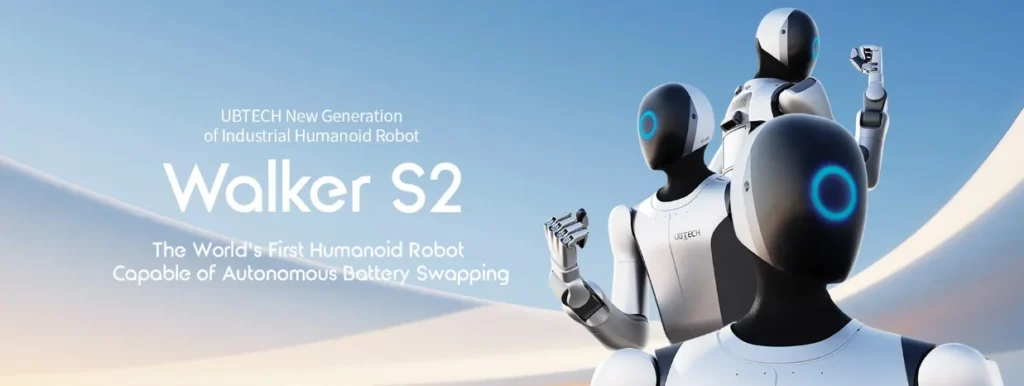
The Walker program began as an experiment in human‑sized bipedal robots. After prototypes like Walker 1.0 and Walker S1, the company revealed Walker S2 in mid‑2025. Walker S2 is not a toy; it is a commercial‑scale walker robot with 52 degrees of freedom, dexterous hands, and autonomous energy management.
Walker S2 can perform a battery swap in under three minutes, allowing near‑continuous 24‑hour operation. The robot carries a 15‑kg payload and uses a dual AI system combining Brainnet 2.0 and the Co‑Agent software for coordination
Brainnet 2.0 is a cloud “swarm brain” that manages fleet scheduling and scenario databases, while the Co‑Agent runs locally on each unit to plan movement primitives and handle errors. This division of intelligence enables autonomous movement and human‑robot interaction. The machine’s 11 degrees of freedom per hand allow it to grip objects with a 7.5‑kg finger load.
Its height ranges from 1.62 to 1.76 meters, and its weight of about 43 kg makes it comparable in form to that of a person. The robot uses dual RGB stereo cameras, force sensors, and microphones to perceive its environment, providing the multimodal capabilities necessary for navigating crowded spaces.
From a mobility standpoint, Walker S2 can walk at about 3 km/h and handle 10 kg payloads while manipulating doors and elevators. The ability to remove its own battery and return to work within minutes, combined with advanced balance algorithms, marks a significant leap in AI robotics integration.
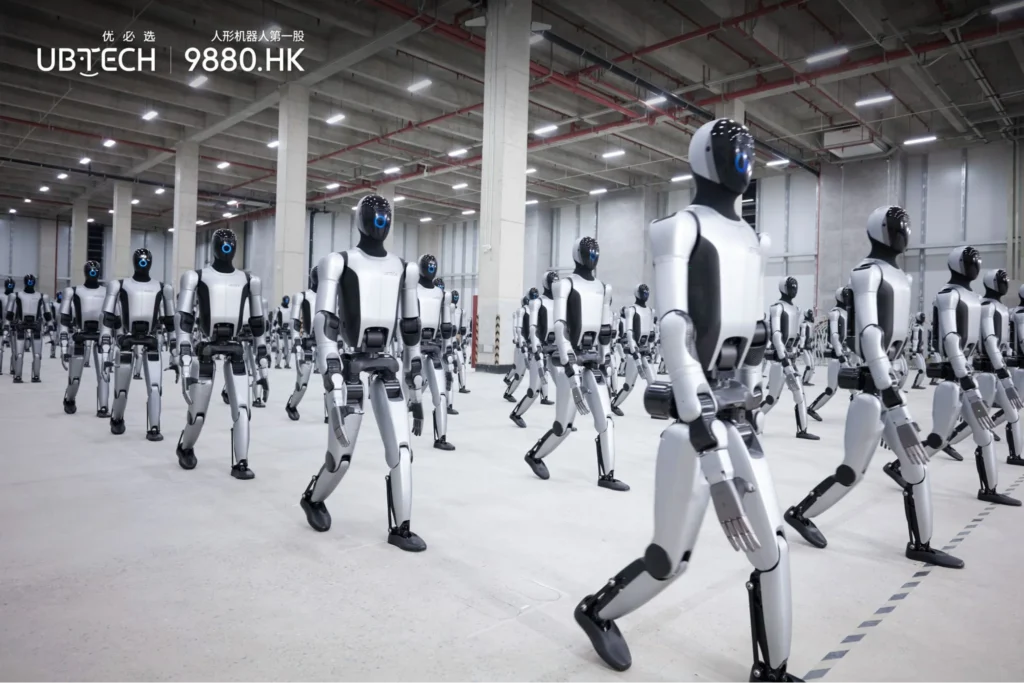
In 2025, UBTECH Robotics shifted its strategy toward commercial humanoids and large business‑to‑business deployments. The company started mass production of the Walker S2 and delivered the first batch of several hundred units.
Orders for Walker units exceeded 800 million yuan (about US$112 million) by mid‑2025. A 264 million yuan ($37.5 million) procurement by the coastal city of Fangchenggang signaled strong government adoption.
The company has adopted a “scenario‑based” delivery model. Instead of shipping robots and leaving integration to customers, UBTECH offers turnkey solutions built on the BrainNet platform. These standardized packages accelerate deployment and include user training.
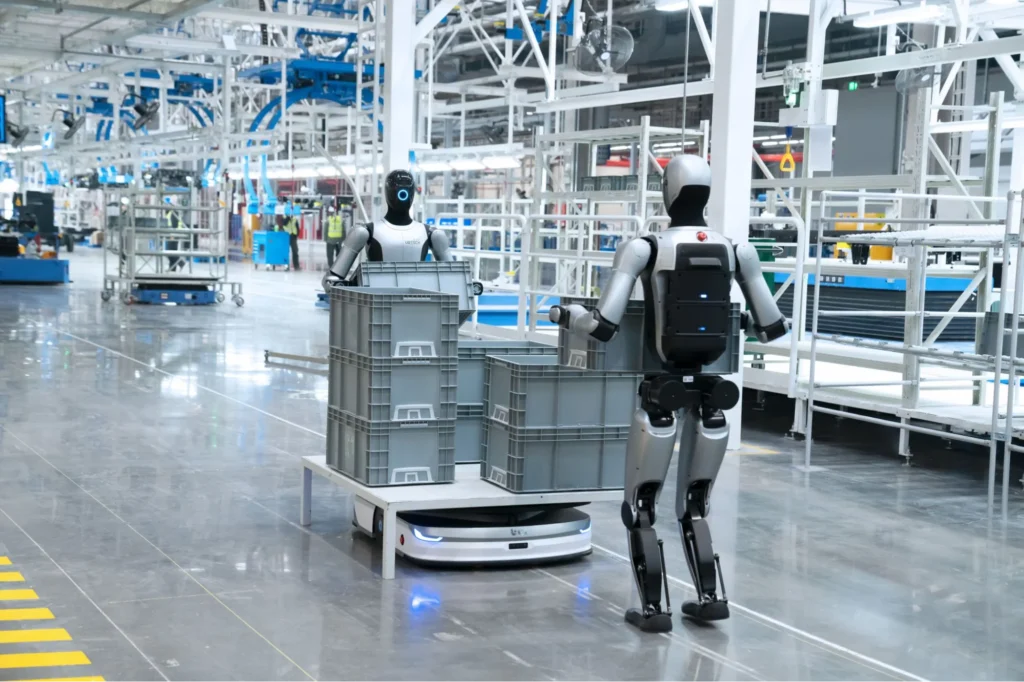
The robots are already operating in automotive manufacturing, smart factories, intelligent logistics, and data collection centers. Collaborations with BYD, Geely Auto, Foxconn, SF Express, and other industrial giants provide real‑world environments for refining algorithms and gathering data.
The PR Newswire release on mass production highlights that UBTECH plans to build 5,000 industrial humanoid robots annually by 2026, scaling to 10,000 units by 2027. This ramp‑up underscores a belief that humanoid deployment will soon move from pilot projects to mainstream automation.
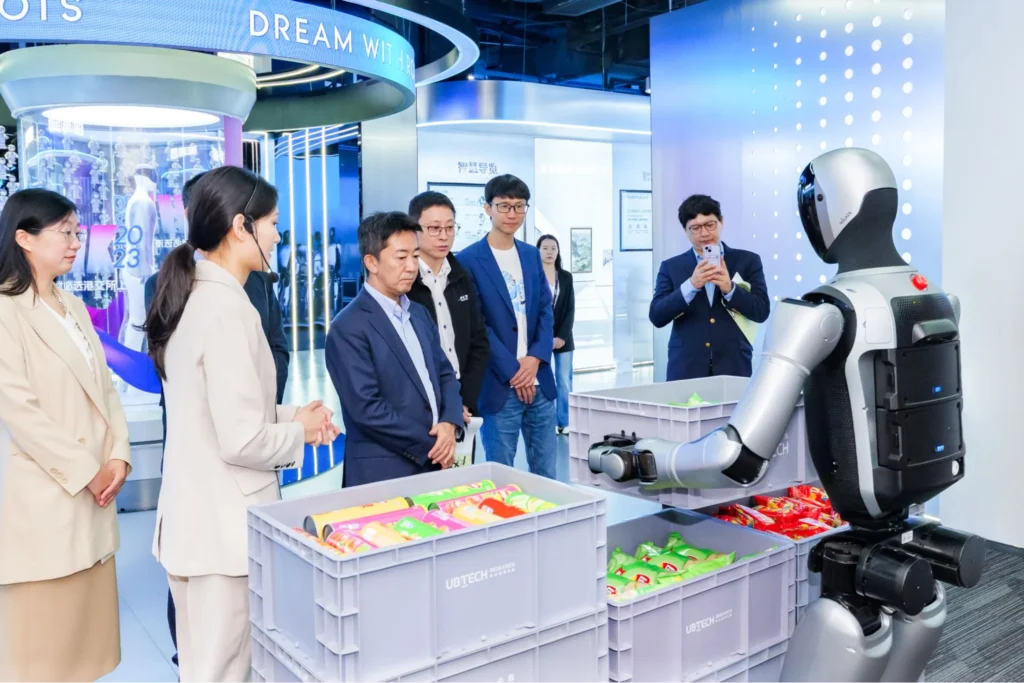
Beyond factories, the Chinese government is testing Walker S2 units in challenging environments. In April 2026, China awarded UBTECH Robotics a US$37 million contract to deploy Walker S2 machines at the busy Fangchenggang border crossing with Vietnam. The robots will guide passenger queues, direct vehicles, and answer simple questions.
Some units will patrol corridors and waiting areas, and others will assist logistics teams by checking container IDs and relaying status updates. The deployment is viewed as a real‑world test of reliability in a crowded, outdoor environment where inspections cannot stop.
If successful, similar deployments may extend to airports, seaports, and train stations. These environments are exactly what executives explore during a China innovation tour, where real-world systems can be studied directly.
Large‑scale production and deployment require significant capital. To support growth, UBTECH raised approximately HK$3.06 billion (US$389 million) through a share placement in December 2025. The funds are earmarked for investments in the company’s supply chain, joint ventures, working capital, and debt repayment. This placement allowed UBTECH to remain flexible while avoiding dilution of existing shareholders.
The company also secured a credit line of up to US$1 billion from Hong Kong and Abu Dhabi-based Infini Capital in September 2025. The financing will help establish a research center and a “super factory” in the Middle East.
Infini Capital plans to take a 5 percent equity stake in UBTECH and leverage its existing AI and robotics supply chain investments. This partnership reflects the growing investment ties between China and Middle Eastern technology hubs and suggests that UBTECH envisions global manufacturing and sales. The capital injection aligns with the broader trend of rising investment in China’s robotics sector.
In addition to funding, the company has formed strategic collaborations. It leverages Tencent’s cloud and speech AI to enhance its robots’ conversational abilities. Performance data from deployed robots feeds back into the development process, enabling iterative improvement and strengthening the company’s lead in practical humanoid deployment.
Looking ahead to 2026 and beyond, UBTECH Robotics aspires to become a global leader in humanoid robotics. Analysts expect the Walker S3 and S4 iterations to feature more dexterous hands and improved manipulation capabilities, enabling tasks such as operating machinery or providing elder care.
Reuters reported in January 2026 that Airbus had already purchased Walker S2 units and signed a deal with UBTECH to expand the use of robots in aerospace manufacturing, though Airbus also said the work remains at an early concept-testing stage. Reuters also reported in June 2025 that Foxconn had trialed UBTECH humanoids as part of preparations for Nvidia AI server production in Houston.
The company aims to deliver 10,000 units by 2027. Such ambitions suggest confidence in manufacturing scalability and demand for real‑world robotics.
Competition is intensifying across global markets, reflecting accelerating China AI and robotics trends where deployment speed defines advantage. Companies like Tesla and Figure have announced humanoid robots, while Boston Dynamics is working on the electric Atlas. Walker S2’s ability to swap batteries quickly and its data‑driven iterative approach may give UBTECH an edge.
Yet challenges remain: the company must demonstrate reliability in diverse conditions, maintain safety around people, and turn large orders into profits. Investors will watch whether government and enterprise clients renew contracts after initial deployments.
Understanding companies like UBTECH Robotics at a surface level is not enough. The real advantage comes from seeing how these systems operate in practice, how embodied AI integrates into real-world industries, and how these models can translate into your own business strategy.
ChoZan works with senior executives, strategy leaders, and innovation teams to decode China’s fast-moving technology ecosystem in a way that is clear, structured, and actionable.
As a China-focused research and digital transformation consultancy, ChoZan helps global organizations learn for China and from China through a combination of research, immersion, and direct exposure to real-world systems.
This includes:
If your goal is to understand how humanoid robotics, embodied AI, and industrial automation systems are scaling in China and what that means for your organization, ChoZan helps you move from insight to execution.
Book a consultation to explore how your team can engage directly with China’s innovation ecosystem and turn these insights into real strategic outcomes.
The UBTECH Walker S2 typically costs between $80,000 and $160,000 per unit, depending on configuration and deployment support. Enterprise buyers often use leasing or robotics-as-a-service models to reduce upfront investment while gradually scaling automation.
UBTECH focuses on real-world industrial deployment, while Tesla Optimus and Figure AI remain earlier in commercialization. UBTECH’s Walker S2 already operates in mass-production factories, giving it a deployment advantage over competitors still refining prototypes.
Automotive manufacturing, logistics, and electronics assembly are the earliest adopters of UBTECH humanoids. These sectors benefit from repetitive-task automation, human-compatible workspaces, and continuous-operation capabilities enabled by autonomous battery systems and AI coordination.
Humanoid robots matter because they can work in environments designed for humans without major infrastructure changes. Their human-like form allows them to use tools, navigate stairs, and operate equipment, reducing the need for costly factory redesigns.
UBTECH’s BrainNet system improves performance by collecting data from deployed robots and feeding it back into centralized models. This allows continuous learning, better task planning, and faster adaptation across fleets, making each deployment smarter over time.
The main risks include reliability in complex environments, safety when working near humans, and high upfront costs. Companies must also manage integration challenges, workforce training, and long-term maintenance to ensure consistent operational performance.
UBTECH’s production model is designed for rapid scaling, with plans to manufacture thousands of humanoid robots annually. This shift from pilot projects to mass production signals a transition toward mainstream industrial adoption of humanoid robotics.
UBTECH robots can perform many tasks autonomously, including navigation, manipulation, and battery swapping. However, most deployments still involve human oversight for safety, exception handling, and workflow optimization in complex industrial environments.
UBTECH generates long-term revenue through integrated solutions, including software platforms, maintenance, training, and deployment services. This “robot + system” model creates recurring income streams while strengthening customer lock-in and operational dependence.
The future of humanoid robotics will shift toward more dexterous manipulation, broader industry adoption, and service-sector use cases such as elder care. As AI improves, robots will move from task execution to decision-making roles within integrated enterprise systems.