CONTENT
The story of WeRide (文远知行) is a window into how Level‑4 autonomous driving is moving from science fiction into everyday life. Founded in Guangzhou, this China‑born firm is now publicly traded and among the first companies to offer fee‑paying robotaxi rides across multiple continents.
Its vehicle‑agnostic platform powers robotaxis, robobuses, and robovans, and its partnerships with Chery, Uber, and Grab have turned urban autonomous mobility into a reality across China, the Middle East, and Europe.
As urban centers seek efficient, low‑carbon transportation solutions and regulators clear the path for driverless technology, WeRide is emerging as a benchmark for scaling autonomous fleets. This article explores how the company combines Level‑4 technology, multi‑product strategy, cost optimization, and global deployment to build the future of ride‑hailing and urban logistics.
At the core of WeRide’s approach is a Level 4 autonomous driving stack designed for multiple vehicle types. The company develops a full-stack system covering perception, planning, simulation, mapping, and fleet operations. This allows the same technology to run across cars, vans, and buses, reducing development complexity and speeding deployment.
In its 2026 annual report, WeRide describes this approach as WeRide One, a unified system that uses a single technology and operations base across multiple use cases. This positions the company as a platform builder rather than a single product operator.
Simulation plays a central role. The GENESIS platform generates photorealistic driving scenarios, including rare edge cases, thereby accelerating model training and reducing on-road testing. The system operates in a closed loop with real-world data, improving training efficiency and reducing costs.
WeRide has also developed its own high-performance computing platform, HPC 3.0. This system reduces per-vehicle production time to under ten minutes and supports factory-installed robotaxis. Together, simulation and computing improvements reduce the total cost of ownership and support large-scale deployment.
This platform structure enables WeRide to scale across multiple vehicle categories using the same core system.
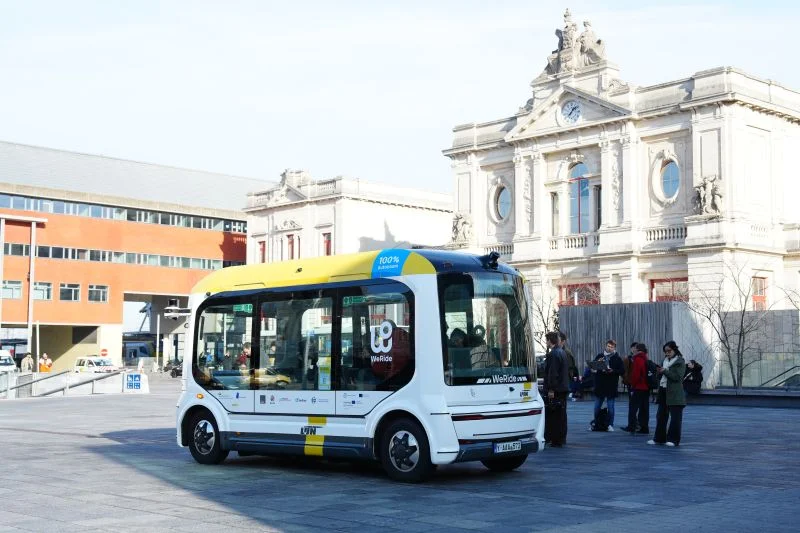
WeRide’s robotaxi fleet in China exceeds 800 vehicles and covers more than 1,000 square kilometers across Beijing and Guangzhou. Registered users grew by more than 900 percent year over year in the fourth quarter of 2025, which shows rising demand and repeat usage.
The company integrates its robotaxi service into existing ride-hailing platforms, which improves accessibility and adoption. These deployments provide real operating data that feed back into system improvements.
The Robovan is designed for urban logistics and operates within geo-fenced areas without a driver. In July 2025, WeRide secured a permit to test driverless logistics vehicles in Guangzhou and launched trials of the Robovan W5.
The vehicle is moving toward small-batch commercial production in partnership with Yutong. This allows logistics providers, campuses, and industrial zones to adopt autonomous delivery at scale. The same platform also powers autonomous street sweepers, extending the system into sanitation services.
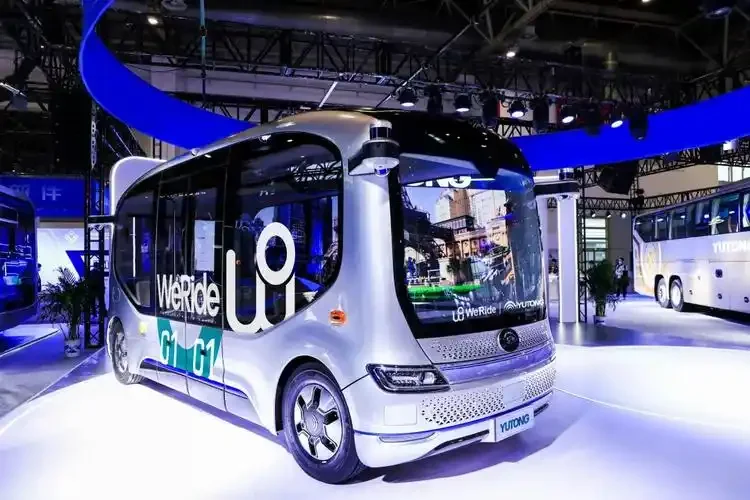
The Mini Robobus targets fixed-route urban transport. It is a steering-wheel-free shuttle with seating for about ten passengers. Cities such as Guangzhou and Shenzhen are planning broader deployment for community transport routes in 2026.
WeRide launched Europe’s first fully driverless commercial robobus service in France in early 2025 and followed with a trial in central Barcelona. Fixed-route transport provides a structured entry point for autonomy, with predictable routes and stable demand.
This multi-product model allows WeRide to serve passengers, logistics, and municipal services through one platform. It also expands data collection and spreads development costs across multiple revenue streams.
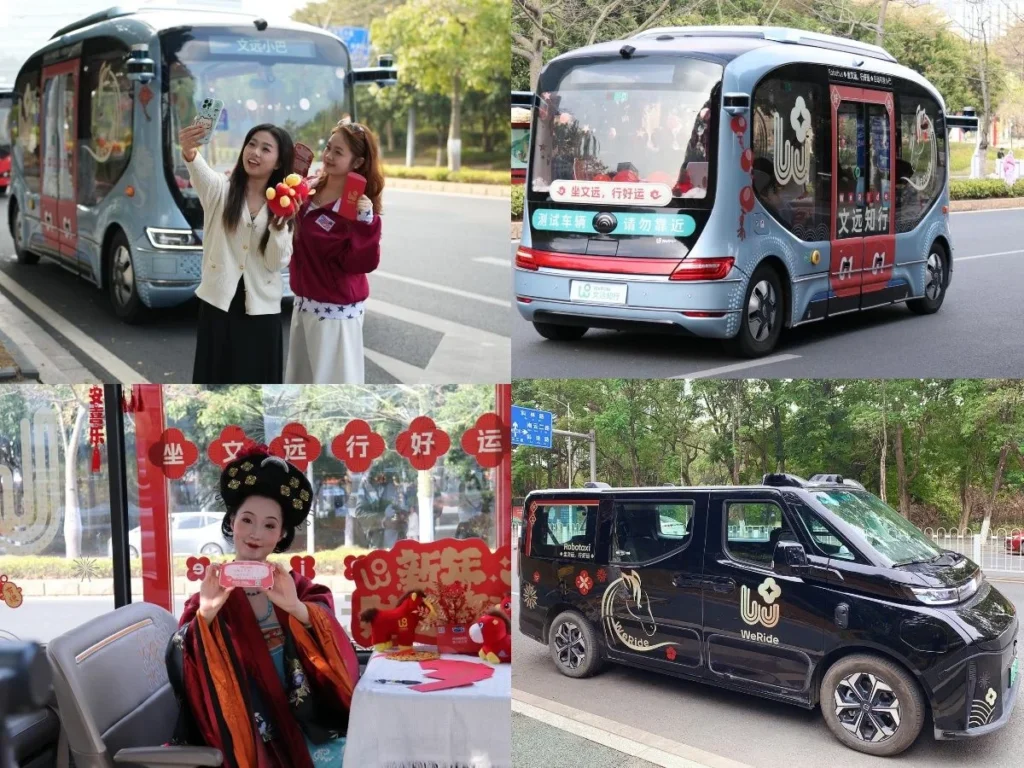
2025 marked a turning point for WeRide’s commercial scale. Third-quarter revenue reached RMB 171 million, up 144 percent year over year. Robotaxi revenue increased more than sevenfold, and gross margin reached 32.9 percent.
Full-year revenue reached RMB 684.6 million in 2025, with robotaxi revenue at RMB 148 million. Gross profit reached RMB 206.8 million, with margins above 30 percent. The company ended the year with RMB 7.1 billion in cash and equivalents, which supports continued expansion.
Operating metrics show improving unit economics. Total cost of ownership fell by 38 percent during 2025. The human-to-vehicle ratio improved from 1:10 in 2024 to 1:40 in 2025, driven by improved remote assistance systems. Average daily orders per vehicle rose to 15 and peaked at 26 during peak periods.
These numbers show progress toward sustainable service economics. The shift is not only technical. It reflects improvements in cost, utilization, and repeat demand.
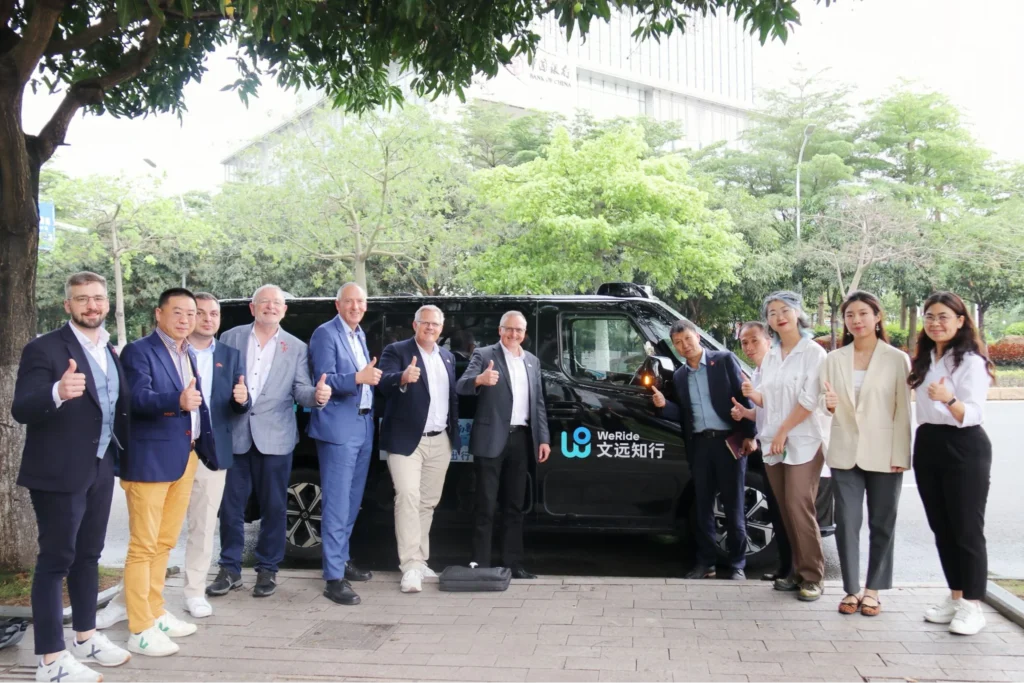
WeRide is expanding globally through regulatory approvals and partnerships. In late 2025, Abu Dhabi granted the first city-level fully driverless robotaxi permit outside the United States, allowing operations without a safety driver.
WeRide and Uber launched driverless rides on Yas Island, covering about 70% of central Abu Dhabi. Riders can book through Uber’s “Autonomous” category. By early 2026, the partnership committed to deploying at least 1,200 robotaxis across Abu Dhabi, Dubai, and Riyadh by 2027.
In November 2025, Switzerland approved the first driverless robotaxi permit for passenger service in Europe, enabling operations in Zurich. WeRide has deployed robobus services across Switzerland, France, Belgium, Spain, and Slovakia. Slovakia plans to deploy robotaxis, robobuses, robovans, and robosweepers nationwide by 2026. In Singapore, testing with Grab began in late 2025, with public services expected in 2026.
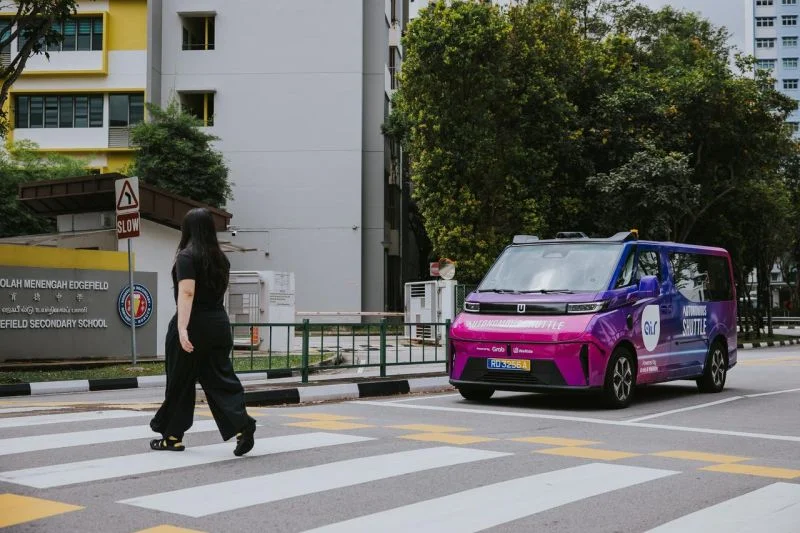
Grab invested in WeRide in 2025 and partnered to deploy robotaxis and robobuses in Southeast Asia. In Singapore’s Punggol district, the Ai.R service logged over 30,000 kilometers and served more than 1,000 early riders by early 2026.
WeRide uses an asset-light model by partnering with fleet operators and leasing firms instead of owning vehicles. This reduces capital needs and speeds up city launches. By mid-2026, WeRide operates over 2,100 vehicles across twelve countries and targets 2,600 robotaxis by the end of 2026, with plans for large-scale global deployment by 2030.
WeRide focuses on reducing cost and improving deployment speed through core technology. The GENESIS simulation platform generates photorealistic scenarios, including rare edge cases, thereby accelerating model training and reducing on-road testing. The robotaxi GXR, developed with Geely Farizon, uses factory-installed autonomous hardware, eliminating retrofitting and lowering unit costs.
The company also builds revenue beyond Level 4 through WePilot 3.0, an L2+ driver-assistance system with end-to-end vision-based perception. Automakers such as Chery, GAC, and Bosch have adopted the system. Performance validation comes from multiple wins at the China Urban Intelligent Driving Competition.
WeRide is developing a scene-adaptive, low-HD map architecture to reduce mapping costs and accelerate city rollouts. Lower sensor costs and improved remote assistance reduce operating expenses. These improvements enable scalable and economically viable autonomous fleet deployment.
WeRide shows that autonomous mobility scales through systems rather than single products. A platform that supports passenger transport, logistics, shuttles, and municipal services can improve utilization, reduce cost, and accelerate learning across use cases.
The key signal is not only scale. It is the shift from isolated pilots to repeatable city-level systems across multiple services and regions. This suggests that the path to autonomy will be operational and economic before it becomes universal.
By early 2026, WeRide operates in more than 40 cities across 12 countries, with permits in multiple markets, including China, the UAE, Singapore, France, and Switzerland. This does not guarantee long-term leadership, yet it shows that the company has moved into a different category. It is now operating as a Level 4 mobility provider with real commercial exposure across multiple segments of urban transport.
WeRide is not an isolated case. It reflects how China’s innovation ecosystem turns emerging technologies into large-scale operating systems across cities, industries, and real-world use cases.
At ChoZan, we help global leaders decode these systems, not as trends, but as strategic frameworks that can be understood, adapted, and applied.
Through our research, executive briefings, and China learning expeditions, we give you direct access to how companies like WeRide scale from pilot to deployment across mobility, AI, and infrastructure.
If you want to understand how autonomous mobility, AI platforms, and urban systems are evolving in China and what that means for your business, we can help you connect the dots. Explore our China innovation research and executive programs
Book a consultation to discuss your strategy.
WeRide robotaxis are designed to operate in controlled environments, with redundant sensors and continuous monitoring systems. Safety performance improves through large-scale data collection, simulation training, and real-world validation across multiple cities and operating conditions.
WeRide handles edge cases through its GENESIS simulation platform, which recreates rare and complex driving scenarios. This allows engineers to train models on situations that are not encountered frequently in real-world testing.
WeRide is developing a low-dependence mapping approach that reduces reliance on high-definition maps. This allows faster deployment in new cities by adapting to environments with less pre-mapped data while maintaining operational safety.
WeRide focuses on partnerships and multi-region deployment, while Waymo prioritizes controlled expansion in selected markets. WeRide’s approach allows faster international scaling through local partners and asset-light operational models.
WeRide technology extends into logistics, sanitation, and municipal services. Autonomous vans and street sweepers show how the platform can support broader urban infrastructure beyond passenger mobility.
Users access WeRide services through integrated platforms such as Uber, Grab, and WeChat-based mobility services. This reduces the need for standalone apps and increases adoption through familiar digital ecosystems.
Regulation, public acceptance, and infrastructure readiness remain key challenges. Even with strong technology, scaling autonomous services depends on local policy alignment and consistent urban operating conditions.
WeRide collects data from active fleets operating across multiple cities and vehicle types. This data feeds into simulation and model training systems, improving performance across different environments and use cases.
Local governments provide permits, infrastructure support, and defined operating zones. Their involvement is critical for testing, scaling, and integrating autonomous vehicles into public transport and urban systems.
WeRide’s model is likely to expand into integrated urban systems combining passenger transport, logistics, and municipal services. Growth will depend on cost efficiency, regulatory progress, and deeper ecosystem integration across cities.