CONTENT

NEURA Robotics belongs in this humanoid robotics series because it represents a different path from China’s speed model and America’s AI platform model. The Chozan report positions NEURA Robotics around the 4NE1 humanoid robot, cognitive robotics, full body sensing, and safe collaboration in human environments.
For executives, the larger story is physical AI. This means artificial intelligence that can perceive space, understand tasks, and act through machines in factories, warehouses, service environments, and eventually homes.
In 2026, NEURA Robotics Germany moved from ambition into a more serious industrial phase through funding, partnerships, and platform development.
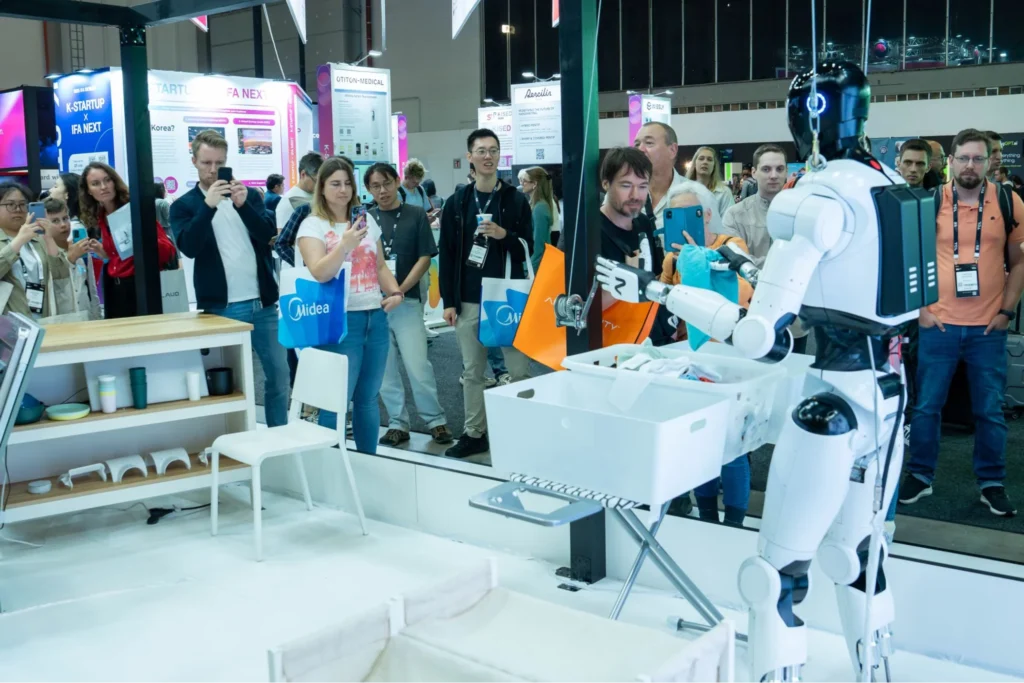
Physical AI refers to intelligence that goes beyond the screen and acts in the physical world. In NEURA Robotics, this idea manifests in robots that combine perception, motion, language understanding, touch awareness, and real-time adaptation. The company calls its category “cognitive robotics,” which gives the concept a more industrial connotation.
It is AI that can understand a physical environment, make decisions inside that environment, and complete tasks through robotic bodies. That matters because factories and warehouses rarely behave like clean software environments. Objects move, workers intervene, lighting changes, and machines create constraints.
This is why NEURA Robotics focuses heavily on human-robot interaction and human-robot collaboration. Its robots are not designed as isolated machines behind safety cages. They are positioned as collaborative systems that can work in close proximity to people, respond to contact, and adapt to changing workplace conditions.
NEURA’s website describes its robots as cognitive platforms for industry, work, and everyday life, with products spanning MAiRA, LARA, MAV, MiPA, 4NE1, and its sensor ecosystem.
NEURA Robotics matters because Europe needs a credible industrial humanoid pathway. China leads in speed, supply chain density, and deployment feedback. The United States leads through foundation model platforms, cloud infrastructure, and venture-backed AI robotics. Germany’s advantage lies in engineering discipline, industrial integration, safety culture, and automation know-how.
That makes NEURA Robotics Germany strategically relevant. It gives Europe a company that can speak the language of factories, compliance, sensors, production systems, and industrial buyers. In January 2025, the company announced a 120 million-euro Series B round to support its vision for cognitive and humanoid robotics.
This funding matters beyond robotics startup funding headlines. It gives NEURA more room to build a full robotics system rather than a single machine. In robotics startup news, capital often signals ambition. In this case, the stronger signal is the combination of capital, industrial partnerships, and a platform strategy.
The 4NE1 humanoid robot is the clearest expression of NEURA’s vision. It gives the company a recognizable platform for humanoid robots in Europe, while its deeper value lies in the sensing, software, and data layer underneath.
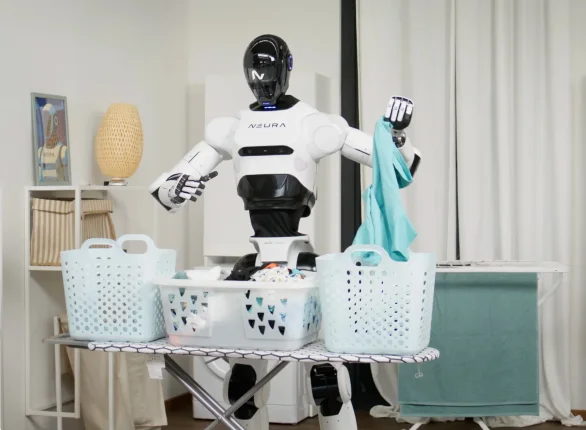
NEURA describes 4NE1 as Europe’s first production-ready humanoid robot. The company says the robot is built for humanlike movement, artificial intelligence perception, industrial workflows, and everyday assistance. Its current product page also shows available reservations, placing the robot beyond a purely conceptual stage.
At CES 2026, NEURA presented the next-generation 4NE1, a compact 4NE1 Mini, and a quadruped robot. The company also highlighted the Neuraverse platform, with CEO David Reger joined by guests from NVIDIA and Schaeffler during the program.
The design partnership with Studio F. A. Porsche gives Neura 4ne1 stronger brand visibility. Yet the more important point is practical. A humanoid robot for industry needs trust before scale. Appearance, motion, perceived safety, and interface quality all shape adoption inside shared workspaces.
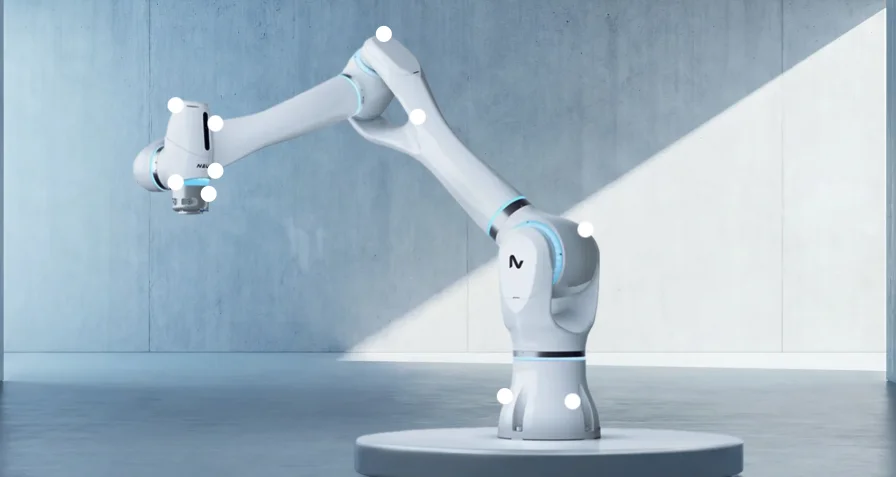
The MAiRA robotic arm matters because it shows how NEURA thinks beyond humanoid spectacle. A humanoid body attracts media attention, but industrial adoption often starts through narrower tasks. Robotic arms, mobile robots, sensors, and software can validate the cognitive stack before a full-scale humanoid rollout.
That cognitive stack includes perception, task logic, safety sensing, motion control, application skills, and fleet learning. In practical terms, this stack helps a robot identify what is happening, select an action, move safely, and improve through data.
This is where cognitive robotics differs from traditional automation. Traditional automation performs defined steps inside controlled environments. Cognitive robotics tries to handle variation. For the industry, that shift is critical because many valuable tasks resist rigid programming.
The Neuraverse cognitive platform may become the most important part of the NEURA story. NEURA presents Neuraverse as an ecosystem that connects robots, people, AI models, applications, and hardware. Its goal is to help robots learn faster across connected environments.
The platform also links directly to NEURA Gym. NEURA describes these gyms as physical training facilities where robots practice tasks under controlled variability. The company frames this real-world training data as one of the scarcest resources in physical artificial intelligence.
This is a strong strategic point. A Neura robot cannot improve only through clean simulation. It needs handling of messy objects, human movement patterns, workplace layouts, failure cases, and task corrections. The company’s platform logic suggests that every connected robot could become part of a learning loop.
In 2025 and 2026, NEURA Robotics built a partner map that supports its claim as an industrial physical AI company. The NVIDIA relationship connects NEURA to simulation, accelerated computing, and robot foundation-model infrastructure. In June 2025, NEURA said it was establishing physical AI training centers in Germany with support from NVIDIA.
SAP adds another layer. In June 2025, SAP described work with NEURA Robotics and NVIDIA to connect business process intelligence, cognitive robots, and digital twin technology for physical AI use across industries.
Schaeffler adds manufacturing credibility. Reuters reported in November 2025 that Schaeffler entered a partnership with NEURA to jointly develop and supply key components for humanoid robots. Schaeffler also planned to integrate several thousand humanoids into its production by 2035.
Bosch strengthens the German industrial narrative. In January 2026, NEURA and Bosch announced a strategic partnership for the development of humanoid robots made in Germany. The collaboration focuses on real-world workplace data, sensor suits, AI-based software, interfaces, and industrial-scale deployment.
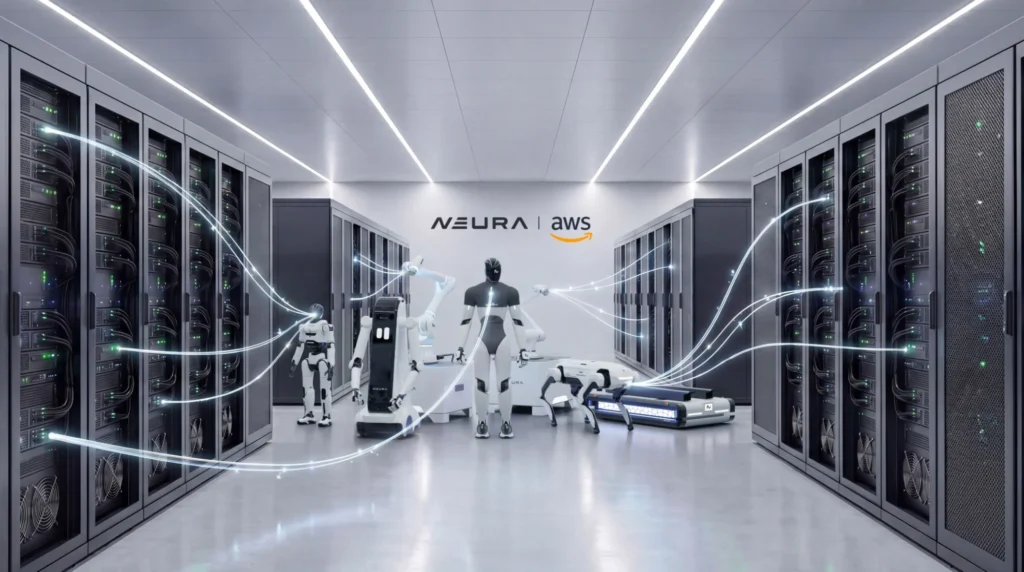
AWS strengthens the cloud and fleet layer. In April 2026, NEURA and Amazon Web Services announced a strategic collaboration to accelerate the adoption of physical AI at scale. AWS will support the Neuraverse platform through cloud and AI infrastructure for training, validation, deployment, data processing, and fleet intelligence.
In October 2025, NEURA opened a Hangzhou site and collaboration hub. The company said the hub would support data-driven robotics training, partnerships with Chinese industry leaders, and the establishment of the first NEURAGym in China.
This matters because China offers something Europe often lacks at the same density. It offers fast robotics feedback from suppliers, factories, platforms, and real deployment environments. For NEURA, Hangzhou can act as a bridge into a faster robotics learning environment.
The strategic tension is clear. NEURA Robotics wants to stay rooted in European engineering while learning from Asia’s deployment speed. That balance could become one of its biggest advantages if the company manages data, partners, and market positioning carefully.
Human-robot collaboration will decide how useful NEURA’s technology becomes. Factory leaders do not adopt humanoids because they look impressive. They adopt them when the robot can reduce repetitive strain, fill labor gaps, improve uptime, and work safely around people.
This is why human-robot interaction becomes a business issue rather than a design detail. Workers need to understand what the robot will do. Managers need clear task boundaries. Safety teams need confidence in sensing and response. IT teams need data governance and system integration.
For industrial humanoid robots, the hardest challenge is not walking on stage. It is repeated performance across shifts, sites, and task variations. NEURA’s focus on sensing, cognitive software, and partner-based deployment directly addresses that enterprise reality.
The next test for NEURA Robotics is execution. The company has funding, visibility, strategic partners, and a clear physical AI story. The open question is how quickly it can convert that ecosystem into repeatable deployments with measurable value.
Executives should watch five areas.
For leaders tracking robotics startups, NEURA offers a useful comparison point. It is less about viral demos and more about system formation. It brings together hardware, sensors, AI models, training environments, industrial partners, and cloud infrastructure.
The wider market is moving toward robots that learn, adapt, and work in human environments. NVIDIA’s March 2026 robotics announcement listed NEURA Robotics among companies adopting Isaac GR00T N models for industrial humanoid deployment.
That places NEURA Robotics inside a broader shift from scripted robots toward embodied systems. The winners will not simply build stronger machines. They will build robots that learn from physical data, integrate with enterprise systems, and improve through repeated use.
For Germany, NEURA’s role is symbolic and practical. It offers a national answer to the question of who will own the next layer of industrial automation. For global companies, it signals that physical AI is moving from research labs into production planning.
Understanding NEURA Robotics helps executives track Europe’s approach to physical AI. Yet the fastest robotics feedback loops are also emerging across China’s factories, supply chains, AI labs, and deployment environments.
ChoZan helps leadership teams study these shifts through direct exposure, structured research, and expert-led learning.
ChoZan supports global teams through:
• China learning expeditions and innovation tours
• Executive keynotes, workshops, and boardroom briefings
• China innovation research and trend analysis
• Consulting and expert dialogues with people close to China’s technology ecosystem
For companies tracking humanoid robots, physical AI, industrial automation, and embodied intelligence, ChoZan turns market noise into practical strategic understanding.
Learn what China is building, how fast it is scaling, and what global companies can take from it. Book a consultation with ChoZan to explore a tailored China innovation program for your team.
NEURA Robotics was founded by David Reger in 2019 in Metzingen near Stuttgart. The company describes itself as a German high-tech robotics business focused on cognitive robots that work safely around people.
NEURA Robotics is privately held, so ordinary investors cannot buy its shares through public stock exchanges. Some private market platforms offer pre-IPO access, but it remains limited to eligible investors.
Yes. NEURA Robotics offers early access reservations for 4NE1, 4NE1 Mini, a quadruped robot, and MiPA via its early access reservation page. Commercial buyers are directed to contact the company for quantity orders.
The 4NE1 reservation fee is 100 euros. NEURA says the fee is fully refundable and will count toward the final purchase price. The Gen 3.5 version is expected at the end of 2026.
4NE1 Mini is built for classrooms, laboratories, prototyping spaces, research, interaction, and entertainment. NEURA lists Standard and Pro versions, with Pro adding manipulation features and deeper developer access.
MiPA is NEURA’s intelligent personal assistant robot for homes and service environments. It can support daily tasks, move items, and act as a smart interface through sensors, adaptive AI, and developer APIs.
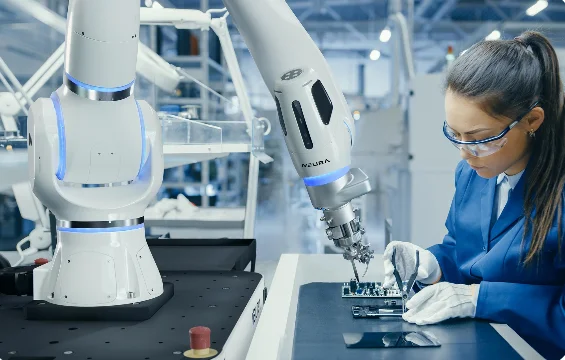
LARA is NEURA’s collaborative robot series for businesses entering automation. It offers multiple payload options, a visual user interface, and ready-to-use applications for tasks that need industrial precision.
NEURA OmniSensor is a safety sensing system for industrial environments. It supports real-time human detection, full spatial coverage, and fast response, which helps robots operate more safely near workers.
AURA is NEURA’s proprietary AI behind its humanoid intelligence. NEURA says 4NE1 uses AURA to move cognitive humanoid capabilities from research into practical, real-world use for work and assistance.
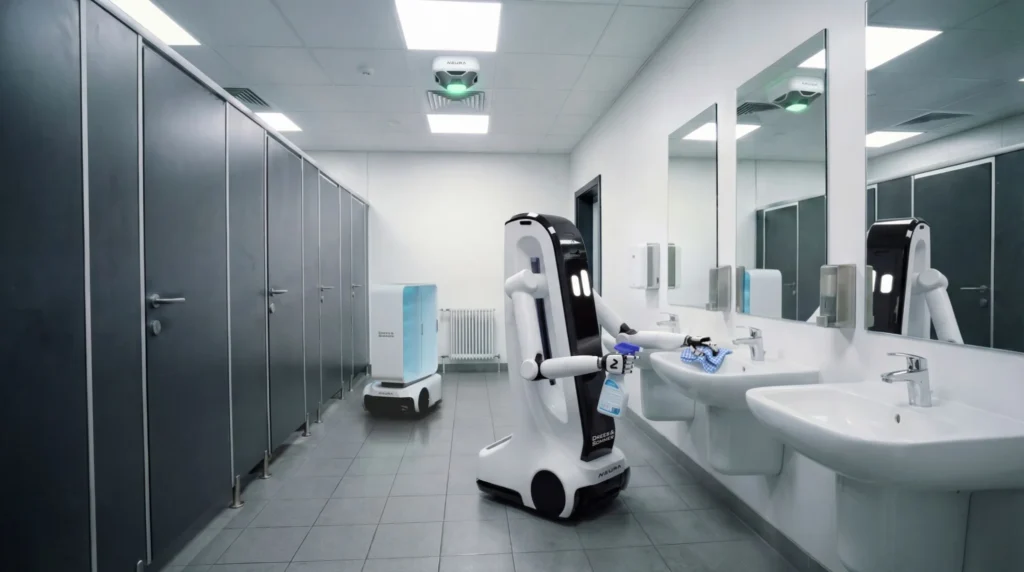
NEURA Robotics highlights industry, services, and home as target environments. Its robots address automation, workplace support, personal assistance, transport, inspection, and application development across businesses that need flexible physical AI.