CONTENT
CALB has moved from a name known mainly inside China’s battery supply chain to a company that global executives now need to track closely. The reason is simple. The CALB battery story is no longer about a second-tier supplier trying to win automaker attention. It is about scale, customer diversification, energy storage growth, European localization, and the rising pressure global brands face as China’s battery ecosystem continues to widen its lead.
From January to May 2026, CALB ranked fourth globally in EV battery installations with 23.8 GWh and a 5.1% share, according to SNE Research data reported by CnEVPost. That puts the company behind CATL, BYD, and LG Energy Solution, but ahead of Gotion, SK On, Panasonic, EVE Energy, Svolt, and Sunwoda for the period.
CATL remains the clear global leader, but challengers such as CALB are building enough volume, technology depth, and customer reach to influence procurement decisions across EVs, commercial vehicles, energy storage, ships, eVTOLs, and robotics.
The market context matters. SNE Research said global EV battery usage reached 1,187 GWh in 2025, up 31.7% year-on-year. It also noted stronger price pressure in China as LFP-centered solutions continued to push cell costs lower. For global brands, this means Chinese battery suppliers are competing through scale and learning speed, not only through price.
The key point is that CALB is located within the world’s deepest battery manufacturing cluster. Its growth is tied to China’s integrated EV industrial base, where automakers, cell makers, materials companies, equipment suppliers, and energy storage developers move in tight feedback loops.
CALB reported approximately US$6.18 billion in revenue in 2025, compared with approximately US$3.86 billion in 2024. Profit for the year rose to approximately US$291.5 million from approximately US$117.2 million.
The company’s net sales margin increased to 4.7% from 3.0%, which management attributed to growth in passenger vehicles, commercial vehicles, energy storage, and cost reduction through technology and management.
The revenue mix shows why calb batteries are gaining strategic relevance beyond passenger EVs. EV batteries generated approximately US$4.22 billion in 2025, equal to 68.2% of total revenue. ESS products and others generated approximately US$1.96 billion, equal to 31.8% of revenue.
ESS revenue grew faster than EV battery revenue, with the company reporting 71.9% growth for ESS products and others versus 55.0% growth for EV batteries.
This split gives CALB a more balanced growth profile than a pure EV cell supplier. Energy storage helps absorb battery manufacturing capacity, deepens relationships with grid and renewable energy players, and gives the company more routes into overseas markets.
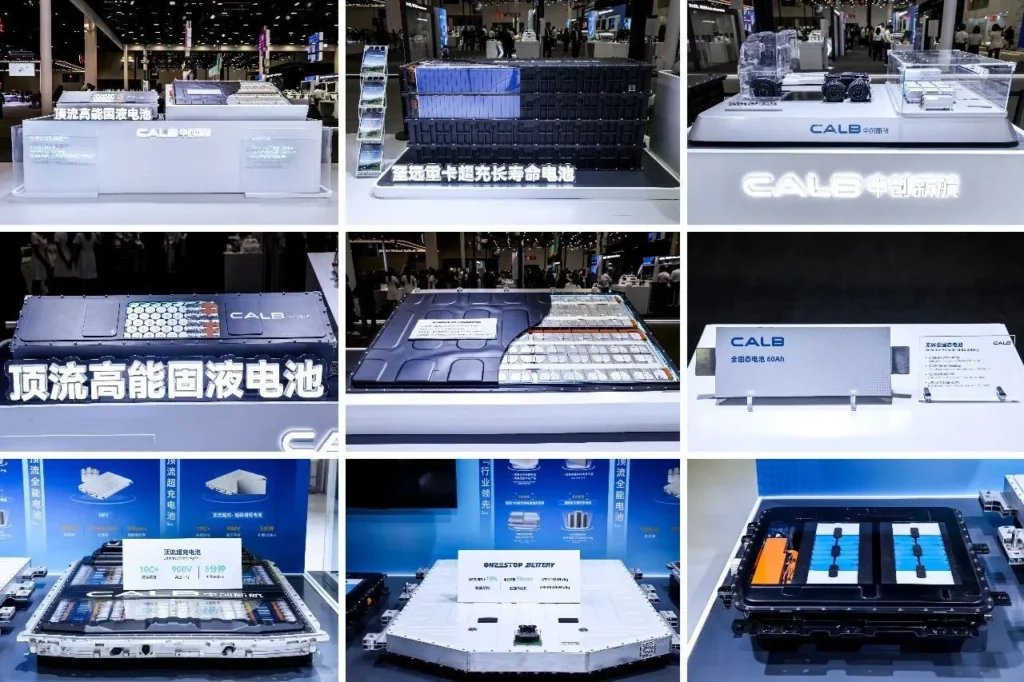
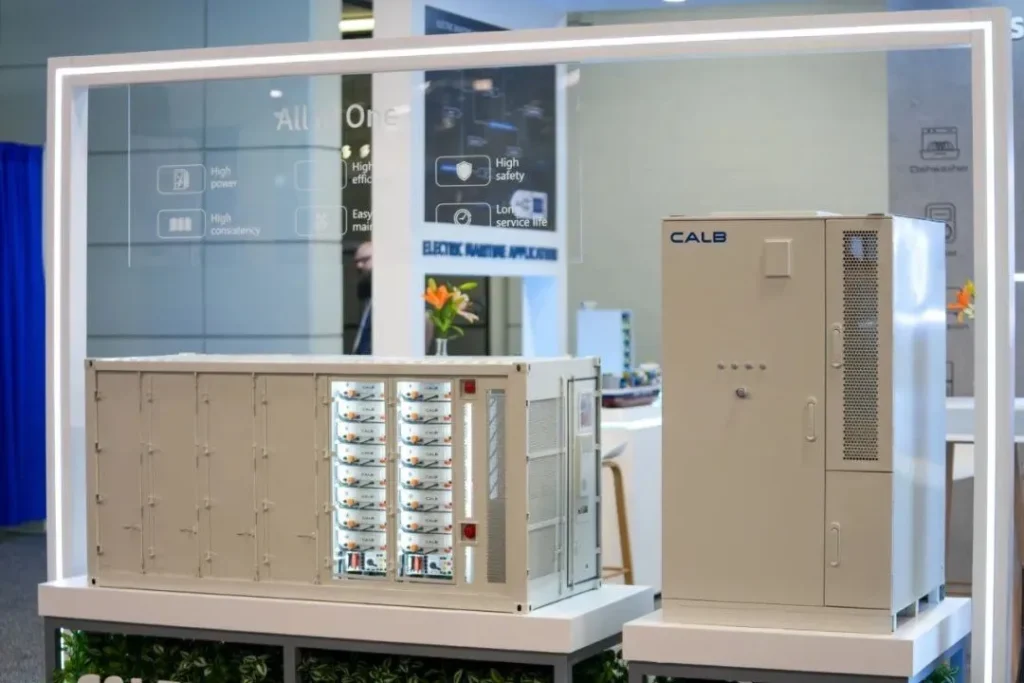
CALB is developing platform-based products that integrate power batteries and energy storage, while also exploring applications in ships, low-altitude aviation, and robotics. Its 2025 report highlights high energy density, ultra-fast charging, long life, wide temperature performance, and safety as core technology directions.
In energy storage, CALB said its next-generation “ZHIJIU” 600 Ah-plus large energy storage cells had secured large-scale nominations. The company also said it entered supplier whitelists of leading energy storage developers and independent power producers in South Africa, Latin America, the United States, Israel, and other regions.
For emerging mobility, CALB reported high-energy cylindrical cells for low-altitude applications, with a cell energy density of 310 Wh/kg. It also said that robot products use high-performance solid-state battery technology with high energy density, stable power output, safety, and production compatibility.
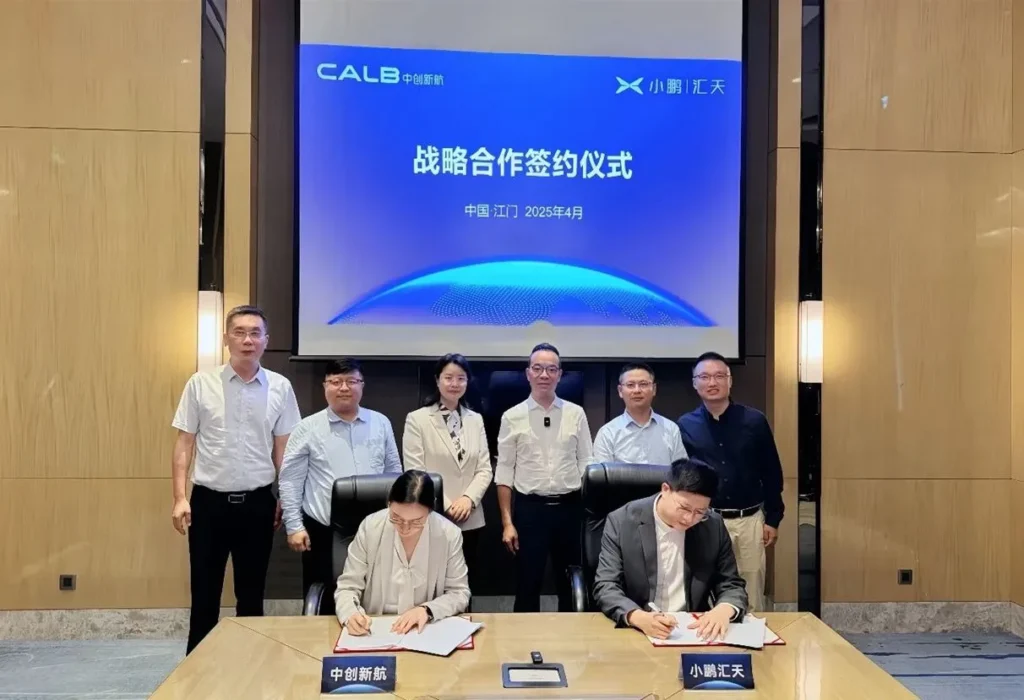
The real proof of a battery supplier is model adoption. CALB said cooperation with Xiaomi, XPeng, Luxeed, SAIC, NIO, Leapmotor, Geely, Changan, Dongfeng, BAIC, GAC, Toyota, Volkswagen, and Hyundai would be progressing in 2025. This mix matters because it includes Chinese EV natives, large state-linked automakers, joint venture-related players, and international brands.
Commercial vehicles add another layer. CALB reported multiple-fold growth in commercial vehicle shipments in 2025 and said it declared more than 468 new models, up 96% year-on-year. It cited collaborations with Chery, Geely, Dongfeng, King Long, Sinotruk, XCMG, SANY, Shaanxi Automobile, GAC, and Lingong across light commercial vehicles, heavy trucks, and construction machinery.
For global automotive teams, this means CALB should be evaluated as a supplier with growing scenario coverage. Passenger EV cells are only one part of the picture. The company is trying to become an energy solution partner across vehicles, storage assets, shipping, aviation, and industrial equipment.
Overseas revenue reached RMB919.23 million, or 2.1% of total revenue. That tells executives two things. The domestic base is strong, but internationalization is still in an early commercial phase.
Europe is central to that shift. The Portuguese government said in January 2026 that the largest of the six AICEP-contracted investments was a 2.065 billion-euro lithium battery plant by the Chinese company CALB in Sines, designed for cars and energy storage. The project is expected to create 1,800 jobs, including 497 highly qualified roles.
CALB USA Inc describes itself as a Chino, California-based operation specializing in the distribution of lithium-ion batteries, with products listed across lithium-ion cells, modules, energy storage systems, telecommunications modules, and mobile container ESS.
The U.S. risk layer changed in 2026. The Department of Defense listed CALB under Section 1260H as a Chinese military company, stating that CALB is indirectly owned by SASAC and directly and indirectly affiliated with SASAC. Reuters reported that Department of Defense contracting restrictions on listed companies are set to take effect in 2027.
For investors, CALB is a signal that China’s battery sector has depth beyond the two most visible leaders. Its 2025 revenue growth, profit improvement, and ESS expansion show a company moving into a stronger operating position, while its global ranking in early 2026 shows that the market is rewarding execution.
For automakers, the message is supplier optionality. A company like CALB can strengthen its negotiating leverage, support second-source planning, and gain access to China’s LFP and ESS engineering advantages. The risk is that cross-border policy, product certification, intellectual property review, and geopolitical scrutiny require more careful due diligence than before.
For strategy teams, CALB is a case study in how Chinese industrial challengers scale. They do not wait for one end market to mature. They build across vehicles, storage, ships, aviation, and robotics. This multi-scenario approach can shorten technology learning cycles and enable faster product iteration for customers.
Chozan helps global leaders understand CALB, CATL, BYD, China’s EV supply chain, energy storage, and the commercial logic behind China’s fast-moving technology sectors.
For executive workshops, China learning expeditions, custom research, expert calls, market entry strategy, or digital transformation consulting, book a consultation with Chozan to turn China intelligence into clearer business decisions.
Buyers can source CALB batteries through official regional channels or verified distributors. For U.S. inquiries, CALB USA Inc lists lithium-ion cells, EV modules, telecom modules, energy storage systems, and mobile container ESS.
A buyer should verify the company address, product documentation, cell grade, warranty terms, and after-sales support before purchasing a CALB battery. CALB USA publishes direct contact details, which can help confirm authorized communication channels.
Yes, CALB is publicly listed on the Hong Kong Stock Exchange under stock code 3931. Its investor relations portal publishes announcements, reports, stock information, governance documents, and contact channels for shareholders and institutional investors.
Safety and compliance certifications matter most for CALB batteries, particularly in EV and energy storage use. In 2025, CALB said its power batteries were among the first to pass China’s new national standard certification.
Yes, CALB technology includes lithium batteries, battery management systems, integrated products, and lithium battery materials. This matters because buyers increasingly evaluate the complete system’s capabilities rather than cell performance alone.
Yes, CALB batteries can be used in energy storage applications, including grid and renewable energy storage systems. CALB USA Inc lists energy storage systems and mobile container ESS among its product categories.
Importers should ask CALB USA Inc about cell origin, product model, testing records, logistics rules, warranty coverage, and replacement support. Lithium battery shipping requires strict documentation, so procurement teams should confirm details before purchase.
CALB China matters because battery buyers need clearer traceability across materials, manufacturing, compliance, and end-of-life planning. Recent battery supply chain policy discussions place growing emphasis on sustainability data and lifecycle accountability.
CALB tech fits into the full life-cycle battery management through product solutions and service capabilities across the power and energy storage markets. IAA Mobility 2025 listed CALB’s focus on complete product solutions and life cycle management.
Yes, calb vs catl is relevant for small buyers because availability, distributor support, documentation, and application fit can matter more than global market share. Smaller projects should compare model specifications and sourcing reliability first.