CONTENT
Industrial inspection still depends on people entering difficult, repetitive, and sometimes hazardous environments. Power facilities, petrochemical sites, substations, tunnels, and emergency zones all create the same operational challenge: companies need accurate inspection data, consistent patrol routines, and lower human exposure to risk.
That is why quadruped robots are becoming serious industrial tools rather than engineering curiosities. In China, DEEP Robotics stands out for building from the beginning with real deployment in mind, focusing on rugged mobility, autonomous navigation, and inspection work in demanding field conditions.
The company’s inclusion in ChoZan’s Top 25 Chinese Tech Innovators 2026, as one of Hangzhou’s Six Little Dragons, also reflects a broader shift in China’s technology landscape: 2025 was about building capability, while 2026 is increasingly about deployment at scale.
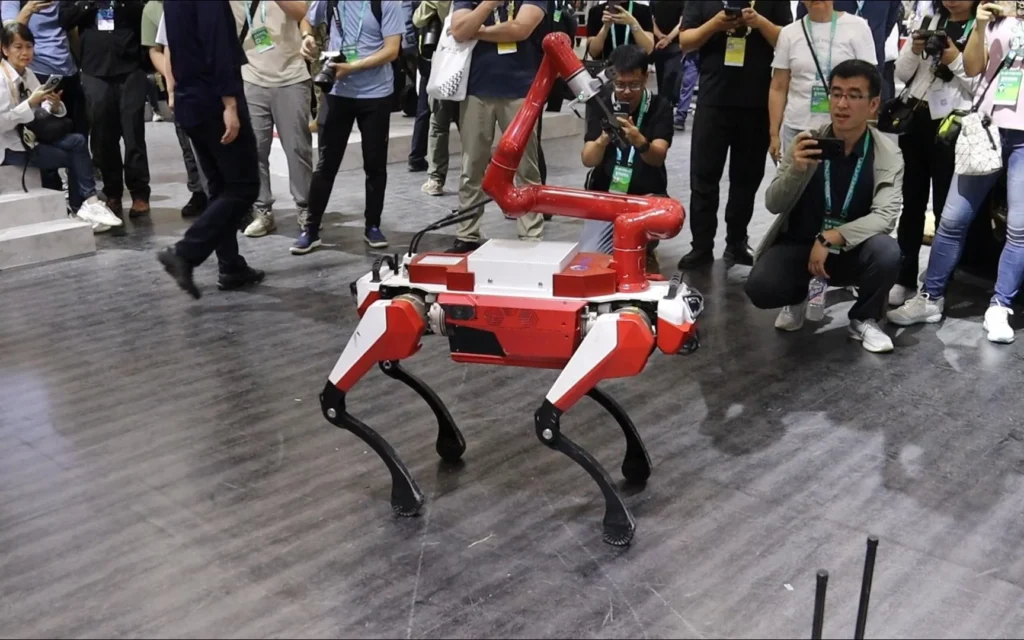
A quadruped robot matters in industry because mobility remains a limiting factor for automation in the physical world. Fixed sensors can only observe what sits inside their field of view. Wheeled machines work well on smooth surfaces, yet many industrial sites are full of stairs, grates, puddles, loose ground, narrow passages, and uneven terrain. A four-legged machine can handle far more of that complexity.
This is why the category has real value in inspection automation. A capable machine can carry LiDAR, cameras, thermal imaging, gas sensors, and edge-computing hardware into areas that are hard for conventional robots to reach.
A quadrupedal robot can map unfamiliar spaces, follow patrol routes, detect anomalies, and return structured data to operators. At that point, the conversation shifts toward uptime, inspection frequency, and response speed. For any buyer looking at an industrial robot dog, the real question is simple. Can it enter places that matter, collect useful data, and keep doing that reliably over time?
ChoZan’s 2026 ranking makes a broader point that is useful here. China’s most important technology story for 2026 is the speed at which breakthroughs become products, platforms, and working deployments. It presents 2025 as the foundation year and 2026 as the period when adoption accelerates across industries.
That context matters because it explains why quadruped robots now deserve attention from business leaders. The category is moving beyond showcase moments and becoming part of regular operations.
That change also says something important about the China robotics industry. China is not producing a single robotics formula for the world. It is building distinct segments with different priorities. Some companies compete on affordability and volume.
DEEP Robotics competes on industrial performance. That difference matters for decision makers. The company’s position centers on hazardous environments, inspection work, public safety, and emergency response, placing it in a very different lane from entertainment robotics or consumer-facing machines.
DEEP Robotics, founded in Hangzhou in 2017 by Zhu Qiuguo, became known for quadruped systems designed for balance, obstacle traversal, and reliable operation in demanding work environments. ChoZan presents the company as a leading maker of rugged robotic dogs for industry, with traction in inspection, emergency response, and security tasks across complex sites.
In business terms, that is a focused B2B model. The company serves energy firms, utility operators, and public safety agencies rather than pursuing widespread consumer adoption.
This point matters because DEEP Robotics has positioned the quadruped robot as one part of a larger operating setup. Its Jueying series has been used for power grid checks, factory patrols, public safety monitoring, mapping, and exploration.
ChoZan also notes that the company combines its hardware with software for autonomous missions and fleet management. That matters to senior decision makers overall.
Buyers are rarely paying for a mobile machine alone. They are paying for a system that eases inspection workloads and strengthens response quality today.
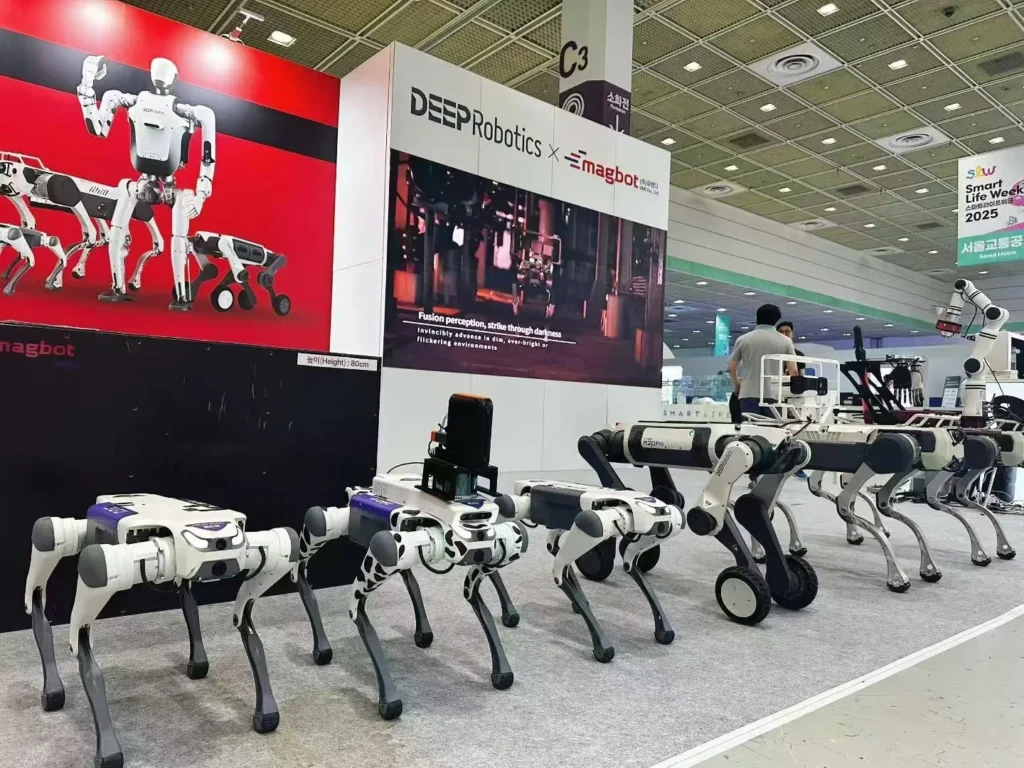
The strength in DEEP Robotics lies in how platform engineering, autonomy, and payload flexibility reinforce one another. ChoZan points to tailored modules, such as gas-sensing packages for mining sites and PTZ camera systems for security applications.
It also points to robust autonomy based on AI perception and SLAM, enabling the robot to interpret unfamiliar structures, detect safety issues, and complete patrol sequences with minimal operator intervention.
Put simply, the platform delivers value when locomotion, sensing, and mission control operate as one integrated whole. That combination defines the practical industrial role of a quadruped robot dog.
The company’s DeepVLA 1.0 release offers another signal of where this segment is moving. ChoZan describes it as a vision-language embodied navigation system that merges large language models with semantic spatial mapping and supports door-to-door movement across indoor and outdoor environments through natural-language instructions.
For operators, this indicates a broader direction in inspection systems. Robots will not succeed through movement alone. They will succeed when navigation, perception, and execution fit smoothly into established operating routines.
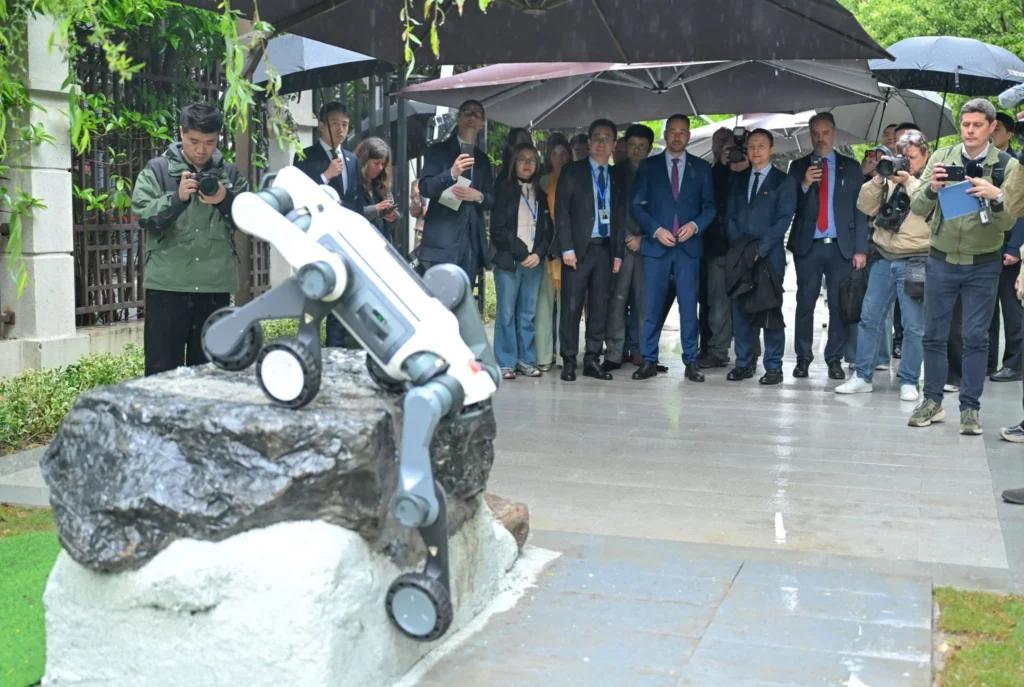
A lot of public attention around robot dogs still comes from viral videos. DEEP Robotics gives a more serious lens. In 2025, the company launched the LYNX M20, a wheel-leg hybrid platform with IP66 protection, autonomous navigation, omnidirectional obstacle avoidance, and the ability to climb obstacles up to 80 centimeters.
ChoZan also notes that it can operate across severe temperature conditions and has been designed for rugged terrain and hazardous settings. That matters far more than visual appeal.
Buyers in oil, utilities, mining, and emergency response care about ingress protection, mobility on unstable ground, sensor payload capacity, runtime, and maintenance reliability.
ChoZan provides strong evidence that DEEP Robotics has been validated in demanding settings. It cites partnerships with firefighting units for smoke-filled and structurally unstable disaster scenarios.
It also points to terrain-capable hardware that can move across rocky ground, shallow water, and slippery surfaces. That is why the term industrial robot suits DEEP better than the lighter consumer language often used for this category. This is field robotics built for hazardous operations, not novelty.
For executives assessing this category, the evaluation process needs to stay practical. Start with the site itself. What surfaces, obstacles, weather exposure, and safety constraints define the environment? Then move to the sensing stack.
LiDAR, thermal imaging, visual cameras, gas detection, and edge analytics only matter if they fit the inspection objective. After that, look at autonomy. Some sites can support high levels of autonomous patrol. Others need stronger teleoperation support and tighter human oversight.
The next layer is the operating model. How will the robot fit into maintenance schedules, alarm escalation, data capture, and compliance cycles? How will battery charging, repair, spare parts, and fleet coordination work across more than one site?
A credible ROI model depends on all of that. ChoZan reinforces this view because DEEP Robotics already offers autonomous mission software and fleet management, showing that integration with inspection workflows sits at the center of its value proposition.
Buyers also need a deployment checklist that covers ingress protection, payload, runtime, mapping accuracy, connectivity, and local safety requirements before broader rollout.

ChoZan places DEEP Robotics inside a larger industrial pattern. China’s innovation system is turning advanced machines into repeatable operating tools. DEEP Robotics had deployed across 34 Chinese provinces and 44 countries by 2025.
It also states that its systems reduced power inspection costs by around 70 percent and increased substation operating efficiency by more than 50 percent.
Those figures matter because they move the category into management territory. A strong quadruped robot case now rests on cost, inspection quality, worker safety, and scalability.
The company’s future direction also reinforces that logic. ChoZan notes plans for greater payload capacity, stronger onboard AI for inspection analytics, broader international expansion, and the aim of making quadrupeds standard industrial equipment by 2026. That goal fits into the broader story of industrial robots in China. 10
Deployment, not demonstration, is now the decisive benchmark. DEEP Robotics deserves attention because it shows how one part of the Chinese robotics market is maturing into infrastructure that companies can actually use.
If your team is tracking quadruped robots, inspection automation, or robotics deployment in China, ChoZan can help you go beyond headlines.
Through custom research, expert calls, and China innovation tours, we help business leaders understand how companies like DEEP Robotics are applying robotics in the field and what those lessons mean for strategy, operations, and investment decisions.
A powerful industrial robot dog can enter hazardous sites, carry sensors, and maintain consistent inspections. That matters in hazardous environments where human exposure, downtime, and blind spots are costly.
For industrial use cases, DEEP Robotics looks stronger on rugged deployment, payload customization, and inspection workflows. Unitree is better known for affordability, broader accessibility, and wider developer adoption.
A quadruped robot can carry LiDAR, thermal cameras, visual cameras, gas detectors, and PTZ modules. The right sensor mix depends on inspection goals, site conditions, and safety risks.
SLAM helps a quadruped robot build a live map while tracking its position. That allows safer movement through unfamiliar industrial spaces where layouts change or visibility drops.
Autonomous navigation lets the robot plan and move with limited input. Teleoperation keeps a human in control, which suits fragile sites, edge cases, and emergency response.
IP66 means the industrial quadruped robot has strong protection against dust and powerful water spray. It signals field readiness, though buyers still need to assess full site conditions.
Quadruped robots in China are not replacing people outright. They handle repetitive and risky inspection work, while human teams still manage judgment, escalation, maintenance, and final decisions.
Global firms should study how DEEP Robotics links mobility, sensors, software, and deployment discipline. China’s inspection automation push shows that field adoption depends on workflow fit.
A strong ROI model for an industrial robot dog measures lower inspection costs, fewer safety risks, better data quality, and reduced downtime. The strongest case comes from repetitive or hazardous inspection work.
Yes, a quadruped robot can handle rain, dust, heat, and rough terrain if built for industrial use. Buyers should still test sealing, mobility, runtime, and sensors in real site conditions.