CONTENT

Walk into a busy restaurant in Shanghai or a hotel lobby in Shenzhen today, and you will often see a service robot moving through the space with a clear purpose. These machines are no longer experimental add-ons or novelty attractions. Instead, they have become part of daily operations across hospitality and retail environments.
China’s service robotics sector has moved from controlled pilots to large-scale deployment in a short period. That shift reflects a bigger change. Operators are no longer asking if robots can work. They are asking which systems can deliver consistent performance inside real venues at scale.
A recent ChoZan analysis frames 2025 as the foundation year and 2026 as the deployment era, which is exactly why service robots now deserve closer attention. In this context, the companies that matter are not those with impressive demonstrations. They are the ones that can embed automation into everyday workflows without disrupting service quality.
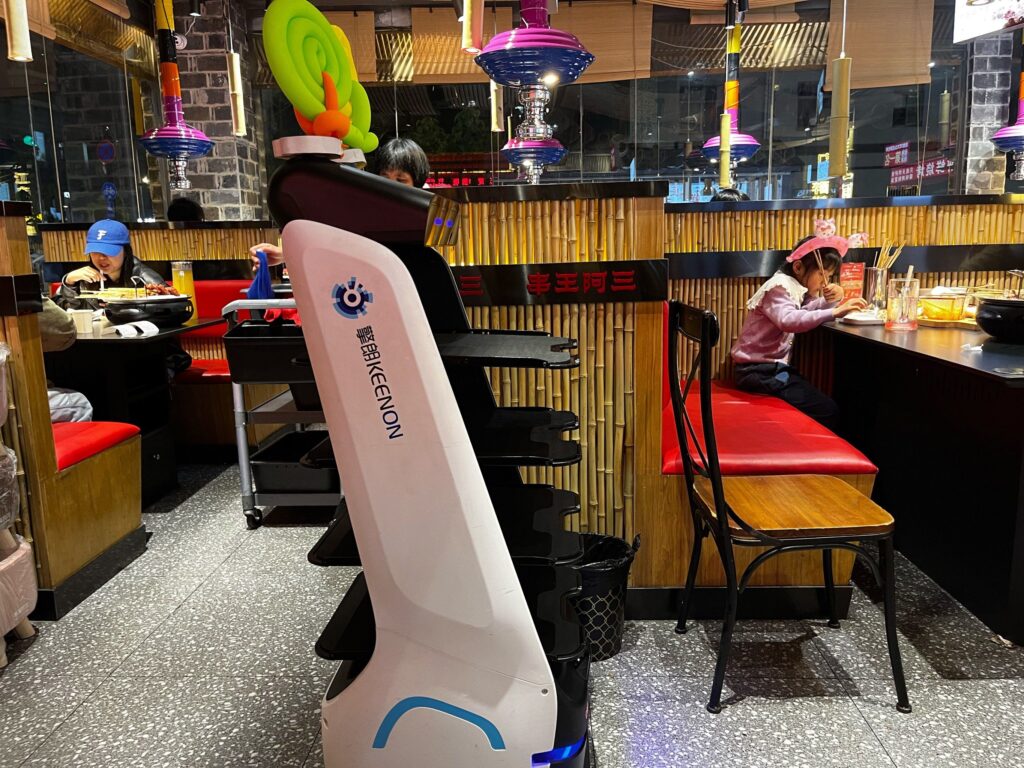
Service robots succeed in hospitality and retail because they solve very specific operational problems that repeat constantly throughout the day. These environments create the right conditions for automation to deliver measurable value, not just visual impact.
In restaurants and hotels, a large share of daily work involves simple, repeated movement. Staff carry dishes from kitchens to tables, deliver items to guest rooms, transport supplies through corridors, and handle routine internal logistics.
Individually, these tasks seem minor. However, across a full day, they consume a significant portion of labor time. Service robots take over this movement layer. As a result, human staff can focus on customer interaction, upselling, and issue resolution, where their presence creates more value.
Unlike open urban streets, hospitality and retail spaces follow predictable layouts. Corridors, dining areas, service stations, and mapped store floors create controlled environments where navigation can be standardized.
This structure allows robots to operate with high consistency. Once routes are mapped and obstacles are accounted for, machines can repeat tasks with minimal variation. That stability makes indoor automation far more practical than many other robotics applications.
At the same time, operators face increasing pressure on staffing. Labor costs continue to rise in major Chinese cities, while customers expect faster and more responsive service.
Service robots address this gap directly. They do not replace entire roles. Instead, they reduce the workload tied to repetitive tasks, allowing businesses to maintain service levels without continuously expanding headcount.
A few years ago, robot waiters often appeared as marketing attractions rather than functional assets. That perception has shifted.
Today, the value of service robotics lies in reliability and integration into daily workflows. When a robot can consistently complete deliveries, navigate busy spaces without disruption, and operate for long shifts, it ceases to be a novelty. It becomes part of the operational system.
Beyond hospitality, delivery robots are transforming retail logistics. The global autonomous last-mile delivery market could reach US$144.2 billion by 2033. Analysts expect the autonomous delivery robot segment to grow from US$728.3 million in 2025 to US$3.8 billion by 2032.
Over 200,000 autonomous delivery units are expected to operate in China by 2025, and more than 30 percent of major restaurant brands are predicted to adopt them. Such robots can cut delivery costs by 40 to 60 percent and may reduce traffic congestion by up to 20%.
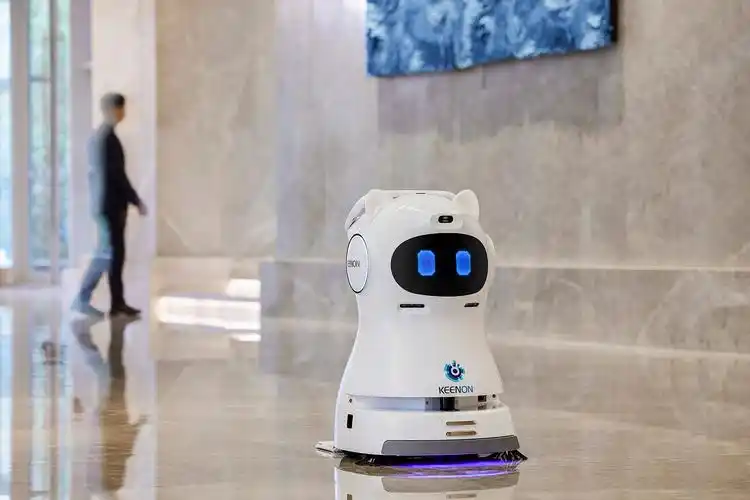
KEENON Robotics represents what happens when service robotics moves from experimentation to operational scale. Founded in 2010 and headquartered in Shanghai, the company has built its position by focusing on reliability, ease of deployment, and consistent performance inside real hospitality environments.
Keenon Robotics led the field with 22.7 percent of commercial shipment share and a commanding 40.4 percent share of the food delivery robot segment.
KEENON has established one of the largest footprints in the service robotics sector. Its machines operate across more than 600 cities in over 60 countries, with a particularly strong presence in China’s restaurant and hospitality segments.
By 2025, the company captured roughly half of the restaurant delivery robot market in China. This level of penetration signals more than early adoption. It shows that service robots can sustain performance across large, diverse commercial environments without constant supervision.
KEENON’s product development focuses on practical deployment rather than experimental features. Its 2024 “Flying Fish” model illustrates this approach through upgrades that directly support real-world use.
The system combines two-dimensional LiDAR with depth cameras to improve navigation accuracy in crowded indoor spaces. In addition, integration with elevators enables robots to perform multi-floor deliveries in hotels without staff assistance.
This capability matters because it removes friction from service workflows. A robot that can move between floors and reach a specific room extends automation beyond single zones into full-building operations.
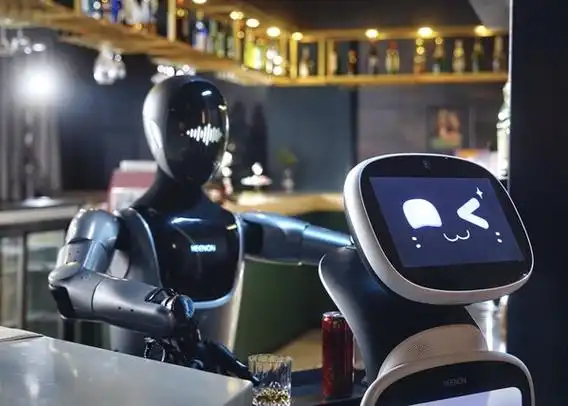
Keenon’s XMAN R1 humanoid service robot can take orders, prepare food, transport items, and collect dishes. Its design replicates human movement patterns to foster natural interactions.
The Kleenbot series offers targeted cleaning solutions:
These innovations support a wide range of restaurant robots and hotel applications while maintaining modularity for maintenance and upgrades.
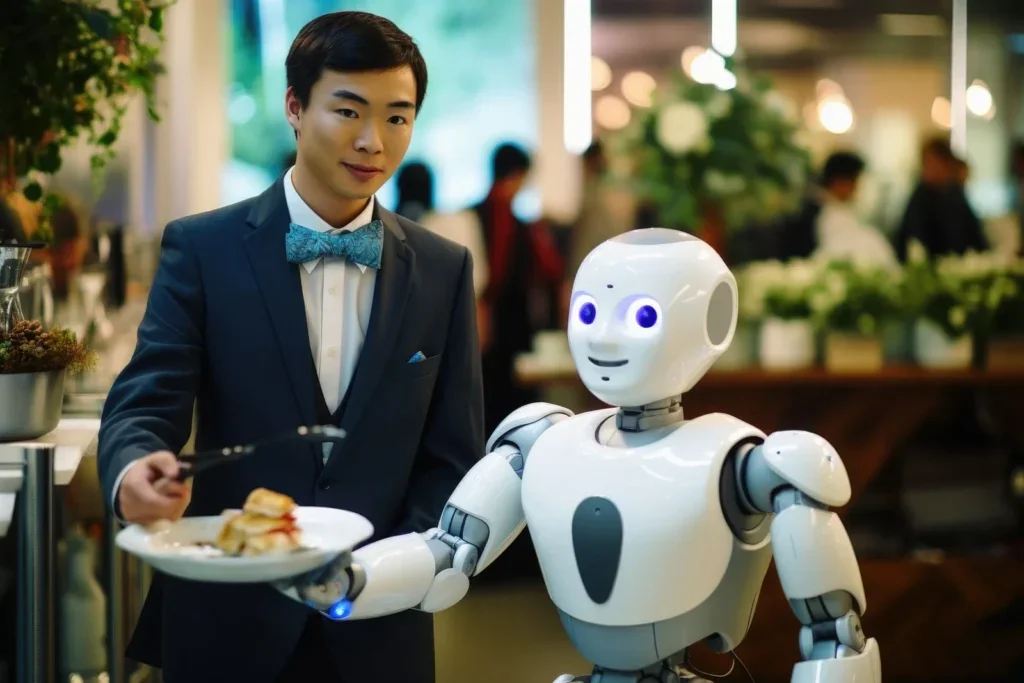
Keenon also leads in the robot waiter segment through partnerships and software. In 2025, the company launched its Operator Model 2.0, an AI system that allows a single platform to handle multiple service roles and remote upgrades.
The model draws data from thousands of units in the field, enabling continuous learning and personalization. Keenon supplies robots to more than six hundred cities worldwide, with major deployments in the United States, Japan, and Europe.
KEENON’s advantage does not come from novelty. It comes from consistency under operational pressure. The company designs its systems to function reliably during peak hours, across long shifts, and in environments where human movement is unpredictable.
China has over 100 service robot manufacturers, most of which are focused on commercial applications. There are at least 107 Chinese service robot manufacturers, 80 percent of which focus on professional robots. This competition accelerates iteration and supports modular system design.
KEENON reflects this approach. Its Operator Model 2.0 enables remote monitoring, continuous updates, and hardware changes during deployment.
Equally important, its robots are built for ease of integration. Businesses can deploy them without restructuring entire workflows or investing heavily in new infrastructure. This lowers the barrier to adoption and accelerates scaling across multiple locations.
In practice, this combination of reliability and usability determines which companies succeed. Many competitors can demonstrate a robot. Far fewer can deliver a system that works every day in a live commercial setting.
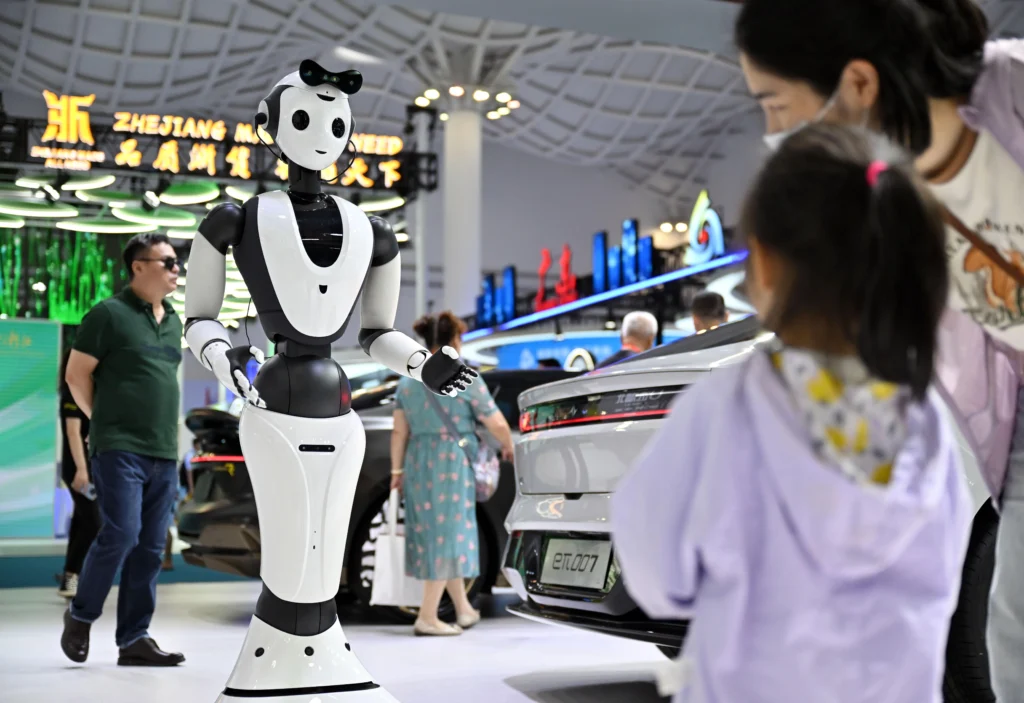
The performance of service robots hinges on reliable connectivity. Simple WiFi networks struggle when many autonomous devices operate simultaneously, causing delays and collisions. To address this bottleneck, telecom operators and equipment makers have partnered with robotics firms.
Leju Robotics highlights that when a single robot operates over WiFi, there are few problems, but fleets of five or more quickly overwhelm the network. Leju collaborated with Huawei to integrate 5G Advanced solutions; once 5G A modules were installed, up to 50 robots could work smoothly.
At the Mobile World Congress in Barcelona in March 2026, China Mobile, Huawei, and Leju unveiled the world’s first humanoid robots equipped with 5G A connectivity, now deployed in First Auto Works factories.
At Huawei’s commercial market summit in 2025, the company showcased intelligent network solutions for hotels that cut energy consumption by fifteen percent and use channel state information sensing to detect hidden cameras.
This combination of high bandwidth connectivity, optical sensing, and AI training forms the backbone of smart venues, where robots, sensors, and management systems communicate seamlessly.
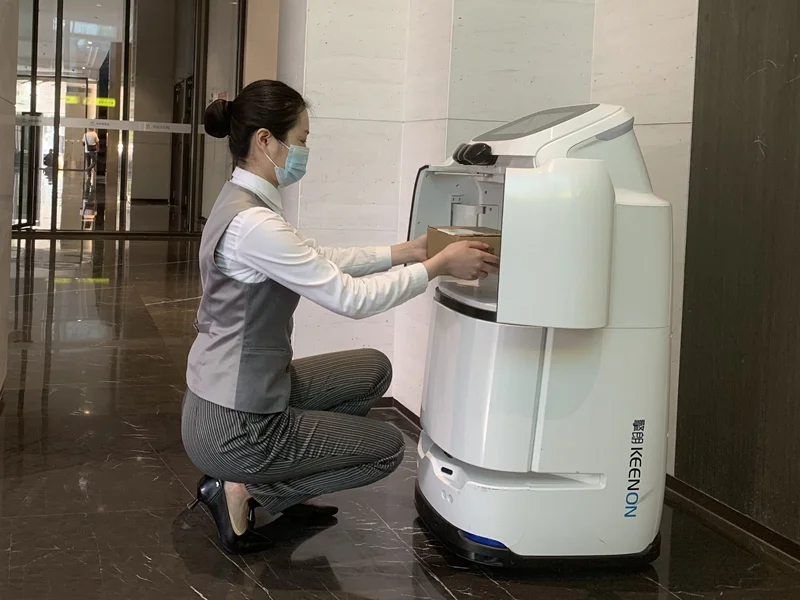
Service robots only create value when they operate consistently inside real environments. That consistency does not come from a single feature. It comes from a combination of navigation, coordination, integration, and durability working together as a system. When one layer fails, the entire deployment breaks down.
Indoor environments are controlled but not static. Guests move unpredictably, furniture shifts, and peak hours create dense traffic.
To operate under these conditions, service robots rely on SLAM-based navigation systems that enable them to map environments and update their positions in real time. Combined with obstacle detection and path adjustment, this enables continuous movement without human intervention.
The result is not perfect autonomy, but stable enough navigation to handle repeated tasks across long operating hours.
Single-robot performance is not enough in large venues. Restaurants, hotels, and retail spaces often deploy multiple units that must operate simultaneously without conflict.
Fleet management systems handle this coordination by assigning tasks, optimizing routes, and preventing congestion in shared spaces. As deployment scales, this layer becomes critical because inefficiencies multiply quickly when multiple machines operate in the same environment.
A robot that moves without context creates limited value. Real deployment requires integration with the systems that run the venue.
This includes POS platforms, ordering systems, and internal service workflows. Through APIs and software connections, robots can receive tasks automatically, update status in real time, and fit into existing operational processes without manual coordination.
This integration is what turns a standalone machine into part of a working system.
Commercial environments demand long operating hours. Service robots must function across extended shifts without frequent downtime or performance degradation.
This requires battery systems that support continuous use, hardware designed for wear and tear, and maintenance models that minimize disruption. Reliability at this level is not about a single successful task. It is about consistent performance across hundreds of daily interactions.
Understanding how service robots and automation scale in China requires direct exposure to real operating environments. ChoZan helps companies translate China’s innovation systems into practical strategy.
If your team is evaluating automation or new operating models, book a consultation with ChoZan to identify what applies to your business and where to act next.
Professional service robots operate in commercial environments such as hotels, hospitals, and retail spaces, while personal robots are designed for home use. The key difference lies in reliability, durability, and the ability to handle high-frequency operational tasks.
Service robots use sensors, cameras, and obstacle detection systems to navigate safely around people. They are designed to operate in shared spaces, adjusting movement in real time to avoid collisions and maintain safe interaction distances.
Service robots are widely used in healthcare, logistics, security, and maintenance. These industries benefit from automating repetitive or time-sensitive tasks, especially when consistent performance and continuous operation improve efficiency and reduce operational strain.
Modern service robots can be deployed within days rather than months. They require minimal infrastructure changes, with setup focused on mapping the environment, integrating basic systems, and configuring workflows for specific operational tasks.
Service robots rely on a combination of SLAM, sensors, cameras, and AI-driven software to navigate and perform tasks. These technologies allow them to map environments, avoid obstacles, and operate with minimal human input.
Service robots are becoming more accessible due to lower costs and simplified deployment. Smaller businesses can adopt them for targeted tasks such as delivery or cleaning, especially in high-volume environments where repetitive work creates operational inefficiencies.
Service robots improve consistency and speed in routine tasks, thereby reducing waiting times and service errors. However, their effectiveness depends on how well they integrate with human staff and support, rather than replace, customer interaction.
Service robots perform best in predictable environments. In highly unstructured or constantly changing spaces, navigation and task execution become less reliable, which limits their effectiveness compared to controlled indoor settings.
Most service robots operate autonomously once configured, but they still require oversight for maintenance, updates, and exception handling. Human involvement remains necessary to manage performance and ensure smooth operation over time.
Service robots connect to existing systems such as ordering platforms and internal workflows through software interfaces. This allows them to receive tasks automatically and operate as part of a coordinated system rather than standalone machines.
Traditional Wi Fi networks cannot support large fleets. With 5G A connectivity, robots receive real-time data and coordinate smoothly; Huawei and partners demonstrated that fifty robots can operate simultaneously without interference.
Yes. The robot-as-a-service model allows companies to lease robots rather than purchase them. This reduces upfront costs and includes maintenance and software updates.