CONTENT
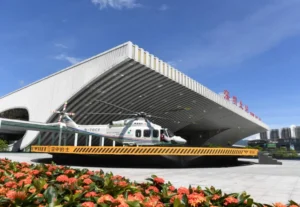
China’s low-altitude economy covers economic activity built around crewed and uncrewed aircraft operating in lower airspace, usually within 1,000 meters of the ground. It includes drones, electric vertical takeoff and landing aircraft, general aviation, aircraft manufacturing, digital traffic systems, ground infrastructure, and flight services.
The subject matters because China is developing policy, hardware, connectivity, air-traffic systems, and commercial trials simultaneously. This is already an operating market. China ended 2025 with 3.287 million registered drones and 45.3 million drone flight hours. The strategic question is which applications can move from supported trials to repeatable, compliant demand.
For readers researching low altitude economy meaning, the practical definition extends far beyond aircraft. It describes a connected economic system in which vehicles, airspace, digital networks, infrastructure, and operators work together.
The value chain has three main layers:
China’s official descriptions commonly refer to airspace within 1,000 meters, although flight permissions depend on the aircraft, location, and mission. This makes the sector broader than urban air mobility and more commercially diverse than the flying-taxi label suggests.
The Civil Aviation Administration of China estimated the sector would reach RMB 1.5 trillion (US211.4billion) in 2025 and exceed RMB3.5 trillion (US 498 billion) by 2035. Those figures describe an economic ecosystem, rather than booked aircraft or operator revenue. Operating data gives a firmer view of scale.
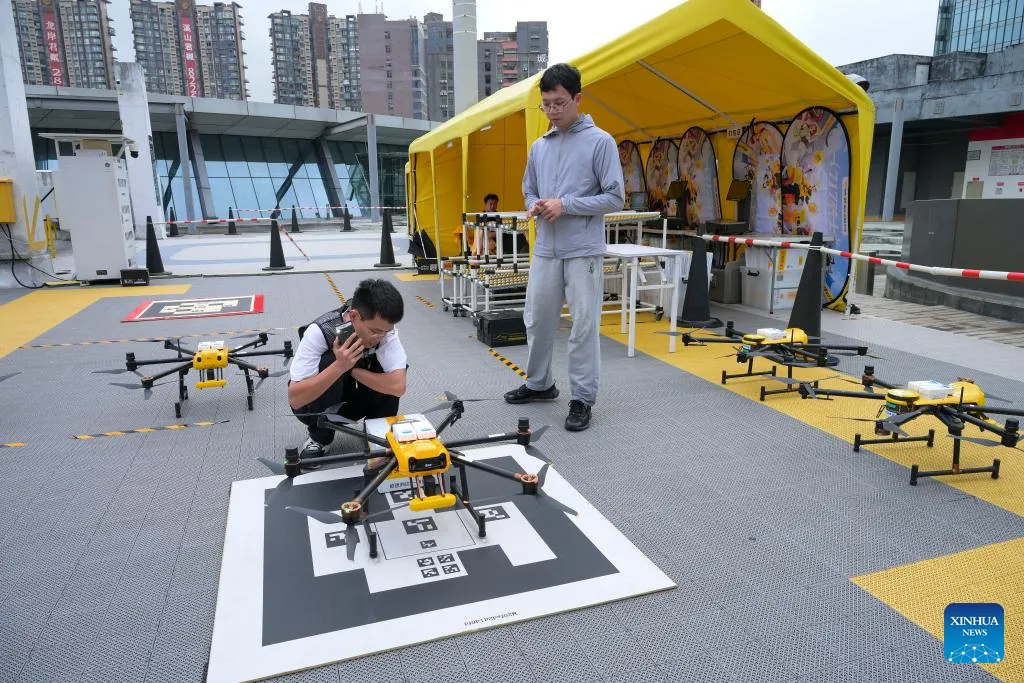
At the end of 2025, China had 513 registered general-aviation airports, 46 low-altitude flight service stations across 23 provincial-level regions, and 3.287 million registered drones. Drone flight time rose 69.89 percent during the year to 45.3 million hours.
Manufacturing indicators also show depth. As of December 30, 2025, 1,081 enterprises had completed low-altitude equipment registration, with 3,623 product types filed and more than 5.29 million units registered.
Market estimates still require care. The NDRC and National Bureau of Statistics began dedicated work on sector statistics in February 2025. This signals that the measurement framework is still developing. Forecasts should support scenario planning, while flight hours, route use, certified operations, and customer demand should guide commercial decisions.
Industrial drones have the clearest near-term path to volume because they already perform defined jobs. Current applications include delivery, agricultural work, surveying, infrastructure inspection, firefighting, emergency response, and power-line monitoring. Each mission has a measurable service outcome, which makes its economics easier to test than mass passenger transport.
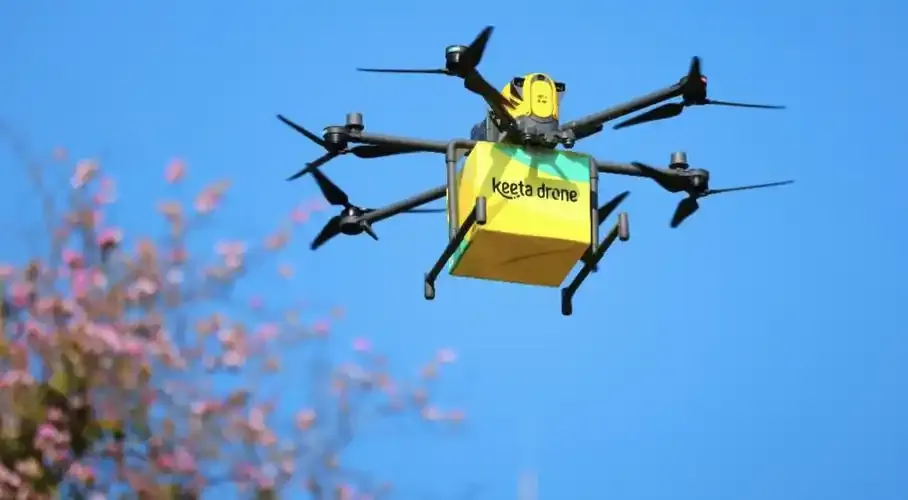
Meituan’s Keeta Drone shows how platform demand can support route development. As of March 2026, the company reported more than 880,000 deliveries across 70 routes in Shenzhen, Beijing, Shanghai, Guangzhou, Hong Kong, and Dubai. Its system combines drones, automated hubs, and an operations platform.
Keeta still operates through approved corridors and designated delivery points. Its first regular Hong Kong service, for example, connected Science Park with Ma On Shan through a 1.8-kilometer route developed under the city’s regulatory sandbox. Each additional route depends on airspace approval, safe takeoff and landing points, ground infrastructure, demand density, and local operating rules.
Operators must also budget for battery renewal, inspections, repairs, calibration, software, insurance, and trained staff. Poor weather can reduce available operating days, while fixed hubs and delivery cabinets add infrastructure costs. A 2025 Associated Press report noted that drone delivery services in Shenzhen could still cost more.
Route count alone therefore says little about unit economics. Cost per completed mission, fleet use, maintenance downtime, repeat demand, and route frequency provide a more useful commercial test.
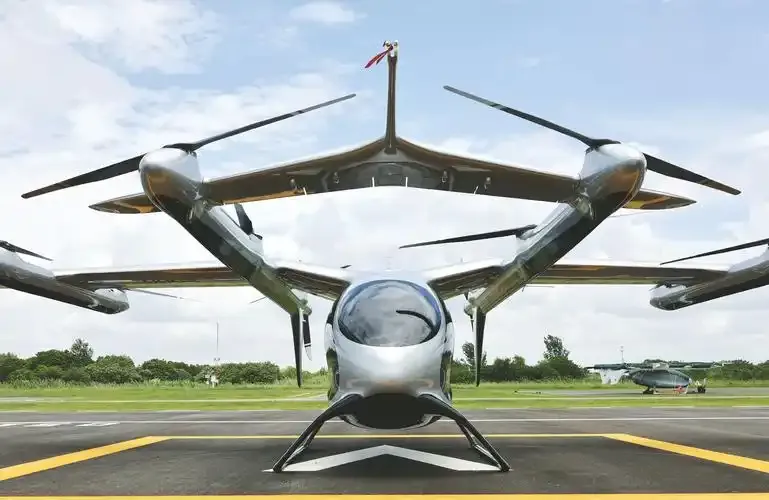
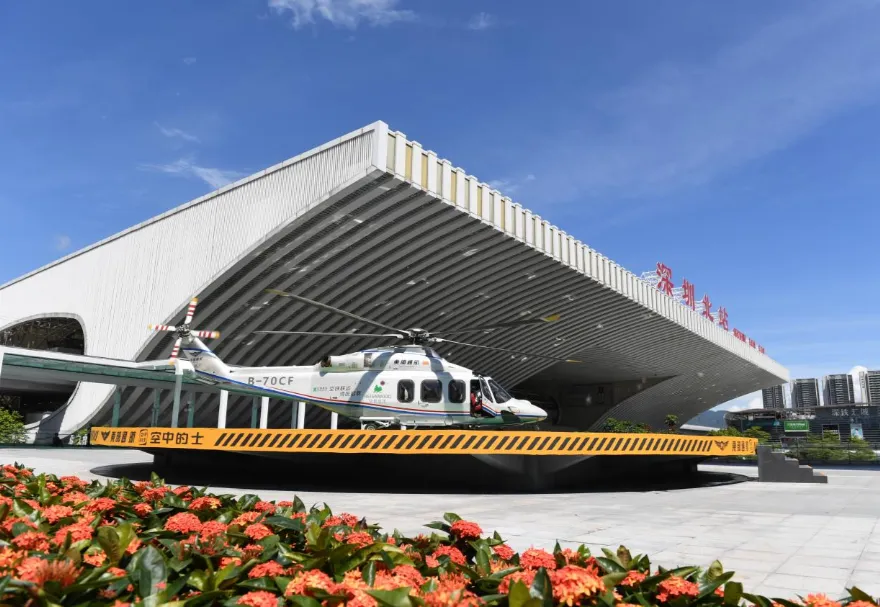
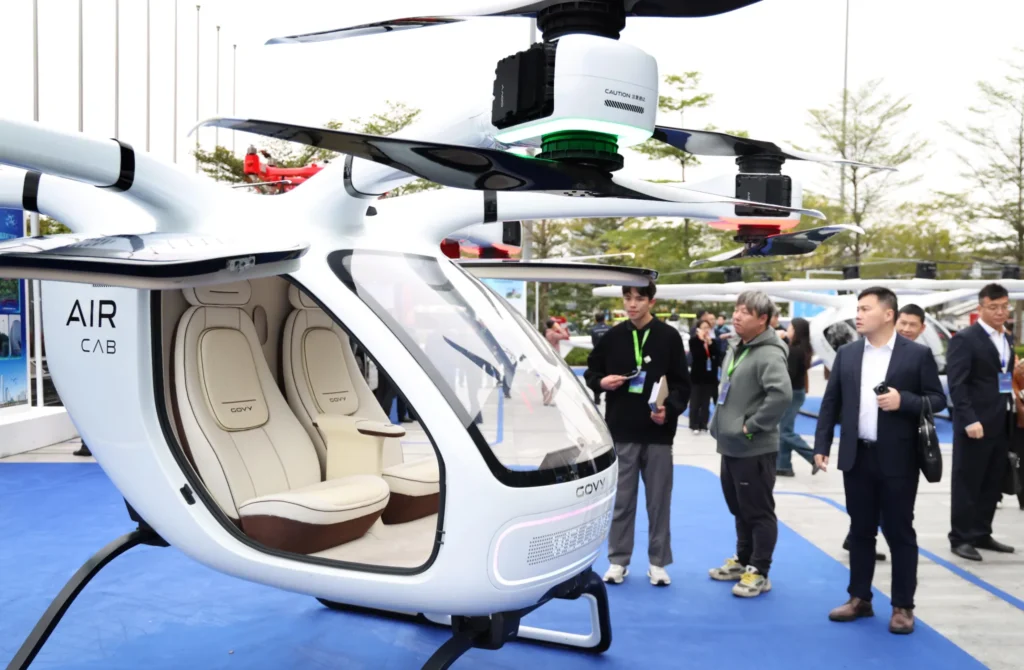
Passenger eVTOLs receive more attention, but certification defines the pace. In March 2025, the CAAC granted the first Air Operator Certificates for civil, passenger-carrying pilotless aircraft to two EH216-S operators.
The certificates permit commercial services at designated sites. EHang stated that expansion would proceed in phases, starting with controlled sites and aerial tourism before broader passenger transport.
This distinction matters. Certification of an aircraft or operator does not create a nationwide air-taxi network. Route approval, ground facilities, weather limits, fleet reliability, public confidence, and trip economics still shape adoption.
DJI’s 2025 Matrice 400 offers up to 59 minutes of forward flight under controlled conditions, but actual endurance changes with payload, weather, and operating conditions. Its maximum wind resistance during takeoff and landing is 12 meters per second, while fog, rain, snow, and cloud can affect obstacle sensing.
Low-altitude traffic needs a digital control layer. Communication, navigation, surveillance, remote identification, weather data, route planning, and emergency response must function as one operating system.
Vertiports and automated hangars are visible assets, but the higher-value layer may sit in dispatch software, airspace services, security, maintenance, and fleet management.
China formalized this priority in May 2026 when the CAAC created a low-altitude safety department. Its remit includes development plans, safety coordination, flight-service dispatch platforms, and service-station systems.
Agricultural drones now cover 180 million hectares of cultivated land, representing 35% of China’s total farmland. Leading manufacturers DJI and XAG released new models in 2026 with enhanced spraying precision and autonomous obstacle avoidance, reducing pesticide usage by 30% while maintaining crop yields.
Surveying and mapping operations generated ¥42 billion ($5.8 billion) in 2025, serving infrastructure planning, environmental monitoring, and mineral exploration.
The National Forestry and Grassland Administration uses drone networks to monitor 60% of China’s protected forests, with AI-powered systems detecting illegal logging and fire risks in real time.
In December 2025, the National Development and Reform Commission reported that China had more than 300,000 agricultural drones, which had completed over three billion mu-times of work.
Drone inspections of power lines had also exceeded four million kilometers. “Mu-times” measures accumulated task area and can include repeated treatments of the same land. It should not be presented as unique farmland coverage or a national penetration rate.
Subsidies can lower adoption costs, but they do not prove stable unsubsidized margins. Returns vary by crop type, farm density, terrain, seasonal use, local labor costs, service pricing, battery cycles, and travel between sites.
Surveying, mapping, forestry, and infrastructure inspection face the same commercial test: the service must reduce labor, response time, risk, or downtime after all recurring operating costs are included.

China’s 2025 Government Work Report called for large-scale application demonstrations and the sector’s “safe and sound” development. In 2026, the government placed low-altitude activity among the emerging pillar industries it plans to develop. The 15th Five-Year Plan also calls for refined airspace management and orderly expansion.
The important signal is coordinated commercialization, not unrestricted flight. The NDRC set out a clear sequence in May 2025: cargo before passengers, isolated airspace before integrated airspace, and outlying areas before dense urban zones. That sequence directs early demand toward logistics, industrial work, tourism, and controlled routes.
Regulation is becoming more specific as activity grows. China’s revised Civil Aviation Law, effective July 1, 2026, brings unmanned aircraft design, production, import, maintenance, and flight activity into a clearer airworthiness framework.
It also requires manufacturers to assign unique product identification codes. Separate national standards for real-name registration and operational identification took effect on May 1, 2026.
Policy support also has limits. In July 2025, the NDRC warned against low-efficiency duplication, irrational construction, and destructive competition. Local targets and industrial parks therefore need to be assessed against certified products, active routes, customer use, and viable operating models.
The Greater Bay Area combines drone manufacturing, electronics, batteries, logistics platforms, eVTOL development, and dense urban test cases. Shanghai and Hangzhou connect advanced manufacturing with digital platforms and city-level service systems. Hefei and Wuhan add aircraft production, research, test infrastructure, and public-service applications.
These clusters should not be read as a single national market. Local airspace, regulators, infrastructure, incentives, operating partners, and demand scenarios differ. A city-level ecosystem map can reveal more than a national market-size figure.
The strongest opportunities sit where a defined task meets regulatory permission and clear economics. Five tests help separate durable value from promotional activity:
China’s low altitude economy is moving from industrial policy into an operating system for aerial services. Drones already provide the volume signal. eVTOL certification points to passenger use, while regulation sets deliberate boundaries around that route.
The companies that understand the full system, from components and data to airspace and demand, will read this market more accurately than those watching vehicle launches alone.
China’s low-altitude economy makes more sense when you can connect the aircraft to the policies, infrastructure, manufacturing networks, and operating models around it.
ChoZan’s China learning expeditions combine company visits, expert briefings, and on-the-ground observation. Explore how China tests and scales future mobility, then translate the relevant lessons into sharper strategic decisions.
The commercial concept mainly covers civil economic activity. Military authorities still influence airspace access and flight coordination, but official civil-aviation definitions do not treat defense aviation as a consumer or commercial industry segment.
Requirements vary by aircraft class, mission, and location. Operators may need real-name aircraft registration and identification, an operator certificate, qualified personnel, flight approval, insurance, applicable airworthiness documentation, and local operating permits.
Foreign participation is possible in selected manufacturing, components, software, services, and research activities. China’s 2025 Foreign Investment Guide outlines market access, while aviation, data, mapping, and export rules require project-specific review.
Commercial passenger eVTOL activity remains limited to approved aircraft, operators, sites, and service scopes. Early authorized services center on controlled tourism and trial operations. Routine point-to-point urban transport has not reached national scale.
Treat forecasts as estimates of a broad ecosystem, not direct revenue projections. Compare each figure’s definition, base year, and methodology, then validate it against registered aircraft, flight hours, certified routes, utilization, and paying demand.
A functioning network needs takeoff and landing sites, charging or battery services, maintenance, weather monitoring, communication, navigation, surveillance, traffic management, remote identification, emergency procedures, and links to ground transport or delivery systems.
Drones can collect imagery, location, infrastructure, and operational data. Companies need clear rules for data minimization, storage, cross-border transfer, access control, encryption, incident response, and compliance with China’s cybersecurity and data regulations.
Applications with repeat routes and measurable savings have the strongest early case. Logistics, inspection, agricultural services, surveying, emergency response, and controlled tourism can prove value before complex passenger networks require wider infrastructure and public acceptance.
The market may require aircraft hull, third-party liability, passenger, cargo, product liability, cyber, property, and business-interruption coverage. Better flight, maintenance, weather, and incident data will help insurers price risk more accurately.
Demand is growing for flight planners, operators, maintenance engineers, airworthiness specialists, dispatchers, safety managers, software developers, data analysts, and infrastructure technicians. China formally recognized drone flight planner as a new occupation in 2025.