CONTENT
Astronergy is the photovoltaic cell and module manufacturing business under China’s CHINT Group. Its current proposition combines n-type TOPCon products, 12 manufacturing bases in China, Thailand, and Turkey, and more than 170 GW of cumulative module shipments as of 2025. Its newest ASTRO N7 3.0 and N7s 3.0 products use TOPCon 5.0 cells, larger rectangular wafers, and high-density encapsulation.
This matters because buyers gain access to industrial scale and a broad product range, but they must still assess the exact model, factory, bill of materials, warranty, and local service route.
The legal company behind the module brand is Chint New Energy Technology Co., Ltd. It focuses on PV cells and modules, while CHINT Solar handles renewable project development, construction, operations, and services.
CHINT’s roots add strategic context. The group reports more than 30 manufacturing bases, over 40,000 employees, and US$25.91 billion in 2025 operating revenue across green energy, electrical solutions, and smart-home businesses. CHINT’s current corporate profile also spans more than 140 countries and regions.
Parent-company scale can support research, procurement, electrical-system knowledge, and international channels. It does not remove product-level risk. A project owner still signs contracts with named legal entities and receives modules from specific factories. Warranty service, spare stock, technical support, and import compliance remain local questions.
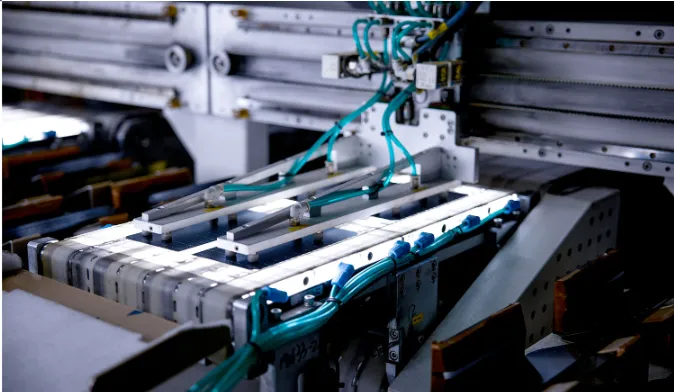
The current Astronergy solar module portfolio centers on n-type TOPCon. In a TOPCon cell, a thin tunnel oxide and passivated contact reduce carrier recombination, which helps the cell convert more sunlight into electricity.
The commercial value comes from module efficiency, temperature behavior, bifacial output, degradation, and system design rather than the technology label alone.
TOPCon 5.0 combines cell-level improvements with module construction. The company says the platform improves passivation, light capture, open-circuit voltage, and current.
Its zero-busbar design removes conventional busbars from the cell face. More ribbons collect current, while low-temperature film-based interconnection reduces welding stress.
The company reports cell efficiency above 27 percent for TOPCon 5.0. That is a cell figure, not the efficiency of a finished panel.
High-density encapsulation is the next important step. It reduces inactive spacing between cells and spreads mechanical stress more evenly. The design aims to increase active area and lower hidden-crack risk.
Those gains matter only when mass production keeps materials, lamination, ribbons, and process controls consistent across every approved bill of materials.
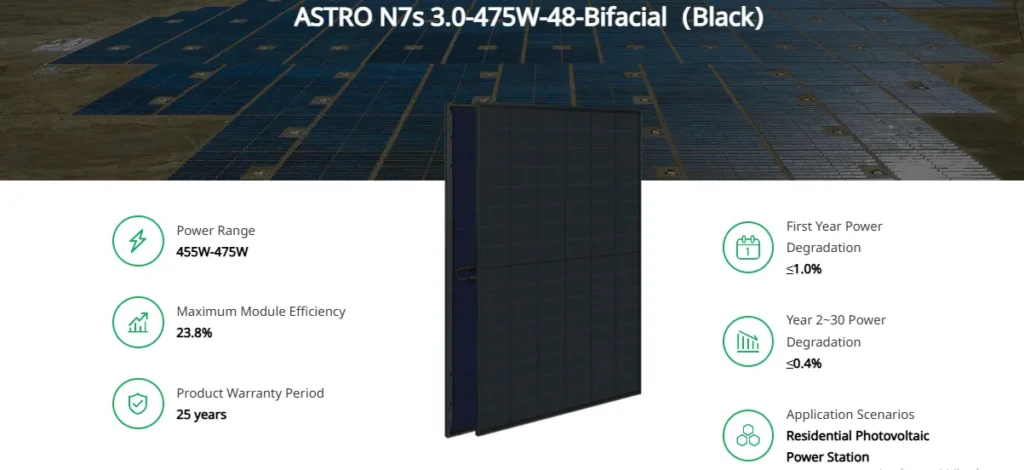
The 2026 lineup divides the N7 platform by application rather than presenting one universal panel.
| Product | Current headline specification | Main role | Commercial relevance |
| ASTRO N7 3.0 | Up to 655 W | Utility and commercial systems | Larger 213R wafers, TOPCon 5.0, and high-density encapsulation within a large format |
| ASTRO N7s 3.0 | 475 W, 480 W, or 535 W | Residential and distributed rooftops | Compact formats, all-black options, 20BB interconnection, and a 25-year product warranty |
| ASTRO N7 Pro | Up to 670 W and 24.8 percent efficiency | Utility and commercial projects | TOPCon 5.0+, quarter-cut cells, and lower hot-spot exposure under partial shading |
The N7 3.0 launch release says the larger wafer and tighter layout increased active area by 0.85 percent for N7 3.0 and 1.1 percent for N7s 3.0 against the prior generation.
For procurement, key comparisons include output per square meter, string length, module current, tracker or racking compatibility, labor, freight, and expected energy yield.
A higher-wattage Astronergy solar panel can reduce module count in some designs, yet a larger or heavier format may change handling and structural requirements.
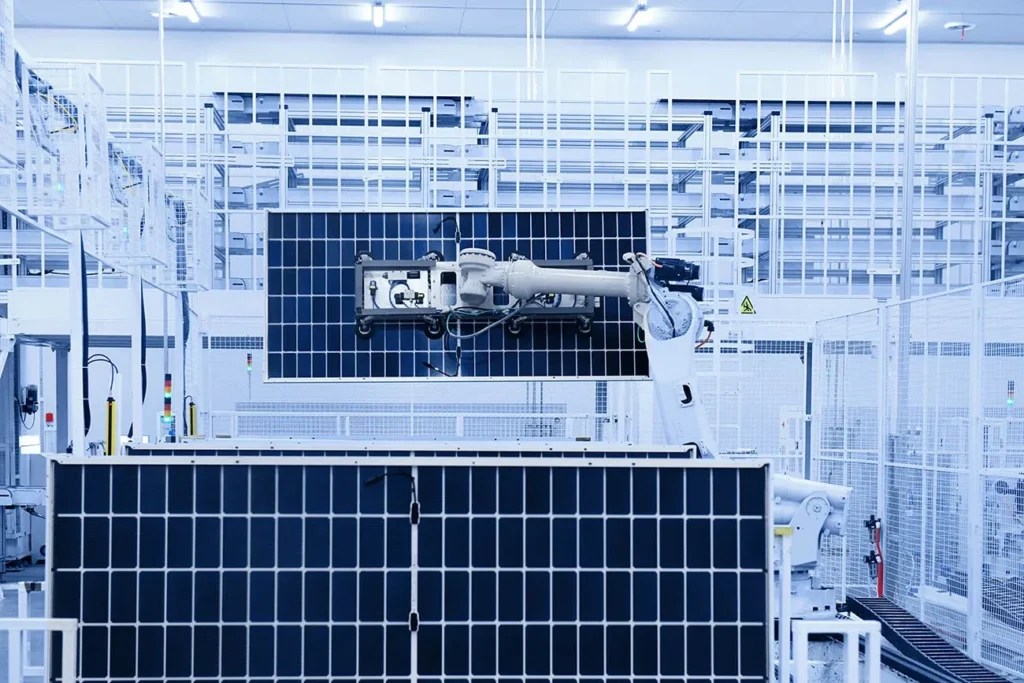
The current manufacturing network includes ten bases in China, plus facilities in Thailand and Turkey. The Chinese sites are Haining, Yancheng, Jiuquan, Songyuan, Fengyang, Yiwu, Yanchi, Yueqing, Fuyang, and Yibin.
The network does more than add nameplate scale. Different sites can support different wafer formats, cell technologies, module dimensions, and destination markets. Fuyang serves as the company’s first mass-production base for zero-busbar TOPCon modules. Yibin began operation in September 2025 with three automated lines and 5 GW of annual TOPCon module capacity.
Country of brand origin does not establish the origin of a delivered batch. Buyers should require the named production site, legal manufacturer, model number, serial-number range, bill of materials, certificate set, and origin documents in the supply agreement.
Factory substitutions should require written approval when tariffs, financing, traceability rules, or laboratory qualifications depend on origin.
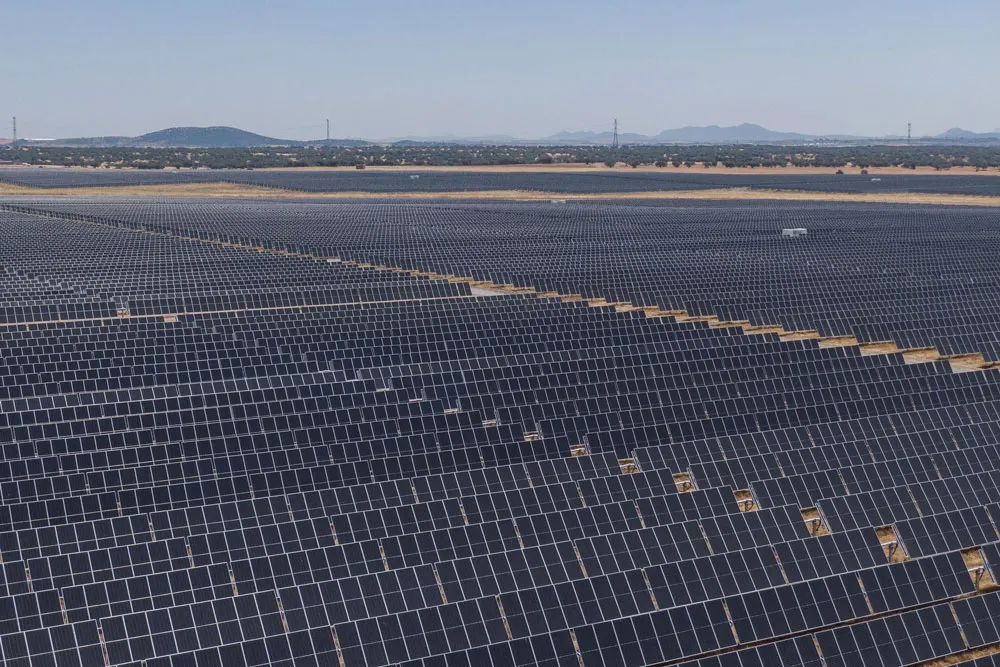
Tier 1 can mean different things because BloombergNEF and S&P Global apply separate frameworks. BloombergNEF says its quarterly classification relies on project and asset-finance data. It does not certify an individual module’s quality. BloombergNEF’s methodology overview explains that the analysis draws from its project and finance databases.
S&P Global’s 2026 Tier 1 Cleantech Companies list names Chint New Energy Technology Co., Ltd. (Astronergy) as a PV module supplier. S&P says the list is not a ranking or investment recommendation. It considers market presence, financial health, sustainability, and other criteria.
The practical conclusion is simple. A Tier 1 label can help with an initial bankability screen. It cannot replace technical due diligence, audited financial review, warranty analysis, factory qualification, or local service checks.
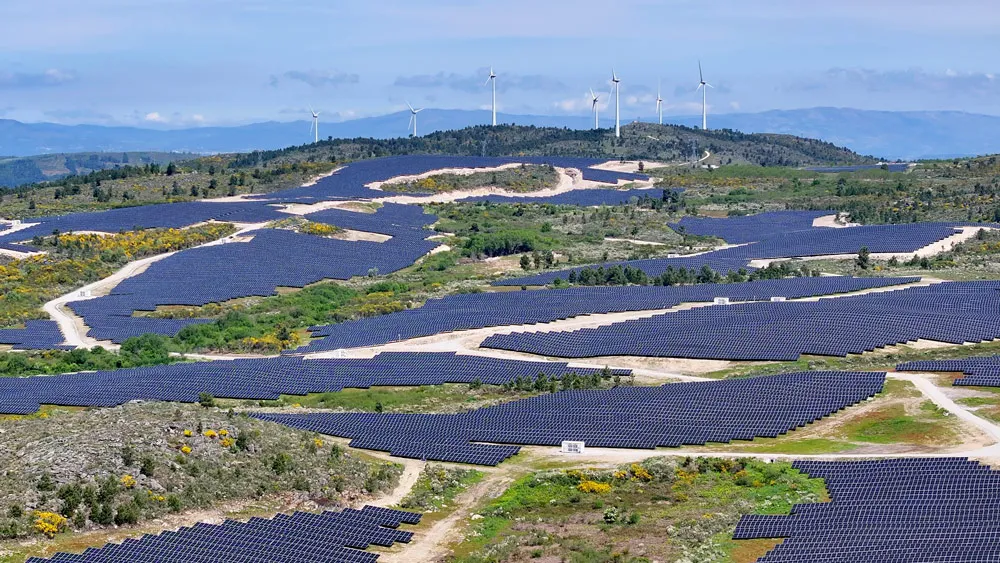
Independent testing adds useful evidence, but results follow specific model types and bills of materials. Kiwa PVEL’s 2026 scorecard lists two Astronergy module families as Top Performers in selected tests, with Chinese factories identified for the tested products.
Its manufacturer summary shows the company as a Top Performer in five categories: damp heat, mechanical stress, hail stress, potential-induced degradation, and LID plus LETID. Kiwa PVEL’s current manufacturer results provide the model-level context.
That detail matters. Kiwa PVEL explains that modules carrying the same model name can use different component combinations. Its samples undergo third-party production oversight to limit bias from hand-picked samples. A buyer should therefore match a quoted Astronergy module to the tested model, factory, and bill of materials rather than relying on a brand-level badge.
Warranty numbers need the same discipline. The 2026 N7s 3.0 release specifies a 25-year product warranty, a 30-year linear power warranty, no more than 1 percent first-year degradation, and no more than 0.4 percent annual degradation afterward.
Other Astronergy panels can carry different terms. The executed warranty document and destination market take precedence over a general product page.
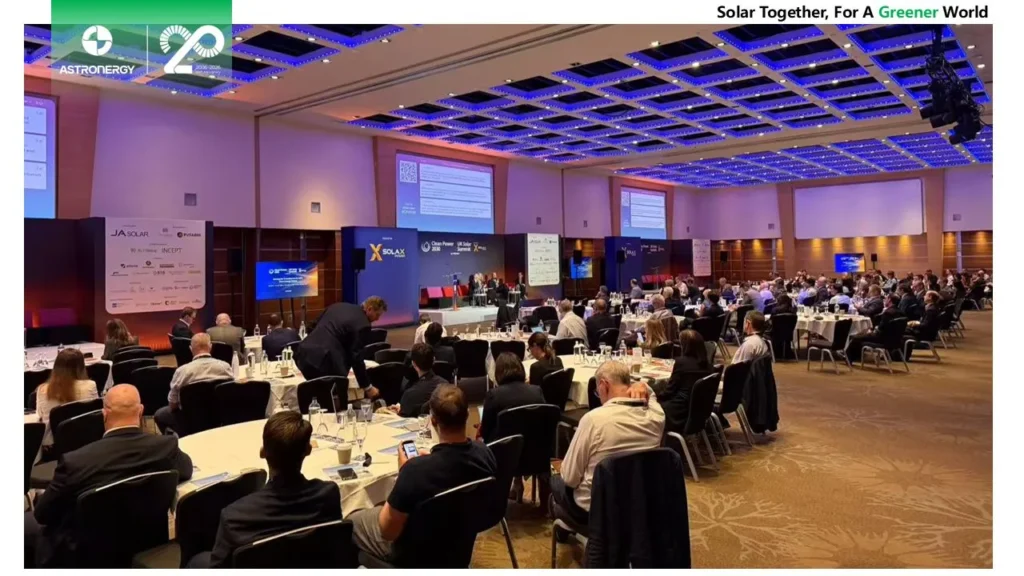
A disciplined comparison should cover six points:
Astronergy presents a credible combination of TOPCon development, CHINT backing, factory breadth, and current third-party recognition. The strongest buying case appears when those company-level advantages connect to a clearly specified product, qualified factory, traceable supply chain, financeable contract, and responsive local service structure.
Astronergy is one example of how Chinese manufacturers are advancing solar technology through technical development, factory scale, and global expansion. ChoZan helps companies examine the wider forces behind this progress through China market research, competitor benchmarking, tech trend watching, business consulting, and expert calls.
Our learning expeditions also provide direct exposure to the companies and innovation hubs shaping China’s green-energy sector.
Have a specific question about China’s solar sector or industrial innovation? Talk to ChoZan’s research team about the market intelligence or expert input your team needs.
Enter the serial number in the company’s official module-authenticity tool. Match the result with the frame label, packing list, invoice, model code, and warranty documents. Report mismatches to the authorized distributor before installation.
Compatibility depends on the exact module’s voltage, current, short-circuit current, temperature-adjusted open-circuit voltage, and string length. The designer must compare those values with the inverter’s MPPT limits, maximum input current, and system-voltage rating.
A positive tolerance means a new module’s tested output should not fall below its nameplate rating and may exceed it slightly under standard test conditions. It does not predict field yield, degradation, shading losses, or temperature losses.
They can, but rear-side gain depends on roof reflectivity, module clearance, row spacing, mounting rails, and shading behind the panel. Model bifacial gain from the actual roof design rather than applying a generic percentage.
The product warranty addresses eligible material and manufacturing defects. The linear power warranty covers output retention against a stated degradation curve. Claim remedies, labor, transport, testing, exclusions, and transfer rights may differ, so read both documents.
Some current N7s products report salt-mist and corrosion testing, but suitability remains model-specific. Request the relevant IEC certificates, approved installation distance from the coast, mounting-material guidance, connector requirements, and warranty exclusions for the proposed site.
Different generations can create electrical mismatch when current, voltage, cell layout, or bifacial behavior differs. Designers should keep one electrical specification per string or complete a documented compatibility study covering operating conditions and inverter limits.
Compare full model codes, wattage bins, efficiency, dimensions, factory origin, bill of materials, warranty version, connectors, certificates, delivery terms, local support, and replacement availability. Price per watt alone can hide meaningful system and service differences.
Request the sales contract, packing list, serial-number file, flash-test data, certificates, warranty, installation manual, country-of-origin evidence, traceability records, and bill-of-materials declaration. Project lenders or customs authorities may require additional market-specific documents.
Factory origin can affect duties, import eligibility, lead times, traceability, financing conditions, and the relevance of laboratory results. Put the approved plant and any substitution rules in the contract before production or shipment begins.