CONTENT

Vision-Language-Action Models turn visual observations and language instructions into robot actions. They learn from examples that connect what a robot sees, the requested task, and the movements needed to complete it. Unlike a model that describes a scene, a VLA predicts physical commands.
Their commercial promise is flexible automation across changing products and settings. The test is reliable work at an acceptable cost.
China’s contribution deserves attention because recent research addresses concrete obstacles: relevant training data, visual precision, and continuous motion. Those advances offer useful lessons, while research demonstrations leave substantial questions about production readiness.
A vision-language-action model usually starts with a pretrained vision-language backbone. Robot demonstrations then connect camera observations and instructions with recorded movements. During training, the system adjusts its policy, the rule for choosing actions, to reproduce useful behavior.
A demonstration might pair “place the carton in the tray” with images, arm positions, and gripper movements. The model must learn which object matters and how movement changes the scene. The 2025 full-stack robotics review explains this training approach.
Some training pipelines also use reinforcement learning. A reward favors successful outcomes rather than exact copies of demonstrations. Real-world trials can create equipment and safety risks, so teams need a controlled training environment.
The vision-language-action connection matters because correct object recognition alone cannot determine a safe grasp or a workable movement.
Some VLA models represent movements as action tokens, discrete symbols that encode physical actions. Others generate continuous values, such as joint targets or gripper positions. A policy can predict several upcoming movements as a single action chunk.
This choice affects speed and precision. Stanford’s 2025 optimized fine-tuning study combines parallel decoding, action chunks, and continuous outputs. It shows why architecture and deployment choices deserve attention alongside model size.
A deployment also needs calibration, motion limits, and emergency stopping. A learned policy does not establish that the complete machine can operate safely.
Standard vision-language-action models map current observations and instructions to actions. World models predict how a scene may change. Some world-action systems combine future-state prediction with action generation.
NVIDIA’s June 2026 technical analysis describes these as different approaches to robot foundation models. It also identifies compute and inference trade-offs. Future-state prediction can add useful information, but it also adds processing cost.
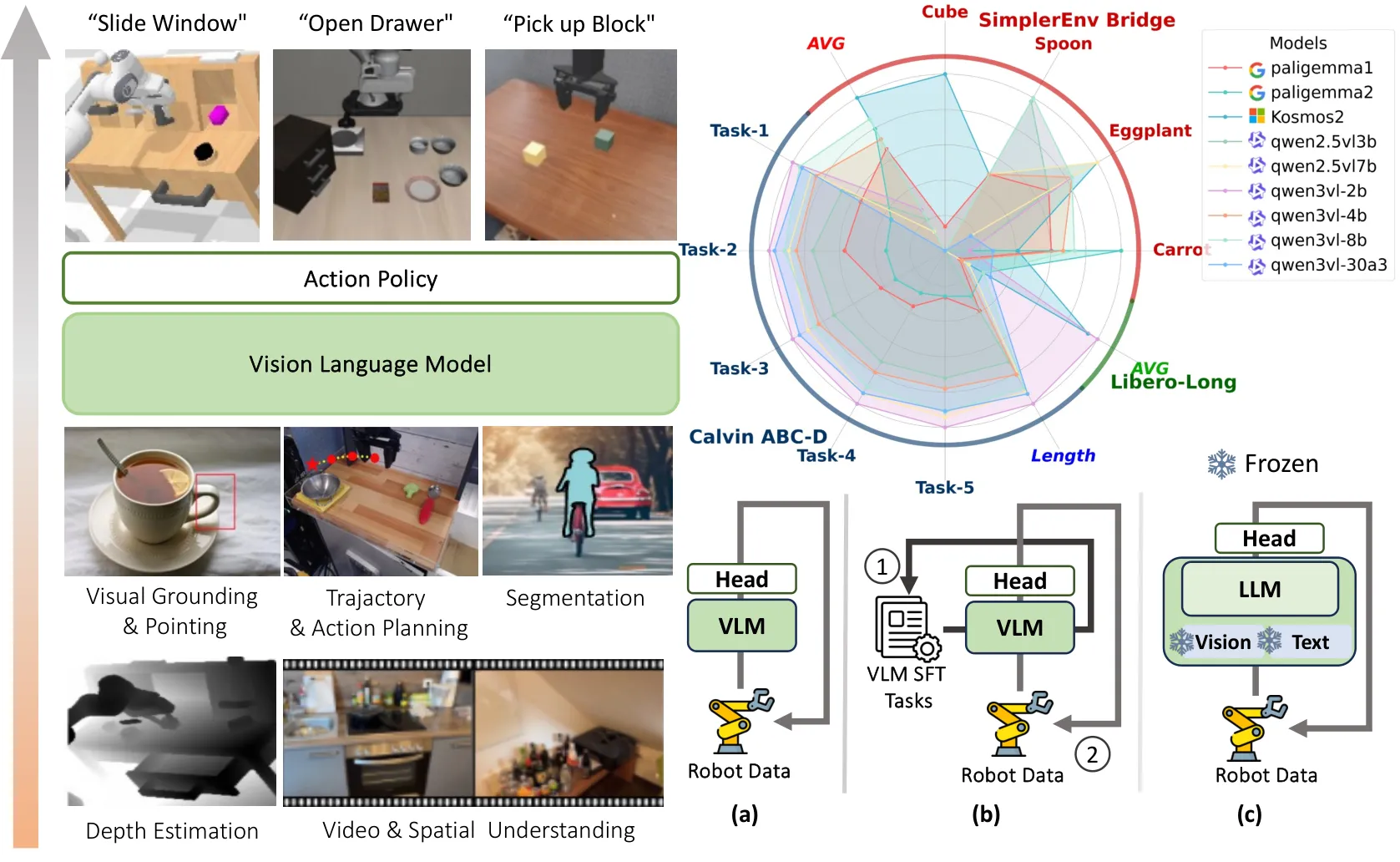
The January 2026 VLM4VLA study, from Tsinghua University and Alibaba’s Qwen team, tested how vision-language capabilities translated into robot control across three benchmarks.
The authors found that general VLM capabilities poorly predicted downstream action performance. Their experiments identified the visual module as the main bottleneck. The authors also reported consistent gains after training the visual encoder with control-relevant supervision.
This finding changes model selection. A system can describe an object convincingly yet miss the spatial information needed to handle it. Multimodal perception needs evaluation against the actual physical task.
The practical lesson is to compare policies on the intended operation before treating a language or image leaderboard as a purchasing signal.
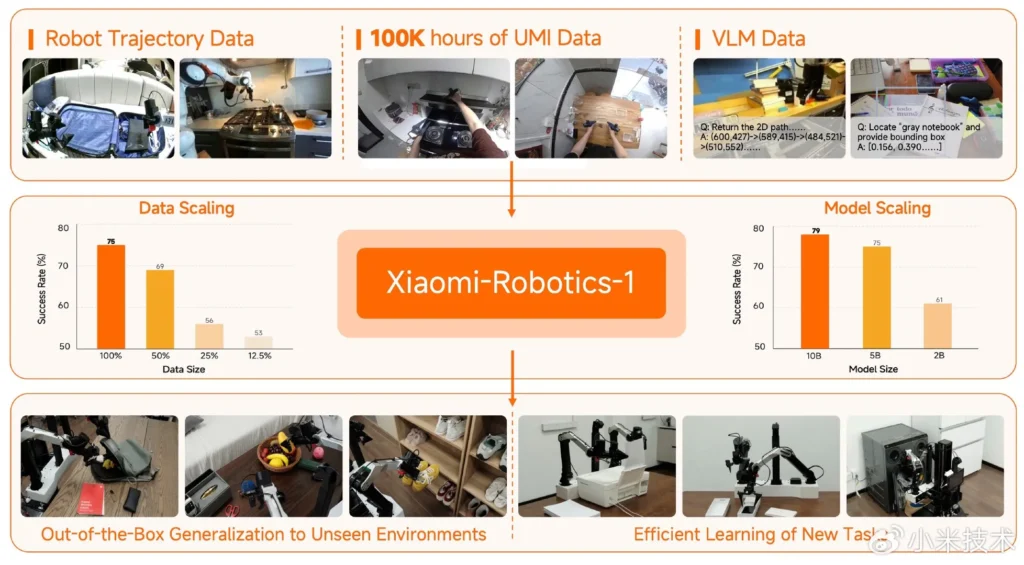
Xiaomi’s July 2026 Robotics-1 report describes pretraining on more than 100,000 hours of real-world manipulation trajectories collected with Universal Manipulation Interface devices.
These handheld grippers let people record interactions with objects. Xiaomi’s automatic annotation pipeline describes changes between scene states. Subsequent training aligns that knowledge with robot bodies and the instructions people give them.
The useful detail is this separation: broad movement data can come from human-operated collection devices, while robot-specific data teaches the policy how to execute with particular hardware. It creates another route for gathering experience, with adaptation still required.
An earlier February 2026 Robotics-0 report addresses a different constraint. Its asynchronous execution lets a robot perform the remaining actions in one chunk while computing the next.
That timing matters commercially. A capable policy that repeatedly pauses can lose useful throughput. Data quality and runtime behavior need separate attention.
Galaxea’s August 2026 G0.5 paper describes one transformer decoder that produces reasoning and action symbols under a shared objective. Its visual memory incorporates recent observations.
That memory addresses a practical weakness: a single image can miss information when an arm or another object briefly blocks the view. Recent visual history can help interpret what happened.
The company’s public repository records its June 2026 checkpoint release and inference examples for several robot platforms. This gives development teams material to inspect and test.
The access terms matter. G0.5’s June 2026 community license excludes production use and places conditions on internal evaluation, including authorized hardware. A commercial deployment therefore requires separate permission. Resolve licensing before budgeting an integration.
The OpenVLA-OFT research provides an important comparison. Its authors reported 26 times higher action-generation throughput and approximately three times lower latency than the base OpenVLA model through parallel decoding and action chunking.

Figure Helix 2.5 addresses a different question: transfer to unfamiliar environments. In its September 17, 2026 announcement, Figure reported tests of three behaviors across 30 previously unseen homes.
These measures describe different capabilities. Faster computation and transfer across homes each matter, but neither establishes performance on a factory shift. Comparisons need matching tasks, hardware, intervention rules, and output standards.
Research results establish a starting point for a pilot. They cannot supply the operating assumptions for a particular site. The 2025 robotics review identifies safety and failure recovery as unresolved deployment challenges.
A useful pilot should test a defined task and record every attempt.
| Evaluation question | Evidence to request |
| Does the robot finish useful work? | Completed units that meet quality requirements per operating hour |
| How much human help does it need? | Intervention frequency and the time spent resolving each incident |
| Can it handle normal variation? | Results across lighting, packaging, object placement, and product changes |
| Can it recover from errors? | Outcomes after dropped objects, missed grasps, and interrupted tasks |
| Does the economics work? | Hardware, compute, data collection, integration, maintenance, and supervision costs |
Start with a bounded operation, such as sorting a defined product family. Compare it with the current manual process and a suitable conventional automation option.
Keep unsuccessful runs in the record. Separate time spent attempting the task from time spent producing accepted output. A fast movement that damages packaging adds rework rather than value.
Agree on stopping rules and human handover before testing near workers. These rules make the pilot’s result easier to assess and expose the operational burden behind a success percentage.
These projects suggest a useful way to assess suppliers: ask which capability remains valuable after a model is replaced. A reusable task dataset, calibrated hardware interface, or established testing process can outlast an individual checkpoint.
For partnerships in China, define who maintains the model, hardware interface, and task data. Agree on deployment ownership, adaptation services, model updates, and exit terms.
Those questions make the growing embodied AI ecosystem easier to evaluate. They direct attention toward the resources and accountability a buyer receives.
ChoZan helps teams examine developments such as Vision-Language-Action Models through China-focused research, expert discussions, workshops, and tailored learning expeditions. Its humanoid robotics report offers a starting point for further study.
Book a consultation to discuss the developments and operational questions most relevant to your business.
A policy can control robot arms, mobile manipulators, or humanoids. It needs compatible observations and action interfaces. The right body depends on reach, payload, mobility, workspace, and the task’s physical requirements.
Yes, if its weights and inference software run locally on suitable hardware. Hugging Face’s 2025 SmolVLA release describes CPU-compatible execution. Local operation still requires checks for latency, memory, cooling, and camera processing.
There is no universal requirement. Xiaomi’s April 2026 Robotics-0 update demonstrates earbud insertion after post-training on 20 hours of data. That task-specific example cannot establish a training budget for another process.
Human videos can provide visual and behavioral information, but they don’t automatically include robot joint commands, contact forces, or calibrated motion. A training method must bridge those missing details before the footage becomes useful control supervision.
Policies may inherit multilingual capabilities from their backbone, but successful robot control needs task-specific validation. Test translated commands, local terminology, ambiguous phrases, and paraphrases. A language benchmark cannot establish dependable instruction following on physical hardware.
Yes, if its architecture and training include those inputs. Figure’s January 2026 Helix 02 announcement describes vision, touch, and body-state sensing. A camera-based policy doesn’t automatically gain tactile capabilities when new sensors are attached.
Keep a fixed set of representative tasks and failure cases for each update. Compare completion quality, intervention time, and motion behavior with the deployed version. Retain a rollback option and approve changes before fleet-wide deployment.
Check the licenses for code, weights, and backbone components alongside dataset terms. Download access alone does not establish commercial rights. Confirm permitted uses, attribution requirements, redistribution terms, and obligations attached to modified models.
Local inference can reduce transfers to external services, but privacy depends on the whole system. Review stored footage, remote diagnostics, training uploads, access controls, and retention periods. Ask vendors to document where each data stream travels.
A deployment can connect through an integration layer that translates business tasks into robot instructions. Define order identifiers, completion signals, exception handling, and human approvals. The model itself does not establish compatibility with existing operational software.