CONTENT
The leading solar panel manufacturers in China include JinkoSolar, LONGi, Trinasolar, JA Solar, Tongwei, Astronergy, and Risen Energy. Yet the best supplier depends on the project. TOPCon leaders compete on scale and cost, HJT specialists target high bifaciality and hot-climate performance, while back-contact producers prioritize power density.
China added 315 GW of solar capacity in 2025 and ended the year with 1.2 TW installed. The commercial question now concerns delivery, traceable materials, financeability, and warranty strength.
This is a strategic shortlist, not a shipment ranking. Canadian Solar is included because CSI Solar has major China operations, although the parent is headquartered in Canada. TCL Solar and DAS Solar appear separately because the July 2026 acquisition is recent and both product portfolios remain visible.
| Manufacturer | Current technology and supply-chain position | Best fit to investigate |
| JinkoSolar | Tiger Neo 3.0 uses next-generation TOPCon cells. | Scale and mature n-type production |
| LONGi | Hi-MO X10 uses HPBC 2.0 back-contact cells. | Space-constrained rooftops |
| Trinasolar | Vertex N uses i-TOPCon Ultra. | Utility and commercial projects |
| JA Solar | DeepBlue 5.0 uses advanced n-type TOPCon. | Large global projects |
| Canadian Solar | CSI Solar spans modules, storage, and regional production. | Globally diversified supply |
| Tongwei | Strong across polysilicon, solar cells, and TNC 2.0 modules. | Upstream depth and vertical integration |
| Astronergy | ASTRO N7 and N8 use advanced TOPCon. | High-power n-type modules |
| Risen Energy | Hyper-ion is a high-power HJT platform. | Hot climates and bifacial sites |
| DAS Solar | Covers TOPCon 5.0, DBC, and tandem development. | Mainstream and emerging technology |
| AIKO | ABC prioritizes power density and commercial module efficiency. | Premium rooftops |
| Huasun Energy | HJT specialist serving several installation types. | High-bifaciality projects |
| DMEGC Solar | Infinity covers utility and distributed TOPCon modules. | Diversified industrial backing |
| GCL System Integration | Module arm within the wider GCL solar ecosystem. | Upstream ecosystem links |
| TCL Solar | Combines wafers, BC products, and control of DAS Solar. | Integrated BC production |
| Yingli Solar | PANDA modules use n-type TOPCon. | Model-level test evidence |
| Runergy | Cell specialist expanding TOPCon 3.0 modules. | Cell-manufacturing expertise |
| Suntech | Ultra T 3.0 uses n-type TOPCon and quarter-cut cells. | Broad project formats |
| Talesun Solar | Module supplier with current testing recognition. | Qualified secondary sourcing |
| EGing PV | Offers TOPCon, HJT, TBC, BAPV, and BIPV. | Specialized formats |
| Jolywood | Covers J-TOPCon plus encapsulation and backsheets. | Module and material expertise |
| Seraphim | Module-focused supplier with global channels. | Multi-brand sourcing |
| Hanersun | Module manufacturer and energy solution provider. | Flexible commercial partnerships |
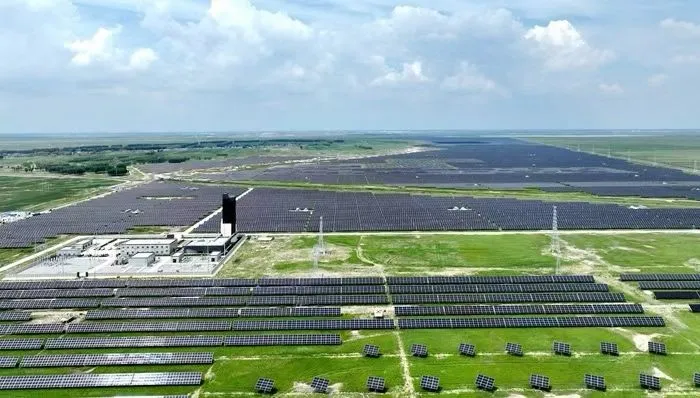
InfoLink Consulting’s 2025 global module shipment rankings reveal a clear four-tier structure among solar module manufacturers in China.
Tier 1 (80–90 GW): JinkoSolar (86.81 GW) and LONGi Green Energy (86.58 GW) finished in a statistical tie for first place. Jinko’s N-type TOPCon modules exceeded 90% of its shipments, while LONGi pushed its HPBC back-contact technology to 22.87 GW, or 26.4% of total shipments.
Tier 2 (60–70 GW): Trina Solar (67.88 GW) and JA Solar (66.53 GW) ranked third and fourth. Trina moved up from fourth place in 2024, while JA Solar’s volumes contracted more sharply as it deliberately reduced low-margin orders.
Tier 3 (35–45 GW): Tongwei (43.25 GW) and Astronergy (Chint New Energy, 35.60 GW) held fifth and sixth places.
Tier 4 (20–30 GW): GCL System Integration ranked seventh, followed by Hengdian Dongci (DMEGC) and Canadian Solar in a tie for eighth, with TCL Zhonghuan, Yingli Development, and Yidai New Energy tied for tenth.
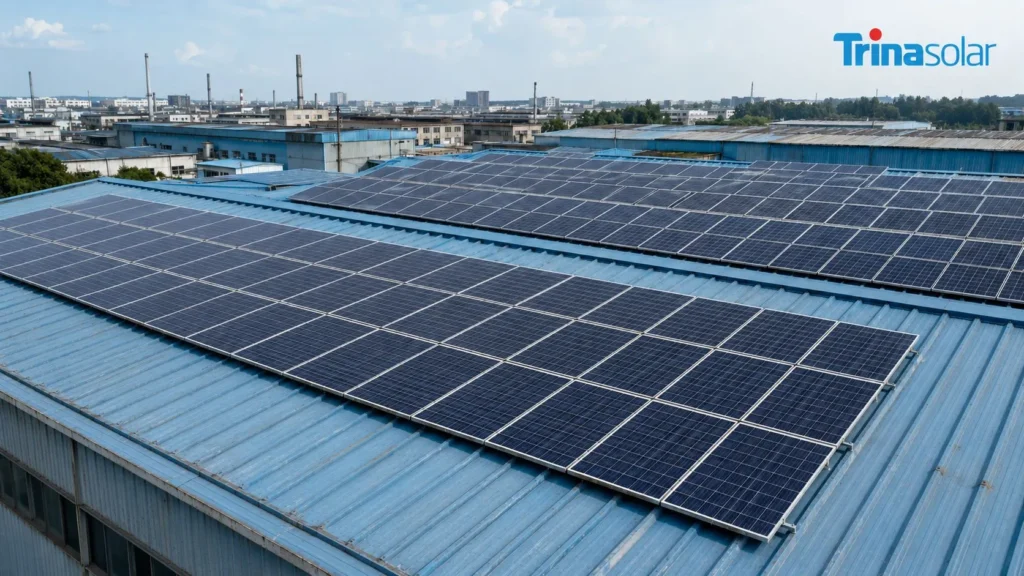
China’s advantage starts before module assembly. The chain moves from polysilicon to ingots and wafers, then to solar cells, glass, encapsulants, frames, junction boxes, and finished PV modules. Dense supplier clusters shorten qualification cycles and speed industrialization. China’s vast domestic deployment provides another source of demand and operating feedback.
The structure is changing. Ember reported that cells and wafers represented more than 40% of China’s solar product exports in the first half of 2025. Overseas factories may assemble modules locally while still depending on Chinese inputs. A “made in” label therefore reveals less than a full origin map.
TOPCon remains the broad commercial platform across JinkoSolar, Trinasolar, JA Solar, Tongwei, Astronergy, DAS Solar, DMEGC, Yingli, and Runergy. It fits current production economics and supports high-output bifacial products.
HJT has a smaller supplier base. Risen and Huasun are clear specialists. Trinasolar reported a certified HJT module-efficiency record in 2025, while Canadian Solar began trial production at a new HJT cell factory in 2026. Its bifaciality and temperature behavior can suit hot or vertical sites, but delivered cost and factory maturity still matter.
Back-contact designs remove front-side electrical contacts. LONGi, AIKO, TCL Solar, and DAS Solar are key names. Their products can deliver higher power per square meter, although proprietary architectures can concentrate replacement risk.
Low prices can hide supplier risk. Six large Chinese cell and panel companies recorded a combined RMB20.2 billion in losses during the first half of 2025. Polysilicon producers then created a restructuring vehicle in December 2025. TCL Solar’s acquisition of DAS shows that industrial consolidation has entered corporate action.
Domestic demand also changed. China’s new solar installations fell 66% year over year in the first half of 2026 after the 2025 rush ahead of pricing reform. Headline manufacturing capacity now deserves less weight than balance-sheet strength, factory selection, and credible service obligations.
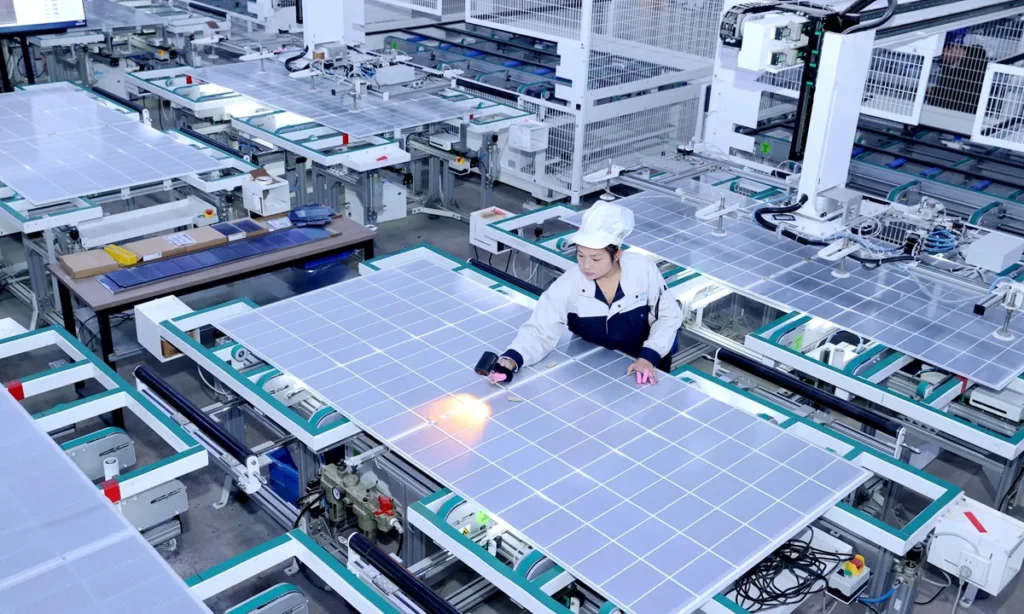
Start with the exact factory and bill of materials. A strong review should cover:
Destination-market rules can reshape a shortlist. The United States finalized trade findings on cells from Cambodia, Malaysia, Thailand, and Vietnam in April 2025. The EU’s 2025 Net-Zero Industry Act implementation introduced resilience criteria for relevant renewable auctions and public procurement.
BloombergNEF states that Tier 1 identifies manufacturers used in recently financed projects and should not replace product due diligence. Bankability measures lender acceptance. It does not create universal quality tiers for every model or factory. Independent testing, production audits, and contract enforcement complete the picture.
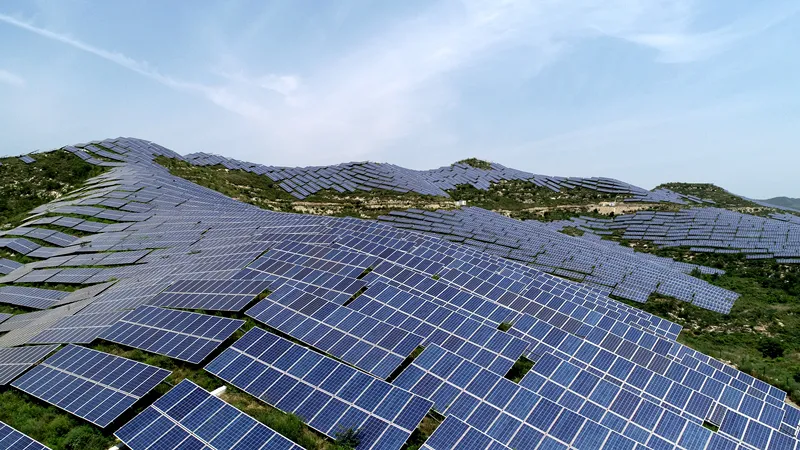
The strongest solar energy manufacturers in China now compete across technology, finance, global production, storage, and service. Price remains important, but the current cycle rewards disciplined sourcing. A resilient shortlist can include one large global supplier, one technology specialist, and one qualified secondary source.
This approach improves supply-chain resilience without ignoring China’s scale. It also reflects changing export markets. Local assembly is growing, Chinese upstream inputs remain influential, and trade rules increasingly follow cell and wafer origin.
China’s photovoltaic module exports reached 267.6 GW in 2025, up approximately 13% year-over-year. The top five destination countries in June 2025 were the Netherlands, Saudi Arabia, Pakistan, the UAE, and Greece. For the first two months of 2025, India, the Netherlands, Pakistan, Brazil, and Portugal led.
Nine of the top ten manufacturers now operate facilities in at least two countries, responding to rising trade tensions and localisation requirements. JinkoSolar maintains more than ten global manufacturing bases across China, the United States, Southeast Asia, and the Middle East.
By the end of the third quarter of 2025, Jinko became the first module manufacturer to deliver 370 GW total cumulative modules, with its Tiger Neo series surpassing 200 GW.
ChoZan helps global teams interpret solar panel manufacturers in China, clean-energy supply chains, and industrial shifts through research, executive briefings, expert calls, workshops, and China learning expeditions.
Book a consultation to turn China’s fast-moving solar sector into practical market, sourcing, and innovation insight.
Large orders may qualify for direct factory sales, while smaller buyers usually work through distributors. Compare minimum order quantities, payment terms, local stock, technical support, warranty handling, and import responsibility before choosing either route.
Check serial numbers through the manufacturer’s official verification channel and buy from an authorized seller. Inspect labels, packaging, connector brands, dimensions, and flash-test records. Confirm suspicious units directly with the manufacturer before installation.
Minimums vary by manufacturer, model, and destination. Large producers may quote full pallets or containers, while distributors can split stock into smaller lots. Custom labeling, uncommon wattages, or special dimensions usually require larger commitments.
Requirements differ by destination and application. Buyers commonly review IEC 61215 and IEC 61730, plus relevant fire, salt-mist, ammonia, or local grid certifications. The certificate holder, factory, model, and construction must match the delivered product.
Many lists mix global brands, trading companies, small OEM factories, and system integrators. Others rely on capacity announcements or old shipment data. Define “manufacturer,” confirm operating factories, and compare companies using one consistent date and method.
Some do, while major branded producers may prioritize their own channels or large project contracts. OEM buyers should clarify branding rights, certification ownership, minimum orders, tooling, approved materials, warranty responsibility, and territorial sales restrictions.
A typical shipment needs the commercial invoice, packing list, bill of lading, certificate of origin, insurance documents, and required conformity records. Customs may request added proof concerning tariff classification, cell origin, or supply-chain traceability.
Support models differ. Some use local subsidiaries, distributors, insurers, or authorized service partners. Buyers should identify the legal warrantor, claims process, response time, labor coverage, shipping responsibility, remedy formula, and recourse if the distributor closes.
Usually not without design review. Utility modules may be larger, heavier, higher-current, and optimized for trackers or ground mounting. Residential products may prioritize roof handling, appearance, fire classification, and compatibility with common inverters or optimizers.
Compare landed cost per watt for the same delivery terms, certification scope, warranty, and module format. Add freight, duties, financing, inspection, balance-of-system effects, expected energy yield, and likely claims costs before selecting the lowest quote.