CONTENT

Nowadays, involution (内卷) and lying flat (躺平) have become defining terms in China. Involution describes a cycle where everyone works harder but gains less, while lying flat reflects a conscious refusal to chase hollow milestones.
Competition in education and the workforce has reached new heights, and many young adults feel dissatisfied and frustrated. According to a recent report, China’s youth unemployment rate was 17.6% in September 2024, despite the country having millions of job openings. They feel that their efforts in academics and careers don’t yield the promised rewards.
Moreover, a research report in August 2025 revealed that workers in Chinese companies average 48.7 hours per week. This overwork and mounting social pressures have resulted in rising stress levels and burnout. It’s also pushing more individuals to adopt the “lying flat” mentality.In this article, we’ll explore how these societal pressures reshape the Chinese workforce and contribute to the growing appeal of the lying flat movement. We’ll discuss the underlying causes and effects and explore what these shifts mean for China’s future and its younger generation’s changing values.

“Involution” in today’s Chinese context refers to a vicious cycle of excessive competition with diminishing returns, leaving participants exhausted but without meaningful progress. The term comes from the Chinese neijuan (literally “curling inward”) and conveys a sense of being trapped in fruitless busyness.
Anthropologist Xiang Biao famously described involution as “a dead loop in which people constantly force themselves … a race that participants are not allowed to fail or exit.
Involution appears across all aspects of Chinese life:
The result is constant anxiety—no matter the effort, someone is working harder, and rewards become increasingly diminished.
The result is a culture of exhaustion. Competitive behaviors once seen as “hard work” are now baseline expectations, leading to diminishing returns and burnout.
Involution traps people in a downward spiral. Late hours or expensive tutoring, once offered an edge, are now baseline expectations, creating pressure without a payoff. With economic growth slowing and competition for jobs, housing, and education rising, many young Chinese feel that the traditional path of hard work no longer guarantees success.
China’s education system has become a prime example of involution, where every year brings higher stakes and heavier workloads.
The education race has become self-sustaining: each parent fears their child will fall behind if they stop, so pressure mounts year after year, entrenching a cycle of financial strain and youth burnout.
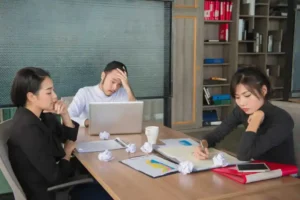
The “996” work culture—working from 9 AM to 9 PM, six days a week—has become prevalent in many industries in China, particularly in the tech sector. Young professionals often feel they must work 72-hour workweeks to keep their jobs or advance in their careers. Such a workaholic culture has led to burnout and publicized tragedies.
Despite being declared illegal in 2021, overwork remains normalized in numerous companies. This overwork culture leads to employee burnout.
Many workers report feeling mentally drained and struggling with poor work-life balance, yet continue to work long hours in hopes of career advancement, even though they realize the limited rewards. The culture of overwork becomes ingrained, making it difficult for many to break free from this cycle of excessive effort and limited return.
China’s slowing economy has intensified competition for stable jobs, especially among younger workers.
This structural imbalance—too many highly educated job seekers chasing too few high-quality roles—has made involution feel unavoidable. Lying flat, in this context, is less rebellion and more a rational retreat from a zero-sum race.
Most of China’s Gen Z are only children, expected to excel academically, secure stable jobs, support parents, and continue the family line. Many feel this social contract has collapsed—despite hard work, they cannot match their parents’ stability or upward mobility.
Marriage and birth rates continue to decline, even after the three-child policy was launched in 2021. For many, lying flat involves choosing not to date, get married, or have children. Some call themselves “full-time children,” living with parents instead of pursuing careers or starting families.
Older generations often view this as irresponsible, but for young people, it’s a practical response to job scarcity, high costs, and relentless pressure. In an involuted society, opting out becomes a coping mechanism rather than a form of rebellion.

High housing costs can delay marriage and family formation, increase financial stress, and lead to longer working hours. Renting is expensive, leaving little room for savings or risk-taking. Homeownership defines social status, making housing a central pressure point that drives competition and contributes to involution.
Millions of workers participate in China’s gig economy. Jobs like ride-hailing and food delivery offer precarious wages, long hours, and no benefits. Many people juggle multiple jobs to make ends meet, which can lead to exhaustion and stress. The gig economy increases competition, reinforces instability, and adds to the burnout cycle.
China’s slower growth and stagnating prices limit job and income opportunities. Young professionals face rising competition, reduced job security, and higher stress. The economic slowdown amplifies societal pressure, making stability more challenging to achieve and intensifying the race for scarce resources.
Virtually all segments of young Chinese society have felt the ripple effects of involution and the lying-flat movement, but in different ways. Below, we explore how various groups experience or respond to these trends:
China’s Gen Z and younger millennials are the most educated generation but face a slowing economy and high youth unemployment. Many believe that the traditional path of attending top schools, securing internships, and working hard no longer guarantees stability.
Tang Ping first appeared among urban white-collar professionals, rejecting the 996 culture. Some left high-paying jobs to pursue simpler lives, often relying on savings or family support. Blue-collar and gig workers experience a similar withdrawal, though often out of necessity rather than choice.

Urban youth dominate online tang ping discourse, but rural youth embody the same disillusionment. Some burned-out graduates have joined the “return-to-hometown lying flat” (返乡躺平) trend, starting guesthouses or living simply in smaller towns. Rural-born youth who never left often face resource inequality, turning to Douyin or gaming for escape and embracing a “let it rot” (摆烂) mindset.
A countertrend has emerged with youth retirement homes in provinces like Hebei, Yunnan, and Shandong. These retreats offer gardening, communal living, and minimal structure, drawing urban youth seeking rest. Whether by choice or necessity, both groups share a desire for stability and a break from relentless pressure.
Companies and cultural creators in China began adapting in subtle yet noticeable ways in 2024, responding to youth fatigue over constant competition and the growing “tang ping” sentiment.
Involution drives students and workers to work long hours with minimal results, leading to burnout. In 2024, 60% of urban employees reported high stress levels, highlighting the growing pressure in the workplace (中国心理健康网). Burnout reduces efficiency, increases mistakes, and raises turnover, impacting both individual well-being and societal productivity.

If involution is the disease, “lying flat” is the cure – at least in the eyes of a growing number of Chinese youth. Lying flat (tǎngpíng) is a slang term and social movement meaning to reject hustle culture and opt for a low-desire, minimalist lifestyle.
Instead of endlessly striving (and stressing) for career advancement, home ownership, marriage, and other traditional markers of success, those who “lie flat” choose to “do the bare minimum” and prioritize peace of mind. It’s essentially dropping out of the rat race as a form of quiet resistance.
Lying flat is not doing nothing; it is deliberately lowering one’s ambitions. Those who take tang ping jobs or remain unemployed live frugally and avoid traditional milestones like home ownership, marriage, or career advancement.
Luo Huazhong, who popularized the term, lived on odd jobs and minimal meals, symbolizing a rejection of overwork. Many embrace this anti-materialist stance to reclaim autonomy and reject being seen as “production tools.”
Tang Ping is a silent protest against an economy demanding total effort without proportional rewards. Similar to Western “quiet quitting,” it has a sharper cultural edge in China, challenging the narrative of the “Chinese Dream.”
By 2021, it was a top internet meme, with slogans like “A chive that lies flat is hard to reap.” This resonated with young people but alarmed authorities and older generations, revealing the tension between an ambition-driven culture and a generation opting out.
The gig economy has grown with the emergence of digital platforms that enable workers to offer on-demand services. This shift provides flexibility and freedom compared to traditional full-time jobs. Sectors like ride-sharing, freelance tech, and creative industries are key examples.
The rise of self-employment is driven by the desire to escape rigid corporate structures and achieve a better work-life balance. Young people are especially drawn to these opportunities for autonomy and the ability to pursue personal interests without long-term commitments.
Lying flat reflects issues like excessive competition and unrealistic expectations. It calls for a shift in how society defines success, moving toward balance and mental well-being.
Governments and businesses must create environments that prioritize work-life balance, support mental health, and reduce pressure. Instead of viewing lying flat as a rebellion, it can be seen as a call for change in societal structure.

Government policies, such as housing subsidies, reduced education and healthcare costs, and increased job opportunities, are essential to alleviating the pressures driving involution and lying flat. In big cities, young adults often struggle with high housing costs, and easing financial burdens can reduce the urge to disengage from the job market.
To combat burnout in the workplace, companies should reduce excessive work hours, offer flexible work schedules, and prioritize employee mental health. Workers often feel trapped by being overworked and receiving little reward. Fostering a healthier work environment can prevent burnout and improve productivity.
The education system exacerbates involution by focusing too heavily on traditional career routes. Some students feel pressure to follow conventional tracks. By emphasizing real-world skills, creativity, and emotional intelligence, we can create a more balanced approach to success, reducing the competitive pressure that fuels burnout.
Both involution and lying flat stem from unrealistic expectations. Young people must focus on clarifying their goals and adopting a balanced approach to work and life. Often, young adults experience stress from societal comparisons, but those who prioritize self-care and meaningful relationships tend to be more fulfilled and resilient.

In response to the challenges posed by involution and the “lying flat” movement, the Chinese government has implemented several policy measures:
While these initiatives signify a commitment to addressing societal pressures, their effectiveness is still under evaluation. Challenges remain in enforcement and cultural adaptation, particularly in industries with entrenched overwork cultures.

To effectively address involution and the lying flat movement, it’s crucial to move beyond raising awareness. Real change requires concrete action. Collaborating with Ashley Dudarenok, an expert in China’s digital trends, can enhance campaigns focused on mental health and work-life balance. Her insights into consumer behavior help craft strategies that resonate with the right audience.
Partnering with ChoZan enables businesses to establish effective support systems for individuals experiencing stress and burnout. ChoZan’s deep understanding of China’s market empowers the development of programs that prioritize employee well-being and foster a healthier work environment.
Get real-time insights into:
Join Ashley Dudarenok today to successfully achieve your goals!
Together, we can create a more supportive and balanced society. Contact us now to discover how we can help you take meaningful action.
The “996” culture — working from 9 AM to 9 PM, six days a week — has led to widespread employee burnout. It forces workers to sacrifice time for themselves and their families, resulting in poor mental health and strained relationships. The relentless pace does not guarantee job satisfaction or personal growth.
While the “lying flat” movement challenges traditional work habits, it raises concerns about productivity. Many young people opting out of the competitive hustle could lead to a drop in the workforce’s efficiency. However, this shift may spark new conversations about striking a balance between economic progress and personal well-being.
Social media amplifies the pressure of involution by showcasing a curated version of success. Platforms like Weibo and Douyin create environments where people feel compelled to keep up with others’ achievements. This constant comparison pushes individuals into unhealthy competition, affecting their mental state and overall satisfaction.
Yes, traditional values, particularly those rooted in Confucianism, emphasize the importance of hard work and meeting family expectations. “Lying flat” can be seen as rejecting these values, often considered lazy or unambitious. Society pressures individuals to conform to norms, making it challenging for many to pursue a lifestyle that prioritizes relaxation and balance.
Young people today feel increasingly detached from the rat race because the constant drive for success seems hollow. After years of intense competition, many question the value of the rewards. Pursuing status and wealth often feels unfulfilling, prompting a desire for a simpler life focused on happiness and personal well-being.
Small businesses feel the weight of involution, especially in a market that rewards only the most competitive. Entrepreneurs face tremendous pressure to outperform their rivals, but they often burn out due to insufficient resources or support. This creates a cycle where businesses struggle to stay afloat while also managing employee well-being.
Although it’s most visible among younger generations, “lying flat” principles resonate with people across age groups. Regardless of age, many workers are tired of the grind and reevaluate their approach to life and work. The desire for a less stressful existence isn’t limited to youth; it’s becoming a wider societal shift.
Skyrocketing property prices in China make homeownership an elusive dream for many, adding pressure to work harder and longer. Young people, especially in large cities, are caught in a cycle of overwork, hoping to buy homes but often unable to reach that goal. The stress of this unattainable dream directly contributes to feelings of exhaustion and disillusionment.
China’s aging population and shrinking birth rates are shaping the future of the workforce. With fewer young people entering the labor market, some might question whether the societal push to work relentlessly is sustainable. This demographic shift prompts China to reassess its traditional work culture and consider alternatives, such as “lying flat,” as a viable lifestyle choice.
For many, especially in lower-income regions, “lying flat” may not be a feasible option. Economic necessity forces people to keep working, even if they feel overwhelmed. However, for those who can afford to slow down, the movement offers a much-needed escape from the pressures that define urban life.
The Chinese government and corporations view “lying flat” as a challenge to their work culture. The government has expressed concern that it could harm the country’s economic growth, while companies worry about the impact on employee productivity. However, some businesses are acknowledging the need for a better balance between hard work and personal time.
Some universities are introducing reforms to ease academic pressure amid rising mental health issues among students. There’s a slow shift toward offering better mental health resources and reducing reliance on after-school tutoring. However, many students still feel intense pressure to perform, as the competition for top universities remains fierce.
While “lying flat” might seem like a form of withdrawal, it could, in the long run, lead to healthier societal norms. It promotes focusing on personal happiness and well-being rather than chasing material wealth. If more widely adopted, it may encourage a better work-life balance and foster a cultural shift that prioritizes mental health over career success.
To avoid getting caught in the cycle of involution, individuals can start by reassessing their priorities. Setting clear boundaries at work, taking regular breaks, and embracing hobbies that aren’t tied to competition can help. Being aware of the signs of burnout and learning to step back when necessary are key steps in maintaining a healthier, balanced life.