CONTENT

China’s industrial drones matter now because they sit at the meeting point of aerial robotics, industrial automation, data infrastructure, and the low-altitude economy. DJI gives this shift a recognizable anchor, but the deeper story is China’s ability to turn drone hardware into repeatable enterprise workflows across inspection, mapping, agriculture, energy, and emergency response.
For global business leaders, the strategic question is no longer only about aircraft performance. It is about how drones move from specialist tools into managed operating systems. That shift changes inspection budgets, field labor models, asset monitoring, farm productivity, and low-altitude services.
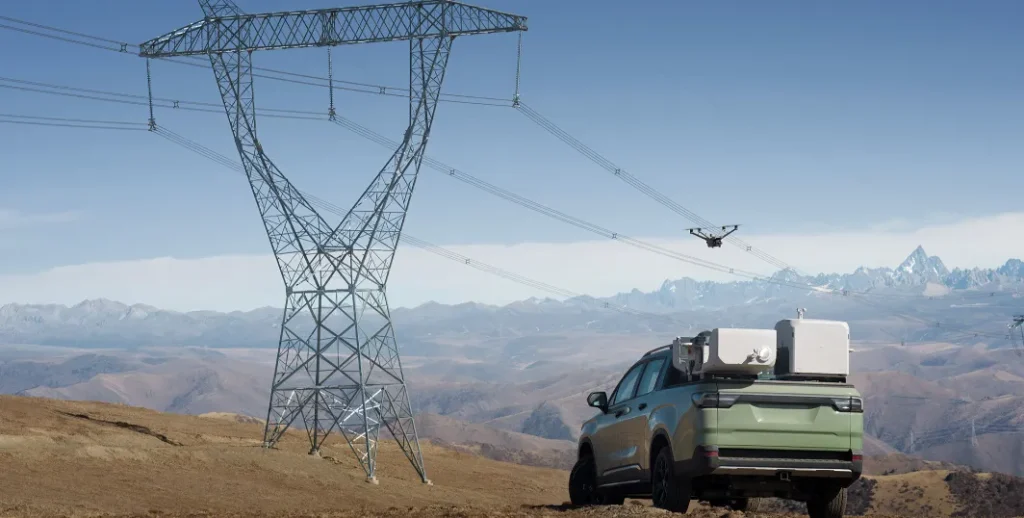
Industrial drones are becoming strategic infrastructure because they collect operational data from places that are expensive, risky, or slow for people to inspect. In China, this matters because infrastructure, energy, agriculture, logistics, and smart city systems all need faster field visibility.
The early drone market focused on flight and imaging. The enterprise market now values repeatability, sensor quality, route planning, cloud coordination, and integration with business processes. That is why drone robotics has become a boardroom topic in asset-heavy industries.
An industrial drone now performs work that once required manual inspection teams, scaffolding, vehicles, helicopters, or delayed site visits. In power grids, the value comes from finding equipment risk earlier. In construction, the value comes from faster site measurement.
China’s low-altitude economy gives industrial drones a policy environment beyond hobbyist aviation. The 2025 policy direction supports large-scale application scenarios, safer airspace management, and stronger commercial use of drones. This creates demand for aircraft, docks, mapping software, data platforms, maintenance providers, and trained operators.
The business implication is clear. China is treating low-altitude activity as a system. That system needs rules, infrastructure, industrial suppliers, and local deployment capacity. For executives, this makes China a living laboratory for drone-enabled productivity.
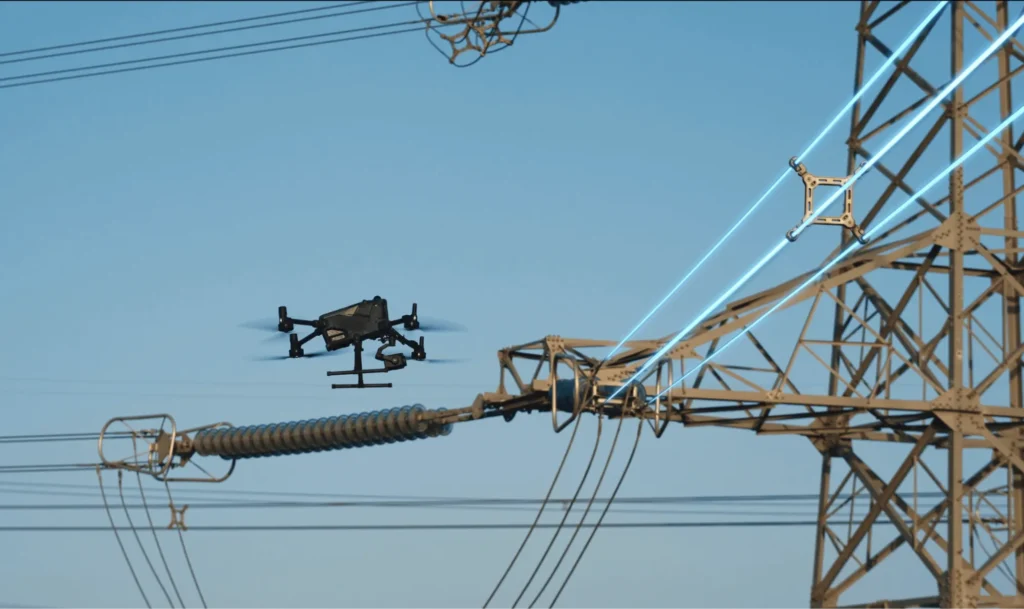
DJI Enterprise has become important because it connects aircraft, sensors, software, services, and developer tools into a usable stack. In March 2026, DJI Enterprise won the first batch of drone inspection contracts for the year, valued at 1.83 billion yuan ($250 million).
This is a mass deployment that simultaneously covers ultra-high-voltage transmission lines, urban substations, and distribution networks.
DJI Enterprise does not compete only as a drone manufacturer. It competes through the full operational package. Aircraft, payloads, controllers, FlightHub 2, Terra, docks, accessories, and service programs help organizations move from flights to managed operations.
This matters for procurement. A utility company or construction group rarely wants a single aircraft. It wants route control, imaging consistency, pilot management, data review, support, and compliance readiness. That broader stack gives DJI enterprise drones practical appeal.
China offers dense supplier networks, deep robotics engineering, fast electronics manufacturing, and demanding domestic use cases. Shenzhen adds another layer because the city combines hardware iteration, software talent, and low-altitude policy experimentation.
The result is a market where products can improve quickly, and deployment playbooks can form across sectors. This is why a DJI enterprise drone can be viewed as part of China’s broader industrial automation story, not only as aviation equipment.
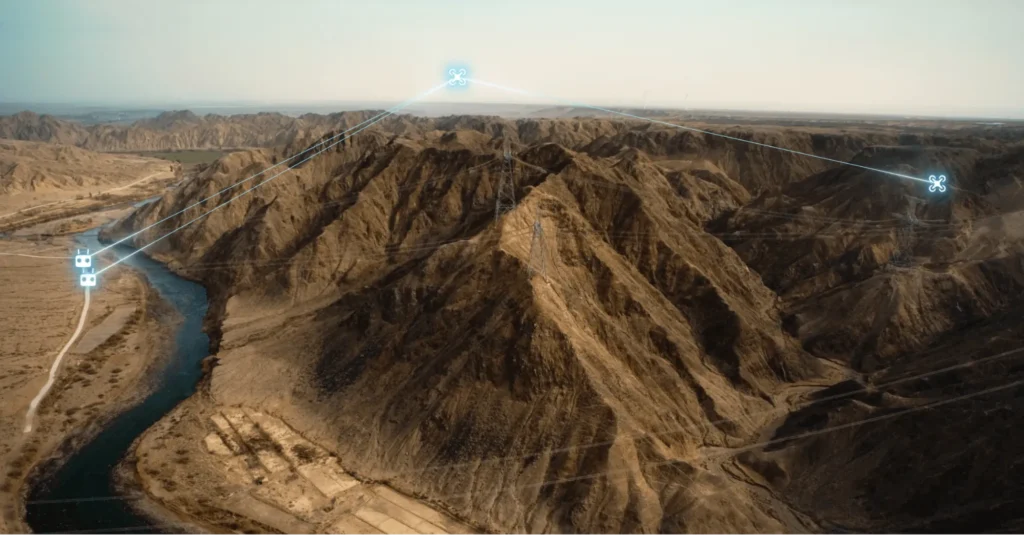
The search term DJI Matrice 4 Enterprise usually directs buyers to the Matrice 4 Series, highlighting how enterprise customers now compare compact multi-sensor drones by mission value. The Matrice 4T serves the electricity, emergency response, public safety, and forestry sectors. The Matrice 4E supports surveying, mapping, construction, and mining.
For the State Grid contract, the DJI Matrice 4T variant provides the thermal inspection capability. The quad camera system includes a wide-angle, medium tele, telephoto, and an infrared thermal camera running at 640×512 resolution. It pairs this with a laser rangefinder that reaches 1,800 meters.
When an insulator overheats on a tower, the M4T flags the anomaly, logs GPS coordinates, and routes the data to an automated report. That workflow removes the need for a helicopter crew to guess which tower is failing.
The DJI Matrice 4E variant is designed for mapping and surveying. It features a 4/3-inch CMOS sensor with a mechanical shutter to avoid rolling-shutter distortion. With RTK positioning accuracy holding at 1 cm + 1 ppm horizontal and 1.5 cm + 1 ppm vertical, the M4E covers 2.8 km² of orthophoto capture in a single flight. For surveyors and civil engineers, this replaces weeks of walking the ground with two hours of flight time.
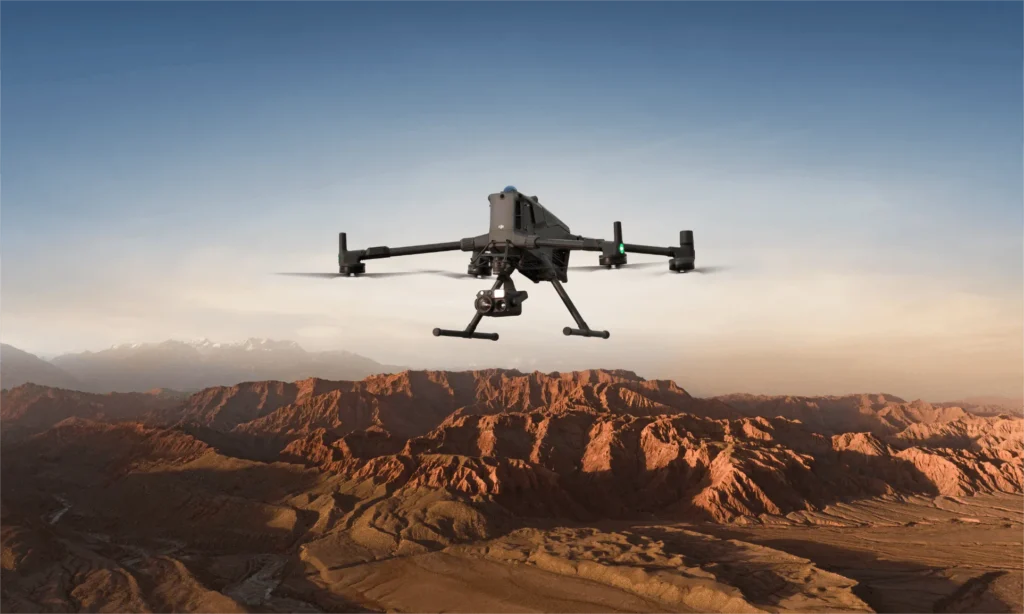
Thermal inspection now supports predictive maintenance, not only fault detection. The DJI Matrice 4T can measure temperatures from-20°C to 550°C with ±2°C accuracy, helping solar farms detect panel hotspots and wind operators identify early friction risks.
For energy inspection, the Zenmuse L2 on the Matrice 350 RTK adds LiDAR-based 3D modeling. It combines LiDAR, high-accuracy IMU, and RGB imaging to map power line corridors, vegetation risk, conductor geometry, and icing conditions.
With autonomous docks, operators can run faster checks, recharge drones quickly, and turn inspection flights into structured maintenance data.
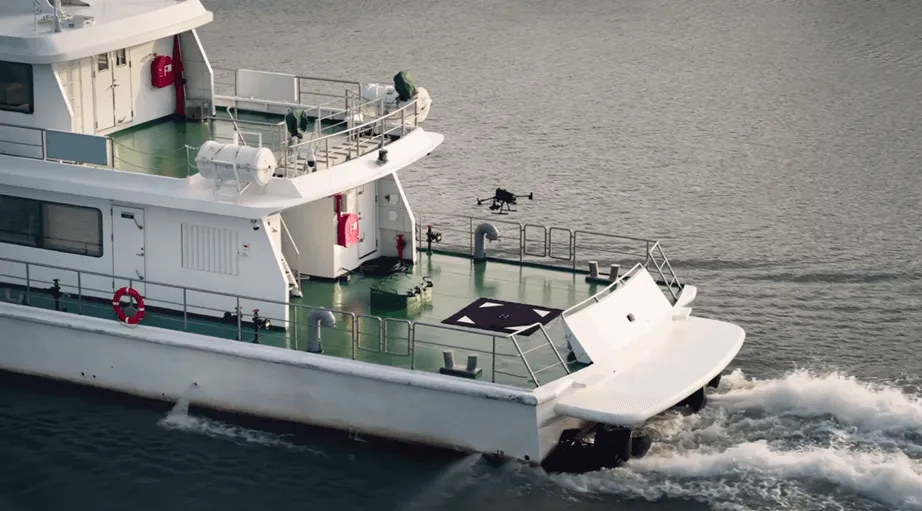
Autonomous docks are important because they move drones closer to continuous infrastructure. DJI Dock 3 strengthens this direction with remote operations, vehicle-mounted deployment, and Matrice 4D or Matrice 4TD drones for demanding field environments.
For industrial users, the dock model changes staffing and response logic. Teams can station drones near ports, substations, highways, industrial parks, mines, and emergency zones. Instead of sending crews to inspect every site, managers can trigger flights, review data, and prioritize human intervention.
Vehicle-mounted docks are particularly relevant in China because many industrial assets span large territories. Power lines, pipelines, roads, farms, and emergency scenes rarely fit within a single fixed operating base.
A mobile dock gives field teams more flexibility. It supports temporary missions, disaster response, and route-based inspection. It also reflects a broader pattern in China’s robotics market. Automation becomes more valuable when it adapts to messy physical environments.
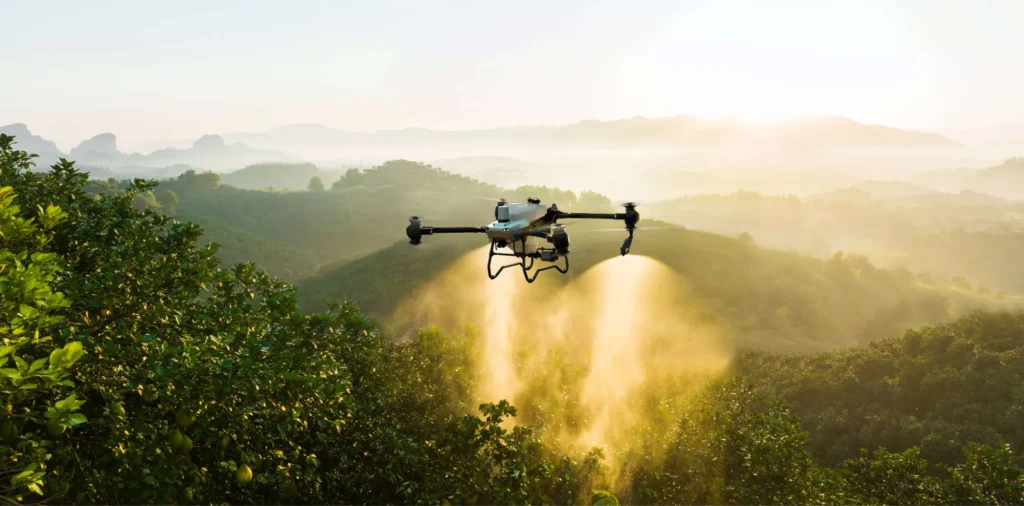
The low altitude economy also supports agricultural automation. DJI agricultural drones, such as the AGRAS T50, help farms spray, fertilize, and cover fields with greater speed and precision. The T50 can spray up to 24 liters per minute and spread granules at up to 108 kg per minute.
The advantage is timing. After rain, rough terrain, or sudden pest pressure, an industrial drone can reach fields faster than heavy ground equipment. It also reduces soil compaction and supports more targeted use of inputs.
Paired with mapping drones such as the Mavic 3M, the system can generate variable-rate spray maps based on crop health imagery. This shifts agricultural spraying from broad application to selective treatment, helping farm managers reduce waste, protect yield, and improve operational control.
Energy inspection is one of the most commercially persuasive use cases for industrial drones. Power grids, wind turbines, solar farms, oil and gas facilities, and substations all require regular inspections. Drones reduce exposure to dangerous environments and improve data frequency.
Thermal inspection adds another layer. Heat, corrosion, vegetation encroachment, structural changes, and component damage can all affect asset performance. When teams combine visual, thermal, and mapping data, they can move from reactive maintenance to earlier intervention.
For investors and operators, the key metric is not flight count. It avoids downtime, enables faster fault detection, improves maintenance planning, and reduces inspection risk. This is where drones become part of industrial resilience.
China’s advantage in industrial drones stems from rapid product cycles, deep manufacturing capabilities, real market demand, and policy support for the low-altitude economy. DJI is the clearest example, but the bigger lesson is execution.
For executives, three areas matter most.
Procurement teams also need a careful sourcing strategy. DJI remains strong across many commercial categories, but geopolitical scrutiny can affect market access, public-sector buying, and compliance requirements.
Industrial drones are becoming part of China’s industrial operating system. They help companies inspect assets, detect problems faster, and automate fieldwork. DJI shows how aerial robotics can move from a hardware purchase to a practical enterprise capability.
ChoZan helps global executives, innovation teams, and strategy leaders understand China’s technology systems through research, workshops, expert briefings, and learning expeditions. If your team is studying industrial drones, low-altitude innovation, DJI Enterprise, robotics, or smart infrastructure, ChoZan can help turn market signals into practical strategic insights.
Book a consultation to explore how China’s aerial robotics ecosystem can inform your next growth, innovation, or transformation agenda.
DJI stands out for combining aircraft, sensors, software, docks, service support, and developer tools. This helps enterprises move more quickly from drone trials to repeatable workflows for inspection, mapping, agriculture, and emergency response.
Industrial drones are widely used for inspection, but they also support mapping, spraying, security patrols, emergency response, surveying, environmental monitoring, and construction progress tracking. The strongest use cases link drone data to operational decisions.
Consumer drones focus on photography, portability, and ease of use. Enterprise drones prioritize sensor options, data accuracy, flight reliability, fleet management, security controls, service plans, and integration with professional workflows.
Companies often search for the DJI Matrice 4 Enterprise when comparing Matrice 4 Series options for inspection, mapping, public safety, or surveying. The search reflects demand for compact enterprise aircraft with stronger sensors.
A company should consider a DJI thermal drone when heat data improves decision-making. Common examples include electrical fault detection, solar panel inspections, search missions, fire response, wildlife monitoring, and night-visibility support.
Autonomous drone docks help teams run repeatable missions from fixed or mobile sites. They reduce travel time, support faster incident response, and help managers collect inspection data across dispersed assets.
DJI drones with thermal cameras can support crop stress observation, irrigation checks, and field monitoring plans, but spraying drones solve a different task. Farms should match payloads to agronomy needs.
Teams need trained pilots, safety procedures, data-handling rules, mission-planning skills, maintenance routines, and clear reporting workflows. The best programs connect drone outputs to decisions, not only flight activity.
China’s low-altitude economy supports commercial drone use through policy attention, local experimentation, infrastructure planning, and aviation rule development. This gives drone companies clearer pathways for logistics, inspection, emergency response, and urban services.
Industrial drone programs can reduce costs by replacing risky site visits, shortening inspection cycles, improving early fault detection, and better organizing data. Savings depend on mission frequency, asset type, and workflow integration.