CONTENT
Updated:
By: Ashley Dudarenok
Updated: March 3, 2026
The emergence of DeepSeek, a family of large language models (LLMs) from the Hangzhou‑based start‑up DeepSeek Inc., marked a pivotal moment in the global artificial intelligence landscape. In December 2024 and January 2025, the company released DeepSeek‑V3 and DeepSeek‑R1, high‑performance LLMs that generated headlines for their impressive reasoning ability and surprisingly low training and inference costs.
Because the models’ weights were publicly available, researchers and developers around the world suddenly had access to Chinese‑developed AI that could rival Western systems like GPT‑4. Within months, major Chinese telecom operators and technology firms began integrating these models into their products and services.
Understanding whether DeepSeek is free and open source requires digging into legal terms, pricing structures, and technical innovations. Open-source code and model weights reduce barriers to experimentation and self-hosting, but developers must still comply with license obligations and pay for API calls. This article examines DeepSeek’s licences, pricing models, cost advantages, and enterprise adoption trends through 2025 and 2026.
DeepSeek is free to access and download, but it is not completely free to use in real-world deployments. The company releases its core models under a permissive license that allows modification and commercial use without licensing fees. However, organizations must still pay for infrastructure, engineering, electricity, and optional API usage when running the models at scale. In practice, DeepSeek removes software licensing costs while shifting spending toward compute and operations.
In simple terms:
✔ Model weights can be downloaded and used at no cost
✔ Commercial use is allowed under the MIT-style license
✔ You can self-host without paying royalties
⨯ Running the model requires hardware, energy, and technical staff
⨯ API access and managed usage are billed based on tokens
DeepSeek functions more like an open software framework than a free SaaS product. The software itself is accessible, but production use still carries operational costs.
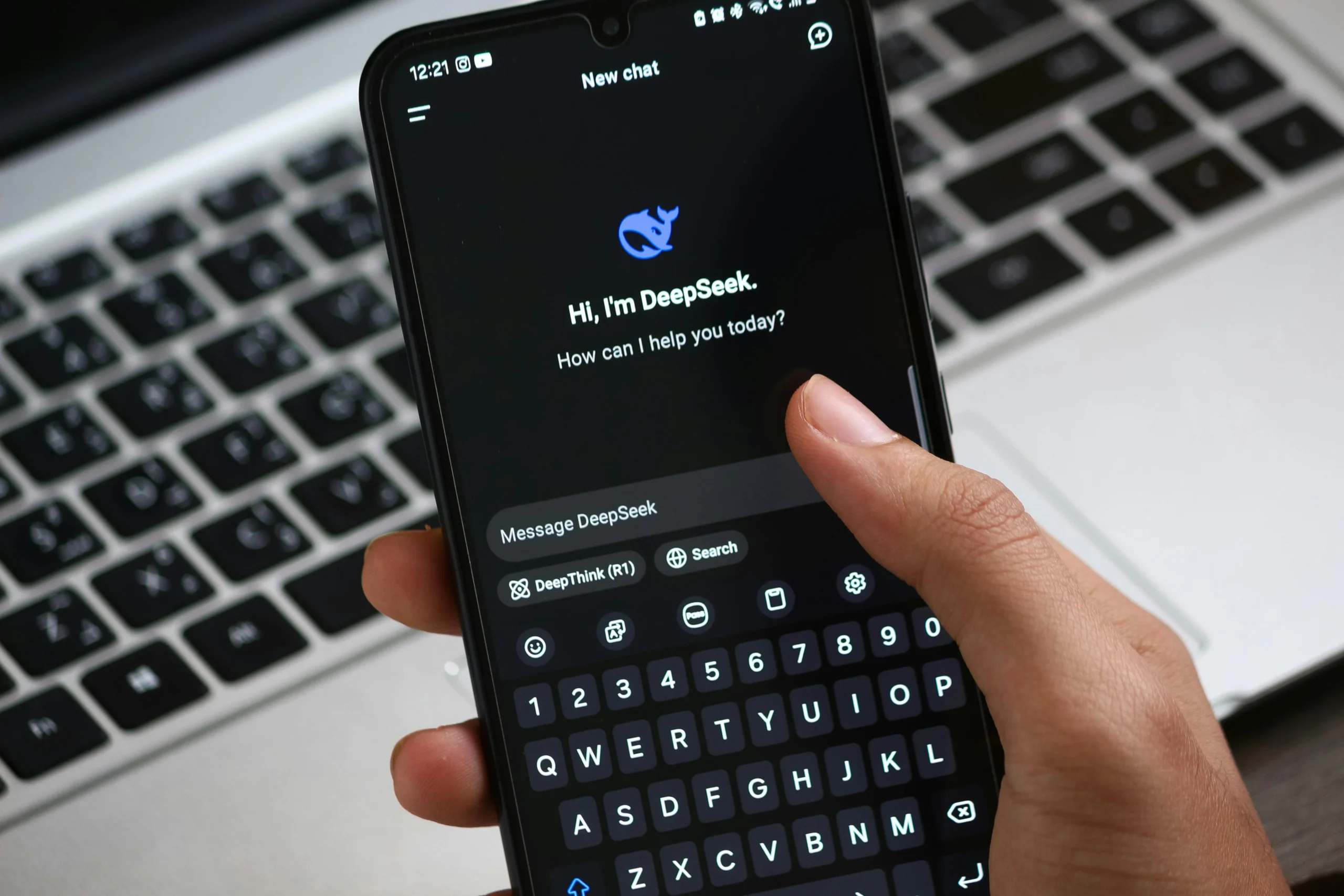
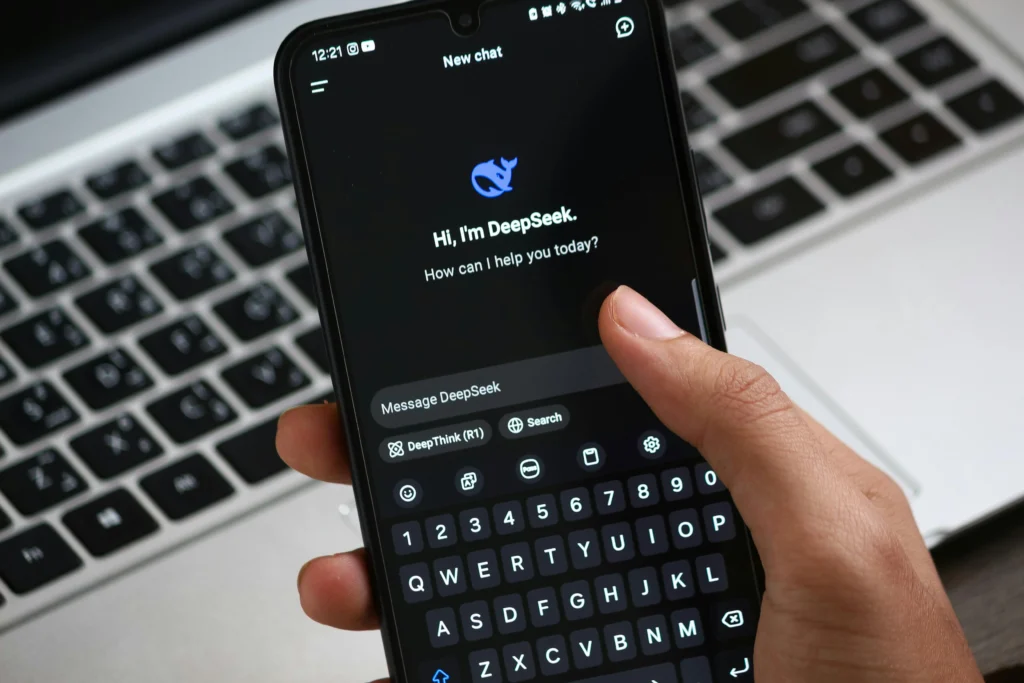
DeepSeek offers a web- and mobile-based chat interface that individuals can use at no cost. An independent pricing guide notes that the chat interface is free, offering unlimited access to DeepSeek‑V3 and R1 models, as well as web search integration.
This free tier has helped DeepSeek quickly build a user base; at its peak, the app topped the free charts on Apple’s App Store in both China and the United States.
For individual hobbyists and students, the free interface offers an opportunity to experience a frontier‑level model without paying subscription fees.
For developers and companies, API usage is not free. The same pricing guide lists the cost of DeepSeek‑V3 input tokens at US$0.14 per million and output tokens at US$0.28 per million. The DeepSeek-R1 reasoning model is more expensive, with input tokens priced at US$0.55 per million and output tokens at US$2.19 per million.
The DeepSeek API documentation provides more detailed figures: for DeepSeek‑V3.2, cache‑hit input tokens cost $0.028 per million and cache‑miss input tokens $0.28 per million; output tokens cost $0.42 per million.
These rates make usage-based deployment viable for workloads that would otherwise be cost-prohibitive under traditional per-token pricing.
DeepSeek initially offered introductory pricing for its V3 API, with input tokens costing 0.1 RMB per million when the cache was hit and 1 RMB per million when it was not, and output tokens at 2 RMB per million. However, this promotional period ended on February 9, 2025, after which the input cost increased to 2 RMB per million and the output cost to 8 RMB per million.
While DeepSeek removes traditional software licensing fees, organizations must evaluate the total cost of ownership before deploying it at scale. The primary expenses shift from paying a model provider to funding the infrastructure, talent, and operational resources required to run large language models reliably in production environments.
Enterprises must supply their own compute resources when self-hosting DeepSeek. This typically includes GPU clusters, high-memory servers, fast storage, and networking capable of handling large inference workloads. Even efficient architectures still require sustained processing capacity for real-time applications.
Running AI models continuously consumes significant electricity and cooling resources. Unlike API-based services, where compute costs are bundled into usage fees, self-hosted deployments require organizations to manage power consumption, system uptime, and hardware lifecycle planning internally.
Deploying DeepSeek is not a one-time installation. Teams must optimize inference pipelines, monitor performance, apply updates, manage scaling behavior, and integrate the model with internal systems. These responsibilities translate into ongoing staffing and maintenance costs.
Production systems must handle concurrency, latency control, and failover protection. As usage grows, organizations often expand infrastructure to maintain performance guarantees, adding further capital and operational expense.
In effect, DeepSeek replaces recurring software licensing fees with investments in compute and operational capability. For enterprises processing large volumes of data, this shift can still result in lower long-term costs, but only when deployment is carefully planned.
While API usage incurs a usage‑based fee, downloading the model weights to run on internal servers is effectively free aside from infrastructure costs. DeepSeek deliberately designed its models for efficient inference on commodity hardware; the updated V3 version can run on a high‑end Mac Studio at around 20 tokens per second, enabling companies to test the model without renting expensive data‑centre GPUs.
Organizations are adopting DeepSeek through several deployment strategies, depending on their data sensitivity, performance requirements, and internal technical capabilities. Rather than relying on a single usage model, enterprises are integrating the technology in ways that balance cost efficiency with operational control.
Some enterprises run DeepSeek entirely within their own data centers or private cloud environments. This approach provides maximum control over data handling, security policies, and customization. It is particularly common in regulated industries, telecommunications, and government-aligned infrastructure projects where external AI services may introduce compliance risks.
Many companies combine local inference with selective API usage. Routine or sensitive workloads run on internal servers, while less critical or highly variable tasks may use hosted services. This hybrid model allows organizations to control costs while maintaining flexibility during demand spikes.
Technology vendors and manufacturers are incorporating DeepSeek directly into customer-facing applications, internal copilots, and smart devices. Instead of treating the model as a standalone tool, they embed language capabilities into software platforms, automation systems, and conversational interfaces to enhance functionality without relying on continuous third-party access.
These varied deployment patterns illustrate that DeepSeek is not simply an alternative chatbot platform. It is increasingly treated as foundational infrastructure that organizations adapt to their own technical and economic environments.
| Platform | Licence Model | Self Hosting Allowed | Approx. Input Cost / 1M Tokens | Approx. Output Cost / 1M Tokens |
| DeepSeek-V3 / R1 | MIT Open Source | Yes | ~$0.55 | ~$2.19 |
| OpenAI GPT-4-class | Proprietary | No | ~$10 | ~$30 |
| Anthropic Claude | Proprietary | No | ~$3 | ~$15 |
| Google Gemini | Proprietary | No | ~$1.25 | ~$5 |
DeepSeek released several of its flagship models, including DeepSeek-V3 and DeepSeek-R1, under the MIT licence, a highly permissive open-source licence. This licence allows organizations to use, modify, distribute, and commercialize the models without paying royalties or disclosing proprietary improvements. The only requirements are to retain the original copyright notice and include the licence text when redistributing the software.
Companies can integrate the models into internal systems, build customer-facing applications, or fine-tune them for specialized use cases without negotiating usage contracts or incurring ongoing licensing fees.
However, some derived versions combine components from other model families such as Llama or Qwen. In those cases, organizations must also comply with the terms attached to the upstream licences. The base DeepSeek models themselves remain permissively licensed, enabling commercial deployment with minimal legal friction.
For enterprises planning to deploy DeepSeek locally, compliance with licence obligations is critical. The key requirements are:
A key factor behind DeepSeek’s affordability is its Mixture-of-Experts architecture. The V3 model contains 671 billion parameters, yet during inference, it activates only around 37 billion parameters per request.
This architecture uses multiple specialised “expert” subnetworks and routes each token through only a few of them, dramatically reducing compute requirements. The result is a model that matches or even surpasses the performance of closed models like GPT‑4 while consuming far less GPU time.
DeepSeek introduced a context-caching feature that automatically stores frequently used prompts and their responses. When a user repeats a prompt, the API retrieves the stored output rather than rerunning the model, reducing the number of tokens processed.
Within weeks of its open source release, DeepSeek attracted notable enterprise customers in China. A February 2025 report from the Singapore‑based Lianhe Zaobao (United Morning Post) notes that China Mobile, China Telecom, and China Unicom had fully integrated DeepSeek into their products and services.
The Ministry of Industry and Information Technology’s report on the 2025 Spring Festival described how these telecom giants promoted new AI applications by deploying DeepSeek’s models and offering dedicated compute resources for the DeepSeek‑R1 model.
The same report confirms that other technology firms, including Huawei’s ModelEngine AI platform, Lenovo, DingTalk, and Mindspore (迈富时), released solutions based on DeepSeek.
For example, Huawei announced that its ModelEngine AI platform would fully support local deployment and optimization of DeepSeek‑R1 and DeepSeek‑V3, enabling enterprises to run the models in on‑premise environments. Lenovo integrated DeepSeek into its smart devices, and Chinese automotive companies used DeepSeek to power in‑vehicle virtual assistants.
These integrations reflect a broader trend in China’s digital economy: state‑owned and private companies alike are adopting open source AI to reduce dependence on foreign vendors and accelerate the development of domestic ecosystems.
DeepSeek’s pricing strategy prompted mixed reactions. During its initial 45‑day promotional period, the V3 API offered input tokens at 0.1 RMB per million for cache hits and 1 RMB for cache misses. When this introductory period ended in February 2025, the input token price rose to 2 RMB per million and the output token price to 8 RMB per million.
Lianhe Zaobao reports that analysts viewed the price increase as part of a common marketing strategy: DeepSeek had attracted a user base with low introductory prices and then adjusted to a sustainable level.
Some experts predicted that the higher API costs would encourage enterprises to deploy the models locally, shifting expenditure from per‑query fees to capital investment in hardware. This dynamic mirrors the strategy of open-source database vendors, who monetise support and hosting rather than software licences.
Beyond telecom operators, other industries began integrating DeepSeek. Automotive manufacturers East Wind (东风) and Lantu (岚图) reportedly built DeepSeek into their smart cockpits, enabling voice assistance and natural language interaction. Cloud service providers introduced one‑click deployment packages that install the model on virtual machines with predetermined settings.
Educational technology firms and video game studios adopted DeepSeek to generate interactive content and moderate chat features. Start‑ups used DeepSeek’s low‑cost inference to power chatbots and summarisation tools targeted at small businesses.
Observers note that this rapid adoption is partially fuelled by national policy. The Chinese government has signalled strong support for open-source AI to reduce reliance on foreign technology and democratise access to advanced models.
Following the release of DeepSeek‑V3, many Chinese analysts referred to a “DeepSeek Moment,” suggesting that the open-source release marked a turning point similar to the introduction of Linux as an operating system.
DeepSeek’s pricing is significantly lower than that of Western proprietary models. OpenAI’s GPT‑4o charges about US$2.5 per million input tokens and US$10 per million output tokens, whereas DeepSeek‑R1 charges US$0.55 and US$2.19, respectively.
Google’s Gemini 1.5 Pro charges $1.25 for input and $5 for output; Anthropic’s Claude 3.5 Sonnet charges $3 for input and $15 for output. Even the “mini” versions of Western models are more expensive than DeepSeek’s mainline offerings. These differences translate into orders of magnitude in cost savings for companies processing millions of tokens per day.
The cost structure also depends on caching. DeepSeek’s context cache reduces charges to US$0.028 per million input tokens for the V3 model and to $0.014 per million when inputs are repeated. For high‑volume customer service or translation workloads where similar prompts recur, caching can reduce DeepSeek’s cost by an additional factor of 10.
Enterprises considering self-hosting must account for hardware, energy, and operations rather than API fees. DeepSeek’s efficient design means it can run on clusters of Chinese‑market H800 GPUs. Training the V3 model required 2,048 H800 GPUs for 55 days and cost around US$5.6 million.
For inference, running the model on a small cluster of GPUs may cost thousands of dollars per month in electricity and depreciation—still far less than paying per‑token fees for millions of queries.
Additionally, Chinese cloud providers are offering customised servers preloaded with DeepSeek and providing volume discounts to large enterprises.
DeepSeek competes not only with proprietary systems but also with other open source models such as Qwen, Llama, and Falcon. Many of these models have less permissive licences that restrict commercial use or require derivative models to carry the same licence.
For example, Meta’s Llama models require users to include “Llama” in the name of derived models, and some versions limit the number of user seats. Qwen is released under the Apache 2.0 licence, which prohibits the use of the model’s trademarks in derivative works.
In contrast, DeepSeek’s adoption of the MIT licence eliminates these restrictions, making it attractive to start‑ups that wish to develop proprietary products without publishing their source code.
Technical performance comparisons also favour DeepSeek. Chinese media reports emphasise that DeepSeek‑V3 outperforms other open-source models across many benchmarks and approaches the level of GPT‑4. Its mixture of experts’ design ensures speed and accuracy while keeping costs low.
Therefore, from both a legal and technical standpoint, DeepSeek offers a compelling alternative for enterprises seeking independence from Western AI vendors.
DeepSeek is best suited for organizations that view artificial intelligence as infrastructure rather than a subscription service. Its design favors teams willing to manage deployment complexity in exchange for lower long-term costs, greater customization, and tighter control over data and performance.
Companies processing large numbers of queries, such as customer support platforms, search applications, or internal automation systems, can benefit from DeepSeek’s lower marginal inference cost once infrastructure is in place. The model becomes more economical as utilization increases.
Industries that must keep sensitive information within controlled environments, such as telecommunications, finance, healthcare technology, and public-sector initiatives, may prefer self-hosted solutions to reduce exposure to external cloud providers.
Vendors embedding language models into software, devices, or vertical solutions can use DeepSeek as a customizable engine rather than relying on third-party APIs. This allows tighter integration, predictable performance, and differentiation at the application layer.
Teams that need to fine-tune behavior, experiment with architectures, or integrate proprietary datasets often find permissively licensed models more adaptable than closed systems that restrict modification.
DeepSeek therefore, aligns best with organizations that are prepared to operate AI as part of their core technical stack, rather than those looking for a fully managed, plug-and-play service.
While DeepSeek’s cost advantages are clear today, the AI landscape is evolving rapidly. Western providers may lower their prices or introduce new licensing schemes; indeed, Google and Anthropic released lower‑cost models after DeepSeek’s debut.
Regulatory changes around data transfer and AI licensing could affect cross‑border use of models, particularly given allegations of distillation from American models. Enterprises should monitor developments in both technology and policy to ensure their model choices remain viable over the long term.
Understanding technologies like DeepSeek is only the first step. The real challenge for global organizations is deciding how to apply emerging AI models, cost structures, and deployment strategies to deliver measurable business value. ChoZan helps companies translate these developments into actionable transformation strategies informed by China’s rapidly evolving digital ecosystem.
ChoZan supports organizations through:
By combining insight, access, and strategic guidance, ChoZan enables organizations to move beyond theory and implement solutions aligned with their operational realities.
If your team is evaluating how innovations like DeepSeek fit into your broader transformation roadmap, ChoZan can help you assess opportunities and act with clarity.
DeepSeek is free to download and access, but it is not completely free to operate. Organizations must still pay for infrastructure, electricity, engineering resources, or API usage when deploying the models in real-world environments.
Yes. DeepSeek’s permissive licensing allows commercial use, modification, and redistribution. Businesses can build proprietary applications on top of the models without paying royalties, provided they comply with the licence terms and retain required notices.
Yes. While the models themselves can be downloaded at no cost, API access is billed based on token usage. Companies that choose hosted access instead of self-hosting incur usage-based operational expenses.
DeepSeek releases several models under a permissive licence that allows modification and redistribution. However, some experts distinguish between open model weights and fully transparent training pipelines, which has led to debate over how “open” the ecosystem truly is.
Yes. Organizations can run DeepSeek on their own servers or private cloud environments. Performance depends on available compute resources, and production deployments typically require GPU acceleration to handle inference workloads efficiently.
DeepSeek uses a Mixture-of-Experts architecture that activates only a portion of its parameters during each request. This reduces compute usage per query, lowering inference costs compared with dense-model architectures used in many proprietary systems.
The primary expenses shift to hardware, energy consumption, and engineering maintenance rather than licensing. Enterprises must provision compute infrastructure and manage internal scaling, monitoring, and updates.
Revenue comes from API services, enterprise deployments, ecosystem partnerships, and infrastructure offerings rather than software licensing. This model resembles open-source software companies that monetize support and operational tooling.
It can be, particularly for organizations that require deployment control, customization, or cost predictability at scale. However, companies must have the technical capability to independently manage infrastructure and ensure reliability.
Pricing advantages today are influenced by architectural efficiency and competitive positioning. As the AI market evolves, costs may shift due to infrastructure pricing, regulatory developments, or competition from other model providers.
By subscribing to Ashley Dudarenok’s China Newsletter, you’ll join a global community of professionals who rely on her insights to navigate the complexities of China’s dynamic market.
Don’t miss out—subscribe today and start learning for China and from China!
Ashley Dudarenok is a leading expert on China’s digital economy, a serial entrepreneur, and the author of 11 books on digital China. Recognized by Thinkers50 as a “Guru on fast-evolving trends in China” and named one of the world’s top 30 internet marketers by Global Gurus, Ashley is a trailblazer in helping global businesses navigate and succeed in one of the world’s most dynamic markets.
She is the founder of ChoZan 超赞, a consultancy specializing in China research and digital transformation, and Alarice, a digital marketing agency that helps international brands grow in China. Through research, consulting, and bespoke learning expeditions, Ashley and her team empower the world’s top companies to learn from China’s unparalleled innovation and apply these insights to their global strategies.
A sought-after keynote speaker, Ashley has delivered tailored presentations on customer centricity, the future of retail, and technology-driven transformation for leading brands like Coca-Cola, Disney, and 3M. Her expertise has been featured in major media outlets, including the BBC, Forbes, Bloomberg, and SCMP, making her one of the most recognized voices on China’s digital landscape.
With over 500,000 followers across platforms like LinkedIn and YouTube, Ashley shares daily insights into China’s cutting-edge consumer trends and digital innovation, inspiring professionals worldwide to think bigger, adapt faster, and innovate smarter.
Please check your email and confirm your subscription.