CONTENT
Ask a team of engineers what they need from AI, and the answer is usually practical. They need code that follows team conventions, agents that stay on task, and pricing that supports daily use. MiniMax artificial intelligence has filled that gap over the past 14 months.
Between the release of MiniMax-text-01 in January 2025 and the launch of M2.5 in February 2026, MiniMax shifted from model releases to a broader platform story. The focus now is reliability, process fit, and workable cost. This article looks at what the model family does today, where it fits, and what buyers should test before rollout.
For a wider view of the competitive landscape, read our guide to China’s artificial intelligence in 2026, which maps the broader model, tool, and enterprise-strategy landscape beyond MiniMax.
The best way to evaluate MiniMax artificial intelligence in 2026 is by capability lane. MiniMax now offers text, speech, video, image, music, Agent, and API access in a single product stack. That platform logic also fits the wider pattern of China’s digital transformation, where AI, data, and connected digital ecosystems are increasingly built into business infrastructure rather than treated as standalone tools.
For buyers, the important question is simple. Which MiniMax capability fits the workflow you need to improve this quarter?
For text, the center of gravity has shifted from MiniMax-01 to the M series. MiniMax’s release timeline shows MiniMax-text-01 in January 2025, MiniMax-m1 in June 2025, MiniMax-m2 in October 2025, and M2.5 in February 2026.
MiniMax moved from long-context text infrastructure to reasoning, then to code and agent execution, and finally to reinforced productivity performance.
MiniMax can support writing tasks, but that is not its strongest public positioning. The company frames M2 and M2.5 around code, agents, search, tool use, and office work. In practice, MiniMax looks most compelling when the task involves long context, structured execution, external tools, or multi-step work that requires more than plain-text completion.
That is why MiniMax LLM is an incomplete search lens. MiniMax is no longer competing only as a generic language model. It is competing on execution speed, price pressure, code performance, and fit for agentic productivity systems.
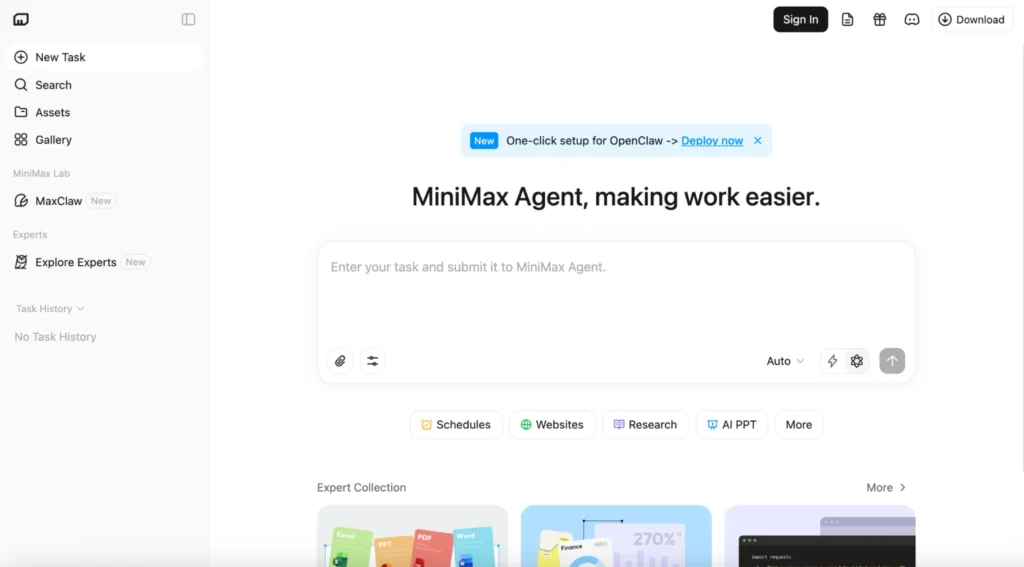
Speech is one of the strongest reasons to examine MiniMax artificial intelligence closely. MiniMax’s public model matrix highlights Speech 2.6 as a core product, while keeping MiniMax Speech 2.5 visible as an earlier milestone. Speech now sits alongside text and video as a primary product line.
For search intent, terms like MiniMax speech 2.5, MiniMax speech-02, and MiniMax speech 02 reflect a product transition. Buyers should treat these names as points in an evolving voice stack, not as isolated products.
From a use case perspective, MiniMax’s speech line looks strongest for AI characters, multilingual voice interfaces, dubbing, creator workflows, and high-volume audio generation, where expressive delivery matters. Its broader product stack includes Talkie and MiniMax Audio, suggesting the speech models were developed with conversational and character-driven use cases in mind, not just basic enterprise transcription.
If voice quality, style control, and multilingual output matter to your product, MiniMax deserves serious testing. If your need is basic speech synthesis, you still need to compare it against alternatives on latency, pronunciation control, consistency, and retention terms through the API.
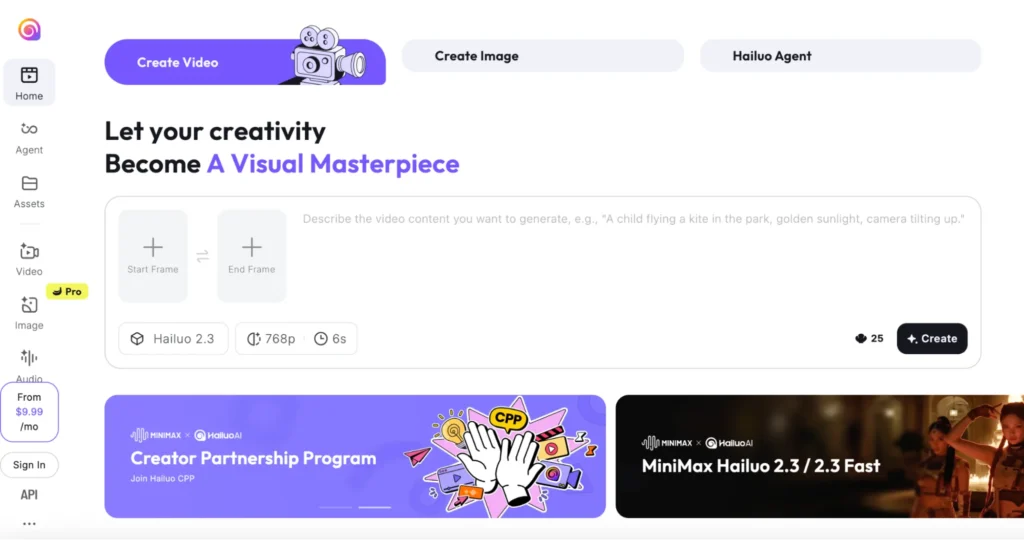
Video is the lane where MiniMax has built some of its strongest public momentum. In June 2025, MiniMax released Hailuo 02 with 1080p support and a 10-second generation time. In October 2025, it followed up with Hailuo 2.3, saying the newer version improved performance while keeping Hailuo 02 pricing, offering a faster, lower-priced option that could reduce batch-creation costs.
That matters because Hailuo MiniMax and MiniMax AI video point to one of the company’s clearest signs of product traction. Hailuo is not only a showcase tool. It is a serious commercial product line.
The Hailuo 2.3 release also showed where MiniMax is aiming commercially. The company highlighted stylized output, better facial detail, and stronger object motion response. It also pointed to ecommerce creator testing during Double Eleven, which suggests a focus on branded content, ad iteration, and short-form visual storytelling.
For enterprise readers, Hailuo looks strongest in rapid creative production, social content variation, ad testing, product visualization, and campaign asset generation. If a team needs deeper cinematic control or heavier rights review, it needs a stricter comparison. If it needs fast video throughput at a tighter cost, MiniMax looks increasingly credible.
The most strategic part of the MiniMax story is not a single text or video model. It is the company’s effort to connect everything through the MiniMax agent. MiniMax keeps Agent at the top level of the navigation, and its M2 release framed the model around agents and code.
Teams comparing Agent.MiniMax, along with other workflow tools, should judge it on task completion, tool use, and operational reliability, not just conversational quality. That matters because Agent is being treated as a workflow layer, not as a wrapper around a chatbot.
It’s January 2025 technical note on the 01 series gives useful background. MiniMax argued that 2025 would be a major year for AI agents and linked long context architecture to single-agent memory and multi-agent communication. That helps explain the path from MiniMax-text-01 to M2 and M2.5.
By 2026, that vision looks more operational. MiniMax’s M2.5 materials say the model has already been launched in MiniMax Agent, supports office tasks, and powers internal work at scale. That suggests MiniMax sees agents as the bridge between model capability and repeatable business value.
If your priority is coding, long context, search, or tool calling, MiniMax’s text line deserves close evaluation. That also matters in a market where AI is changing how consumers use search in China, especially as search, social discovery, and platform trust signals become more interconnected. If your priority is an expressive multilingual voice, the speech line may be the stronger entry point.
If your priority is fast, creative video at aggressive price points, Hailuo is likely the best place to start. If your priority is workflow automation, the real evaluation should center on the MiniMax agent and the model plus tool stack around it.
The February 2026 release of M2.5 introduced a pricing structure designed for production use. The standard variant is priced low enough to make sustained agent workloads more feasible, while faster variants cost more for higher throughput.
These economics matter most in continuous workflows. In agent sessions, coding tasks, and repeated structured outputs, the key issue is not the cost of a single prompt. It is the cost of running the system continuously in real-world conditions.
The MiniMax API’s price structure also includes prompt caching, which reduces input costs when context is repeated across calls. In agent workflows where system prompts and tool schemas stay stable, caching can materially reduce spend and remove setup friction.
For developers with predictable usage, the MiniMax api also offers a Coding Plan. This is a subscription model layered on top of pay-as-you-go access. It is aimed at frequent use of programming and can be more economical for daily active developers than token-based billing.
One important caveat remains. As of early 2026, the Coding Plan runs on M2.1 rather than M2.5. If your priority is the latest flagship text model, pay-as-you-go remains the direct route.
A serious review of MiniMax artificial intelligence should focus on production fit rather than benchmark claims. MiniMax’s public model catalog, pricing structure, and release history provide buyers with sufficient visibility to properly test real workflows.
Start with your real task.
For text and agent workflows, test code support, long context handling, search, tool use, and structured outputs. A generic writing prompt is too weak to evaluate MiniMax’s strongest lane.
Speed can decide adoption.
MiniMax offers high-speed variants for M2.5 and M2.1, indicating the company understands that response time affects real-world usage. If your workflow involves coding tools, voice interfaces, or multi-step agents, slow output can ruin the experience, even when the model looks good on paper.
So measure:
A strong test asks one question. Can people use this model fast enough inside daily work?
MiniMax pricing is clear enough to model before rollout.
This is why the MiniMax api price should be treated as a workflow question, not a headline number. The real bill depends on how your team uses the system.
Do not test only happy path prompts.
Run failure cases. Test hallucinations, prompt injection, confidential inputs, sensitive topics, and weak tool calls. In MiniMax agent style workflows, go beyond answer quality and score action quality, routing accuracy, escalation logic, and audit visibility.
Data handling also needs direct verification. Before any sensitive deployment, ask these in writing:
I did not find a clear enough public statement to make a firm claim on that last point, so it should be verified directly with MiniMax.
The strongest case for MiniMax artificial intelligence in 2026 is practical adoption in coding, office productivity, voice, video, and agent-based execution. It is a strong choice for teams that want multimodal coverage, fast iteration, and aggressive price-to-performance across well-defined workflows.
MiniMax is a weaker first choice for buyers who want one vendor to solve every enterprise AI problem at once.
It is also a weaker first choice for teams that have not defined the workflow, the review standard, or the governance rules.
And it is a weaker first choice for firms that need maximum production stability across a slow-moving model lineup. MiniMax has been shipping quickly, which helps innovation, but also makes version change and migration planning more important.
If your company needs better coding support, faster internal knowledge work, stronger multilingual speech, or cheaper video generation, MiniMax deserves a real pilot.
If your company only wants a familiar brand name or a vague all-purpose AI conversation layer, MiniMax may not be the right first move.
That is the clearest way to frame what MiniMax AI is for decision-makers in 2026. It is a multimodal platform with real traction and a clear product story, but its value becomes obvious only when matched to a concrete job.
Reuters reported 159 percent revenue growth in 2025 and said more than 70 percent of MiniMax sales came from outside China, which adds commercial weight to that platform’s story.
If your team needs a clearer view of China’s AI market, digital ecosystems, or platform shifts, ChoZan offers practical support tailored for leadership, strategy, and innovation teams. ChoZan’s site presents its work across consulting, research, workshops, expert dialogues, and China learning programs.
For teams tracking the broader pattern behind releases like Hailuo, our China innovation trends coverage examines how AI, platform infrastructure, and commercial experimentation are evolving across China’s tech landscape.
Book a consultation with ChoZan to turn China market insight into a practical strategy.
Yes. MiniMax’s release notes show Image 01 launched in February 2025, and the pricing page lists image generation at $0.0035 per image. That means MiniMax is broader than a text, speech, and video stack.
Yes. MiniMax’s public release notes list the Music 1.5, 2.0, 2.5, and 2.5+ releases across 2025 and 2026. Its pricing page also lists music generation pricing for Music 2.5 and Music 2.5+.
Yes. MiniMax’s January 15, 2025, release notes list both MiniMax Text 01 and MiniMax VL 01. That shows the company has offered a vision language model layer alongside its text releases.
Yes. The pricing page lists high-speed versions for M2.5 and M2.1 at higher token rates than the standard models. That suggests MiniMax is explicitly offering a lower-latency option for teams that value faster response times.
Yes. MiniMax’s pay-as-you-go pricing lists separate prompt caching, read, and write charges for its text models. That matters for repeated workflows where the same context or system instructions are reused across calls.
Yes. The audio pricing page lists rapid voice cloning at $1.5 per voice and voice design at $3 per voice. That makes MiniMax more relevant for branded voice systems, characters, and localization work.
MiniMax is based in China, but Reuters reported that more than 70 percent of its 2025 sales came from outside China. That points to a much stronger international revenue mix than many readers may expect.
MiniMax wants to become a global AI platform company and is pushing both model development and product platforms. That helps explain the company’s wide product surface across models, agents, and APIs.
Yes. Reuters reported in March 2026 that MiniMax planned to release M3 in the first half of 2026. That matters for buyers because it signals continued rapid iteration across the company’s flagship text line.