CONTENT
The OMODA car brand is one of the clearest signals yet that China’s automotive industry is no longer just competing at home. Launched in 2022, OMODA has already reached 42 countries, established over 1,300 showrooms, and sold 600,000 units combined with its sister brand JAECOO within just 27 months. That is not incremental growth. That is a structural shift.
For business leaders tracking China’s global expansion, OMODA is worth understanding closely. It is not simply a car company. It is a blueprint for how Chinese brands are building globally competitive products at a speed and price point that legacy automakers are still struggling to match.
The OMODA car brand was born inside Chery Automobile, one of China’s largest and most internationally experienced automakers. Founded in 1997 and headquartered in Wuhu, Anhui, Chery has grown into a global automotive powerhouse with a reach across more than 80 countries.
By the end of 2025, Chery’s cumulative global user base had reached 18.53 million vehicles, and the company sold a record 2.8 million vehicles in 2025 alone, a 7.8% year-on-year increase. In the same year, Chery ranked 233rd on the Fortune Global 500, jumping 152 places to become the fastest-rising automaker on the list.
On the innovation front, Chery’s invention patents have ranked first in Anhui Province for 12 consecutive years. In 2025, patent applications climbed nearly 50% year-on-year, with authorizations surging more than 300%. The company now operates eight global R&D centers, with locations in:
This global R&D structure, supported by over 30,000 R&D professionals, reflects a company that has long positioned technology as its core competitive advantage.
In 2022, Chery made a strategic decision to separate its export-focused vehicle line into a new, independent identity. OMODA was created specifically for international markets, positioned above the mainstream Chery brand and below the premium Exeed marque.
The name itself carries intent. The letter “O” is derived from “oxygen,” while “Moda” references modernity, and together they signal a brand designed to feel fresh and globally relevant.
OMODA operates alongside its sister brand JAECOO under a combined structure referred to as “O&J.” The two brands target different buyer profiles but share dealership networks, back-end infrastructure, and the same parent technology base. Together, they are targeting annual global sales of 1.4 million units by 2030, excluding China entirely.
This is a critical context. OMODA is not a brand trying to find export customers as an afterthought. It was built, from the ground up, to be a global challenger.
To understand OMODA, you first need to understand the broader wave it is riding. China has become the world’s largest auto exporter, and the pace of that ascent has accelerated sharply.
Made-in-China vehicle exports rose 12.8% year-to-date through mid-2025, with May through July 2025 marking the strongest three-month export stretch in recorded history.
New Energy Vehicles (新能源汽车, xīn néng yuán qìchē) now account for more than 35.5% of all Chinese auto exports, a number that has climbed steadily as domestic competition forces manufacturers to look outward.
At home, the picture is equally striking. Local Chinese brands now hold nearly 70% of domestic passenger vehicle shipments, compared to just 36% five years ago.
Foreign legacy players, including Volkswagen, Toyota, and GM, have ceded 33 percentage points of market share since 2020. In the NEV segment specifically, more than 80% of vehicles sold in China come from local brands.
This is not a short-term pricing story. It reflects deep structural changes in engineering capability, supply chain control, software integration, and consumer brand perception. The global auto industry is being reset, and OMODA is one of the brands doing the resetting.
The OMODA car brand currently fields a lineup built around crossover and SUV form factors, a deliberate choice that aligns with the fastest-growing vehicle segments globally.
The core range includes:
The technological centerpiece of the lineup is the Super Hybrid System (SHS), a proprietary powertrain developed by Chery that achieves 44.5% thermal efficiency, produces up to 340 horsepower, and delivers a combined driving range exceeding 1,200 km.
The system uses a fifth-generation 1.5-litre Dedicated Hybrid Engine (DHE) paired with an advanced Dedicated Hybrid Transmission (DHT).
The C7 SHS set a cross-country marathon record, covering 1,457 km on a single tank in hybrid mode and achieving fuel consumption of just 4.4 litres per 100 km. That kind of real-world performance has made the SHS technology one of OMODA’s most powerful selling points internationally.
Aesthetically, OMODA targets what Chery president Zhang Guibing calls the “Fashion Elite”, a consumer profile described as “dynamic, avantgarde, and fashion-centric.”
The brand positions itself as a crossover fashion statement as much as a vehicle, appealing to younger global buyers who want design-forward technology. The vehicles reflect this with low, sweeping rooflines, slim full-LED lighting, diamond-shaped front grilles, and minimalist interiors with large touchscreen displays.
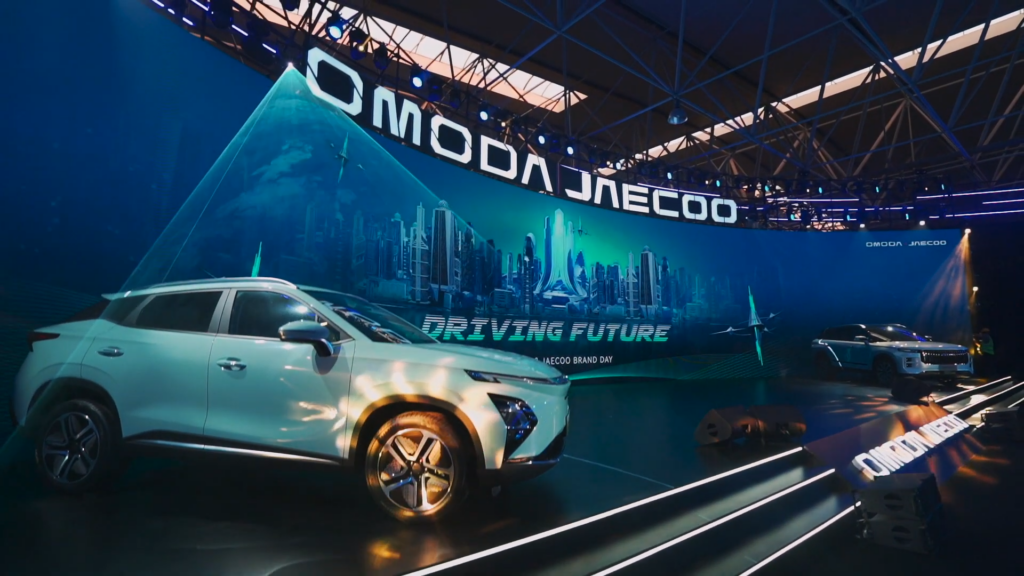
At Auto Shanghai 2025, operating under the theme “2 Years 2gether: From Seed to Speed,” OMODA and JAECOO debuted the C7 SHS, C5 SHS, and the Jaecoo J5 BEV together, signaling a full-lineup pivot toward electrification.
CEO Shawn Xu described it as the brand’s official entry into a new era of accelerated NEV advancement. In the first quarter of 2025 alone, OMODA and JAECOO’s combined EV and hybrid sales jumped 460% year-on-year, according to Chery International data.
The OMODA car brand made its first international move in Russia in late 2022, where it was positioned as a “worthy alternative” to Japanese and German brands that had suspended operations. That early launch gave the brand real-world retail experience before its global debut in April 2023 alongside JAECOO at the Shanghai Auto Show.
Europe became the marquee expansion target. OMODA entered Spain in early 2024, followed by Italy and the UK, where it launched with the OMODA 5 and OMODA E5.
In a landmark move, Chery signed a joint venture with Spanish company EV Motors to produce vehicles at a former Nissan plant in Barcelona, giving OMODA local manufacturing presence and a path around EU import tariffs.
By mid-2025, OMODA and JAECOO had established over 72 dealerships in the UK through partnerships with major dealer groups including Arnold Clark, Listers, and Endeavour.
In Europe’s H1 2025 rankings, OMODA appeared among the five fastest-growing Chinese brands, a list that also includes BYD, JAECOO, Leapmotor, and Xpeng. In Spain, the JAECOO J7 SHS captured 7% of the PHEV market within its first month of sales.
Beyond Europe, the brand has moved aggressively into Southeast Asia, including Indonesia, Malaysia, Thailand, the Philippines, and Vietnam. Latin America, the Middle East, South Africa, and Oceania round out a presence that now spans 42 countries and over 1,300 showrooms.
The speed behind this expansion is not accidental. Chery’s internal culture of rapid iteration allowed the company to overhaul the OMODA 5 specifically for the European market in just six weeks.
“You can forget doing something that fast with a European automaker,” said Riccardo Tonelli, Chery’s senior vehicle-dynamics expert. “It’s impossible.” That speed is a strategic weapon, not an anomaly.
The OMODA story cannot be separated from broader patterns in how Chinese manufacturers approach product development and global scaling.
Development timelines at Chinese automakers like Chery now run as short as 18 months, compared to more than five years for Western rivals. This is achieved by minimizing physical prototypes, relying on digital simulation, and building modular platforms that can be configured for different powertrains and markets quickly.
Digital-first design is embedded in the process. Chery produces 5 to 10 digital design proposals per model, allowing leadership to pivot quickly based on market feedback without the cost penalties that come with physical tooling.
“If everybody said today, ‘We hate it,’ Chery will just change it,” said Peter Matkin, Chery’s chief international-brands engineer.
Vertical integration is another key differentiator. BYD, Chery’s closest rival, produces approximately 75% of its Seal sedan’s components in-house. This control over the supply chain compresses costs and accelerates production timelines significantly compared to brands that rely on external suppliers.
The result is a product refresh cycle that has no parallel in the Western automotive world. The average age of a Chinese-brand EV or PHEV is 1.6 years, compared to 5.4 years for foreign brand equivalents. Consumers buying a Chinese-brand vehicle are almost always getting more current technology than those choosing a Western alternative at the same price point.
Finally, Chinese automakers are increasingly moving from pure export to what analysts call “glocalization” (本土化, běntǔ huà). Building factories, R&D centers, and supplier networks inside target markets makes Chinese brands less vulnerable to tariffs, more responsive to local preferences, and more embedded in local economies.
OMODA is worth studying beyond the automotive sector. The brand’s trajectory illustrates a pattern that is now appearing across Chinese consumer electronics, industrial equipment, renewable energy, and technology platforms.
The pattern is consistent: a Chinese company develops world-class capability at home under intense domestic competition, then deploys that capability globally with aggressive pricing and rapid iteration. The automotive sector has simply become one of the most visible arenas where this is playing out.
For foreign executives, the most important insight is that visiting China is not the same as reading about it.
Understanding why OMODA can overhaul a vehicle in six weeks, or how Chery’s R&D structure supports 14,000 patents, requires firsthand exposure to facilities, teams, and supply chains. Reports and data alone do not convey the speed and ambition visible on the ground.
Cities like Wuhu (Chery’s headquarters and base of operations), Shanghai (home to the biennial international auto show and China’s largest innovation ecosystem), and Shenzhen (the hardware and technology manufacturing capital) give visitors direct access to the environments producing these companies.
Seeing a factory floor, meeting engineers and brand managers, or walking an auto show showroom in China provides context that no external analysis fully replicates.
This is the kind of immersive understanding that informs better strategy, faster decisions, and more accurate assessments of the competitive threats and opportunities that Chinese brands represent for any global industry.
ChoZan helps global businesses decode the forces shaping markets like the one OMODA operates in. Whether you are tracking the rise of Chinese auto challengers, assessing the innovation ecosystems behind them, or preparing your organization to respond strategically, ChoZan provides the expertise and access to make that possible.
ChoZan’s relevant services include:
OMODA’s rise from a 2022 brand launch to a presence across 64 markets by the close of 2025 is one of the most compressed global expansion stories in automotive history. But the deeper significance is what it represents.
China’s industrial base has developed the capability to produce globally competitive, technology-forward products and deploy them internationally with a speed and cost structure that established players cannot easily replicate.
The patterns behind OMODA, including compressed development timelines, SHS hybrid technology, vertical integration, and glocalization strategy, are not unique to the auto sector. They reflect how Chinese companies across industries are approaching global markets right now.
For business leaders, ignoring this shift is no longer a viable option. The question is not whether Chinese brands will continue expanding globally. The question is whether your organization understands what is driving that expansion well enough to respond strategically.
ChoZan exists to help you answer that question. Through research, learning expeditions, consulting, and training, we bring China’s ground-level reality to the global leaders who need to understand it most.
OMODA is an export-focused automotive brand owned by Chery Automobile, one of China’s largest carmakers. Launched in 2022, it was created specifically for international markets and is never sold in China’s domestic market.
Yes. OMODA has expanded to 42 countries, including the UK, Spain, Italy, South Africa, Indonesia, Malaysia, the Philippines, and multiple Latin American markets. The brand operates over 1,300 showrooms globally.
The Super Hybrid System (SHS) is OMODA’s proprietary hybrid powertrain. It achieves 44.5% thermal efficiency, produces up to 340 hp, and delivers a combined driving range of over 1,200 km on petrol and electric power together.
OMODA was purpose-built for export from day one, unlike most Chinese brands that later adapted domestic models for overseas markets. Its “fashion-forward” design, SHS hybrid technology, and rapid product refresh cycles give it a distinct positioning in the global mid-range SUV segment.
China’s auto sector illustrates how Chinese companies compress development timelines, scale globally at speed, and disrupt incumbents through price-performance advantages. These same dynamics are reshaping industries from electronics to renewable energy, making automotive trends a leading indicator for broader competitive shifts.