CONTENT

Artificial intelligence is reshaping China’s digital economy, and Baidu AI is at the center of this transformation. In late 2025 and early 2026, the Beijing‑based company unveiled a stream of upgrades that collectively rebuild how search, cloud services, chips, and autonomous driving work.
This piece dives deep into the recent changes, drawing on credible Chinese sources to provide real‑world insights that marketing professionals and technology enthusiasts can apply.

Baidu introduced ERNIE 5.0 at Baidu World 2025 and released it commercially in January 2026. The model has 2.4 trillion parameters and uses a mixture-of-experts architecture, in which fewer than 3 percent of parameters activate per inference.
This design matters. It allows Baidu to scale model size without proportional increases in compute cost. Instead of brute-force processing, the system selectively routes tasks to specialized components, improving both efficiency and response speed.
ERNIE 5.0 natively processes text, images, audio, and video. This capability directly reshapes how search outputs are delivered. By 2026, approximately 70 percent of top search results appear in rich media formats, including visual summaries and video responses.
This is not a feature upgrade. It is a format shift. Search moves from text-dominant results to multi-format outputs, in which AI determines the most effective medium to answer a query.
According to LMArena benchmarks, ERNIE 5.0 ranks first among Chinese models and eighth globally in text-based tasks. It competes directly with leading systems such as GPT-5.1-High and Gemini-2.5-Pro.
This positioning is important because it places Baidu within the top global tier, not just as a domestic leader. Performance parity at this level allows Baidu to compete on ecosystem strength rather than raw model capability alone.
ERNIE 5.0 is not confined to experimental environments. It is deployed across Baidu’s search engine, cloud services, and consumer applications. This integration allows the model to operate at scale, processing real user queries rather than controlled benchmark tasks.
Because of this deployment model, improvements are not theoretical. They are continuously refined using live interaction data, accelerating iteration cycles and improving real-world performance faster than isolated model development.
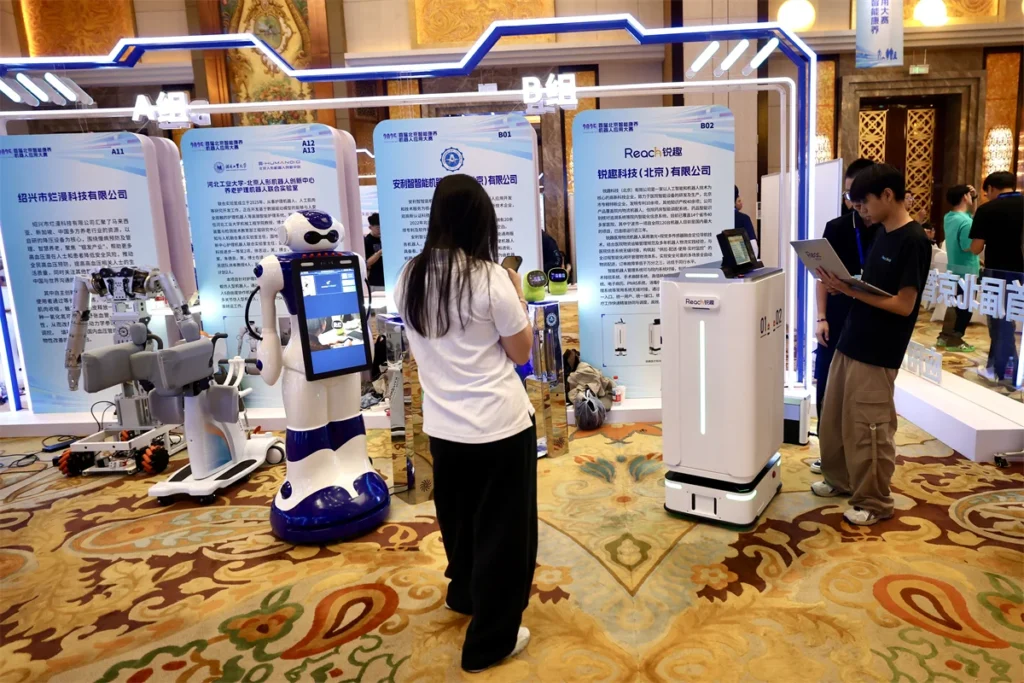
Search behavior in China has shifted from keyword queries to natural-language interaction. Baidu rebuilt its search engine around large models, turning the results page into an interactive conversation rather than a list of links. Users now expect direct, synthesized answers rather than having to scan multiple sources.
Baidu integrated its ERNIE Bot directly into search and its mobile app, removing the need for a standalone assistant. Users can switch between traditional search and AI responses instantly. The assistant handles tasks such as answering queries, booking flights through Trip.com, and ordering food via Meituan.
In January 2026, ERNIE Bot surpassed 200 million monthly active users. Multiple independent reports, including Cybernews and coverage based on The Wall Street Journal, confirmed this milestone, reinforcing that adoption is not anecdotal but system-wide.
AI usage surged in 2025 as Baidu incorporated third-party models, such as DeepSeek, into its ecosystem. Monthly engagement time increased sharply as users shifted toward multi-turn conversations where the system retains context.
This shift signals a bigger behavioral change. Users no longer treat search as retrieval. Instead, they treat it as an interaction. The system remembers prior inputs, refines responses, and reduces the need to navigate across multiple pages.
Competition among Chinese super-apps is intensifying, with major players collectively allocating around RMB 6 billion (US$ 840 million) to user acquisition in 2026.
Baidu’s advantage lies in its scale and entry point. With more than 700 million users and high-frequency search intent, it does not need to redirect behavior. Instead, it upgrades an existing habit. Embedding ERNIE into core workflows allows the company to test, iterate, and scale AI features faster than competitors building standalone products.
Visibility no longer depends on ranking within a list of links. Instead, brands must become part of the AI’s response layer. Structured, authoritative content increases the likelihood of being cited directly in generated answers.
At the same time, measurement frameworks must adapt. Click-through rates become less important as users receive answers without leaving the interface. Instead, brands should track citation frequency, knowledge inclusion, and response visibility within AI-generated outputs.
At the 2025 Baidu Cloud Intelligence Conference, Baidu introduced Qianfan 4.0 as its model-as-a-service platform. It hosts more than 150 curated models and provides a unified environment for building, deploying, and managing AI applications.
A key upgrade is reinforcement feedback tuning, which improved efficiency by 43 percent. This directly reduces the cost and time required to refine models for enterprise use cases.
Qianfan has shifted toward an agent-centric architecture. Instead of building isolated models, enterprises deploy task-oriented agents that execute workflows such as procurement handling, customer inquiry resolution, and internal operations.
The platform includes an MCP Server for monitoring and control, enabling structured orchestration of these agents across workflows. Pre-built agents can be generated rapidly, even from demonstration videos, reducing deployment friction.
Baidu expanded accessibility through no-code tools like Miaoda 2.0. These tools allow non-technical users to build AI applications without writing code. As a result, adoption extends beyond engineering teams into operations and business units.
By late 2025, more than 400,000 mini-apps had been created. The platform also supports multimodal retrieval-augmented generation and connects to hundreds of internal and external models.
Adoption has moved beyond experimentation. By late 2025, over 85,000 enterprise clients used Qianfan to build approximately 190,000 AI applications.
Commercial traction is visible in revenue. Baidu secured 95 large-scale model projects worth 710 million yuan over 11 months. AI cloud revenue reached RMB 4.2 billion in Q3 2025, growing 33 percent year-on-year.
At the same time, subscription-based high-performance computing revenue increased by 128 percent, signaling strong demand for compute-intensive AI workloads.
Baidu applies its AI capabilities across sectors, including finance, manufacturing, energy, and public services. These are not generic deployments. The company is building industry-specific AI stacks tailored to operational workflows.
One of the most commercially visible applications is digital humans. Nova, built on ERNIE 4.5 Turbo, synchronizes facial expressions and gestures to deliver realistic livestream experiences. It analyzes real-time streaming data and generates targeted product recommendations during broadcasts.
During the 2025 Double 11 shopping festival, 83 percent of livestreamers on Baidu platforms used digital humans. This drove a 119 percent increase in livestream sessions and a 91 percent increase in gross merchandise value.
Baidu continues to expand its ecosystem by open-sourcing ten models from its Wenxin 4.5 series. While these models are freely available, the company maintains a competitive edge through optimized commercial versions and integrated cloud services.
At the same time, the platform supports edge-to-cloud deployment. This allows enterprises to run AI workloads with low latency while maintaining centralized control, a critical requirement for real-time applications.
AI agents shift software from interaction to execution. Instead of completing tasks step by step, users define outcomes. The system handles the sequence of actions required to achieve them.
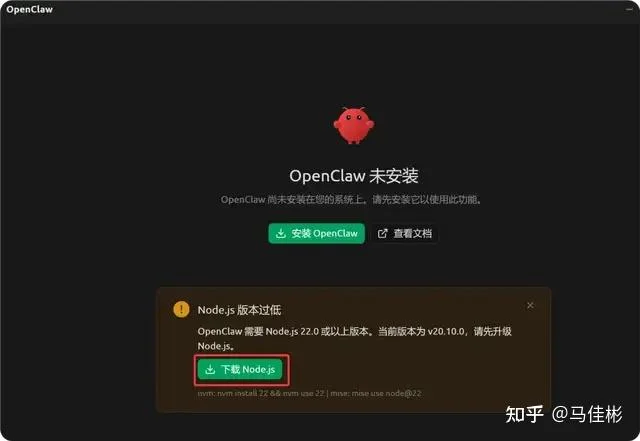
In March 2026, Baidu introduced OpenClaw, an open-source framework for consumer-facing agents. These agents perform multi-step tasks such as editing videos, generating presentations, conducting research, and completing transactions across applications.
Users refine outputs through repeated interaction, allowing agents to improve over time.
Baidu’s agent ecosystem spans desktop, mobile, cloud, and smart devices. DuMate runs on desktops, RedClaw on mobile devices, and DuClaw enables cloud deployment. Xiaodu integrates these capabilities into voice-controlled environments.
Agents execute tasks across systems without requiring users to switch between applications.
Agent performance remains inconsistent. Tasks can become inefficient or overly complex. However, continuous feedback and real-world usage are expected to improve reliability over time.
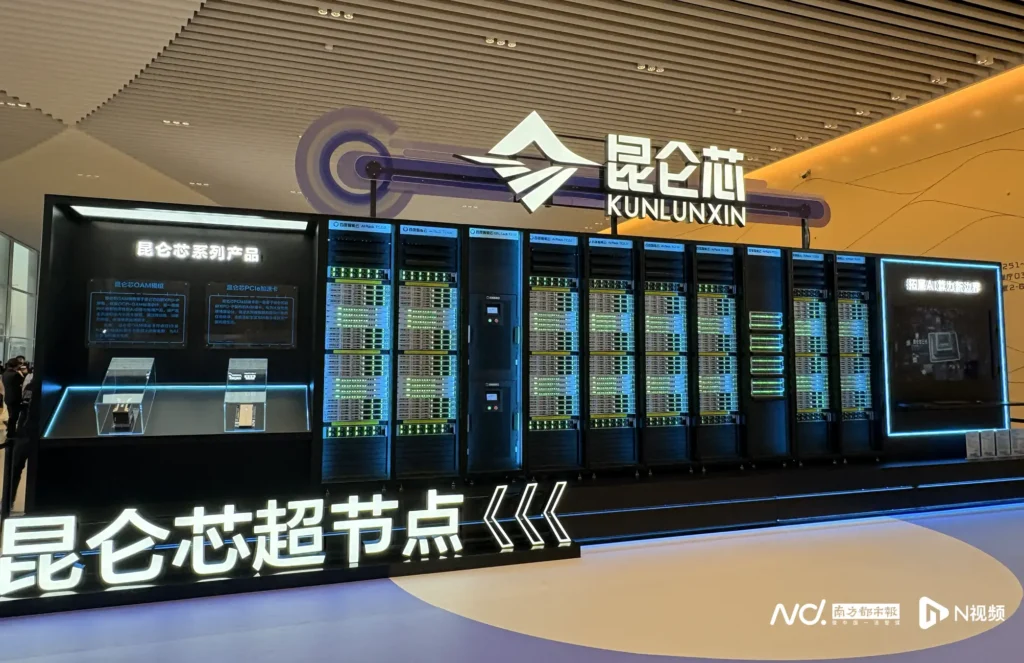
Baidu’s chip subsidiary, Kunlunxin, underpins its AI infrastructure strategy. The roadmap spans the decade, with the M100 chip, focused on large-scale inference, launching in 2026, followed by the M300 chip for both training and inference in 2027. A next-generation N-series chip is planned for 2029.
This progression reflects a shift toward specialized AI hardware rather than general-purpose compute.
In 2025, Kunlunxin shipped approximately 60,000 P800 chips, while total orders exceeded 200,000 units. This created a backlog of around 140,000 chips.
At an average price of roughly RMB 60,000 per unit, this backlog alone represents potential revenue of about RMB 8.4 billion. The supply-demand gap underscores a strong market need for domestic AI chips.
Baidu introduced the Tianchi 256 and Tianchi 512 supernode systems, enabling the interconnection of 256 and 512 AI accelerator cards, respectively. These systems deliver more than 50% performance improvement and up to 3.5 times the token throughput for large-model inference workloads.
The company plans to scale further, targeting thousand-card clusters by 2028 and million-card systems by 2030.
To coordinate this infrastructure, Baidu launched the Baige 5.0 platform in 2025. It integrates multiple semiconductor sources, including Kunlun chips, to support model training and inference at scale.
The platform improves network performance, computational efficiency, and workload distribution, particularly for large-scale model deployment.
Baidu’s advantage lies in controlling multiple layers of the stack. By aligning chip design, model architecture, and cloud infrastructure, the company optimizes instruction handling and workload scheduling.
This coordination improves efficiency and reduces dependence on external hardware ecosystems, which is critical in a constrained semiconductor environment.
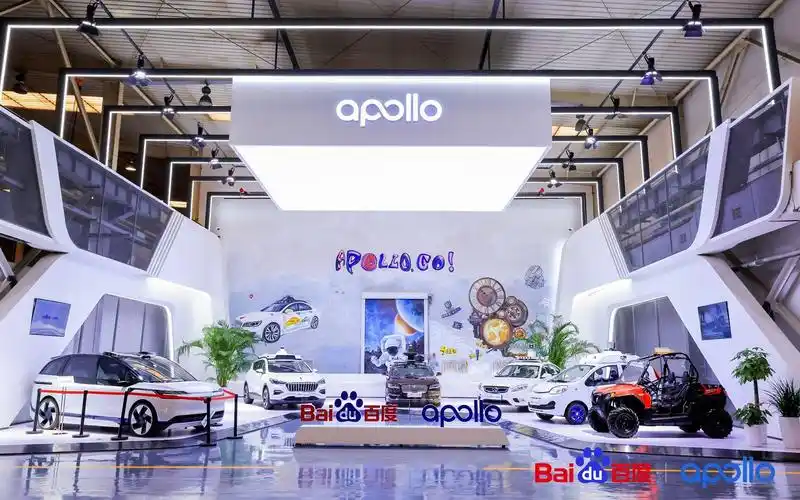
Baidu’s Apollo Go robotaxi service has moved beyond pilot testing into large-scale deployment. By late 2025, it had completed over 17 million cumulative rides and operated in 22 cities.
The fleet includes more than 1,000 fully driverless vehicles, delivering around 250,000 rides per week. In addition, the system has accumulated over 240 million autonomous driving kilometers, providing a substantial real-world data advantage.
The latest robotaxi model, RT6, is priced under $ 30,000. This cost reduction is critical. Lower vehicle costs directly improve unit economics and make large-scale deployment financially viable.
Without this shift, robotaxis remain experimental. With it, they become a scalable transportation model.
Baidu is extending its autonomous mobility operations beyond China. The company plans to deploy 1,000 robotaxis in Dubai by 2028 and begin operations in Europe through a partnership with Lyft in 2026.
This expansion indicates that Apollo Go is not limited to domestic infrastructure. It is being positioned as a globally deployable system.
Baidu is also developing AI-driven transportation infrastructure. Its intelligent traffic system optimizes signal timing, reduces congestion, and improves road efficiency.
By 2025, the company had shipped over 100,000 units of its Apollo smart transportation system. Annual revenue from this segment is expected to exceed 10 billion yuan, showing that infrastructure, not just vehicles, is a key part of the business model.
Baidu’s shift reflects a broader pattern across China’s AI landscape. Understanding it requires more than tracking announcements. It requires breaking down how platforms, models, infrastructure, and user behavior connect in practice.
ChoZan’s work focuses on this level of analysis. It supports companies through:
This work is grounded in ongoing research, not one-off reporting. The goal is to make China’s fast-moving AI ecosystem easier to understand, evaluate, and act on.
If you are trying to connect these shifts to your own strategy, you can explore ChoZan’s research or book a consultation to discuss your specific questions.
Baidu’s AI ecosystem integrates search, cloud infrastructure, and applications into a single system. It powers conversational search, enterprise tools, and services such as robotaxis, enabling data and models to operate seamlessly across multiple layers.
Baidu AI China strategy matters because it shows how AI is deployed at the system level rather than as isolated tools. It integrates models, infrastructure, and user platforms, reflecting how China is scaling AI across industries and real-world applications.
Baidu’s AI search engine delivers direct answers rather than lists of links. Users interact through conversations, asking complex questions and receiving synthesized responses, thereby reducing browsing and changing how information is accessed online.
ERNIE Bot, a Baidu AI, drives adoption by integrating AI directly into search and apps. It reached over 200 million users, showing strong demand for conversational AI and positioning it as a primary interface for everyday digital tasks.
Baidu AI Cloud Qianfan enables companies to build and deploy AI applications without complex infrastructure. It combines models, tools, and workflows into a single platform, enabling faster enterprise adoption and more practical use in real business operations.
AI agents, such as Baidu AI, complete tasks rather than respond to prompts. They automate workflows such as research, content creation, and operations, helping users and businesses move from manual interaction to outcome-based execution across systems.
Baidu AI, OpenAI, and Google AI differ mainly in approach. While global players focus on model performance, Baidu emphasizes integration across search, cloud, and infrastructure to create a system that operates across real-world use cases.
Baidu AI chips Kunlunxin provide the computing power for training and running large AI models. They support Baidu’s infrastructure strategy and help reduce reliance on external hardware in a competitive and supply-constrained environment.
Baidu AI robotaxi Apollo Go applies AI in real-world mobility. It powers navigation, decision-making, and fleet operations, showing how AI systems extend beyond software into large-scale transportation infrastructure and services.
Baidu’s AI ecosystem stands out for integrating models, infrastructure, and applications into a single system. This allows faster deployment, better performance control, and more practical use across industries compared to standalone AI platforms.