CONTENT
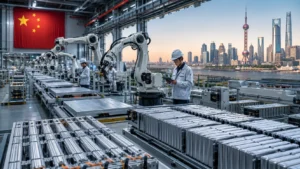
When people ask what Huawei is today, the answer no longer fits a single category. Huawei Technologies Co., Ltd. has moved from a consumer-focused brand into a company that operates across networks, cloud, compute, and enterprise systems.
In ChoZan’s latest China tech study, the Huawei company stands out because it sits at the point where technology becomes infrastructure. The next phase of competition depends on control over compute, networks, and software, as well as the ability to deploy them at scale.
That is where Huawei now operates. It plays a central role in China’s digital infrastructure, AI compute stack, connected device ecosystem, and enterprise technology landscape, while continuing to operate under global scrutiny and long-running sanctions.
If you ask what company Huawei is, the clean answer is simple. Huawei Technologies Co., Ltd. is a Chinese technology company founded in Shenzhen in 1987. Officially, Huawei says it operates in more than 170 countries and regions, employs about 213,000 people, and serves more than 3 billion people worldwide.
Huawei began with telecommunications equipment and expanded into network infrastructure, enterprise ICT, and consumer technology. That origin still defines how it operates. The company builds for large-scale systems where reliability, deployment depth, and long-term control matter.
Today, Huawei Technologies operates as an integrated company across telecom networks, cloud computing, enterprise solutions, and devices. That structure explains how the company competes across multiple layers of the technology stack without shifting its core model.
The Huawei company matters because it operates across several critical layers of China’s technology system within a single commercial structure. It combines telecom networks, cloud infrastructure, AI compute, operating systems, and industry solutions in a way few companies can replicate.
In 2025, Huawei reported CNY 880.9 billion in revenue and CNY 192.3 billion in research and development spending, equal to about 22 percent of revenue.
That scale supports continuous investment across chips, software, and infrastructure simultaneously. It allows Huawei to build long-term capabilities rather than compete on short-cycle product releases.
This positioning explains why Huawei appears consistently in discussions about China’s AI buildout, industrial transformation, and technology independence. It operates where infrastructure, compute, and deployment converge.
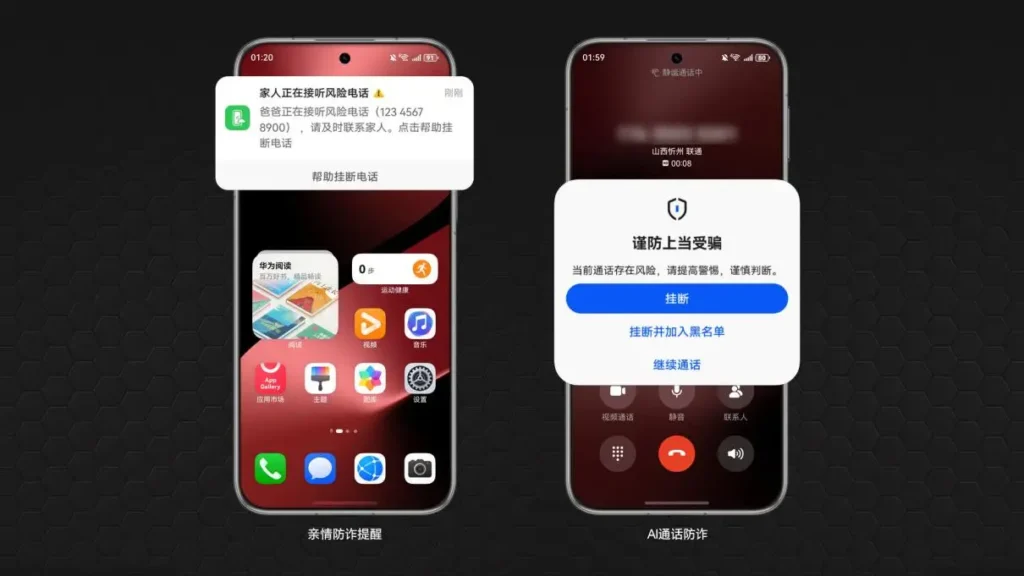
Huawei’s position in telecom equipment remains a core advantage because it anchors the company inside national infrastructure and large-scale network deployments.
By 2025, Huawei supported more than 230 carriers in building and upgrading fiber broadband networks, while its ICT solutions connected more than 170 million people in rural and remote areas across more than 80 countries and regions. It also reported more than 60 million advanced 5G users worldwide.
This installed base keeps Huawei embedded in long-term infrastructure projects where reliability, scale, and lifecycle support matter more than short-term product cycles.
That position extends directly into enterprise ICT. Large organizations do not buy connectivity in isolation. They require integrated systems across networks, cloud, storage, security, and compute. Huawei’s experience in carrier-grade deployment gives it credibility in that environment and allows its network business to open pathways into cloud services, AI infrastructure, and enterprise platforms.
Huawei Cloud is the layer that turns Huawei’s infrastructure into an enterprise platform. By 2025, it operated across 34 regions and 101 availability zones and built a developer base exceeding 10 million.
The Ascend and Kunpeng ecosystems reached more than 4 million and 3.8 million developers, respectively, and over 26,000 industry solutions were built with partners.
This reflects a scaled compute ecosystem built around developers, partners, and industry deployment.
Huawei expanded this ecosystem through Pangu. The 5.5 generation includes a 718-billion-parameter model designed for industrial use cases across manufacturing, agriculture, and scientific research.
Huawei also open-sourced parts of the Pangu model family, including a 72-billion-parameter MoE model optimized for Ascend chips. This approach drives adoption at the software layer while aligning developers with Huawei’s compute architecture.
Huawei introduced FlexAI as an orchestration layer for AI clusters. External reporting indicates around 30 percent improvement in chip utilization.
This shifts the competitive focus from raw hardware access to the efficient use of existing compute resources.
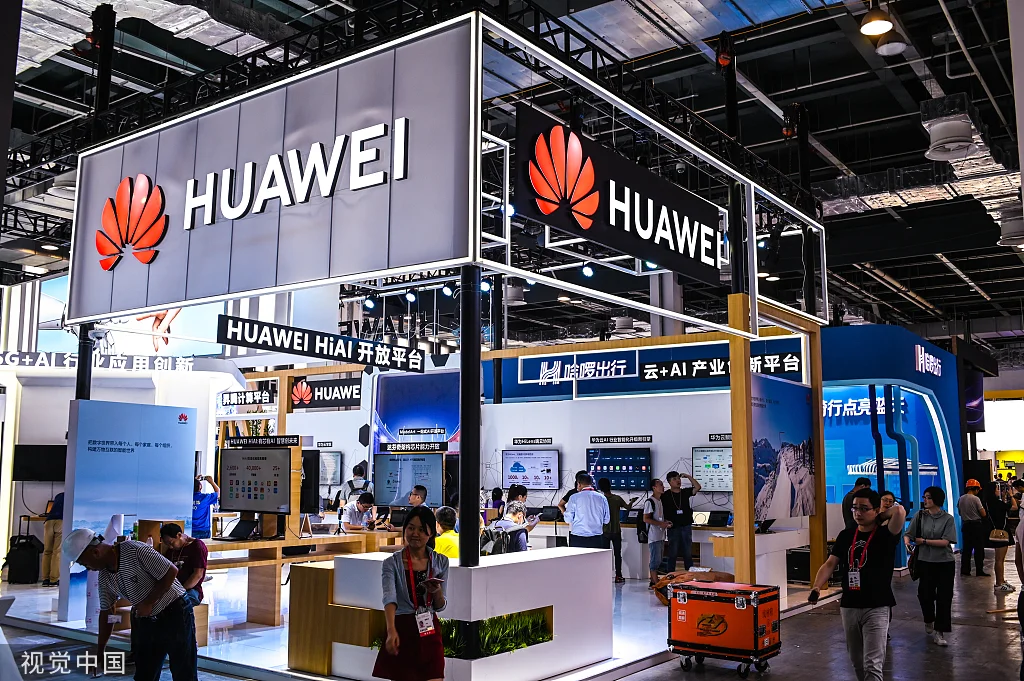
Huawei Technologies built HarmonyOS into a viable operating system that now runs across phones, tablets, wearables, and automotive interfaces. By the end of 2025, more than 36 million devices were running HarmonyOS 5 and 6, and the ecosystem had attracted more than 10 million developers and over 300,000 applications and services.
This scale gives Huawei control over the software layer across its device portfolio. It connects hardware categories through a unified system, strengthens developer participation, and supports deeper integration across services and user experiences.
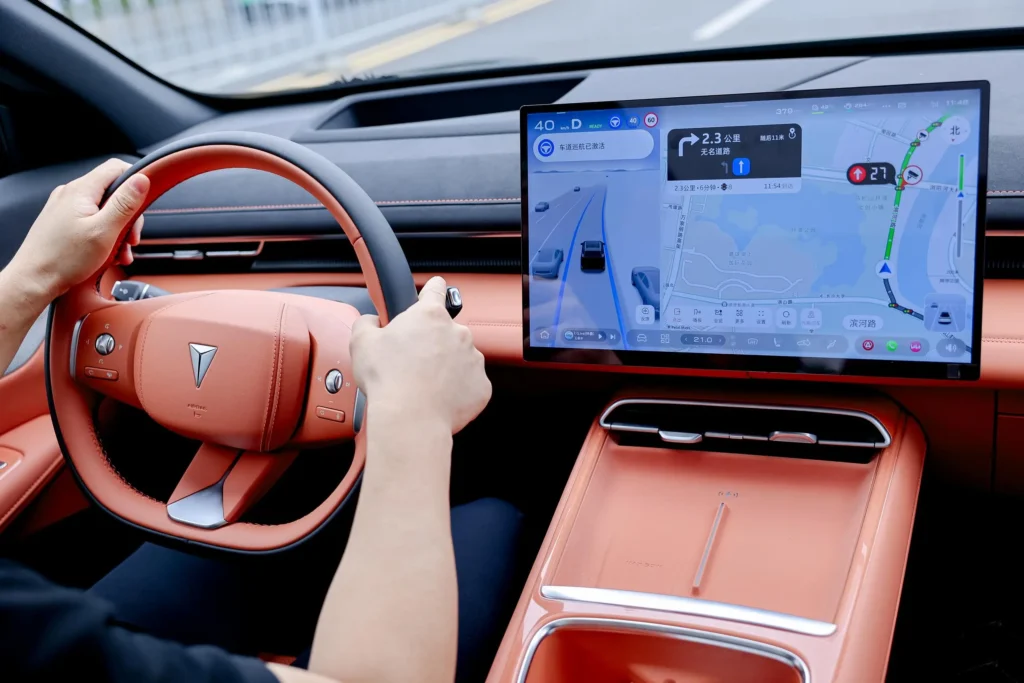
The same logic extends into automotive. Huawei Inside partnerships with SERES, BAIC, and other manufacturers place Huawei’s software and assisted-driving systems in production vehicles. The ADS system supports Level 2+ city driving, with deployments in models such as the Aito M5, and partnerships like Avatr further expand this role.
Huawei’s position in automotive is consistent with its broader strategy. It does not operate as a car manufacturer. It provides the intelligence layer, combining software, sensors, and connectivity within partner ecosystems.
Since 2019, Huawei has been subject to US export controls that restrict access to advanced semiconductors, chip design tools, and related technologies. These controls have expanded over time, including tighter rules on AI chips and broader restrictions through the Entity List.
In 2025, US authorities also warned that the use of Huawei’s Ascend AI chips could trigger export control violations, extending regulatory pressure beyond direct suppliers.
These restrictions shape where and how Huawei operates, particularly in Western markets. Searches for Huawei in the USA often lead to policy, security, and compliance concerns rather than standard commercial positioning.
At the same time, Huawei continues to generate revenue outside China and remains active in global markets. The company operates under constraints, but it continues to build and deploy its technology stack within those limits.
Huawei’s next phase of growth centers on applying its technology stack across the industry. Its cloud, compute, and connectivity systems are already deployed across hundreds of scenarios in sectors such as manufacturing, energy, transportation, and public services.
This reflects a shift from building technology components to delivering operational systems. Huawei’s focus is on integrating cloud infrastructure, AI models, and network capabilities into environments where performance, reliability, and scale are critical.
In these settings, value comes from deployment rather than experimentation. Huawei positions its technology as infrastructure for industrial operations, where long-term integration and system stability matter more than isolated product innovation.
Huawei’s supply chain strategy has shifted toward internal capability and domestic coordination in response to external restrictions. The company has expanded its work across chip design, software frameworks, and hardware integration to reduce dependence on foreign suppliers.
Huawei’s Ascend ecosystem now operates alongside domestic manufacturing partners, packaging suppliers, and electronic design automation networks that support a China-focused semiconductor base.
Despite limits on advanced manufacturing tools, Huawei continues to develop AI chips using 7-nanometer-class processes and alternative design approaches. These constraints have pushed the company to focus on system-level optimization rather than relying on cutting-edge fabrication alone.
This approach reflects a broader shift. Instead of competing on access to the most advanced nodes, Huawei builds value through integration across chip design, software, and deployment environments. That model allows it to continue scaling its AI and infrastructure capabilities within a constrained supply environment.
The report from ChoZan places Huawei at the center of China’s artificial intelligence infrastructure buildout. The company will continue to advance domestic semiconductor capabilities, supporting 14-nanometer and higher fabrication efforts. Chiplet and 3D stacking technologies will help Huawei Technologies co ltd boost performance despite manufacturing constraints.
The Pangu model family will expand to GPT-4-level capabilities optimized for the Chinese language, government workflows, scientific tasks, and industrial applications. The open-source strategy will continue to drive developer adoption. MindSpore will strengthen its PyTorch interoperability to attract more enterprise users.
For the Huawei company in the USA and other Western markets, the situation will not change. But what company is Huawei globally has already transformed from a sanctioned smartphone maker into the most complete domestic technology provider in the world’s second-largest economy.
Understanding companies like Huawei requires more than surface-level analysis. It requires direct exposure to how China’s technology systems actually operate across infrastructure, platforms, and industries. That is where ChoZan works with global leadership teams.
ChoZan helps Fortune 500 companies, strategy leaders, and innovation teams translate China’s fast-moving ecosystem into actionable business insight. The work focuses on decoding how companies scale technology into real systems and how those models can be applied globally.
How ChoZan works with leadership teams
ChoZan’s role is straightforward. It helps leadership teams move from observation to understanding, and from understanding to application. That is the difference between watching China’s innovation and learning from it.
Book a consultation to explore how your team can apply lessons from China’s technology ecosystem to your own strategy.
Huawei is not a state-owned company. It is privately held and owned by employees through an internal shareholding structure, though its role in China’s tech ecosystem often leads to ongoing scrutiny and geopolitical debate.
Huawei faces restrictions due to national security concerns, particularly around telecom infrastructure and potential data access risks. Governments in the US and some allied countries have limited their market access and technology partnerships.
Yes, Huawei continues to produce smartphones, primarily for China and selected international markets. Its device strategy now operates alongside broader investments in cloud, AI, and enterprise technology systems.
Huawei operates across telecommunications, cloud computing, enterprise IT, artificial intelligence, smart devices, and automotive technology. Its business spans both infrastructure and applied industry solutions across multiple sectors.
Huawei’s largest revenue contributor remains its telecommunications and ICT infrastructure business, followed by consumer devices and enterprise services such as cloud and digital solutions.
Huawei competes differently. While Apple and Samsung focus heavily on consumer devices, Huawei combines devices with telecom infrastructure, cloud services, and enterprise systems, creating a broader and more integrated technology position.
Huawei Mobile Services is a suite of apps, APIs, and developer tools that replace Google services on Huawei devices. It supports app development, cloud integration, and ecosystem functionality across Huawei’s platform.
Huawei remains competitive by focusing on domestic markets, enterprise infrastructure, and internal technology development. Its strategy emphasizes long-term capability building rather than short-term global expansion under restricted conditions.
Huawei is one of the world’s largest suppliers of telecom equipment and has played a major role in global 5G infrastructure deployment, working with carriers to build and upgrade network systems.
Huawei was founded in 1987 by Ren Zhengfei, a former engineer, to build telecommunications equipment for China’s growing infrastructure needs. The company later expanded into global networks, devices, and enterprise technology systems.