CONTENT
AI robots in China span three categories: industrial robots, logistics and delivery systems, and humanoid robots. All three are advancing rapidly and all three are in commercial deployment at scale. In 2025, China led globally in all three.
The real story is not which robots China builds. It is why China can build them faster, cheaper, and at greater scale than anywhere else. That answer comes down to a structural convergence. AI capability, manufacturing depth, supply chain control, and national strategy all converge in China. They do not converge this way elsewhere.
This article maps the full AI robotics landscape in China and what it means for global business leaders.
AI robots are autonomous machines that use artificial intelligence to perceive their environment and carry out physical tasks. They make decisions in real time. They go beyond pre-programmed industrial arms. They learn, adapt, and respond to changing real-world conditions.
In China, the term covers three main categories. Industrial AI robots operate on factory floors for assembly, inspection, welding, and quality control. Logistics and delivery AI robots move goods across warehouses, fulfillment centers, and city streets. Humanoid AI robots take human form and handle complex physical tasks in unstructured environments.
All three are in commercial deployment at scale. What distinguishes China is the pace at which China artificial intelligence is embedded into hardware. The speed from prototype to deployment, and the scale of real-world operation, set China apart from every competitor.
The gap between China and every other country in AI robotics is not narrow. It is structural, and it is widening.
China’s industrial robotics market reached $9.42 billion in 2025 (Spherical Insights, May 2026). Domestic industrial robot output grew 28% year-on-year in 2025, accelerating from 14% in 2024 (ChinaPower/CCID, February 2026). By 2026, China’s broader robotics market is expanding at 47% year-on-year (SVRC Research, April 2026). The IFR’s most recent confirmed figures cover 2024. China installed 295,000 industrial robots that year, representing 54% of global installations. China’s operational stock reached 2,027,000 units, approximately 4.5 times more than Japan. For the first time, Chinese suppliers outsold foreign competitors domestically, reaching 57% domestic market share in 2024. Global installations are forecast to hit 575,000 in 2025 and 700,000+ by 2028 (IFR).
Global VC funding in robotics hit a record $27.6 billion in 2025 (PitchBook). China recorded over 610 robotics investment deals in the first nine months of 2025. These totalled 50 billion yuan ($7 billion). That represents a 250% year-on-year increase. China’s humanoid robot market is estimated at 5.3 billion yuan ($730 million) in 2025. It is projected to exceed 20 billion yuan ($2.8 billion) by 2026 (CCID/MIIT).
China’s autonomous last-mile fleet is scaling sharply. China shipped 6,600 unmanned delivery vehicles in all of 2024. In H1 2025 alone, over 12,000 units were delivered, more than double the full prior year. By mid-2025, 103 Chinese cities had opened roads to unmanned delivery. Full-year 2025 sales are forecast to exceed 30,000 units (Soochow Securities). Humanoid robots are the fastest-growing category. For the full commercialization story, see our dedicated China Humanoid Robots article.
Numbers reflect outcomes. The reasons behind them are structural. China’s lead in AI robots rests on four foundations that compound over time.
Policy and national strategy. The Chinese government designated robotics as a strategic priority under Made in China 2025. It has since committed a $138 billion state venture fund for robotics, AI, and advanced technology. Embodied AI, the integration of AI into physical robots, was included in China’s forthcoming 15th Five-Year Plan. Premier Li Qiang highlighted it alongside large language models at the 2025 World AI Conference. This is not peripheral support. It is national strategy.
Supply chain depth. China controls approximately 26% of the global actuator market, compared with roughly 5% for the United States. Actuators are critical robotics components. It also drives around 60% of global rare earth element production, materials that underpin motors, sensors, and batteries. China’s Yangtze River Delta alone contains the world’s most vertically integrated supply chain for humanoid robotics. Component makers, robot assemblers, and end users co-locate and iterate together. This proximity compresses development cycles.
Cost collapse. Chinese manufacturers have driven humanoid robot costs down faster than any projection anticipated. Unitree launched its R1 humanoid in July 2025 at just $5,900, a price previously considered impossible for years. Goldman Sachs reported that manufacturing costs declined 40% year-on-year, against earlier projections of 15 to 20% annually. Lower cost means faster adoption. Faster adoption generates more operational data. More data improves AI systems. The cycle accelerates itself.
Speed to scale. China’s ecosystem compresses the entire development loop. R&D, supply chain, manufacturing, integration, and deployment happen in close proximity. As one industry strategist noted, this allows companies to move from prototype to deployment faster. They learn from real operations and iterate at a pace that is difficult to match. The Greater Bay Area, anchored by Shenzhen, is the epicentre of this hardware-software convergence.
China’s AI robotics leadership spans all three categories: industrial automation, logistics systems, and humanoid robots. The following companies represent each layer.
Foxconn replaced 60,000 workers with robots at its Kunshan facility. It has since targeted 30% full automation across all operations. Its Shenzhen lighthouse facility produces electronics for Apple, Nvidia, and other global brands. AI scheduling and robotic assembly run the entire process without human coordination.
Cainiao (Alibaba’s logistics arm) operates over 700,000 autonomous mobile robots across its global logistics parks. Its systems sort, route, and manage fulfillment at a scale no other logistics operator matches. Cainiao’s robot fleet represents the largest single deployment of AI logistics robots globally.
Meituan’s delivery robot network operates across more than 100 Chinese cities. Its autonomous pods and drones handle last-mile delivery, navigating urban environments in real time. Meituan has completed over 10 million drone delivery orders. Its logistics AI manages route optimization, traffic prediction, and customer interaction simultaneously. These high tech companies demonstrate AI robotics deployed at consumer scale, not just industrial pilots.
China’s humanoid robot sector is led by AgiBot, Unitree Robotics, and UBTECH Robotics. Together they accounted for the majority of the roughly 13,000 to 14,500 humanoid units shipped globally in 2025. Chinese companies represented approximately 90% of that total. The commercialization race, factory deployments, and key obstacles are covered in our dedicated China Humanoid Robots article.
China’s AI robotics dominance is not a story about the future. It is a story about what is already true and where it is heading.
The productivity gap is opening. Chinese manufacturers deploy AI robots that operate 24 hours a day. No breaks, no fatigue errors, and continuous learning from real operations. Companies competing with Chinese manufacturers in any sector that can be automated are already facing a structural disadvantage.
The EV playbook is repeating itself. China used policy, supply chain control, and cost engineering to dominate electric vehicles. The robotics arc is following the same path. The robotics industry is following the same arc, but at a faster pace. Understanding how this happened in EVs helps predict how it will unfold in AI robots.
Supply chain exposure is real. Businesses sourcing actuators, sensors, or robotics systems face growing dependency on Chinese supply chains. This applies whether they build or use robots. This is true regardless of whether they are building robots or simply using them. The digital transformation implications reach every sector from manufacturing to logistics to services.
The window to learn is now. China has more operational AI robots deployed in real environments than any other country. The learning advantage compounds with every deployment. Understanding what Chinese companies are doing on the ground is the clearest preparation for what is coming. This window exists now, before the technology becomes mainstream globally.
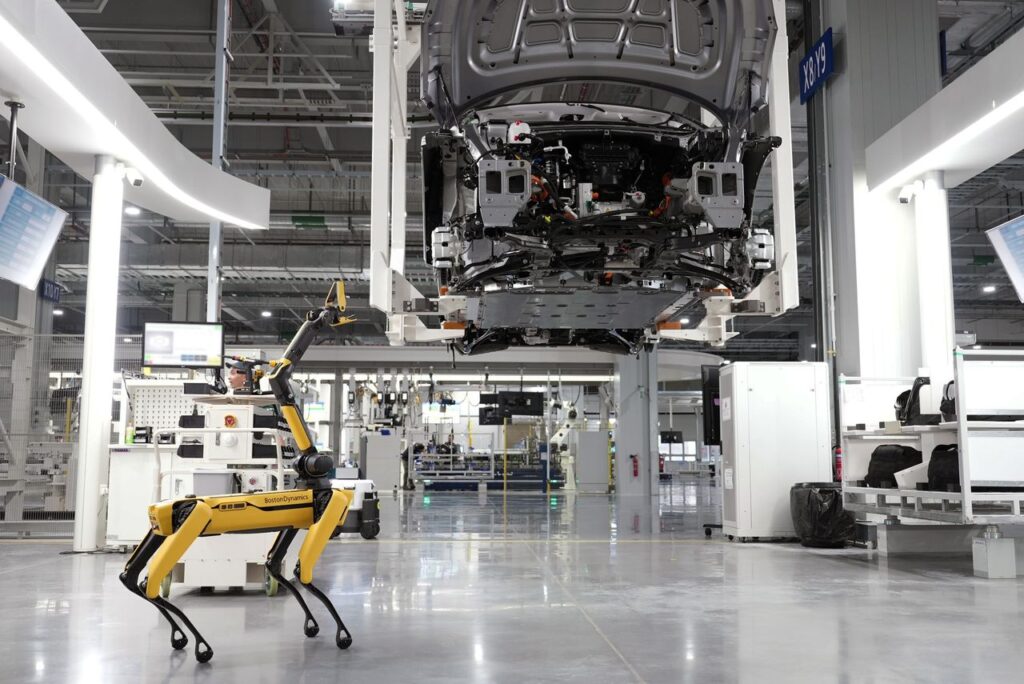
Understanding China’s AI robotics revolution from the outside is useful. Getting on the ground to see it firsthand is where strategy gets built.
ChoZan’s China Innovation Tours take business leaders into the companies, facilities, and ecosystems driving this transformation. Participants leave with the kind of ground-level insight that no report can replicate.
Book a consultation with ChoZan and start learning from China’s robotics innovation frontier today.
AI robots in China are not a future scenario. They are a present-day structural force reshaping manufacturing, logistics, and the economics of automation globally.
China did not arrive here by accident. It arrived through a decade of deliberate policy, investment, and supply chain building. Competitive pressure turned that investment into the world’s most deployed AI robotics ecosystem.
For global business leaders, the question is no longer whether to pay attention. It is how quickly they can understand what China has built. And what it means for their own industries.
ChoZan is the bridge.
AI robots in China are autonomous machines that use AI to perceive environments and carry out physical tasks. They span three categories: industrial robots on factory floors, logistics and delivery robots, and humanoid robots. China leads globally in all three.
China leads through national policy, supply chain depth, falling hardware costs, and faster R&D-to-deployment cycles than any competitor.
For industrial and logistics robots, Foxconn, Cainiao, and Meituan represent the largest deployments. For humanoid robots, AgiBot, Unitree, and UBTECH lead globally. See our China Humanoid Robots article for a full breakdown of the humanoid sector.
Chinese manufacturers have driven robot costs down faster than any projection anticipated. Goldman Sachs reported manufacturing costs declined 40% year-on-year. This cost collapse applies across industrial, logistics, and humanoid robot categories, accelerating adoption at every level.
ChoZan’s China Innovation Tours offer structured visits to AI robotics companies, smart factories, and technology leaders across China. Expert sessions with on-the-ground practitioners are included.