CONTENT

Humanoid robots have been on the horizon for decades, but most systems stayed in research laboratories or in flashy demonstration videos. Recent advances in sensors, actuators, and generative artificial intelligence are now pushing bipedal robots into factories, shopping malls, and entertainment venues. One of the leading companies driving this shift is AgiBot, also known as Zhiyuan Robotics.
According to the Chozan report on emerging humanoids, China’s robotics ecosystem benefits from a national industrial strategy, world-class supply chain integration, and close cooperation between hardware makers and artificial intelligence developers. This environment allows the company to scale fast from prototype to production.
In 2025, AgiBot shipped more humanoid robots than any competitor, and in 2026, its AgiBot A2 platform is at the center of real-world deployment across service and industrial tasks. This article builds on the insights of that report, incorporating updated information from 2025 and 2026 to show how the A2 is shaping the next phase of humanoid robotics.
Zhiyuan Robotics, also known as AgiBot, was founded in Shanghai in February 2023 by former Huawei engineers Deng Taihua and Peng Zhihui. By 2025, it had reported more than 5,000 deliveries of humanoid robots.
The company is backed by Tencent, HongShan Capital, BYD, Hillhouse Investment, LG Electronics, and Baidu. It has raised roughly $83 million, reached a valuation above $1 billion by mid 2025, and is planning a Hong Kong IPO in 2026.
AgiBot benefits from Shanghai’s robotics ecosystem, where suppliers, AI teams, engineers, and pilot sites sit close together. This helps the company move faster from prototype to production.
Its A2 platform that combines motion intelligence, interaction intelligence, and task intelligence. That makes it suitable for customer service, exhibitions, reception work, and light industrial tasks.
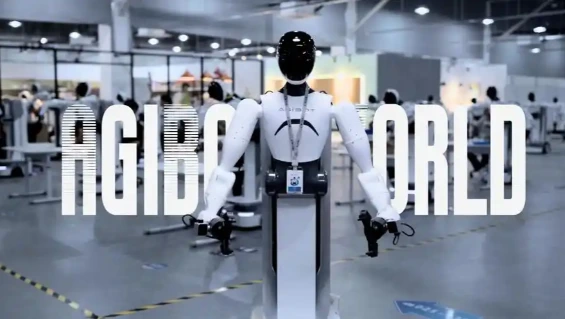
The AgiBot A2 humanoid robot is a full-sized bipedal robot built for human environments.
Key specifications:
| Feature | AgiBot A2 |
| Height | About 175 cm |
| Weight | About 55 kg |
| Degrees of freedom | 49 plus |
| Hand dexterity | 12 active plus 5 passive degrees per hand |
| Walking speed | Up to about 3 m/s |
| Payload | About 15 kg total |
| AI compute | Around 200 TOPS |
| Battery | Around 700 Wh standard, up to 2,000 Wh for industrial use |
The A2 uses lidar, stereo depth cameras, RGBD cameras, microphones, tactile sensors, force sensors, and IMU systems for mapping, obstacle avoidance, voice interaction, and object handling.
Its WorkGPT multimodal AI processes text, audio, and visual inputs with reported 96% accuracy. It also supports facial recognition, with a reported 99% face wake-up rate.
The platform also includes multiple variants designed for different deployment environments. The standard A2 focuses on service roles such as reception work, exhibitions, and customer interaction.
A2 Max increases payload capacity for industrial handling tasks, while A2 W supports longer runtime operations with larger battery configurations. A2 Ultra targets high-end demonstrations and interactive public events. Meanwhile, A2 Lite offers a lighter configuration for education and other service applications.
Overall, the A2 series combines mobility, sensing, interaction, and modular power options. This makes it suitable for customer-facing spaces and selected industrial tasks.
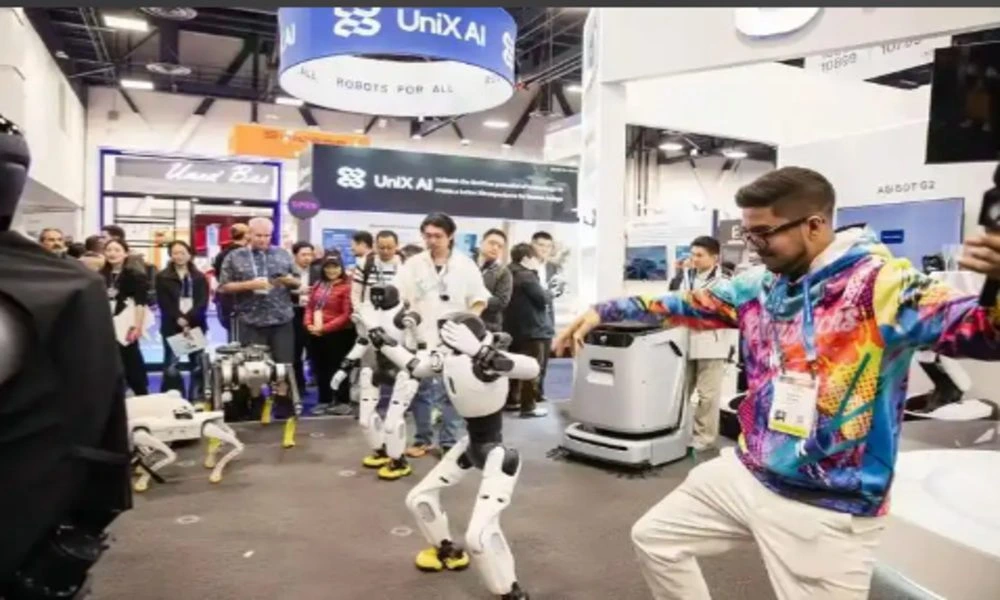
The AgiBot World dataset, released in 2026, comprises millions of samples from real-world environments such as commercial spaces, homes, and general-purpose settings.
It uses free-form, teleoperated demonstrations, so the data covers a variety of objects, starting positions, and task sequences. A mobile camera tracks head movements and waist rotations, while force control records contact and force feedback.
The dataset also includes one-to-one digital twin simulations for each real capture. Its annotations cover high-level instructions, task descriptions, atomic skills, and error recovery trajectories. This supports imitation learning, reinforcement learning, and training for the AgiBot A2 humanoid robot.
AgiBot also provides Genie Sim 3.0, built on NVIDIA Isaac Sim, for motion and task prototyping. Its custom runtime, AimRT, uses C++20 and reportedly outperforms ROS 2.
The multimodal AI core, WorkGPT, connects with the GO 1 foundation model and large language models to support language understanding, visual recognition, and auditory perception. It also helps A2 handle multi-turn conversations, facial expressions, fluid motion, customized enterprise knowledge bases, and remote control through smartphones or computers.
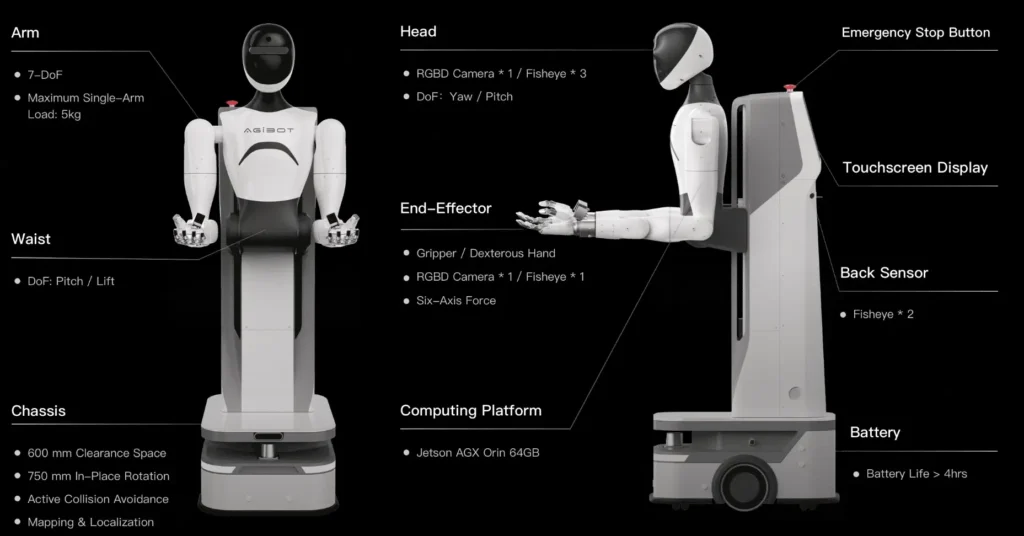
The AgiBot A2 humanoid robot is built for customer-facing roles such as reception, guided tours, concierge support, and corporate lobby assistance. Its multimodal AI understands spoken requests, responds with natural speech, and supports facial expressions during interaction.
The robot uses high-definition cameras and microphone arrays to maintain 96% recognition accuracy in noisy spaces. It can also navigate large indoor areas, including marble, carpet, and wooden floors. Its obstacle avoidance system and backup control pathways support safer operation in crowded venues.
AgiBot has used major public showcases to prove these capabilities. At CES 2026, it presented its robot portfolio and won multiple “Best of CES” awards. In February 2026, AgiBot Night featured more than 200 robots performing dance, kung fu, comedy, and magic, reinforcing the A2 series’ reliability in live public settings.
Although the standard AgiBot A2 focuses on service roles, its variants support light industrial work. A2 Max increases payload capacity for material handling and palletizing, while A2 W uses larger batteries for longer manufacturing shifts.
In factories, the A2 can support assembly, quality inspection, machine tending, and parts movement. It has been deployed by BYD and SAIC Motor for factory automation. Its walking speed of up to 7 kilometers per hour helps it move parts between stations.
In warehouses, the A2 can navigate aisles, lift boxes, and sort packages. Its dual-arm setup can handle up to 10 kilograms, while sensors help it handle a wider range of objects more accurately. Hot-swappable batteries enable longer operation, and remote control allows human supervision when needed.
Because real-world data is essential for training embodied AI, AgiBot uses its own robots to collect data continuously. The A2 and G2 platforms gather information via the AIDEA Giga Data Factory, which supports the AgiBot dataset (also known as AgiBot World) and the GO 1 foundation model.
Universities and research labs can purchase the A2 or rent it via the Robot-as-a-Service (RaaS) model to conduct human-robot interaction studies and develop new applications. The compact A2 Lite variant offers an affordable educational platform with a similar sensor suite but lighter weight and lower price.
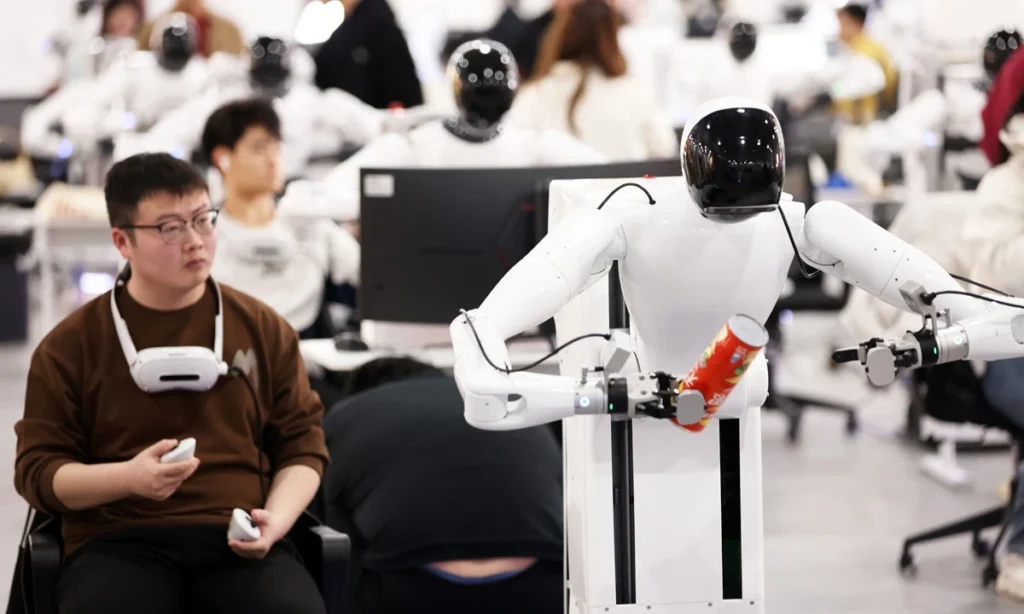
The agibot A2 price varies by configuration, battery size, AI compute, and hand dexterity. In March 2026, BotInfo estimated pricing between $100,000 and $190,000, while reseller Robozaps listed the standard A2 at around $120,000.
AgiBot also launched a Robot-as-a-Service platform in 2026, with rental pricing starting at about €899 per day across 17 countries. The company sells robots directly through its online store and works with enterprise clients through events such as CES.
The A2 received Chinese, American, and European certifications by May 2025, which supports wider international deployment. AgiBot also combines hardware sales with subscription services like WorkGPT and Genie Sim, following the growing robotics trend of shifting from upfront hardware purchases toward service-based operating models.
With more than 5,000 units delivered in 2025, AgiBot has moved beyond the prototype stage. Its A2 platform that combines lightweight hardware, modular batteries, and multimodal AI for use in service and light industrial settings.
The A2’s 106-kilometer autonomous walk from Suzhou to Shanghai in November 2025 showed its endurance and reliability. AgiBot’s large public showcases, including robot performances and coordinated demonstrations, also helped prove the platform can operate in complex live environments.
Next, AgiBot is focused on international expansion, a planned IPO, AI stack improvements, and more home-friendly humanoid versions. Its integration with NVIDIA’s GR00T ecosystem could improve motion, perception, and task learning.
As prices fall and battery systems improve, AgiBot A2 shows how humanoids can move from exhibitions and reception work into broader service, logistics, manufacturing, healthcare, and education use cases.
China’s humanoid robotics industry is moving from research labs into commercial deployment faster than many global markets expected. Companies like AgiBot show how China integrates AI, hardware manufacturing, supply chains, and real-world testing into a single execution system.
At ChoZan, we help executives, innovation teams, and business leaders understand the systems behind China’s next-generation technology companies.
Our work includes:
If your organization wants to understand how China is scaling humanoid robotics, embodied AI, and automation infrastructure, ChoZan helps translate fast-moving developments into practical business insight.
Manufacturing, logistics, hospitality, retail, healthcare, and commercial property management are likely early adopters because these sectors already use automation and repetitive workflow systems.
Yes. Many humanoid robots can perform core navigation, perception, and task execution locally, while cloud systems mainly support updates, training, analytics, and remote management.
AgiBot focuses more heavily on near term commercial deployment and service applications, while Tesla Optimus still remains closely tied to Tesla’s internal manufacturing roadmap and long term ecosystem plans.
Embodied AI allows robots to learn through physical interaction with environments instead of relying only on static datasets. This improves movement, adaptation, and real world task execution.
NVIDIA supports robotics companies through simulation tools, AI training infrastructure, and GR00T humanoid models that improve robot perception, motion learning, and task coordination.
Yes. The platform uses obstacle avoidance, multimodal sensing, force feedback, and real time navigation systems designed for operation in shared human environments.
China combines hardware manufacturing, AI development, supply chains, battery production, and real world deployment environments within the same ecosystem, which shortens commercialization timelines.
Traditional industrial robots usually perform fixed repetitive tasks inside controlled environments, while humanoid robots are designed for flexible movement and interaction in human spaces.
Yes. Humanoid robots could help offset labor shortages in logistics, eldercare, manufacturing, and service industries where aging populations are creating workforce gaps.
AgiBot demonstrates how Chinese robotics companies are moving beyond prototypes into scaled deployment, combining embodied AI, manufacturing capability, and real world commercialization.