CONTENT
Beijing, China, has entered a new phase of technology development. The capital is connecting fundamental research, artificial intelligence, advanced computing, open source platforms, industrial policy, public testing, and commercialization more tightly than before. Official estimates place Beijing’s 2025 core AI industry at RMB 450 billion, with more than 2,500 AI companies concentrated in the city.
Beijing’s advantage comes from coordination. Universities, laboratories, municipal agencies, technology parks, investors, established companies, startups, and application owners operate across a connected innovation system. This structure can move a research priority into infrastructure, policy support, industry pilots, and commercial adoption through several local channels.
The Beijing Municipality is treating AI as an economic system rather than a single industry. Its 2026 AI innovation plan organizes work across nine areas: core technology, domestic computing ecosystems, high-quality data, citywide applications, AI for Science, embodied intelligence, open-source development, innovation services, and safety governance. The city aims to raise the core AI industry above US$147.5 billion in roughly two years.
This policy structure gives the Beijing tech ecosystem a clear direction. Research institutions gain stronger links to application settings, while companies gain access to computing, data, testing, and sector partners.
For companies studying the Beijing market in China, the key point is institutional density. Beijing combines national research capacity with municipal implementation power.
A technology can move through research validation, standards work, public demonstrations, pilot programs, and industrial adoption within one metropolitan system. This progression reflects the city’s coordinated approach to technology development.
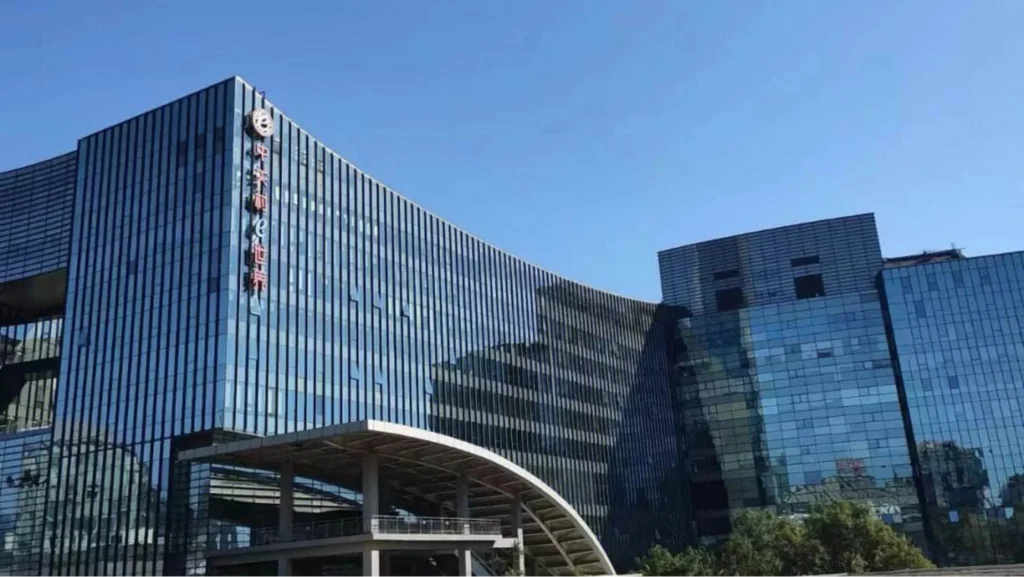
Zhongguancun remains the most visible center of the capital’s innovation system, yet its role extends across multiple districts and institutions. It connects research institutes, science parks, technology transactions, corporate innovation, startup services, and international exchange.
Zhongguancun benefits from the immediate proximity of Peking University, Tsinghua University, and the Chinese Academy of Sciences, providing a robust pipeline of basic research and elite talent. This academic firepower is complemented by flexible institutional frameworks within research organizations such as the Beijing Academy of Artificial Intelligence, which inject vitality into applied research.
The 2025 Zhongguancun Forum included 128 activities, participation from more than 100 countries and regions, and more than 1,000 speakers. Its agenda covered large AI models, embodied intelligence, quantum technology, biomedicine, 6G, and brain-computer interfaces. The program included technology transactions, innovation competitions, and major scientific achievement releases.
Zhongguancun Science City hosts 70 percent of the city’s AI unicorn companies, and Haidian district alone is home to 1,900 AI companies, including 26 unicorns. In the first half of 2025, 6,902 new tech enterprises were established in the area, demonstrating a velocity of innovation unmatched elsewhere in the country.
The Zhongguancun Jingxi AI Technology Park opened in Mentougou in October 2025. Its first phase included 170,000 square meters of core facilities and an AI computing center with 700 petaflops of accessible computing capacity. The first group included more than 10 companies working across AI applications in manufacturing, energy, and pharmaceuticals.
This expansion shows how the Beijing tech market is extending beyond its traditional Haidian core. New parks combine workspace with computing, incubation, research, pilot testing, and manufacturing support. The model reduces the operational distance between AI development and industry deployment.
Nine of the top 10 global open-source AI models hail from China, with the leading model, GLM-4.5, developed by the Haidian-based unicorn Zhipu AI. The area’s influence is further underscored by the fact that Haidian is home to over 70 percent of the country’s AI companies and over 80 percent of the world’s top AI scholars.
As of June 2025, 89 large models were registered in Haidian, accounting for one-third of the national total. This is the core of the Beijing tech hub.
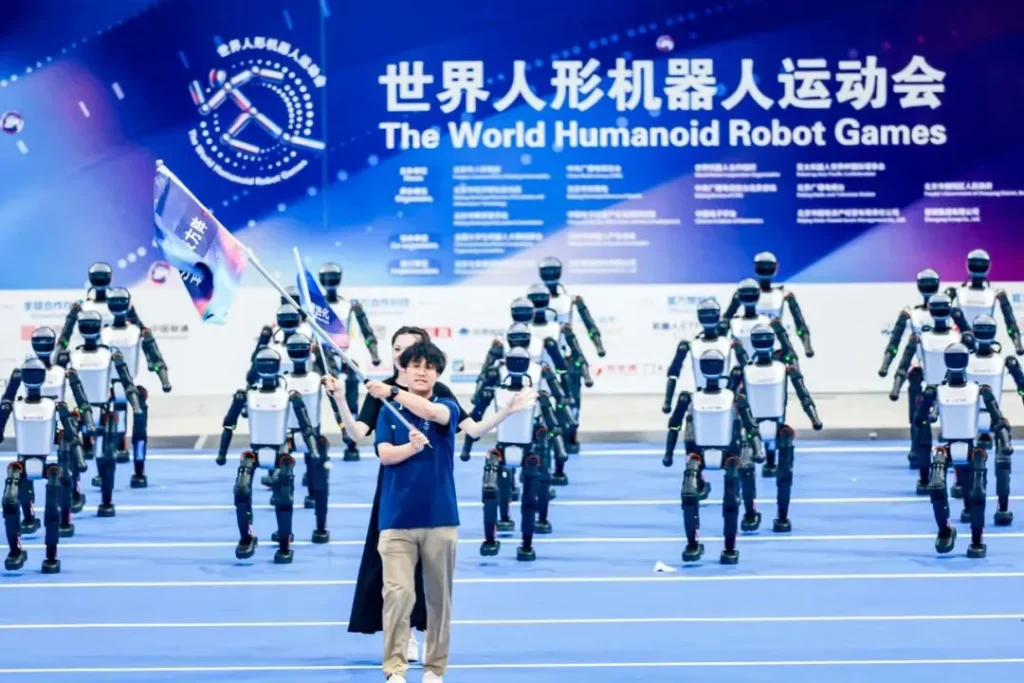
The city’s embodied intelligence action plan for 2025 to 2027 targets breakthroughs in more than 100 key technologies, at least 10 internationally leading hardware or software products, deployment of 10,000 embodied intelligent robots, and an industry cluster worth approximately US$14.7 billion by the end of 2027.
The targets reveal Beijing’s policy logic. The city wants progress across the full technology stack, from models and control systems to robot bodies, components, training data, testing, and adoption. Product capability forms one part of a larger deployment system.
Beijing E-Town is a central hub for applications and manufacturing of embodied intelligence. Measures released in August 2025 call for more than 100 strong, embodied-intelligence companies, production capacity for 10,000 robots, application coverage across more than 10 fields, and a large real-world training dataset by the end of 2027.
The support model addresses practical bottlenecks. E-Town plans to allocate US$14.7 million in annual data vouchers to support the purchase of datasets, interfaces, models, and related products. Its measures also cover shared robot bodies, computing support, joint laboratories, pilot production, first use programs, insurance, leasing, and robot retail formats.
Robotics companies can gain access to more than funding through this structure. Data collection sites, engineering partners, testing environments, early customers, and manufacturing support can influence how quickly a prototype becomes a dependable commercial product.
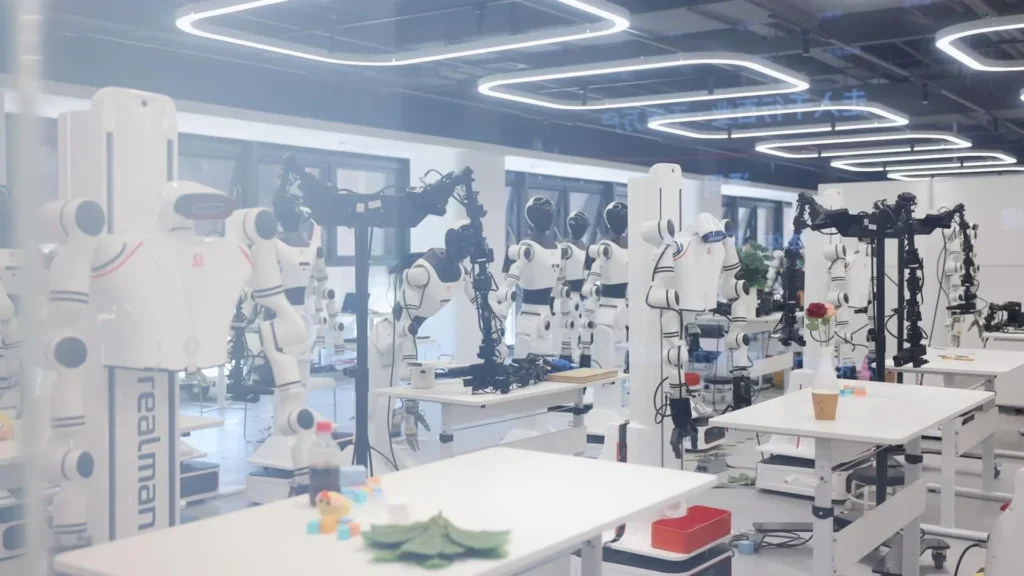
The Beijing Innovation Center of Humanoid Robotics serves as a platform within the city’s robotics system. In March 2025, it launched Hui Si Kai Wu, a general embodied intelligence platform designed to support multiple robot types and tasks through a shared intelligence layer. Demonstrations covered industrial sorting, block assembly, desk clearing, and logistics packing.
The center also uses open source tools to expand industry participation. The RoboMIND dataset released more than 100,000 trajectories across 479 tasks, and its Tien Kung platform made technical resources available to developers. In July 2025, the center released Tien Kung Lab, an open-source motion control framework based on technology used by the winning robot in Beijing’s humanoid half marathon.
This platform strategy can reduce duplicated development across the industry. Developers can build on shared data, robot hardware, simulation tools, and control frameworks. Companies can direct more resources toward sector applications, reliability, integration, and customer value.
In Shijingshan District, the “Shougang Winter Olympics Plaza Humanoid Robot Industrial Base” has become a hub for the development and innovation of the humanoid robot industry.
This base has brought together upstream and downstream enterprises, achieving preliminary industrial agglomeration within a planned area of nearly 37,000 square meters. The base focuses on key areas, including embodied intelligence, smart sensing, motion control, and core components.
The strongest opportunities in Beijing China may sit at the intersection of sectors. AI is moving into scientific research, healthcare, manufacturing, energy, finance, mobility, education, and public services. Robotics policy follows a similar direction through application access and sector-focused pilots.
Market entry should begin with ecosystem mapping. A company needs to identify the district, research institution, policy program, platform partner, application owner, and commercialization route connected to its technology. A broad China strategy may overlook these local operating links.
Partnership design also needs to account for open source development, standards, data access, testing, procurement, and industrial policy. Beijing rewards contributions that strengthen a wider technology system and solve a defined sector problem. The capital’s model favors long-term participation, technical credibility, and local collaboration over short launch cycles.
Beijing’s AI and robotics ecosystem connects research institutions, policy programs, technology companies, industrial parks, and commercial applications.
ChoZan helps organizations understand these connections through research, executive briefings, consulting, and direct learning experiences. From September 6 to 9, 2026, its China Innovation Tour to Beijing will offer a four-day executive immersion into applied AI, Zhongguancun, robotics, technology policy, and real-world deployment.
The program gives a small group of leaders direct exposure to the institutions, people, and operating logic shaping Beijing’s innovation system.
Book a consultation with ChoZan to turn Beijing’s innovation system into a practical market, partnership, and growth strategy.
Beijing is a municipality governed at the provincial level and serves as China’s national capital. The Beijing Municipality coordinates policy through municipal departments and district governments, including agencies responsible for science, technology, industry, education, and investment.
Beijing is a full municipality, while Zhongguancun is its leading science and technology innovation network. Zhongguancun connects research institutions, industrial parks, startup services, technology transactions, policy programs, and international innovation events across several districts.
Haidian remains the core research cluster because it combines Zhongguancun, major universities, research institutions, and technology companies. E-Town has greater strength in robotics, intelligent manufacturing, pilot production, and industrial application scenarios.
Beijing E-Town is a major base for advanced manufacturing, robotics, embodied intelligence, and commercial applications. Its current programs support robot data, shared hardware, laboratories, pilot production, scenario testing, leasing, insurance, and early product use.
In Beijing China, AI for Science refers to artificial intelligence used in scientific discovery, simulation, experimentation, screening, and research tools. Beijing’s dedicated policy connects scientific models with infrastructure, research institutions, and commercial applications in specialized fields.
Overseas companies can engage through research cooperation, technology forums, industrial parks, local partnerships, and sector projects. The Zhongguancun Forum brings institutions from more than 100 countries and regions into Beijing’s science and technology exchange network.
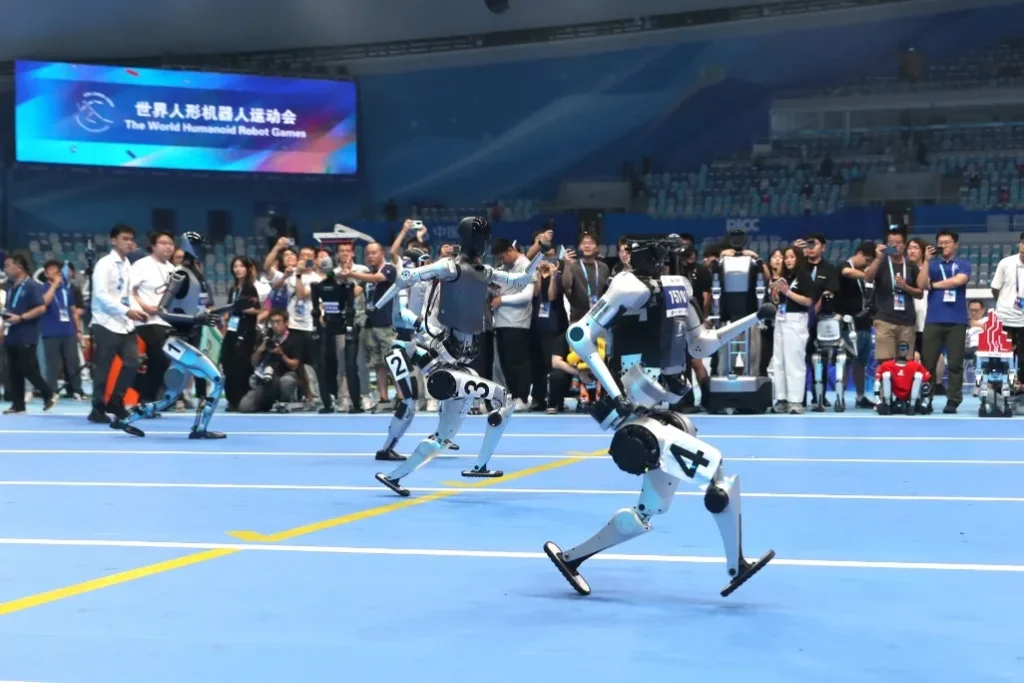
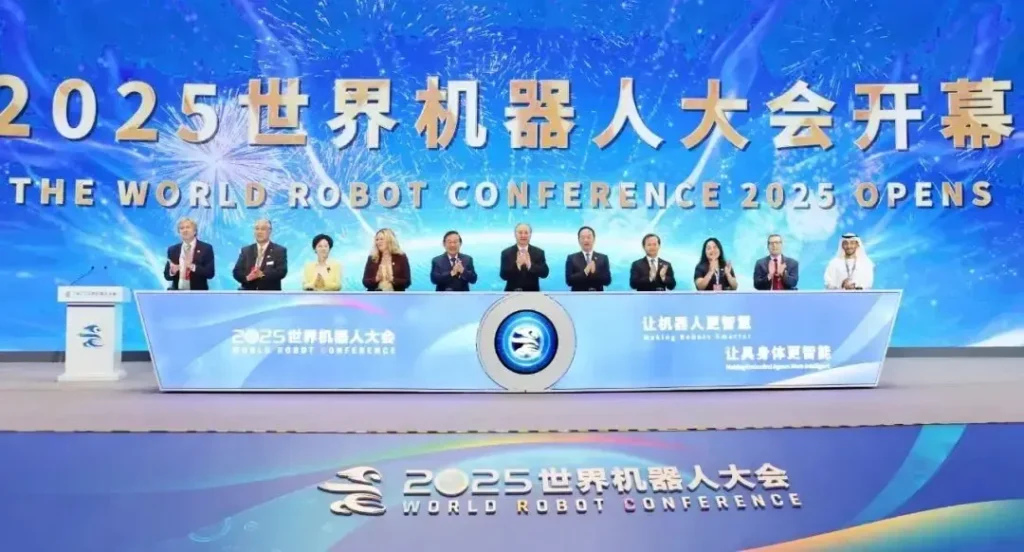
Beijing hosts the World Robot Conference and has introduced public events such as humanoid robot races and games. These events serve as testing grounds, product showcases, industry meeting points, and public demonstrations of embodied intelligence.
Yes. Beijing is expanding pilot testing, real world data collection, training facilities, and application scenarios for humanoid robots. E-Town policy covers manufacturing, education, healthcare, government services, commercial communities, and other operating environments.
AI safety forms part of Beijing’s current citywide AI plan. The city also inaugurated a Data and AI Security Testing Center in 2026 to support security testing, risk assessment, standards development, and regional governance capabilities.
Start with the local cluster connected to the product, then assess policy eligibility, research partners, data access, standards, pilot scenarios, procurement routes, and commercialization support. The right district and institutional network can shape market progress.