CONTENT

Chinese social media is a fast-moving universe. To understand how brands succeed in this environment, many marketers study Chinese consumer behavior and the digital ecosystems shaping modern retail. With over 1.3 billion WeChat users and more than 1 billion short-video users across platforms like Douyin and Kuaishou, brands can no longer treat the country as an afterthought.
Consumers spend an extraordinary amount of time online. The average Chinese internet user spends over 5 hours per day on mobile internet, much of it on social and video platforms. Just as importantly, trust in social recommendations is high—49% of Chinese consumers say influencer recommendations directly affect their purchasing decisions, far higher than in many Western markets.
By 2026, the Chinese digital landscape will have matured into a dense ecosystem of super-apps, niche forums, and seamless social commerce. Western platforms like Facebook and Instagram remain blocked, while local platforms such as WeChat, Douyin, and Xiaohongshu (RedNote) dominate everyday digital life. These platforms operate inside a broader ecosystem of social commerce in China, where consumers discover, discuss, and purchase products without leaving the same app.
Even smaller vertical platforms command massive reach. For example, Xiaohongshu alone surpassed 260 million monthly active users, becoming one of the country’s most influential lifestyle platforms.
Successful campaigns in this environment rarely rely on simple advertising. Instead, they’re bespoke experiences: they speak the language of local memes, festivals, and internet jokes, and they invite users to participate rather than passively consume content.
The four examples below show how brands succeed by tapping into cultural references, encouraging user-generated content, and telling stories that feel personal.
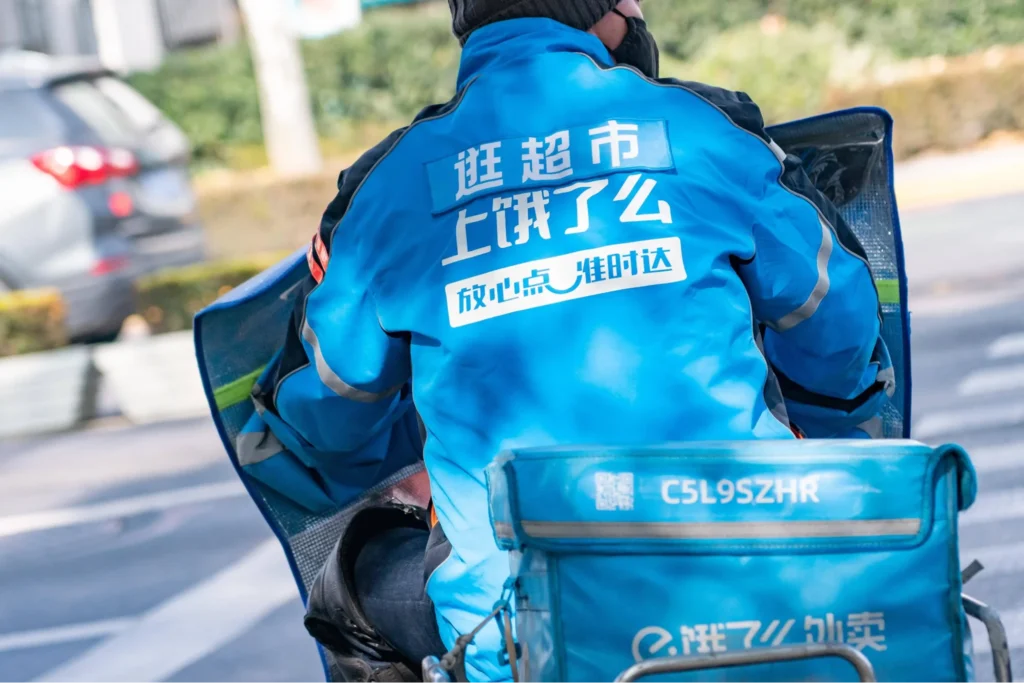
China’s food delivery industry is enormous. The market surpassed ¥1.5 trillion ($210 billion) in transaction value, making it the largest online food delivery market globally.
The sector is dominated by two major players:
In 2025, competition between delivery platforms spilled onto social media in the form of playful brand-color humor.
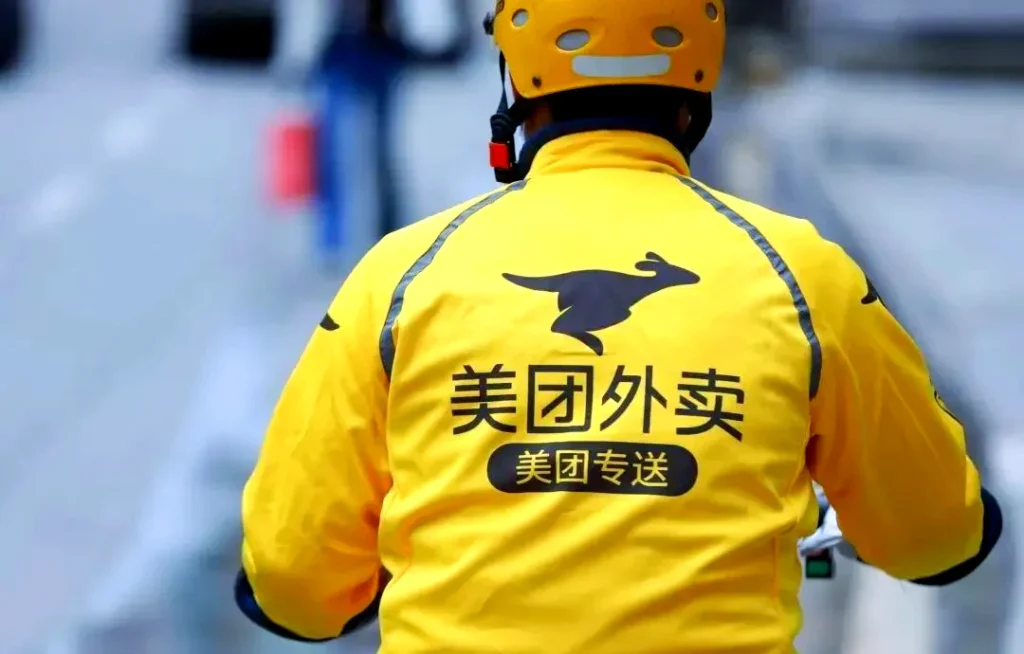
Meituan’s branding is yellow, Ele.me’s is blue, and JD.com—another logistics giant entering the instant delivery market—uses red.
Online users began joking about celebrities whose names matched those colors, suggesting:
Rather than ignoring the jokes, brands leaned into them. Marketing teams acknowledged the memes and amplified the conversation across Chinese social platforms.
The brand recruited singer Huang Ling, whose surname sounds like the word for yellow (黄). They released a Shanghai‑dialect music video and the line “外卖,黄的更灵!” which translates roughly as “delivery – the yellow one is more efficient.”
The pun lies in “黄龄” (Huang Ling) and “黄的更灵” (yellow is more effective). The campaign’s play on words made the music video and slogan instantly memorable.
Netizens joked that Ele.me should hire actress Lan Yingying because her name contains the word blue (蓝). The company listened. Within days, Ele.me announced Lan as its “必赢官” (“win‑for‑sure officer”) and adopted the slogan “蓝的一定赢” (“blue will win”).
Ele.me even used the English nickname “Blue Win‑Win,” referencing an old variety show joke. Fans praised the brand for responding quickly and for leaning into the humour.
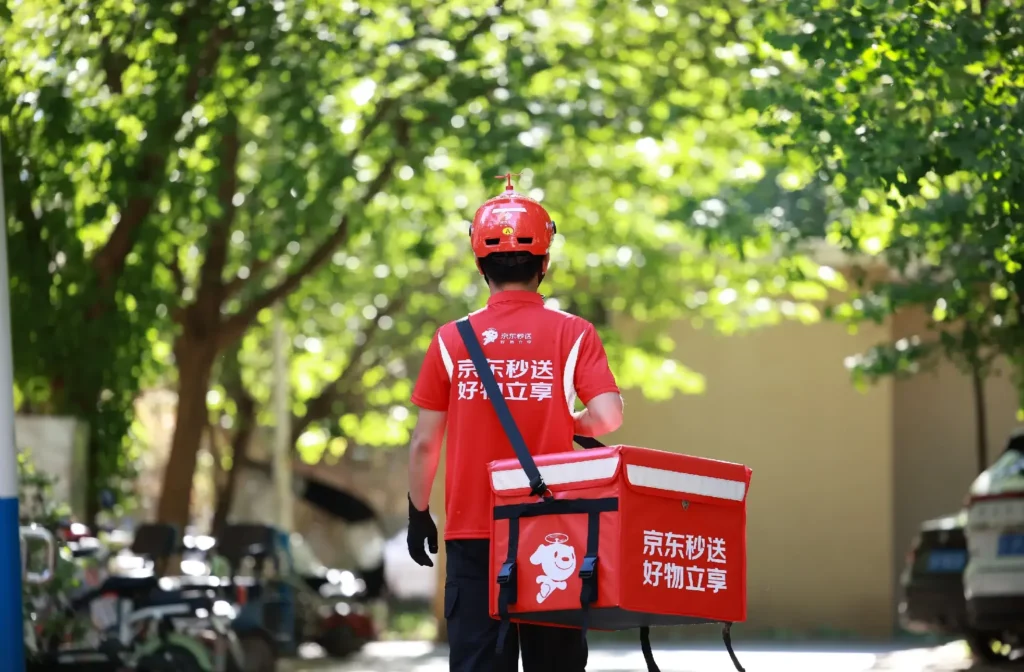
Online spectators demanded a “red” pun from JD.com. Fans proposed actresses with 红 in their names, from Hui Yinghong to Wang Li‑hong; they even designed mock posters. By inviting the public to choose its ambassador, JD kept its brand in the conversation despite being a smaller player.
The pun war worked for several reasons:
Chinese consumers are used to brand collaborations, but the 2025 summer campaign between Luckin Coffee and language‑learning app Duolingo rewrote the rulebook. It treated co‑branding as a romantic drama with teasers, a wedding ceremony, and episodes. Campaigns like this reflect how brands adapt to Gen Z shopping habits in China, where entertainment, storytelling, and interactive content strongly influence purchase decisions.
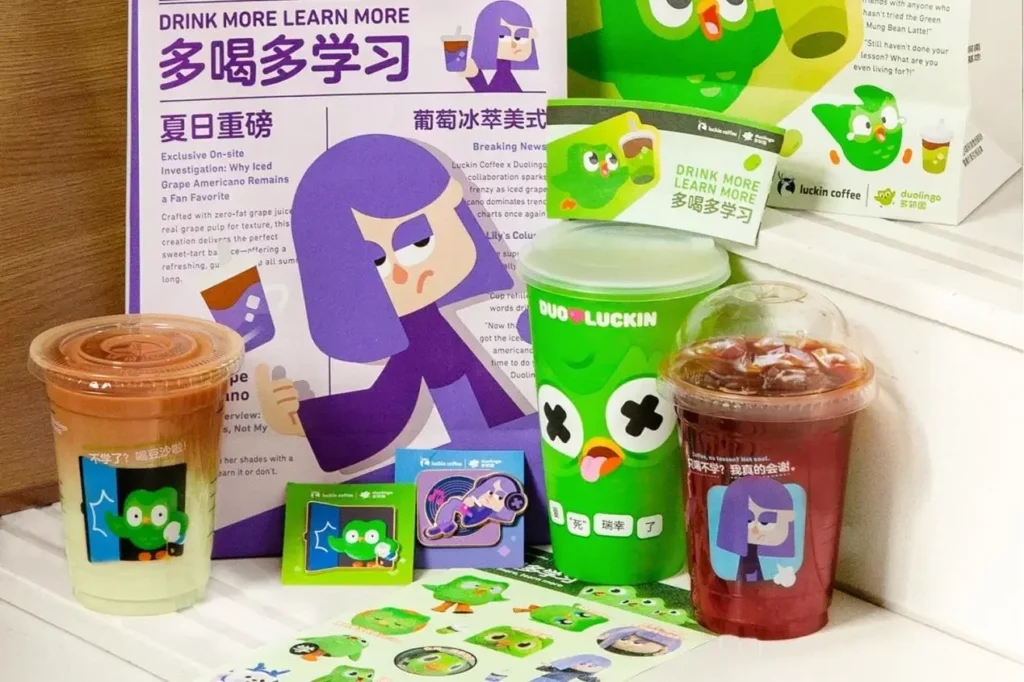
In late June 2025, Duolingo’s Chinese Weibo account posted a marriage certificate for its mascot Duo the Owl, without revealing the groom. The post invited speculation and set off a frenzy as brands like Ele.me and Watsons added their mascots to the “wedding photos”.
Luckin responded with a silhouette teaser and the phrase “好事将近” (good news is coming). On 6 July, the company officially announced the partnership and launched the Green Shasha Latte, a creamy drink using slow‑cooked green beans and high‑quality coffee.
Alongside the drink came an array of merchandise – cup sleeves, mugs, stickers, and study cards – reinforcing the sense of a wedding gift set.
On 8 July, the mascots Duo and Lucky the Deer “married” at a ceremony broadcast on Weibo. Short dramas were released at 10:00, 12:00, and 14:00, continuing the storyline. The hashtag #多邻国猫头鹰官宣结婚 (Duolingo’s owl announces marriage) amassed more than 9.6 million views and reached Weibo’s top search list. A limited edition mug sold out by 8 a.m. on release day.
The campaign was about more than a wedding. The Green Shasha Latte used local green beans and rewarded fans with exclusive cards and mugs. It remained available throughout the summer, encouraging repeat purchases.
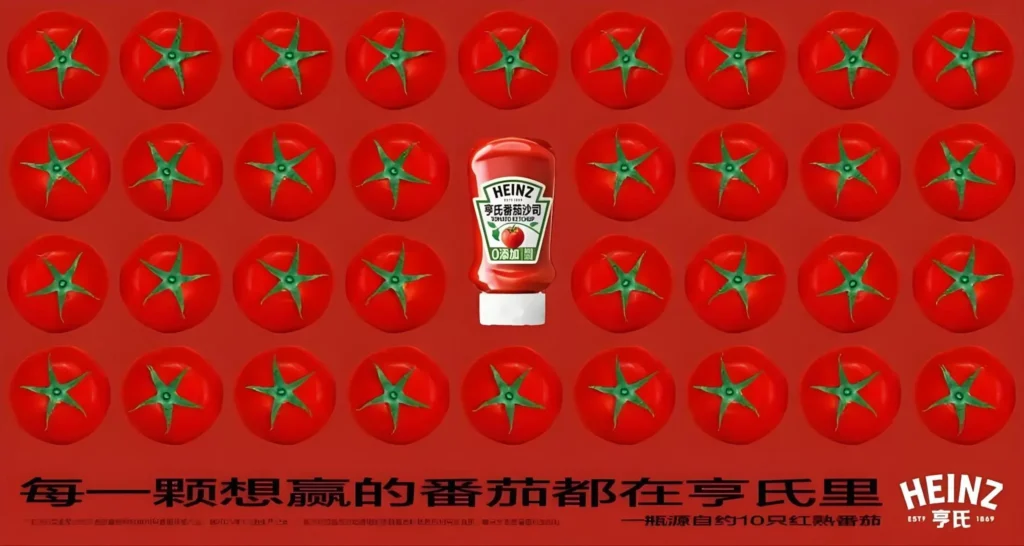
In 2025, Guangzhou hosted China’s National Games. Many brands saw an opportunity to capitalise on the pride surrounding the event. Heinz, a Western condiment brand trying to gain relevance in Chinese cooking, chose a surprisingly simple route. Instead of sponsoring athletes or creating big‑budget spectacles, it put tomatoes on a pedestal.
The campaign centred on posters placed in high‑traffic subway and train stations. Each poster featured a tomato with its green sepals arranged to resemble an athlete mid‑action: a sprinter’s drive, a diver’s twist, a weightlifter’s brace.
The tagline read “想赢的番茄都在亨氏,” roughly “every tomato that wants to win is in Heinz”. The posters required only a glance to decode; commuters instantly saw the athletes in the tomatoes.
The simplicity stood out amid the crowded media environment. Even minimal campaigns succeed when brands understand retail technology trends in China, where digital platforms and data reshape how consumers engage with products. The idea felt like “a breath of fresh air” in a cluttered, algorithm‑driven landscape. Rather than employing AI‑generated visuals, the creative team relied on analogue wit.
Within days, the images flooded Xiaohongshu and Weibo. Users posted selfies with the posters and praised the ads as a “creative idea that actually thinks” and as “quality local creative”. Some comments mentioned that the ads prompted them to buy Heinz ketchup. The campaign’s hashtag accumulated thousands of views.
The success also stemmed from cultural localisation. Guangdong cuisine prizes fresh ingredients and careful preparation. By comparing tomato sepals to athletes’ movements, the posters linked culinary craftsmanship with athletic excellence. The messaging honoured local pride without heavy‑handed patriotism, tying Heinz to a moment of national unity.
Haier is one of China’s largest home appliance groups. In mid‑2025, a user commented on the brand’s social media asking for a washing machine that could wash clothing, underwear, and shoes separately without taking up extra space.
Instead of ignoring the request, Haier’s young sub‑brand Leader took it as a brief. Within months, the company launched the world’s first lazy triple‑tub washing machine (懒人三筒洗衣机). The story illustrates how social listening and rapid iteration can turn a comment into a best‑selling product.
According to the Leader’s official site, the triple‑tub washer was inspired by user demands collected via the HOPE platform. The company debuted the product in March 2025, just eight months after design and testing began.
The washer became a phenomenon. Initial sales reached 20,000 units in 16 hours, broke the industry’s fastest one‑billion‑yuan sales record, and delivered over 100,000 units within five months. By November 2025, total sales across channels exceeded 300,000 units, with the model ranking first on JD.com’s segmented washing machine list.
Users continued to request features, such as shoe‑washing functions and drying. Leader responded by adding a wash‑shoe module and launching Pro versions with integrated drying, expanded capacity, and AI‑controlled detergent dosing. The product line evolved into a “lazy home” series with matching refrigerators, air‑conditioners, and water heaters.
These four campaigns span different industries, yet they share underlying principles:
China’s digital landscape evolves faster than most global markets. Platforms change quickly, consumer behaviour shifts rapidly, and successful campaigns often depend on cultural nuance that international brands may miss.
ChoZan is a China-focused digital consultancy founded by China marketing expert Ashley Dudarenok. The company helps global organisations understand Chinese consumers, platforms, and digital innovation.
ChoZan works with multinational brands and technology companies to analyse China’s digital ecosystem and translate those insights into practical strategies.
ChoZan has worked with global companies including Coca-Cola, Google, BMW, Richemont, Disney, and Shiseido, helping them navigate China’s rapidly changing digital market.
To discuss how your brand can engage with China’s digital ecosystem, book a consultation with ChoZan.
Many consumers discover products through short videos, influencer recommendations, livestream shopping, and user reviews. Platforms such as Douyin and Xiaohongshu combine entertainment with product discovery, allowing consumers to move from inspiration to purchase within the same digital environment.
Chinese platforms prioritise participation. Comment threads, reposts, livestream chats, and user challenges encourage audiences to engage actively. Campaigns that invite user input, voting, or storytelling spread faster because participants feel part of the campaign narrative.
Influencers shape purchasing decisions through product demonstrations, reviews, and livestream selling. Brands often combine large influencers for reach with smaller creators who provide credibility within niche communities and generate more authentic conversations around products.
Chinese platforms integrate shopping directly into social media experiences. Users can watch product demonstrations, interact with hosts, and complete purchases without leaving the platform, making social media both a discovery channel and a retail environment.
Brands typically track engagement metrics such as views, comments, and reposts, alongside commerce metrics such as click-through rates and sales conversions. Livestream campaigns also measure real-time sales volume and audience retention during broadcasts.
Local cultural references strongly influence engagement. Campaigns that incorporate Chinese humour, language nuances, festivals, or trending memes feel more authentic to audiences and often generate stronger participation and social sharing.
Foreign brands often struggle with platform differences, cultural nuances, and rapidly changing trends. Strategies that work on Western platforms may not resonate in China, where community interaction, influencer ecosystems, and social commerce drive engagement.
Online trends in China can emerge and spread within hours. Memes, hashtags, or video formats often gain millions of views quickly. Marketing teams monitor conversations closely and respond rapidly to stay relevant.
China frequently leads global digital innovation. Concepts such as livestream shopping, integrated mobile payments, and social commerce ecosystems developed rapidly in China and later influenced marketing and retail strategies worldwide.