TL;DR.
China’s AI commerce is moving faster than the West’s, and the reason starts underneath the storefront: the AI models are free. Alibaba’s Qwen and the startup DeepSeek release their models open-source, so any platform or brand can build a shopping assistant for the cost of the servers instead of a per-query fee. That drops the price of putting AI in front of a shopper close to zero and lets Chinese platforms ship new features in weeks. Qwen passed 700 million downloads by January 2026 and overtook Meta’s Llama as the world’s most-used open model.
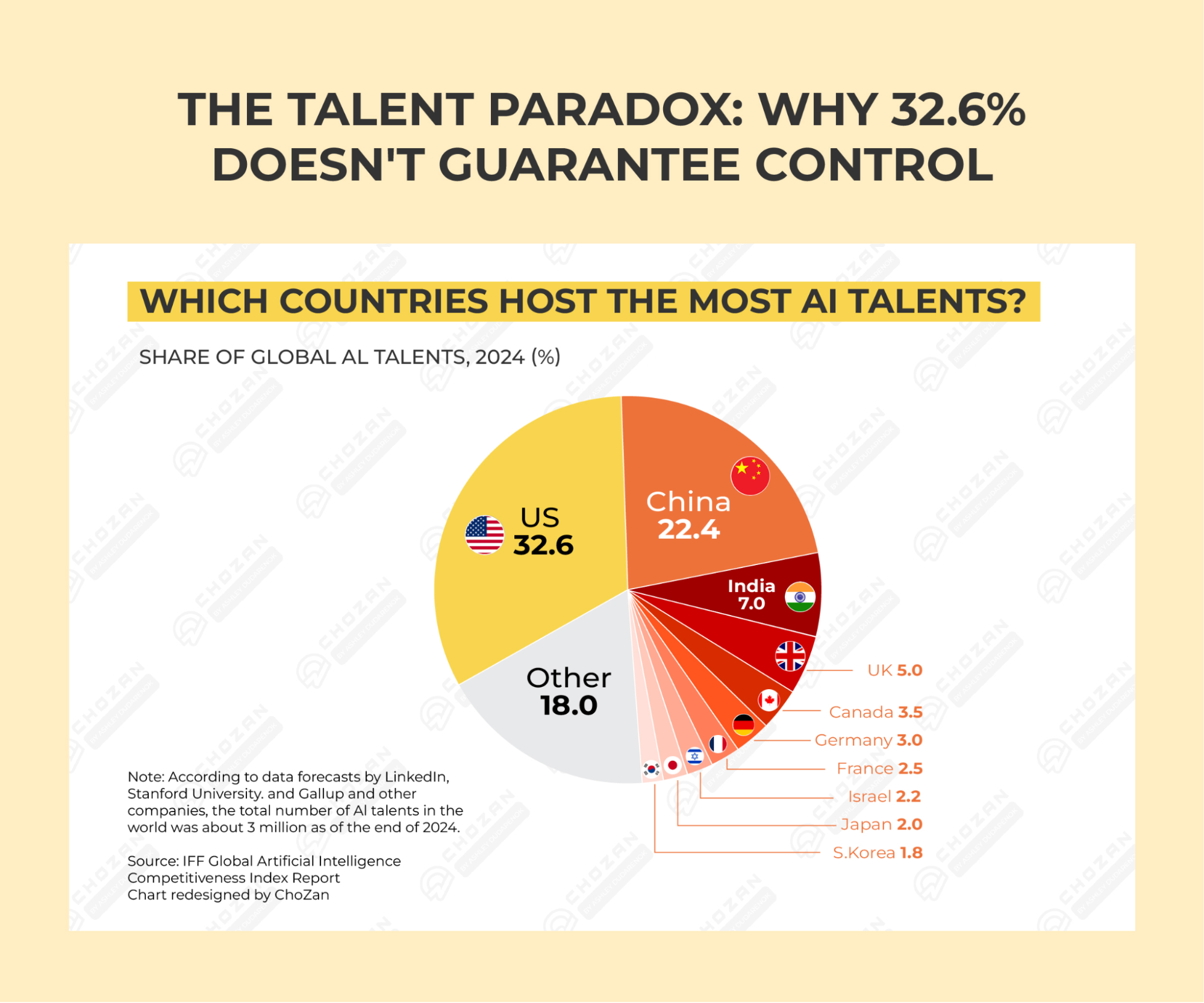
China is not winning AI commerce because it has the single best model. It is winning because the models that power the shopping journey are free, good enough, and improve fast. Alibaba’s Qwen and DeepSeek release their models open-source, meaning any developer can download them, run them on their own servers, and adapt them at no license cost. That decision is what lets a Chinese platform, or a small merchant on it, put an AI assistant in front of a shopper without a Western-sized software bill. This piece answers why China’s AI commerce is pulling ahead, how free models cut the cost of selling with AI, why Chinese platforms ship faster, and what a global brand should do about it.
For how these assistants actually pick products at the storefront, see the Pillar A spoke: When China’s AI Picks the Product, Does It Pick Yours?
At a glance
- Alibaba has open-sourced 300+ Qwen models with 170,000+ derivatives worldwide (Alibaba Cloud, October 2025).
- Qwen passed 700 million downloads by January 2026 and overtook Meta’s Llama as the most-downloaded open model (Xinhua, January 2026).
- The best open models closed to within 1.7% of the best proprietary ones in 2024, down from 8% (Stanford AI Index 2025).
- Chinese open models run at roughly US$0.10–0.50 per million tokens versus US$3–15 for closed US models (Artificial Analysis, Q4 2025).
Why is China's commerce AI free?
Because China competes on distribution, not on owning the single best model. US chip controls limited its access to top-end hardware, so Chinese labs optimized for models that run cheaply and gave them away to win developers. Alibaba open-sourced its Qwen family and DeepSeek released its models open-weight, meaning any platform or merchant can download and run them with no per-query license fee. As Kai-Fu Lee, the AI investor and former head of Google China, put it, DeepSeek’s lasting contribution will be the open-source era for large models it set off, not the technology itself (李开复, WeChat, January 2025).
How does free AI compound into a commerce advantage?
Free removes the cost gate on deployment, and deployment is what feeds the models, so the advantage grows the more it is used. This is the flywheel, and it turns in four steps.
- Free models, so AI goes everywhere. At roughly US$0.10–0.50 per million tokens against US$3–15 for closed US models (Artificial Analysis, Q4 2025), a shopping assistant runs across a whole catalog, not just a FAQ. Every merchant can afford it, so nearly every store adds it.
- Every store turns its own traffic into a smarter store. A merchant points free AI at its own followers, livestreams, and order history, its private traffic, and improves its recommendations without paying a platform toll per query. Douyin’s AI cut merchant labor costs about 70% during the 618 festival.
- Use feeds the models back. More than 170,000 community versions have been built on Qwen (Alibaba Cloud, October 2025), and every real shopping interaction is data that sharpens the next model.
- Better and cheaper pulls in more use. Qwen passed 700 million downloads and overtook Meta’s Llama (Xinhua, January 2026), while the open-versus-closed quality gap fell to 1.7% (Stanford AI Index 2025). Smarter, cheaper AI draws in the next wave of merchants, and the loop turns again.
The West runs a different setup. Commerce AI mostly sits behind paid APIs from a few vendors, so cost gates how widely it gets deployed, and a closed model does not get the open community improving it. The loop is harder to start when the intelligence is metered. (How that plays out in the US-vs-China race.)
Which Chinese open-source AI models power all this?
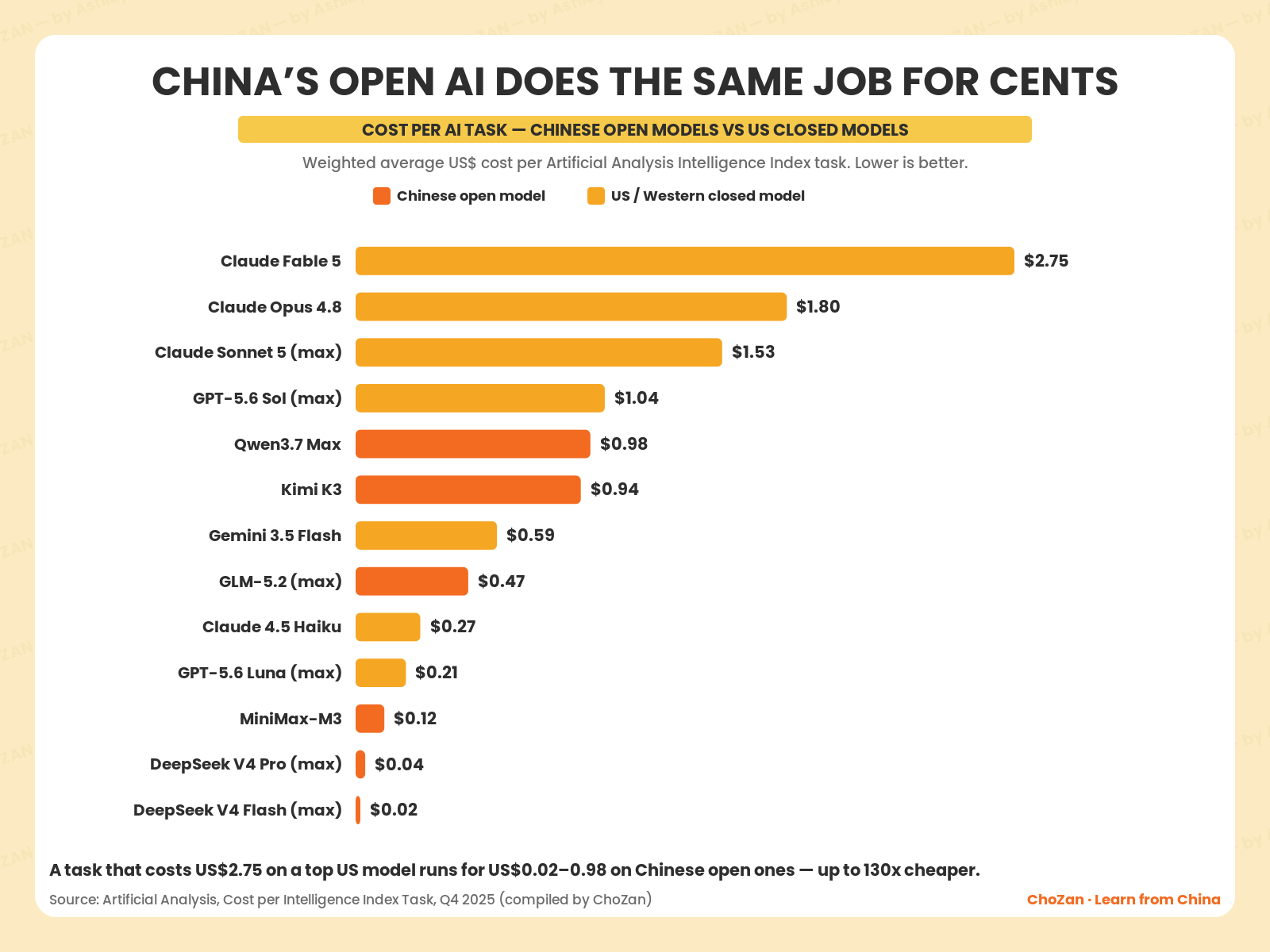
The cheapest capable models are all Chinese and open. On a standard task, the leading Chinese models run from about US$0.02 to US$0.98, while top US models cost up to US$2.75 (Artificial Analysis, Q4 2025). The five a brand will actually meet (see these companies up close on a China Innovation Tour):
- DeepSeek (DeepSeek, a Hangzhou startup) — the model that set off the 2025 open-source wave, and the cheapest to run, from about US$0.02 per task.
- Qwen (Alibaba) — the most-downloaded open model in the world, wired into Alibaba’s Taobao marketplace and Alipay payments. About US$0.98 per task.
- GLM (Zhipu AI, a Tsinghua University spin-off often called China’s enterprise-focused OpenAI) — about US$0.47 per task.
- Kimi (Moonshot AI) — known for handling very long documents, with a popular consumer assistant of the same name. About US$0.94 per task.
- MiniMax (MiniMax, a Shanghai lab backed by Alibaba and Tencent) — strong on voice and multimodal, about US$0.12 per task.
For contrast, the closed US models on the same test run from US$0.21 (a mid-tier GPT) up to US$2.75 (a top Claude). Same job, a fraction of the cost.
What does the flywheel mean for your brand?
- Put free AI on your own traffic first. Point an open model at the audience you already own, your email list, app users, or livestream viewers, before renting reach. That is the flywheel’s first turn, and it is cheap to start.
- Price a live assistant two ways. Cost one shopper journey on a closed API versus a self-hosted open model at real volume. A 10x gap is a budget decision, not a research project.
- Keep the model swappable. Build on the free foundation, but keep payments, marketplace, and hosting portable so you own the compounding data, not a platform.
For the full playbook, talk to our China team.
FAQ About China's Free AI Ecosystem
Why is Chinese commerce AI free?
China competes on distribution rather than on owning the single best model. Labs like Alibaba and DeepSeek open-source their models so any platform or merchant can run them with no per-query fee, which wins developer adoption and makes Chinese models the commerce foundation.
How does free AI give China a commerce advantage?
Free removes the cost gate on deployment, so nearly every store adds AI. Every use generates data and community improvements that make the models better and cheaper, which pulls in more deployment. That compounding loop is the advantage.
How much cheaper is open-source AI than closed models?
Chinese open models run at roughly US$0.10–0.50 per million tokens against US$3–15 for closed US models, a 10–40x gap for typical workloads (Artificial Analysis, Q4 2025).
Can a Western brand use Chinese open-source models safely?
Running an open-weight model on your own or a trusted cloud’s servers keeps your data under your control and is the lower-risk path. The risk sits in Chinese-hosted APIs or wiring in a platform’s payment and marketplace stack, which are separate decisions from using the model.
Sources: Stanford AI Index 2025 · Artificial Analysis, Model Pricing Leaderboard (Q4 2025) · a16z / Martin Casado (2025) · Alibaba Cloud 阿里云开发者社区 (October 2025) · Xinhua (January 2026) · Bloomberg, “Airbnb Turns to Alibaba’s AI to Power New Translation Tool” (14 October 2025) · 李开复 WeChat, “DeepSeek崛起的启示与中国AI的未来” (27 January 2025) · 36Kr (January 2026).