CONTENT
Moore Threads is a Chinese GPU designer building a full-stack GPU platform for AI training, inference, graphics, and scientific computing. Its offering combines GPU hardware with MUSA software and KUAE computing systems.
The business significance lies in the package: companies evaluating China’s domestic compute need to assess the applications, engineering work, and service reliability around the chip.
The company’s 2026 disclosures reveal commercial progress alongside unfinished work. Its most instructive contribution to China’s technology ambitions is the effort to make a locally developed computing platform usable across existing workflows.
Two concepts explain the strategy. Full function describes the workloads a GPU architecture can handle, including AI calculations, rendering, and video processing. Full stack describes the layers that turn that hardware into a usable computing system.
MUSA sits across those layers. The company’s current S5000 platform documentation describes drivers, a software development kit, computing libraries, and training and serving suites. These components determine how applications reach the hardware and how developers diagnose problems.
That breadth creates a demanding commercial model. A specialist supplier of AI accelerators can concentrate on a narrower set of operations. A general GPU platform must maintain useful performance across multiple applications and software dependencies.
The potential customer benefit is a common computing foundation for workloads that combine AI with visual processing or simulation. The purchasing discipline remains application-specific: broad architectural capability cannot establish that every required program works efficiently.
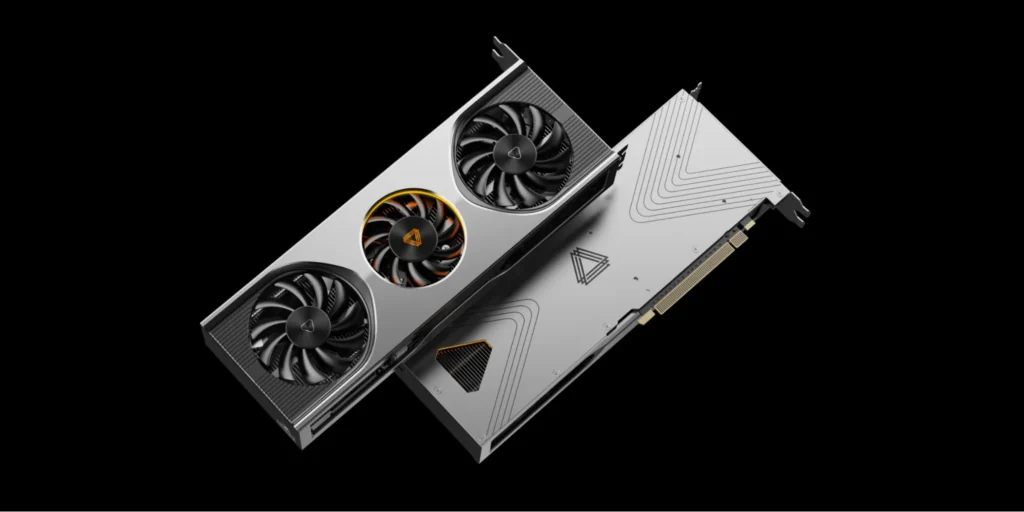
The current flagship MTT S5000 uses the PH100 chip and PingHu architecture. Official server driver documentation identifies it as a GPU for training, model fine-tuning, and online serving. It also supports MTLink connections between GPUs.
The product hierarchy matters when comparing offers:
| Component | Role in a deployment |
| PH100 and MTT S5000 | The chip and computing module |
| MTLink | Communication between GPUs |
| SGX5000 | A server containing eight S5000 modules |
| KUAE | A larger computing system with cluster software |
A module quote and a cluster proposal cover different responsibilities. Contracts should specify the server configuration, networking, software installation, acceptance tests, and maintenance commitments.
The August 2026 filing describes Huashan AI and Lushan graphics chips based on the newer Huagang architecture in forward-looking terms. Those statements should enter a procurement review as roadmap evidence. An offer for MTT GPUs should identify the hardware and software versions covered by the delivery contract.
The software ecosystem is where buyers can examine concrete engineering progress.
The Torch-MUSA 2.11.0.post1 release supports PyTorch 2.11 and MUSA SDK versions 5.1 and 5.2. Its notes describe fixes to communication between servers.
The same release identifies a PyTorch interpreter-locking issue that may delay GPU task submission and reduce throughput. Certain data-loading configurations can intensify that contention. The notes suggest configuration changes as possible mitigation.
This is useful evidence of both maintenance activity and a remaining constraint. An application can execute successfully while delivering less throughput than its owner expects.
The MUSA SDK 5.2 release notes describe expanded compiler, communication, and compatibility capabilities, alongside known issues.
A technical evaluation should record the complete version combination: GPU driver, SDK, framework extension, model, and custom operators. The pilot should then establish who maintains that combination after updates.
The commercial question extends beyond the initial port. A platform that requires ongoing specialist intervention changes staffing needs, release schedules, and operating costs.
The financial disclosures provide a useful view of commercial progress.
The company’s unaudited first-half 2026 results show revenue of RMB 1.736 billion (approximately US$256 million) and negative operating cash flow.
A calculation from the revenue breakdown puts cloud products at approximately 97.5% of total revenue. The filing reports all revenue as domestic for that period.
That concentration suggests the clearest near-term test of execution is cloud infrastructure in China. Desktop and edge products represent broader ambitions with a much smaller revenue contribution.
The full filing also confirms delivery and revenue recognition for a major KUAE cluster contract during the first half. Moore Threads’ subsequent Q3 2026 filing reported nine-month revenue of RMB 3.289 billion (approximately US$490 million) and attributable net profit of RMB 37.7 million (approximately US$5.6 million).
However, the company still recorded a RMB 130.7 million (approximately US$19.5 million) net loss excluding nonrecurring items.
Framework integration provides another way to assess domestic compute adoption.
The RLinf project’s August 2026 update and hardware matrix include MUSA support. RLinf supplies infrastructure for reinforcement learning, including robotics training.
Its published matrix lists MUSA support for OpenVLA-OFT, GR00T N1.5, and the OpenPI models in specified LIBERO and ManiSkill environments. Other combinations, including StarVLA with LIBERO, lack MUSA support in that matrix.
The strategic value lies in the relationship between hardware and shared software. Support inside a framework’s main project can reduce dependence on a separately maintained vendor adaptation. That is an adoption advantage, although its size depends on the workload and implementation.
The matrix also supplies a useful boundary. A robotics demonstration using one supported model and simulation environment cannot establish compatibility across the entire application category.
China’s technology development becomes commercially relevant when external developers can inspect these boundaries and work within familiar tools. Such evidence gives potential partners a concrete starting point for evaluating research or product development on the platform.
The appropriate comparison is the cost of delivering an accepted workload.
For inference, a useful test separates prompt processing from token generation. The S5000 published benchmark conditions describe a setup that assigns those stages to different servers and uses six servers with eight GPUs each. Buyers should preserve that context when interpreting figures presented per GPU.
Time to first token measures the initial wait. Time per output token measures generation speed after the response begins. The acceptance test should set limits for both at the intended concurrency. A system serving many customers needs predictable response times under that load.
A long-document assistant, an interactive chatbot, and a video generation service place different demands on memory and response time. Peak arithmetic performance cannot settle their operating economics.
A practical acceptance plan should cover four areas:
| Evaluation area | Evidence to request |
| Application output | Accuracy or quality on the actual model and business data |
| Service behavior | Response time and throughput at realistic concurrent demand |
| Operating cost | Electricity, infrastructure, engineering time, and completed work |
| Recovery | Restart time and lost work after a worker or server failure |
A pilot should include a sustained run, a software update, and an intentional recovery exercise. The supplier and customer should agree on acceptance thresholds before purchasing additional capacity.
The resulting business case should specify the volume of work that justifies expansion, the team responsible for maintaining the platform, and the budget for that maintenance. Moore Threads deserves consideration where the agreed workload can meet those operating commitments.
The developments around Moore Threads raise practical questions about technology partnerships and operating models. ChoZan’s China technology research and learning expeditions offer ways to investigate those questions in context. Start with our China reports, then discuss a focused briefing or learning program built around the decision your team needs to make.
Its Chinese name is 摩尔线程. The 2026 company filing pairs that name with the English legal name Moore Threads Technology Co., Ltd. Searches using both names can locate Chinese announcements, technical documentation, and corporate disclosures.
Yes. Moore Threads began trading on Shanghai’s STAR Market on December 5, 2025. Its stock code is 688795. The company’s 2026 filing confirms the listing venue and code for readers seeking official disclosures.
The company is based in Beijing. Its 2026 interim disclosure lists an office in the Wangjing International R&D Park in Chaoyang District. The filing includes investor contact details, which provide an official route for corporate inquiries.
The official documentation center provides server driver guidance and links to installation instructions. Select the documentation for the exact GPU and release combination. An installation guide for another card may describe different requirements.
Yes. The company publishes Torch-MUSA on GitHub under a BSD-style license. That license applies to the repository’s code. Teams should review the terms of each additional library, toolkit, and dependency included in their deployment.
The SDK 5.2 notes report testing on Intel, AMD, and Hygon4 CPU platforms, with systems including Ubuntu, Kylin, Alinux, VesselOS, and Bclinux. Check the detailed platform table before assuming a specific server configuration has validation.
According to its technical documentation, S5000 has both air-cooled and liquid-cooled versions. The appropriate configuration depends on the server and facility design. Ask the supplier to specify power, cooling, rack, and installation requirements.
The official AIBOOK page says the device ships with Linux and describes Windows through a virtualization platform. Its advertised access to multiple operating systems therefore requires attention to the implementation and the applications involved.
The AIBOOK specifications describe local operation of a preinstalled Qwen3-8B model and offline document processing. The device can also call cloud model APIs. Data handling therefore depends on which application and mode you select.
The S5000 product page identifies PH100’s Chinese security and reliability certification in 2026. That credential has a defined evaluation scope. Customers should separately verify their application’s performance, data controls, and deployment requirements before accepting a system.