CONTENT

While humanoid robots dominate headlines, China’s real robotics story is unfolding on factory floors. Industrial robots are welding, palletizing, loading, and moving materials, reshaping how manufacturers think about cost, speed, and scale.
Chinese robotics companies are no longer just lower-cost alternatives to foreign brands. They are building stronger component supply chains, faster customization models, and integrated automation systems that compete across practical factory tasks.
This shift matters because China is not only automating its own manufacturing base. It is also exporting a new industrial automation playbook to the rest of the world.
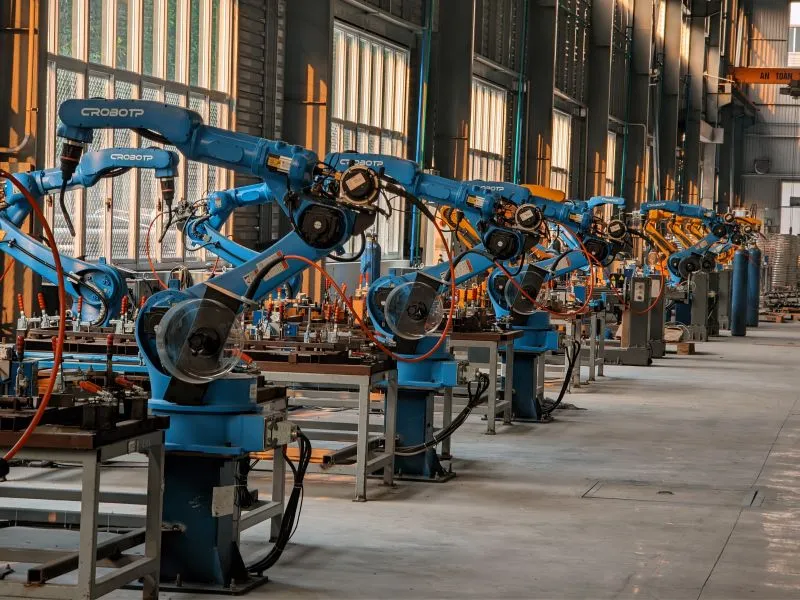
China’s robotics sector has moved from imitation to innovation. In 2025, the country remained the world’s largest industrial robotics market, with IFR reporting strong double-digit order growth across Asia, largely driven by China. Chinese manufacturers also crossed a major threshold: for the first time, they sold more industrial robots in the domestic market than foreign suppliers, capturing 57% of the market.
Domestic substitution is strongest in newer automation markets. Chinese suppliers provide about 80% of food and beverage robots and nearly all textile and apparel robots, while also supplying 31% of automotive robots and 59% of electronics robots.
Policy support, subsidies, local integration networks, and lower production costs are accelerating this shift. Chinese buyers increasingly choose domestic suppliers for customization, faster after-sales service, and cost-sensitive automation projects.
Exports are also rising quickly. China’s industrial robot exports increased by 61.5% in the first half of 2025, showing that domestic robot makers are no longer only serving China’s factories but are also expanding into overseas markets.
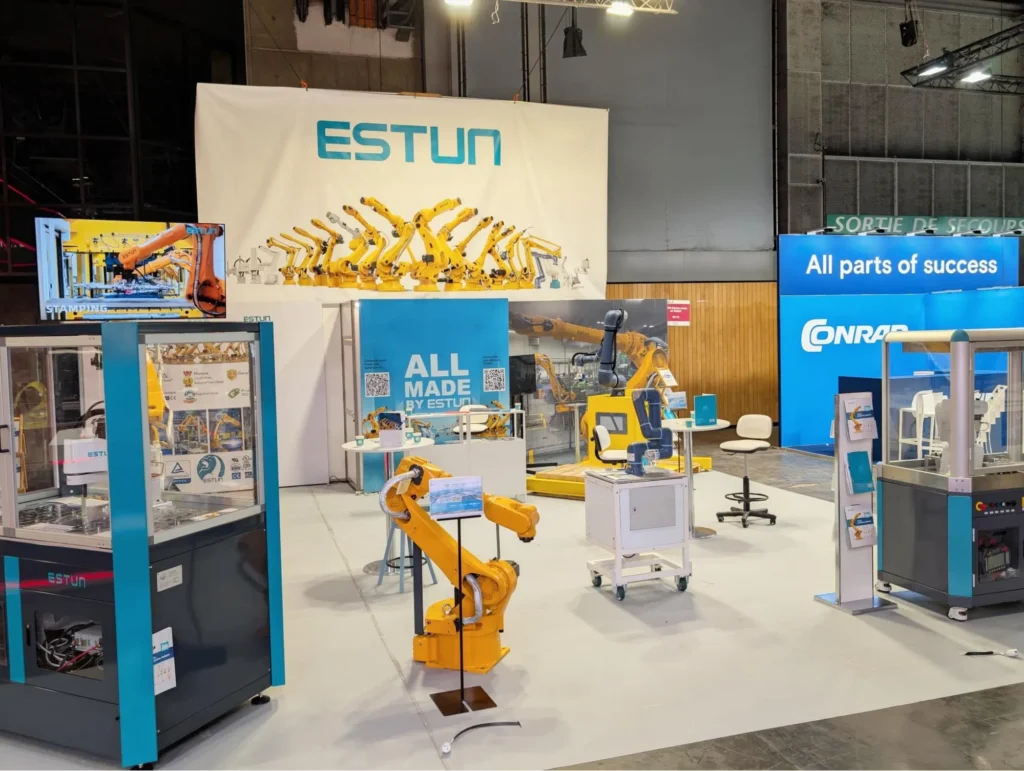
Founded in 1993 in Nanjing and listed on the Shenzhen Stock Exchange, Estun Automation is one of China’s largest industrial robotics companies. It held about 9.5 percent of the domestic market share in 2024 and ranked first in shipments in Q3 2025.
Estun makes six-axis industrial robots and collaborative robots with payloads from 3 kg to 600 kg. Its main advantage is vertical integration across servo motors, controllers, and motion control systems. Its 2019 acquisition of German welding specialist Cloos added European-grade welding technology and overseas distribution.
Exports contributed 34 percent of revenue in 2025, while RMB 442 million in 2024 R&D spending supported a 700 kg payload robot for heavy machinery and construction. Estun also ranks second in China and fourth globally in SCARA robot shipments.
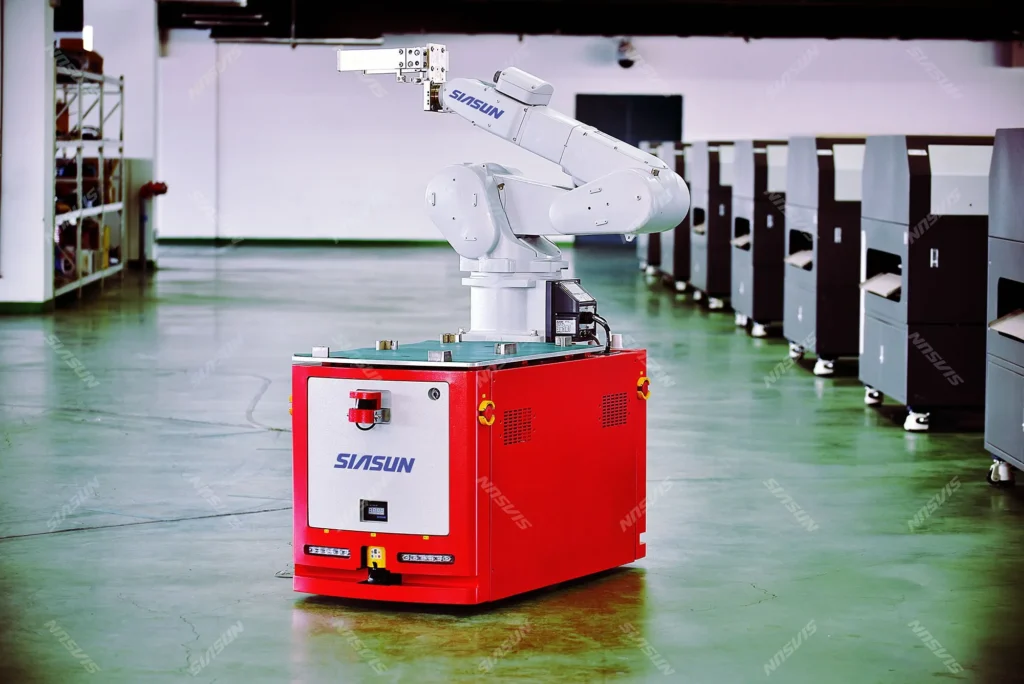
Founded in 2000 in Shenyang as a spin-off of the Chinese Academy of Sciences, Siasun is one of China’s pioneering robot manufacturers. It holds roughly 6.2 percent domestic market share and offers industrial robots, collaborative robots, AGVs, AMRs, and turnkey smart manufacturing systems. Its broad portfolio helps serve automotive, electronics, logistics, and new energy customers.
Overseas, Siasun has deployed automated cells in a Thai automotive plant using 3D intelligent vision for unstructured half-shaft loading. One robot covers two production lines, completing identification, grasping, and loading in 24 seconds per shaft.
Siasun has also received RMB 588 million in subsidies over three years and launched microelectronics subsidiaries to strengthen its component supply chain.
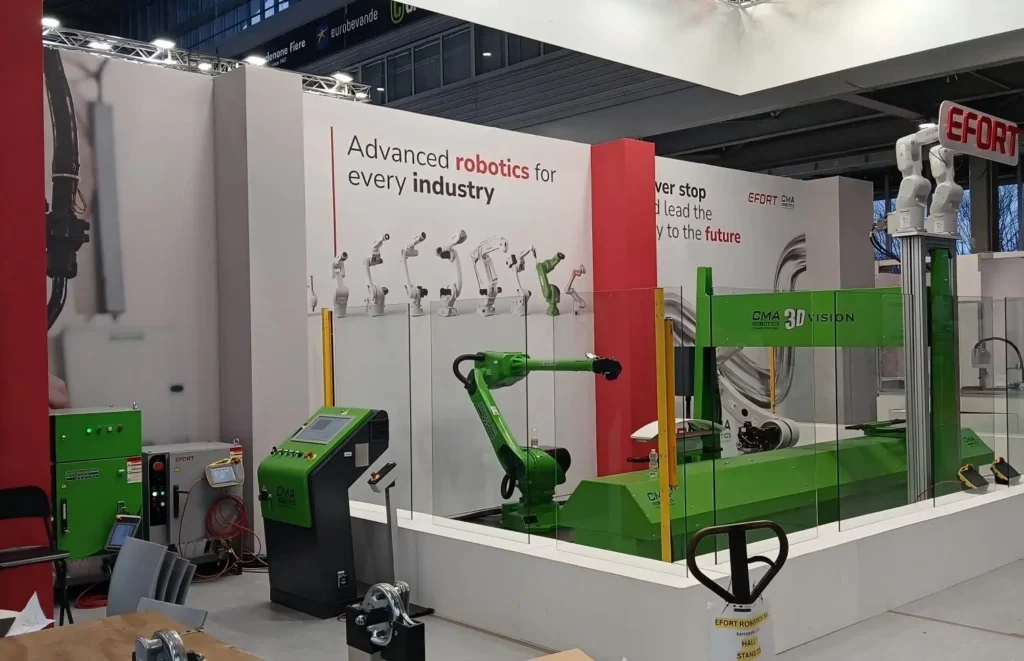
Established in 2007 and listed on the Shanghai Stock Exchange, EFORT expanded through internal development and strategic acquisitions. Its acquisition of Italian controller specialist Robox improved its software and control capabilities.
EFORT makes six-axis industrial robots for welding, painting, palletizing, and material handling, with payloads from 6 kg to 500 kg. Exports accounted for 44 percent of revenue in 2024, the highest ratio among Chinese robot manufacturers.
The company is investing RMB 1.9 billion in a new factory planned to produce 100,000 robots annually by 2029. Its heavy-duty model sold more than 100 units in 2024, while partnerships with European integrators support its overseas expansion.
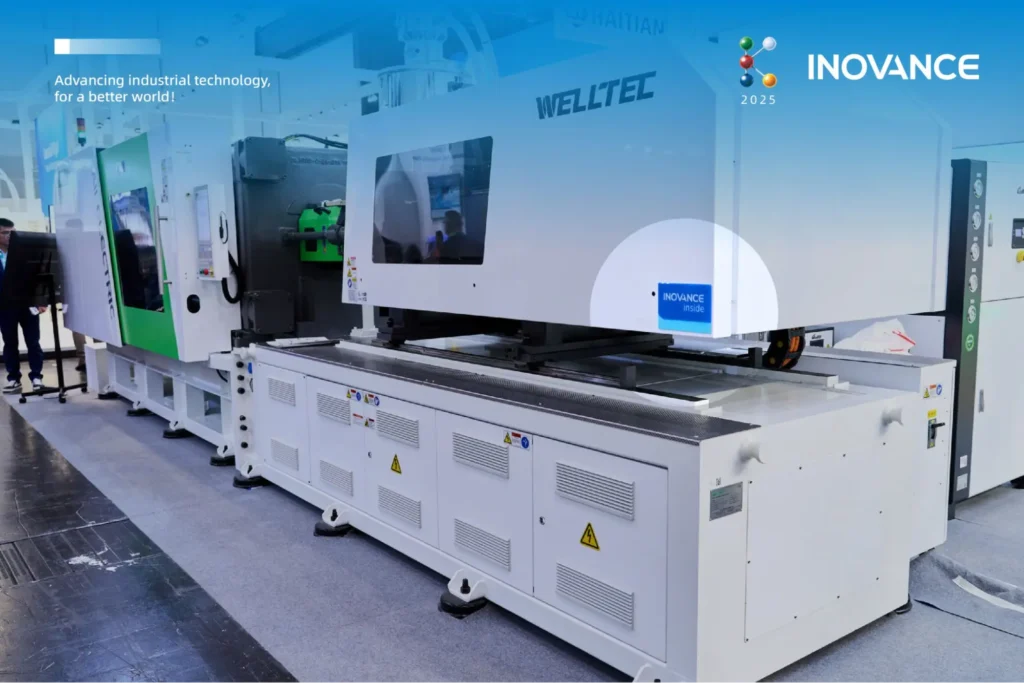
Founded in 2003 in Shenzhen, Inovance is China’s leading servo motor and motion control supplier. It has used this base to expand into robotics, supplying 27.3 percent of SCARA robots sold in China in 2024. Inovance shipped more than 5 million robotic joint servo motors in 2025 and developed force-control robots for EV battery assembly.
Robotics still contributes less than 5 percent of revenue, but the company is expanding quickly. In September 2025, it launched 17 products, including the U8 cobot with an 8 kg payload and 780 mm reach. It plans a full lineup of 4 kg to 22 kg cobots by 2026, alongside smart conveyance and machine vision products.
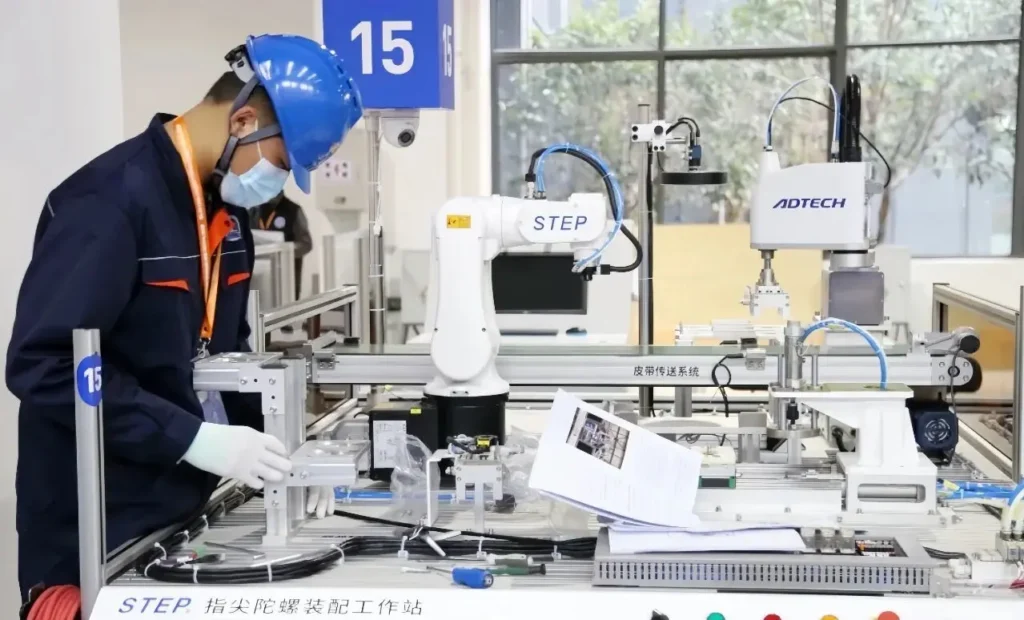
Founded in 1995 and listed in 2010, Shanghai STEP began in elevator control before expanding into industrial robotics. It now focuses on multi-joint robots, SCARA robots, wafer-handling robots, control systems, servo technologies, and robot software for payloads from 1 kg to 600 kg.
In June 2025, Haier announced plans to acquire a controlling stake in STEP for about RMB 2.5 billion, or US$ 343 million, to enter the robotics industry. STEP is one of Shanghai’s first recognized smart factories and an MIIT intelligent manufacturing demonstration unit.
Haier’s ecosystem could help STEP scale adoption of its technology across the appliance and consumer electronics manufacturing sectors.
Founded in 2012 in Chengdu, CRP Robot Technology specializes in industrial robots and core components. It develops control systems, servo systems, smart sensors, collaborative robots, and complete industrial robots.
As one of the few domestic firms covering the full industrial robot value chain, CRP holds more than 90 patents and helps draft national robot standards. It serves customers across the general industry, automotive, electronics, and new energy sectors.
The company also provides training and after-sales support through more than 60 technicians worldwide. Its vertically integrated model helps small and medium-sized manufacturers access customizable, cost-effective automation systems.
China’s robotics market is highly competitive. Foreign leaders such as FANUC, ABB, KUKA, and Yaskawa continue to lead in high-precision areas such as semiconductor manufacturing and safety-critical applications. However, Chinese industrial robotics companies are gaining ground through lower pricing, faster customization, and rapid product iteration.
Leading domestic players often price robots 20 to 40 percent below foreign equivalents, while the performance gap is narrowing in welding, palletizing, and machine tending.
Government policies such as the Robot+ Application Action Plan provide subsidies and tax incentives, while local governments support robotics clusters. This has created thousands of startups and intensified margin pressure as companies compete for emerging niches.
Domestic manufacturers also benefit from vertically integrated supply chains. Servo motors, harmonic reducers, and controllers can account for 50 to 65 percent of a robot’s ex-factory cost. Chinese suppliers such as Inovance and Leaderdrive produce these components at 15 to 30 percent lower cost than imported alternatives. Local sourcing reduces tariffs, shortens lead times, and supports faster customization.
This cost advantage enables China to offer sub-$10,000 industrial arms. Eight of the fourteen global producers in this low-cost segment are Chinese. However, buyers still face major deployment costs. Integration services, end-of-arm tooling, and safety assessments can account for 50 to 60 percent of total deployment cost. Therefore, manufacturers with turnkey capabilities have a stronger advantage because they reduce buyer risk and implementation cost.
Humanoid robots attract major media attention, and Chinese firms shipped roughly 80 percent of global humanoids in 2025. Unitree and AgiBot alone plan to produce 75,000 humanoid units annually. However, most humanoids still require human teleoperation, so near-term returns come from practical industrial robots.
Chinese manufacturers are moving beyond standalone robot arms into integrated automation systems. Embedded AI, machine vision, modular design, servo drives, motion controllers, and smart conveyance now combine into smarter production cells.
Inovance’s cobots, machine vision systems, and smart conveyors reflect this shift. Siasun’s 3D vision-guided loading applications also show how AI and perception technologies are entering factory lines.
Shenzhen’s hardware supply chain gives Chinese robotics firms another advantage. Prototype development can take 10 to 14 days, compared with about 12 weeks in the U.S. or Germany. This speed supports faster iteration and factory-specific customization.
Government programs also connect component suppliers, system integrators, and end users. As domestic firms gain market share and increase R&D, China’s automation ecosystem is moving from cost-driven manufacturing toward higher-value innovation.
Chinese robotics companies are reshaping global industrial automation. Estun, Siasun, EFORT, Inovance, STEP Electric, and CRP show that China is no longer only a manufacturing base for foreign robot brands. It now has domestic manufacturers with competitive pricing, improving performance, and strong local service.
The Big Four still lead in high-precision applications, but Chinese suppliers are gaining ground in welding, palletizing, material handling, and general assembly. The next stage will focus on AI integration, machine vision, cloud-connected control systems, and overseas expansion through partnerships and acquisitions.
With supportive policies, deep supply chains, and fast product iteration, China is becoming a stronger force in the future of industrial automation.
China’s rise in robotics is not only a manufacturing story. It reflects deeper shifts in supply chains, industrial policy, AI integration, component innovation, and factory automation strategy. For global business leaders, the real question is how these changes affect competitiveness, sourcing, partnerships, and future industrial models.
ChoZan helps executives, innovation teams, and strategy leaders understand China’s fast-moving technology ecosystem through practical insight and firsthand exposure. Our work connects market research with real business context, so teams can see how Chinese robotics, AI, EVs, smart manufacturing, and automation systems are developing on the ground.
Through ChoZan’s China learning expeditions, executive briefings, workshops, and innovation research, your team can explore:
If your organization wants to understand where China’s industrial innovation is heading next, ChoZan can help turn complex market signals into clear strategic insight.
Book a consultation to explore China’s robotics companies and discover how their advanced automation ecosystem can inform your next growth, innovation, or transformation agenda.
Start by matching the supplier to your process, not just the robot model. Check payload, reach, cycle time, safety design, integration capability, local support, spare parts access, and proof of similar deployments.
Yes, many Chinese industrial robots are reliable for repetitive factory tasks when the application is well scoped. Buyers should still verify certifications, controller stability, maintenance support, software documentation, and integrator experience before deployment.
CE marking, ISO 10218 alignment, electrical safety documentation, and risk assessment files matter most for international buyers. Export markets may also require local machinery compliance, technical files, manuals, and verified safety validation.
Installation time depends on the application, tooling, programming, safety setup, and production testing. Simple palletizing cells may move faster, while welding, machine tending, or vision-guided systems need deeper integration and operator training.
A robot manufacturer builds the robot, controller, and related hardware. A system integrator designs the complete working cell, including tooling, fixtures, safety systems, programming, testing, and connection with existing factory equipment.
Yes, small manufacturers can use Chinese industrial robots when the task is repetitive, measurable, and easy to standardize. Lower hardware costs help, but successful adoption still depends on tooling, training, maintenance, and integration planning.
Industrial robot projects often fail because buyers underestimate the importance of integration, safety, programming, operator training, and maintenance. The robot arm is only one part of the investment, while tooling and process design determine real productivity.
The easiest tasks are repetitive, high-volume, and physically consistent. Common examples include palletizing, loading and unloading, basic welding, pick-and-place work, packaging, dispensing, and simple inspection when parts arrive in predictable positions.
Collaborative robots are designed for closer human interaction under controlled safety conditions. Traditional industrial robots usually prioritize speed, payload, and repeatability, so they often operate inside guarded cells with stricter separation.
Yes, AI can make it easier to program robots, inspect parts, and adapt to changing production conditions. However, factories still need clean data, safe workflows, trained operators, and robust integration before AI can add real value.