CONTENT

The global commercial cleaning industry is undergoing a structural transformation, and China sits at the epicenter. Floor cleaning robot adoption in commercial settings has shifted from novelty to operational necessity.
According to IDC data, global commercial cleaning robot shipments reached approximately 58,000 units in 2025, representing 83.8% year-over-year growth, with the market size exceeding USD 760 million, up 48.5%. Chinese manufacturers accounted for the overwhelming majority of these shipments, reinforcing the country’s dominance in commercial robotics.
Two names consistently surface in global conversations about commercial automation: Gausium and Pudu. Both are headquartered in China. Both have expanded aggressively into Europe, North America, and Asia-Pacific. But their approaches, product philosophies, and go-to-market strategies reflect distinctly different readings of what the market needs.
This article examines how Gausium and Pudu are shaping the commercial cleaning robot landscape, the technology bets each has placed, and what their recent activities reveal about the industry’s direction.
The Chinese market is moving from labor substitution to operational standardization. A floor-cleaning robot provides facility teams with route consistency, visible cleaning records, and more efficient use of human labor during peak traffic periods.
This is especially relevant in China because commercial real estate operators are under pressure to improve service quality while managing costs. In that environment, cleaning robots become part of the service stack alongside delivery robots, concierge robots, security systems, and energy management tools.
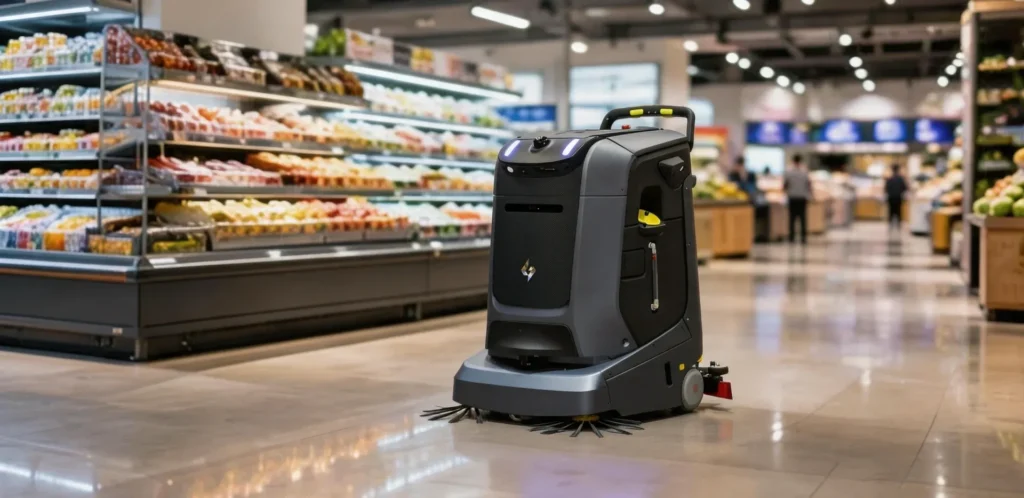
Gausium is one of the most visible Chinese players in this space. The company serves more than 6,000 customers across over 70 countries and regions. Its product line spans scrubbers, sweepers, vacuums, and multi-function cleaners, adopting a “right-size-for-every-space” approach that matches robot capabilities to facility footprints.
The company’s 2025 activity shows a clear product direction: smarter cleaning, heavy-duty use cases, and retail-oriented deployment. At the International SPAR Congress 2025, Gausium showcased Beetle and Omnie, with positioning around operational efficiency and reduced labor dependency in retail cleaning.
In November 2025, Mira won Innovation of the Year in the Automation & Equipment category at the ISSA Show North America, the premier event for the global cleaning and facility management industries.
PhanShop extends the Phantas line into retail environments by combining autonomous floor cleaning with customer engagement. The robot features an optional 13-inch touchscreen that supports video and image playback, voice interaction, and a sliding merchandise tray. This transforms a floor cleaning robot into a retail tool that cleans while selling.
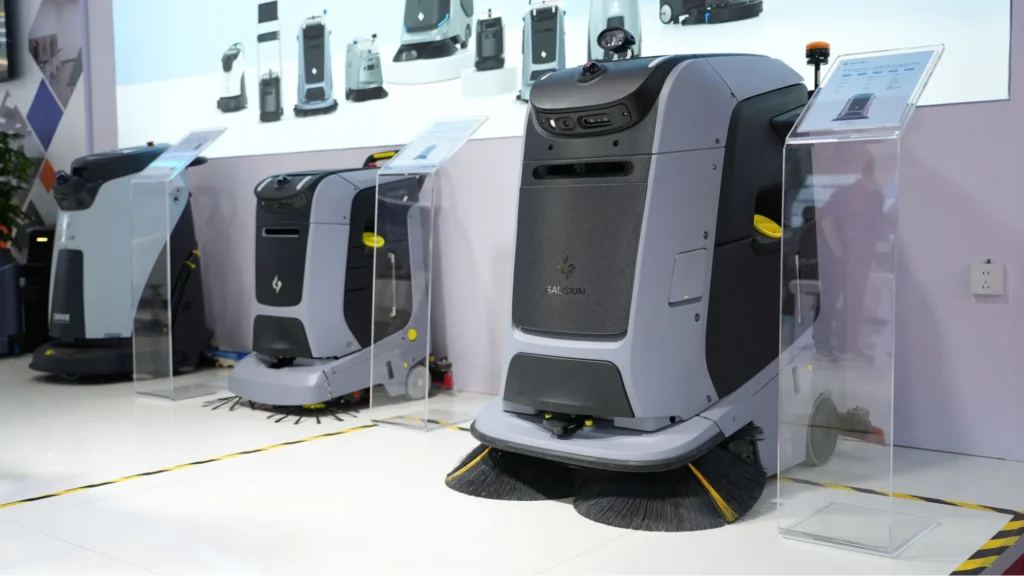
Gausium Omnie, the company’s most advanced autonomous floor-cleaning robot, is purpose-built for complex, high-traffic environments such as supermarkets, shopping centers, and transport hubs.
Powered by 3D LiDAR with full 360-degree coverage and a panoramic camera system, Omnie delivers centimeter-accurate navigation and real-time obstacle avoidance. Its AI-powered Spot Cleaning mode intelligently identifies and targets both dry and wet waste rather than simply following pre-programmed routes.
In April 2026, French hypermarket chain Auchan began deploying Omnie robots across its store network in a phased rollout, placing one unit in each participating store. The deployment focuses on high-traffic main aisles and fresh produce zones where consistent floor cleanliness is most critical to the customer experience.
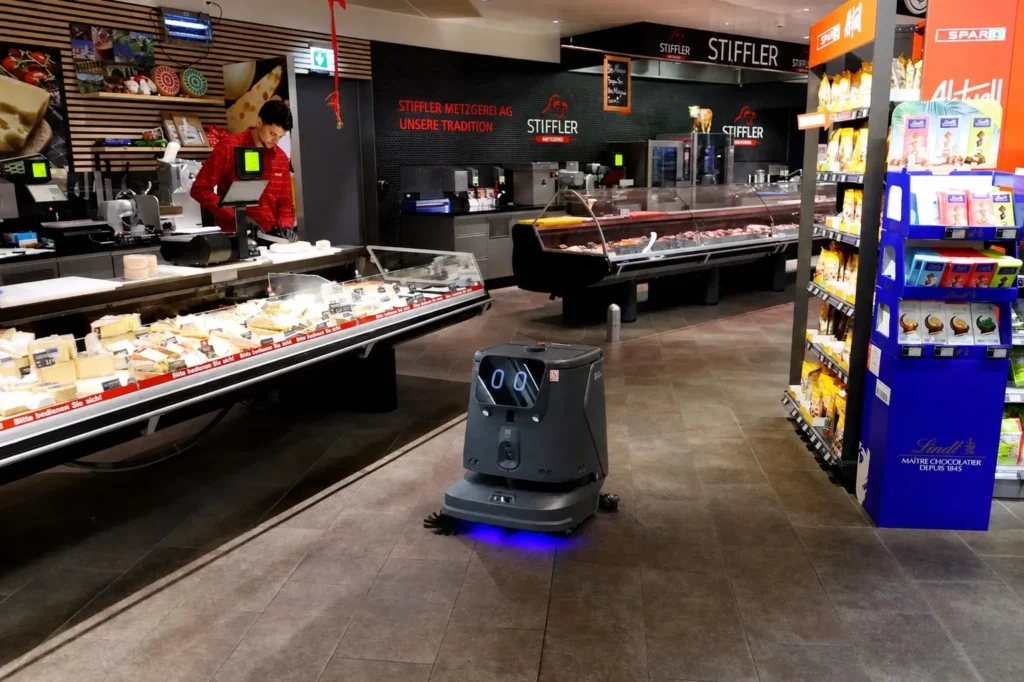
Rossmann, one of Europe’s largest drugstore chains, deployed a fleet of over 200 Gausium Phantas robots across its German stores in 2025, with all new store openings now including Phantas by default. Each robot cleans an entire store in 1.5 hours without supervision. Store managers report that the robots adapt dynamically to changes in store layout and return valuable time to staff.
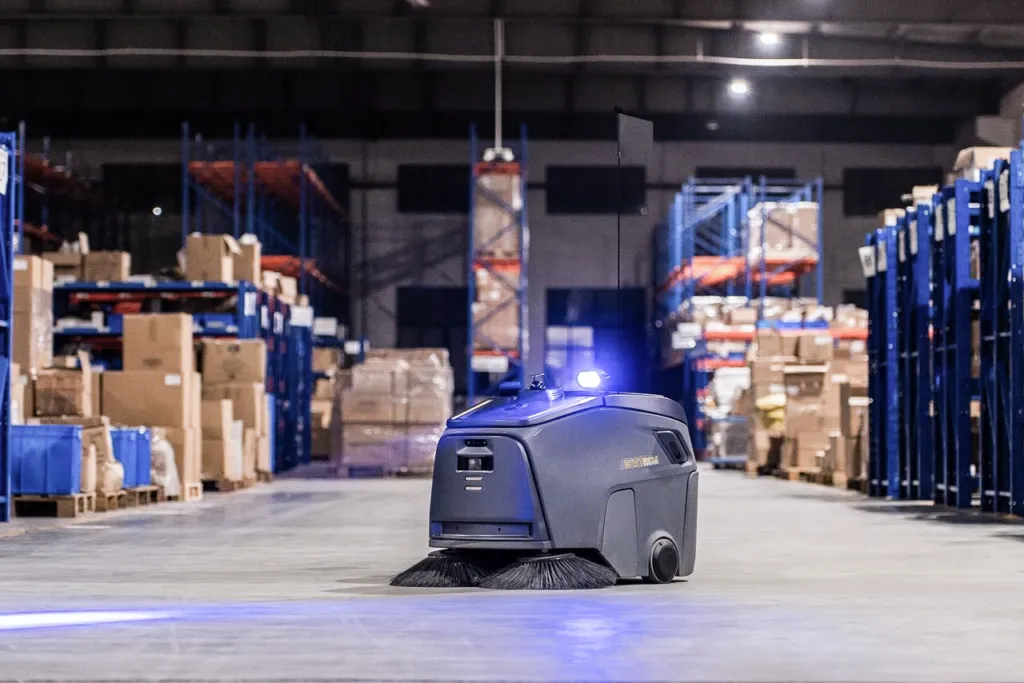
In December 2025, Hesai Technology announced a partnership to equip Gausium’s entire line of commercial cleaning robots with Hesai’s JT series 3D LiDAR.
The JT series offers a 360-degree field of view and coverage of over 10,000 square meters per frame, and can detect small obstacles such as chair and table legs, enabling smoother path planning. As of November 2025, cumulative deliveries of Hesai’s JT series had exceeded 200,000 units.
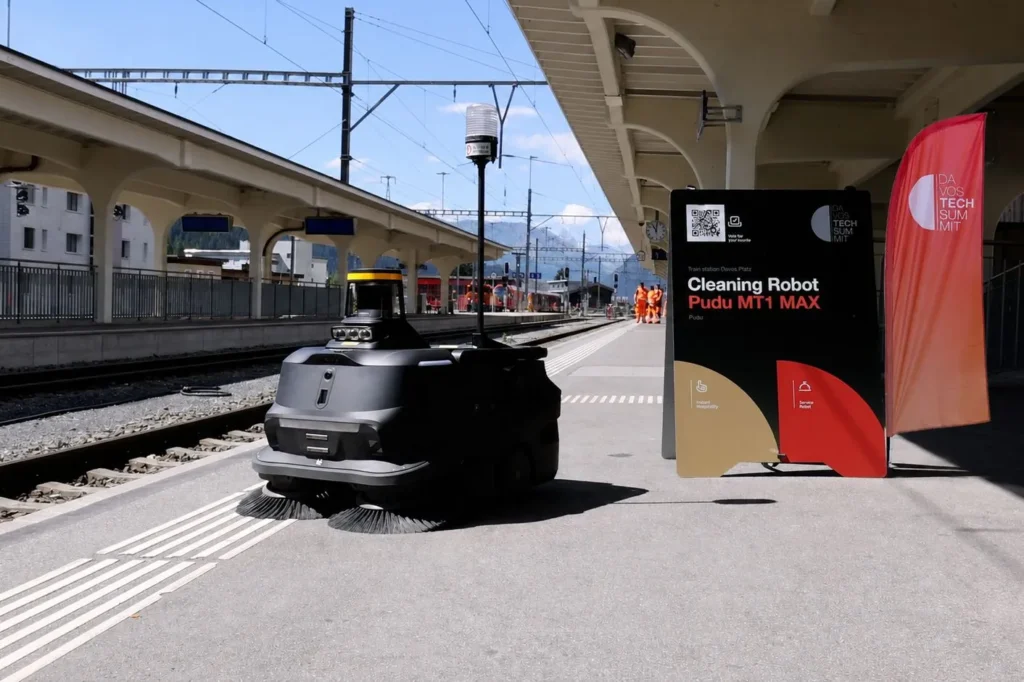
Pudu Robotics, headquartered in Shenzhen, has taken a different path. While Gausium emphasizes portfolio breadth and global scale, Pudu has focused on product innovation that reduces the operational friction of deploying cleaning robots in commercial environments.
In September 2025, Pudu launched the CC1 series Self-Cleaning Docking Station, the industry’s first fully autonomous self-cleaning docking station for commercial service robots. The station features a 100W ultrasonic module and a 65-degree-Celsius hot-water system that cleans the CC1’s squeegee and roller brush.
The cleaning mechanism removes over 95% of visible dirt and debris, and the station maintains the squeegee in optimal condition to prevent streaks and secondary pollution. When combined with the CC1 Pro’s stain detection capability, the robot can automatically return to the station for cleaning and resume operation, creating a complete “detect-return-clean-resume” cycle.
The impact on operational efficiency is substantial. The self-cleaning station reduces maintenance effort by a factor of 35, with users only needing to clean the removable water tank approximately once per week.
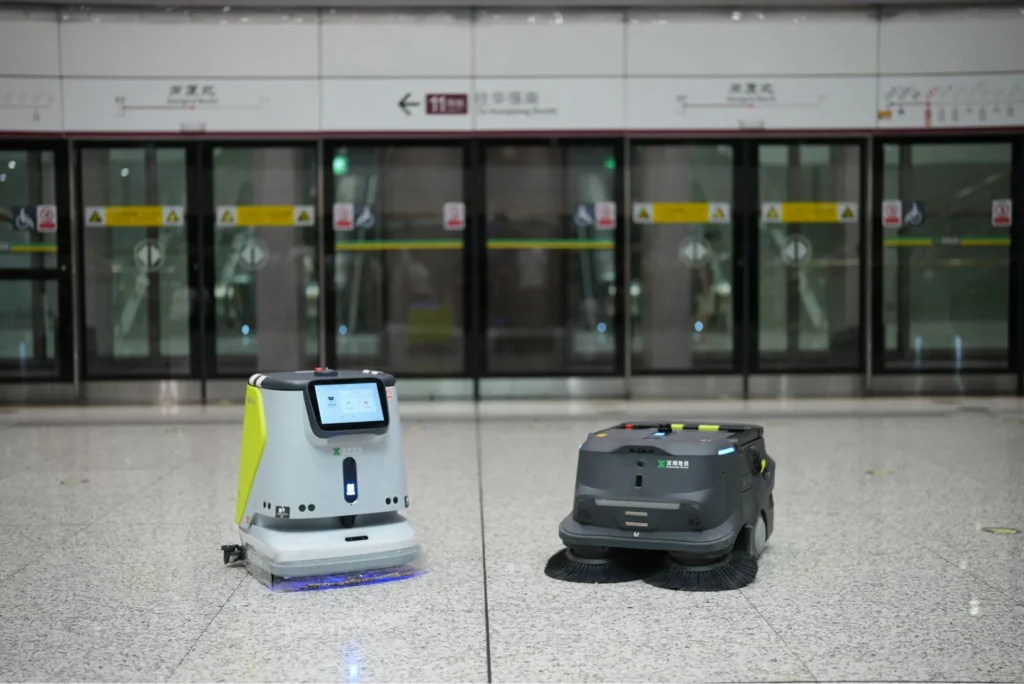
Pudu launched the CC1 Pro in May 2025 as the world’s first commercial cleaning robot equipped with a rear AI camera. The camera continuously monitors floor cleanliness and automatically marks locations where stubborn stains remain for re-cleaning. This capability, combined with the self-cleaning docking station, creates a closed-loop system that minimizes human intervention.
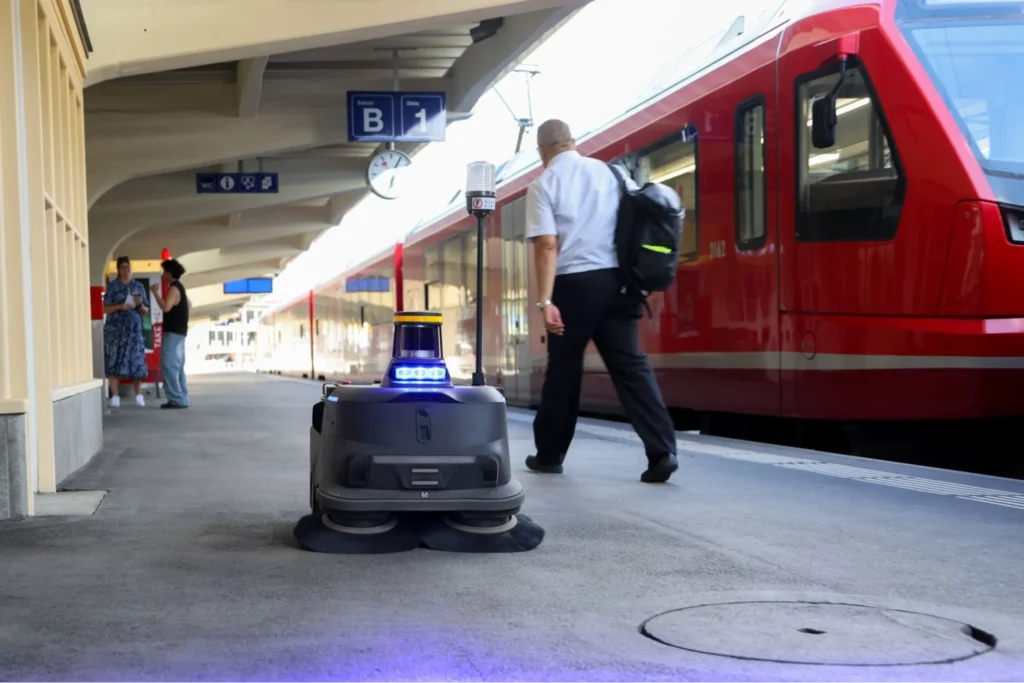
In July 2025, Pudu introduced the MT1 Vac, an AI-powered robotic sweeper and vacuum designed for high-performance dry cleaning in commercial and industrial spaces. The robot combines sweeping, vacuuming, and dust-mopping functions in a single unit, targeting large-area environments such as airports, metro stations, hotels, casinos, and office buildings.
The MT1 Vac features a twin-fan vacuum design that boosts suction efficiency by up to 200%, a 55cm suction path for efficient coverage, and a 20 L total waste capacity for extended operation. HEPA 11 filtration captures over 98% of 0.3-micron particles.
Pudu’s commercial cleaning business has become the company’s core growth engine. In 2025, commercial cleaning revenue surpassed 70% of the company’s total revenue. According to Frost & Sullivan, Pudu holds a 23% global share of the commercial service robot market. The company has deployed across more than 80 countries.
A robot floor scrubber should be judged on more than cleaning width or tank size. The sharper questions are operational.
Can the robot work during business hours? Can it manage reflective floors and moving crowds? Can staff adjust tasks without calling engineers? Can cleaning fleet management data support site audits?
Water tanks matter because refilling and drainage still affect labor savings. Docking stations matter because charging, water exchange, and maintenance determine real autonomy. Route planning matters because poor maps turn robots into supervised equipment.
The strongest use cases are not abstract. They sit in high-footfall and high-accountability environments.
Hotels need visible service quality without disrupting guest experience. Malls need frequent cleaning across mixed surfaces. Airports need large area coverage and stable navigation. Hospitals need repeatable processes that support hygiene routines. Warehouses need durability and coverage over big floor plates.
This is where commercial cleaning robots can shift from novelty to procurement logic. A facility does not buy robots because robots are trendy. It buys them because cleaning quality, staffing pressure, and operational data now sit in the same decision.
China’s advantage is not only in manufacturing scale. It is scenario density. A single Chinese city can contain airports, mega malls, hospitals, campuses, high-speed rail hubs, hotels, factories, and retail chains within a compact operating radius.
That density gives cleaning robots commercial value as a learning loop. Robots face real crowds, varied layouts, and long operating hours. Product teams receive faster feedback on navigation, docking, water tanks, obstacle handling, and fleet dashboards.
For global business leaders, the lesson is simple: China is not only producing machines. It is stress testing commercial automation in dense, demanding environments.
The floor-cleaning robot category in China is entering a more competitive phase. Gausium’s 2025 product activity points toward AI-driven floor care across retail and industrial settings. Pudu’s CC1 Pro launch shows service robotics companies moving deeper into facility management.
The winners will not be the brands with the loudest robot videos. They will be the companies that help facilities clean predictably, report clearly, deploy quickly, and reduce friction for staff. China’s commercial automation market rewards usefulness over spectacle. In floor cleaning, that usefulness is already rolling across the tiles.
Commercial cleaning robots are just one part of China’s broader automation story. At ChoZan, we help business leaders, investors, and innovation teams understand the technologies, companies, and market dynamics shaping China’s robotics sector through tailored research, strategic consulting, executive workshops, and immersive China learning expeditions.
If you’re evaluating automation opportunities or benchmarking China’s innovation ecosystem, we’re here to help you learn for China and learn from China.
Book a consultation to explore how developments in China’s commercial automation could inform your strategy, investment decisions, or innovation roadmap.
A floor-cleaning robot automates floor-care tasks such as scrubbing, sweeping, vacuuming, and dust mopping. It helps commercial sites improve consistency, reduce repetitive labor, and collect cleaning data for facility reviews.
Prices vary by model and capability. All-in-one platforms such as the Pudu CC1 and Gausium Phantas are priced in the USD 25,000 range. Higher-end models with advanced AI and larger coverage areas command premium pricing. Total cost of ownership depends on maintenance requirements and labor savings.
A commercial cleaning robot is built for larger spaces, longer working hours, more robust navigation, larger water tanks, and facility-level reporting. Home robots are designed for smaller, private rooms and lighter daily cleaning.
LiDAR navigation helps an autonomous floor cleaning robot map spaces, detect obstacles, localize itself, and follow planned routes. It is especially useful in malls, airports, hospitals, and other changing environments.
A robot floor scrubber can support consistent floor cleaning in selected hospital zones. Human supervision still matters because hospitals require strict protocols, infection-control procedures, and careful workflow coordination.
Buyers should compare cleaning modes, navigation, docking, tank capacity, service support, data reporting, battery life, and deployment effort. The right choice of commercial cleaning robots depends on site complexity.
An industrial cleaning robot can be well-suited for warehouses with large, hard floors, defined routes, and repetitive cleaning needs. Dust, debris type, traffic patterns, and safety rules should guide model selection.
Pudu CC1 is known for combining multiple cleaning functions into a single commercial robot platform, including sweeping, scrubbing, vacuuming, and dust mopping. It targets professional facility cleaning rather than home use.
Retail, hospitality, healthcare, transportation hubs, and logistics facilities are leading in adoption. Hypermarkets, drugstore chains, hotels, airports, and hospitals deploy commercial cleaning robots to maintain consistent standards across large footprints while reducing labor costs and improving operational efficiency.
Yes. Robots like the Pudu MT1 Vac are specifically designed for mixed surfaces, including carpet and hard floors. The MT1 Vac uses AI-powered sensors to detect floor material and automatically adjust brush pressure, roller speed, and suction strength