CONTENT
In 2026, Geekplus will have become more than a Chinese robotics name for logistics insiders. Demand around Geekplus robotics and warehouse AMR suppliers reflects a bigger executive question: which automation companies can turn robotics into repeatable commercial value across regions, warehouses, and labor models?
Geekplus matters because it sits at the intersection of China’s depth in robotics engineering, goods-to-person automation, and global warehouse modernization. The company listed on the Hong Kong Stock Exchange in July 2025 and reported 2025 revenue of RMB 3.171 billion, up 31.6 percent year-on-year, with adjusted net profit turning positive to RMB 43.8 million.
That shift points to a broader AMR strategy centered on software, deployment scale, and embodied intelligence.
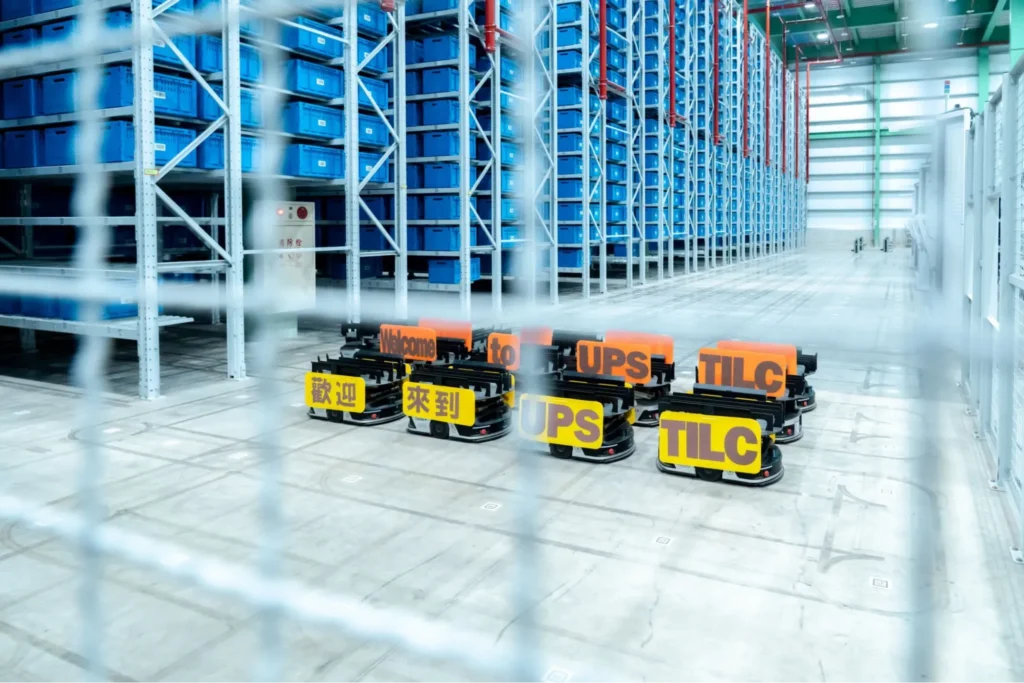
Geekplus develops autonomous mobile robot systems for warehouse storage, picking, sorting, intralogistics, and order fulfillment. Its public product architecture covers Shelf-to-Person, Tote-to-Person, Pallet-to-Person, robot arm picking, sorting, and internal transport.
The company also lists AMR families for shelf, tote, pallet, sorting, and transport workflows, as well as robotic arms for workstation automation.
The strategic idea behind the model is simple but powerful. In a goods-to-person model, robots bring inventory to workers or workstations. That cuts walking time, supports denser storage, and gives warehouse managers more control over picking waves.
In Walmart Chile’s 2025 deployment announcement, the company said the Geekplus Goods-to-Person Picking System uses P-series robots and smart algorithms for task management, order optimization, inventory management, dynamic wave optimization, and inventory layout adjustment.
Geekplus robotics increasingly rests on warehouse execution logic, robot fleet management, and integration with enterprise systems. The company describes its software suite as a unified layer that covers WES, RMS, IOP, monitoring tools, ERP, WMS, and MES integration, open APIs, and multilingual support.
For executives, this matters because warehouse robotics buying has shifted from machine procurement to the need for orchestration capabilities. A fleet linked to warehouse orchestration can support faster SKU rotation, returns handling, multi-client operations, and better exception control.
China gives AMR companies a demanding home market. E-commerce operators, apparel players, 3PLs, electronics manufacturers, and industrial factories deal with rapid product turnover and high fulfillment expectations. That environment rewards systems that can be deployed fast and adjusted without heavy fixed infrastructure.
For the company, China also provides reference cases in advanced manufacturing. In 2025, the company announced that Shanghai Siemens Switchgear achieved a 300 percent increase in storage capacity, a 150 percent improvement in picking efficiency, and 99.99 percent accuracy after a multi-year intelligent warehouse project.
The executive lesson is that AMRs need to be judged by process redesign. Buyers should ask how robots change slotting, batching, replenishment, safety zones, labor allocation, and data feedback. That is where the company becomes relevant to both strategy and operations teams.
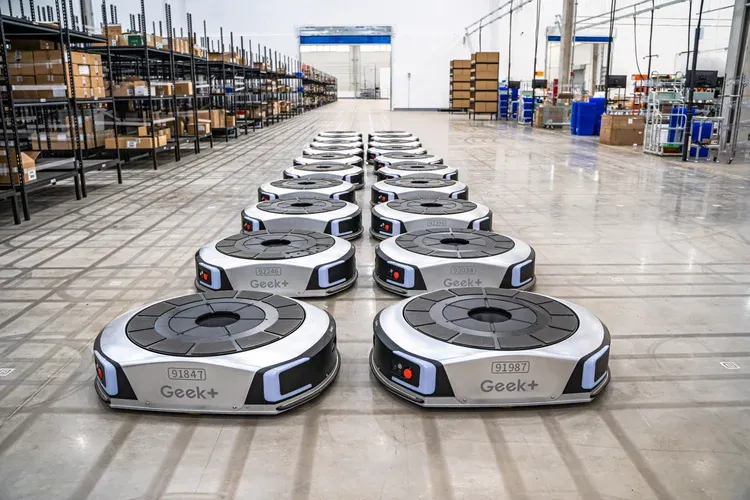
The most important shift in 2025 and 2026 is commercial maturity. Many robotics companies can show a demo. Fewer can show revenue scale, customer repurchase, service coverage, and positive profitability signals.
Geekplus listed on the HKEX Main Board in July 2025. By March 2026, it reported audited 2025 revenue of RMB 3.171 billion, gross profit of RMB 1.125 billion, gross margin of 35.5 percent, and adjusted net profit of RMB 43.8 million. New orders reached RMB 4.137 billion, up 31.7 percent year-on-year.
That matters for investors and enterprise buyers. Warehouse automation has long faced a credibility gap between exciting pilots and the economics of repeatable rollouts. A supplier with revenue growth, order momentum, and cash flow progress can speak more directly to long-term support, spare parts, software upgrades, and global delivery.
As of the end of 2025, Geekplus reported more than 72,000 robots delivered across more than 40 countries and regions, around 950 end customers, more than 80 Fortune Global 500 customers, and a high customer repurchase rate of about 78 percent. It also reported over 64 service stations and partner sites, 12 global spare parts centers, and more than 90 new channel partners added during 2025.
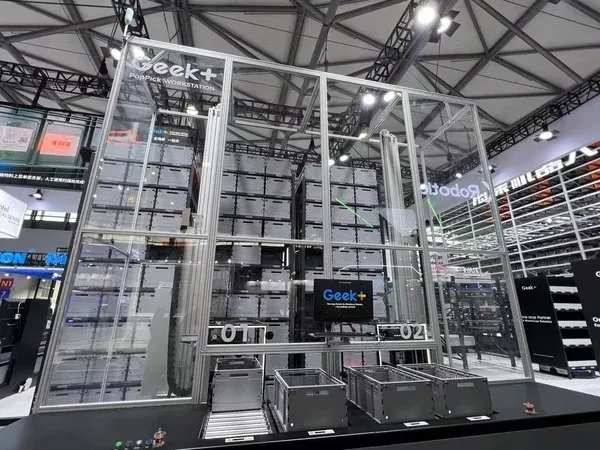
Geekplus America is important because North America is a demanding test for automation suppliers. US warehouse operators care about labor availability, peak season resilience, grocery complexity, 3PL customer variation, and retrofit constraints.
At MODEX 2026, Geekplus introduced Geek+ Brain and RoboShuttle V5 to the US market. The company said new orders signed in the Americas, led by the US, grew by more than 50 percent year-on-year in 2025. It presented a warehouse robotics stack covering Tote-to-Person, Pallet-to-Person, and Shelf-to-Person solutions for grocery, 3PL, retail, and e-commerce operations.
For global strategy leaders, Geekplus America signals how Chinese robotics companies are localizing beyond export sales. They are building partner ecosystems, demo environments, implementation playbooks, and region-specific proof points.
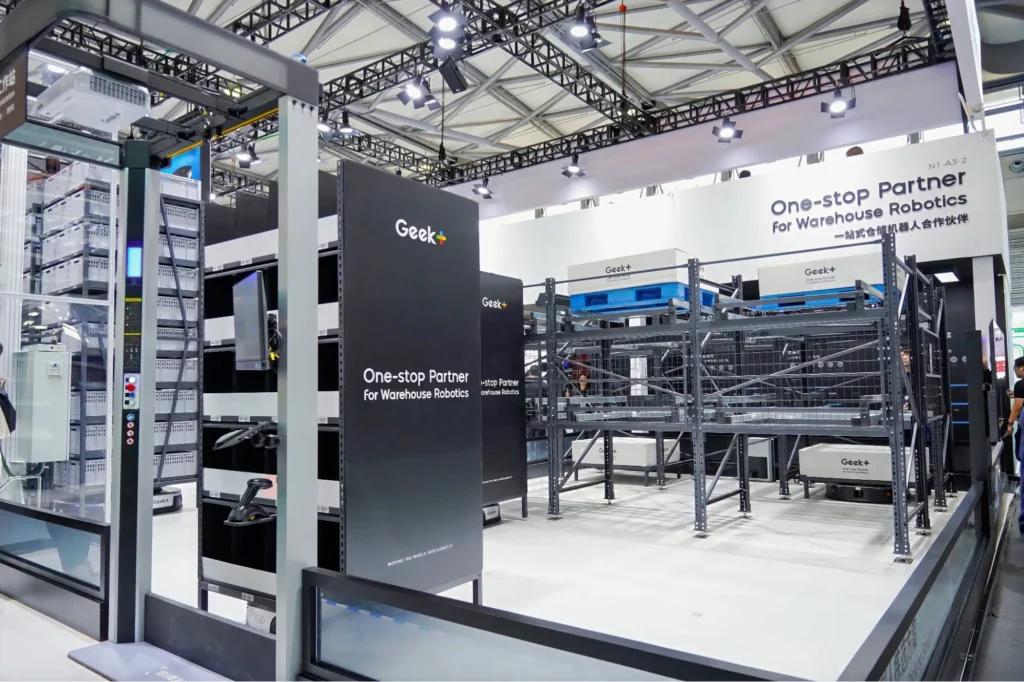
The company’s 2026 strategy now goes further into embodied intelligence, where software models, perception, robotic arms, and AMR infrastructure work together.
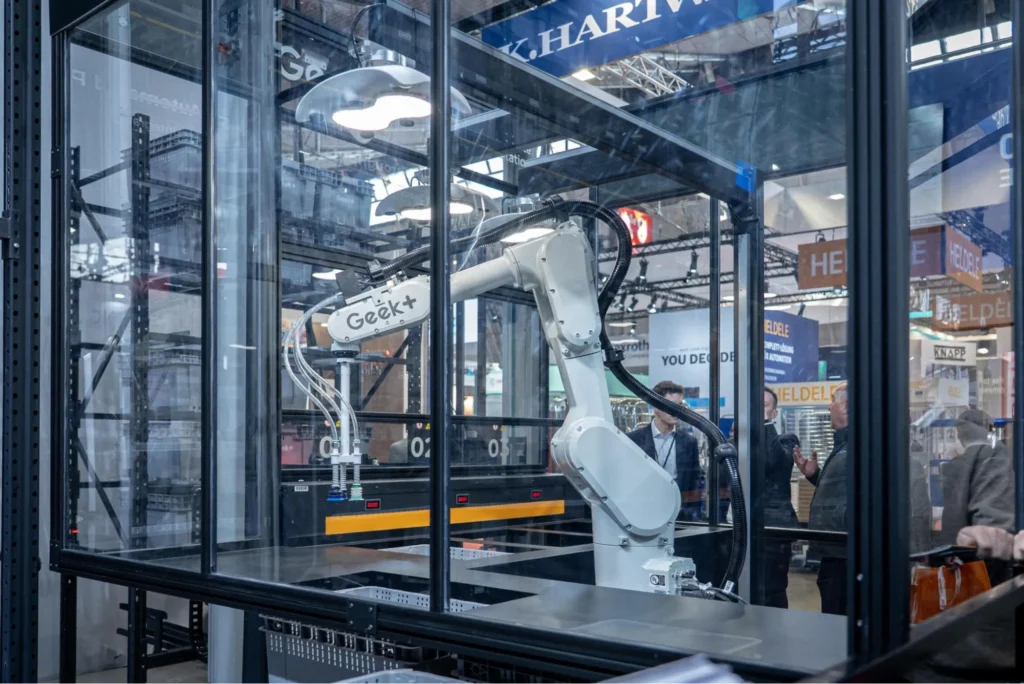
In May 2026, Geekplus won a 2026 RBR50 Innovation Award for its Robot Arm Picking Station deployed at Schneider Electric’s Shanghai warehouse. The solution combines the company’s Geek+ Brain, an embodied intelligence foundation model, with zero-shot learning. It doubled manual throughput, achieved at least 99.99 percent accuracy, and was production-ready within 48 hours, according to the company announcement.
This is strategically important because manual item picking remains one of the hardest areas to automate. AMRs can bring shelves or totes to a station, but mixed-SKU picking still requires perception, gripping decisions, error control, and exception handling. Robotic arms bring the company closer to a fuller warehouse automation stack.
At MODEX 2026, the company also positioned RoboShuttle V5 as a next-generation autonomous case-handling system. Case handling matters for grocery, retail, and high-density fulfillment because tote and case movement can define the economics of storage, picking, and replenishment.
For technology leaders, the decision should begin with workflow fit. Shelf-to-Person works well for certain SKU profiles and order types. Tote-to-Person may suit dense storage and smaller items. Pallet-to-Person or intralogistics AMRs may fit manufacturing and replenishment flows.
For CFOs, the key questions are payback period, retrofit cost, uptime assumptions, labor model impact, and scalability during seasonal peaks. For CIOs, the concern is the depth of integration with WMS, ERP, MES, cybersecurity, data ownership, and system visibility. For investors, the signals are order growth, customer repurchase, gross margin, regional diversification, and recurring service orders.
The strongest reading of Geekplus is that it represents a new phase of Chinese automation: commercially disciplined, globally deployed, and increasingly software-led. That does not remove execution risk. It does make the company a serious reference point for any global team studying warehouse AMRs, goods-to-person systems, and logistics automation strategy.
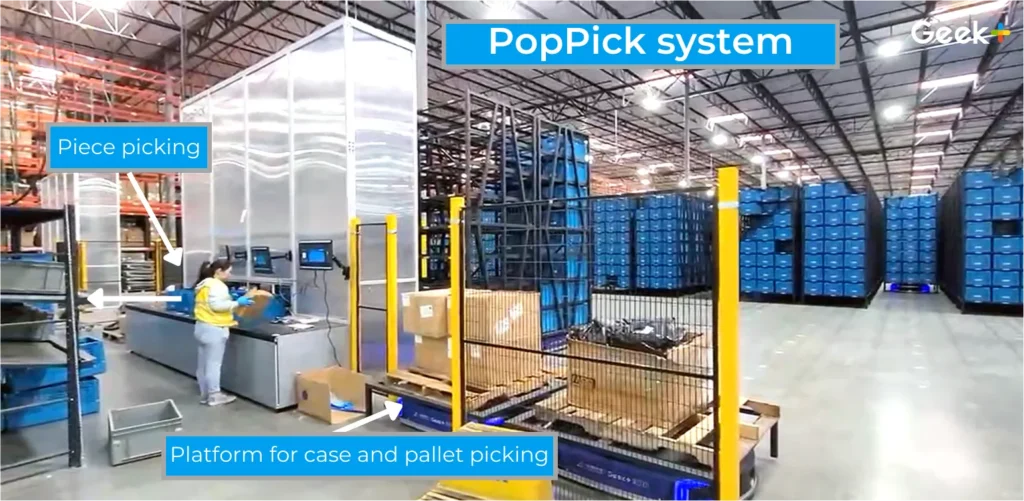
Geekplus shows how Chinese robotics companies are moving up the value chain. The company’s strategy combines AMRs, goods-to-person workflows, robot fleet software, robotic picking, and global service coverage. It’s 2025 and 2026 milestones suggest that warehouse automation is becoming a board-level productivity topic, not a niche operations upgrade.
For global business leaders, the real question has moved beyond “Should we test AMRs?” The sharper question is: which supplier can connect robots, software, service, and workflow redesign into a measurable operating advantage? Geekplus is one of the companies forcing that question into the open.
ChoZan helps global executives understand how China’s automation leaders are changing logistics, retail, manufacturing, and supply chain strategy. If your team is studying Geekplus, AMRs, smart warehouses, or China’s robotics ecosystem, ChoZan can support you with China market research, executive workshops, innovation briefings, expert calls, and learning expeditions.
Book a consultation to turn China automation insights into clearer strategic decisions.
Geekplus is best suited for high-volume operations with repetitive material movement, including retail, e-commerce, grocery, manufacturing, healthcare, and third-party logistics. Modular robot workflows let organizations automate different processes without replacing every warehouse operation at once.
Yes. Geek Plus AMR solutions are designed to integrate with major WMS, ERP, and MES platforms through open interfaces. This allows companies to preserve existing software investments while adding robotic automation in phases rather than rebuilding their technology stack.
Deployment depends on warehouse size, process complexity, and integration requirements. Because Geekplus uses modular automation, many projects can be introduced gradually, reducing operational disruption while allowing teams to validate performance before expanding across additional workflows.
Geekplus offers greater layout flexibility because AMRs move independently without extensive fixed infrastructure. Businesses can reconfigure storage, expand robot fleets, or adjust workflows as demand changes, making the system more adaptable to evolving fulfillment requirements than conveyor-based designs.
Yes. Smaller facilities can begin with a limited number of robots and expand capacity as order volumes grow. This phased approach lowers upfront investment while providing a practical path toward warehouse automation without major facility reconstruction.
Geekplus robots combine technologies such as LiDAR, visual SLAM, inertial navigation, and multi-sensor obstacle detection to operate safely around people and equipment. The systems are also designed to comply with relevant industrial safety standards for warehouse environments.
Yes. Geekplus supports returns processing alongside storage, picking, replenishment, and sorting workflows. This makes the platform valuable for retailers and logistics providers managing growing return volumes while maintaining inventory accuracy and processing efficiency.
Yes, in selected markets and through certain partners. Robotics as a Service allows businesses to access warehouse automation through subscription-based models rather than purchasing all hardware upfront, though availability varies by region and implementation partner.
Autonomous mobile robots are evolving toward AI-driven orchestration, multi-robot collaboration, robotic manipulation, digital twins, and increasingly autonomous warehouse decision-making. Buyers are also placing greater emphasis on software intelligence, interoperability, and lifecycle support when selecting automation partners.
Start with a warehouse assessment covering labor costs, order profiles, storage utilization, travel distance, throughput goals, and seasonal demand. Simulation tools and pilot projects can estimate operational improvements before committing to a larger rollout, reducing investment uncertainty.