CONTENT

Mindray is a Chinese medical technology company headquartered in Shenzhen, and its recent progress shows why China’s high-end medtech sector deserves closer study. The company now competes across patient monitoring, ultrasound, diagnostics, anesthesia, critical care, surgery, and connected hospital technology.
In the first half of 2026, international business generated 53% of company revenue and grew 13.67% year over year. Yet its own filing says overseas ultrasound market share remains in the single digits.
That combination makes Mindray strategically interesting. China has produced a company that can compete internationally without yet dominating its major overseas markets.
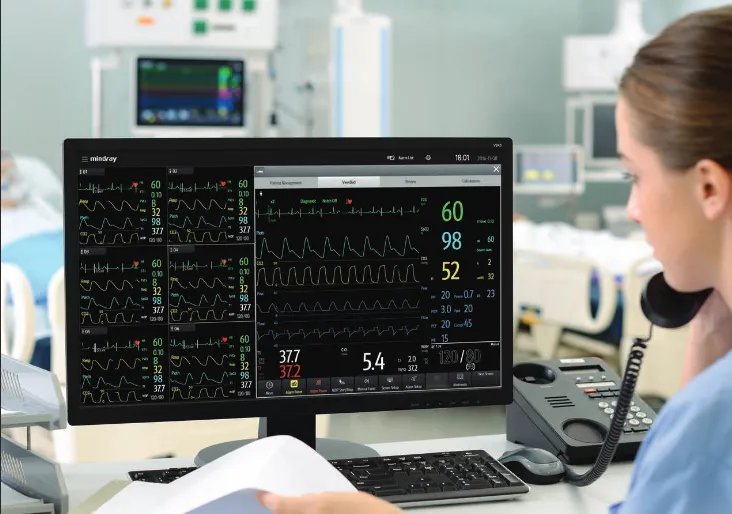
A defining part of the current strategy is the move toward systems that link equipment, software, clinical information, and AI.
At WHX 2026, Mindray presented its Smart Hospital Ecosystem around M-Connect, MiCo+, and Innolab. These systems connect data and imaging across intensive care, operating rooms, wards, and laboratories. The company also demonstrated a Smart ICU combining BeneVision V monitors, the wireless MRV Pod, and the SV900 ventilator.
The scale is becoming commercially relevant. Its 2026 half-year filing said international M-Connect projects had exceeded 1,000 signed deployments by June 30, with more than 160 added during the first half of the year.
This changes the competitive question. Product specifications still matter, but medical-device companies increasingly gain value when their devices can share information, fit existing workflows, and support decisions across multiple departments.
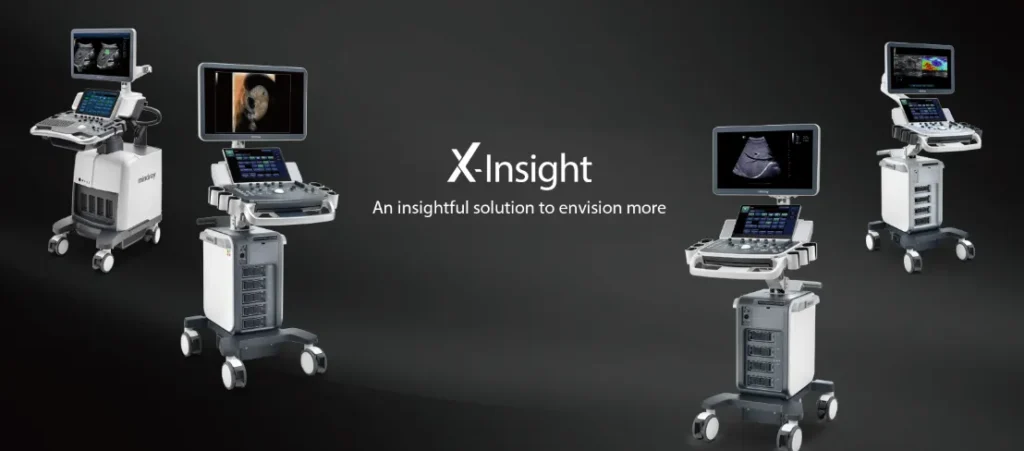
The Resona A20 provides one of the clearest recent examples. Mindray introduced the ultra-premium radiology ultrasound system at RSNA 2025, positioning intelligent automation and advanced imaging as key platform elements.
The 2026 numbers add useful context. Medical imaging revenue declined 5.78% in the first half, yet revenue from ultra-high-end ultrasound products increased by more than 30%. International revenue represented 68% of the imaging business. At the same time, Mindray disclosed that its overseas ultrasound share remained in the single digits and still leaned toward midrange and entry-level models.
That is a more useful indicator than a broad claim that a Chinese brand has already displaced established global players. Mindray has evidence of premiumization, while considerable international share remains to be won.
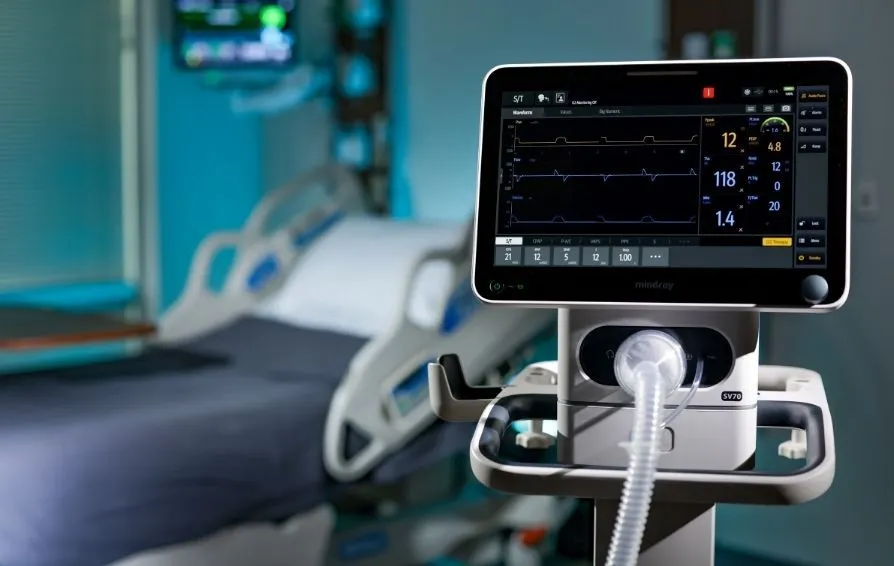
In May 2025, Mindray launched the BeneVision V Series patient monitoring platform at Euroanaesthesia. The system combines monitoring with integrated ultrasound hemodynamic assessment and a cable-light workflow through the MRV Pod.
Its critical-care scope widened further in 2026. The company entered additional North American respiratory-care categories and launched the SV70 non-invasive ventilator in September. The product sits alongside a wider portfolio spanning monitors, ventilators, anesthesia, and perioperative systems.
The strategic logic is straightforward: a supplier that can connect monitoring, respiratory support, imaging, and perioperative equipment has more room to compete around clinical workflows rather than isolated hardware.
The laboratory business gives Mindray a different growth engine. In-vitro diagnostics revenue increased 9.58% in the first half of 2026, while international IVD revenue grew more than 20%. The segment had reached close to 39% of total group revenue.
International expansion also includes production. The company reported localized manufacturing projects across 13 countries, with 10 already producing, mostly in IVD. That approach brings production, logistics, technical support, and market access closer to local healthcare systems.
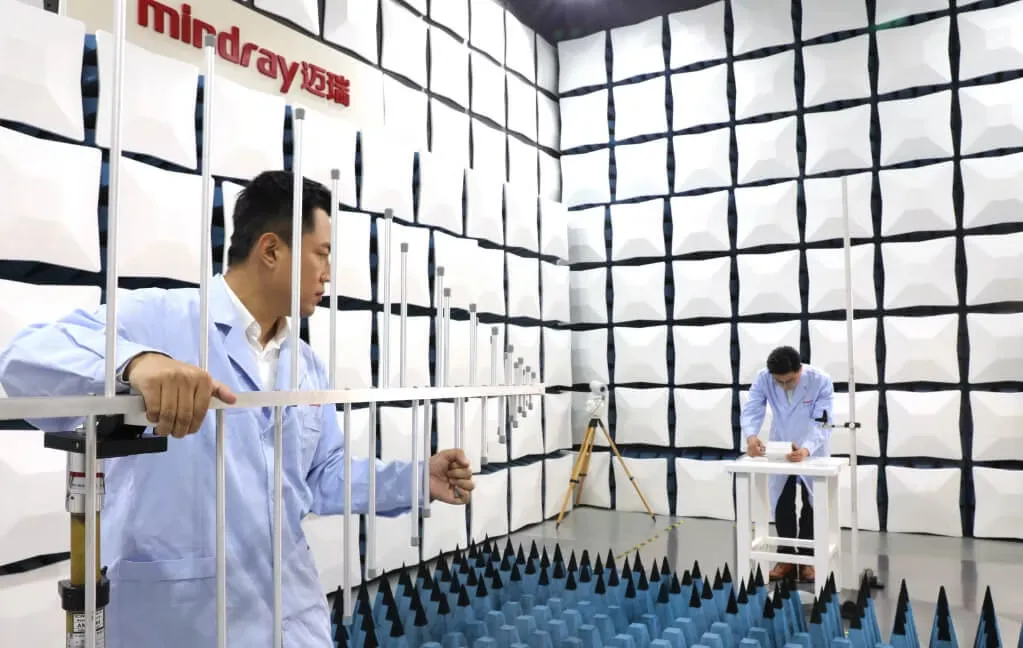
The company’s progress also sits inside a changing Chinese medtech ecosystem.
China’s National Medical Products Administration issued measures in October 2025 to support innovation and lifecycle regulation for high-end medical devices. The policy specifically identifies high-end medical imaging, medical robots, AI-powered medical devices, and new biomaterial devices.
Shenzhen has also made medical technology an explicit industrial priority. Its 2026 to 2030 development plan calls for high-end imaging, IVD, life monitoring and support, medical robotics, and AI-assisted diagnosis. It also names accelerating the Mindray medical supply-chain technology park as one of its planned industrial projects.
Policy support should not be confused with commercial success. Hospitals still assess clinical performance, service, economics, regulation, and integration. The policy does show that high-end medical equipment now sits within a broader Chinese effort to develop advanced healthcare technologies, rather than being treated primarily as an import-dependent sector.
Mindray’s international strategy has evolved from exporting products to building local operating capacity. At the end of 2025, Mindray had reported localized production projects in 14 countries, with 11 already in production; its June 2026 filing later listed 13 countries and 10 in production. It operates over 60 international subsidiaries.
In Asia, Mindray deepened cooperation with IHH Healthcare, one of the region’s largest private hospital groups. Mindray now supplies monitoring, ultrasound, and operating room equipment to IHH hospitals across Malaysia, India, Turkey, Bulgaria, and the Netherlands. In Turkey, Mindray serves more than 1,300 medical institutions through two branches, with 90% local employees.
The company’s “Ruijing Ecosystem” remote imaging solution is deployed across all 47 counties in Kenya, covering 98 referral hospitals.
This is not charity branding. It is market entry through infrastructure building, creating long-term dependency on Mindray’s platform.

A credible Mindray company profile also needs the weaker numbers.
Revenue fell 9.38% in 2025, while net profit attributable to listed-company shareholders declined 30.28%, according to the annual report. R&D spending still represented 11.80% of revenue that year.
The first half of 2026 showed some improvement. Revenue increased 6.00%, or 8.16% on a currency-neutral basis, while attributable net profit remained 5.37% below the previous year. Mindray reported 12 R&D centers and around 5,200 R&D engineers, with first-half R&D spending equal to 10.02% of revenue.
The numbers support a challenger narrative more convincingly than a dominance narrative. International growth, premium product momentum, and sustained research spending are real. Domestic procurement pressure, uneven product-line performance, and limited overseas share in areas such as ultrasound remain equally relevant.
The first lesson is to compete at the workflow level. Mindray has expanded from individual monitors, laboratory analyzers, and imaging systems toward integrated hospital technology. That gives hardware innovation a software and data layer.
The second lesson concerns localization. Current expansion includes manufacturing, logistics, clinical support, partnerships, and regulatory work. Selling internationally becomes harder once a product enters highly regulated, mission-critical hospital environments. Local operating capability becomes part of the product proposition.
The third lesson is China’s role as a development base. Shenzhen combines engineering talent, medical-device manufacturing, healthcare institutions, software capability, and current policy support for advanced medical technologies. That creates conditions in which Chinese companies can test broader product portfolios and move into more technically demanding categories.
The fourth lesson is restraint. Mindray shows that Chinese companies can move from price competition toward higher-value technology, but progress differs sharply across products and regions. That distinction helps anyone trying to understand what China’s technology development can genuinely teach the rest of the world.
The Mindray case becomes more valuable when you examine company strategy alongside Chinese technology trends, policy, customers, and local operating models. ChoZan combines China-focused research, strategy consulting, expert calls, workshops, and tailored learning expeditions designed to help organizations study developments in China and assess which lessons transfer to other markets.
ChoZan can also build tailored China learning programs around technology companies, innovation hubs, and expert discussions for teams seeking direct exposure to the forces shaping sectors such as medtech, AI, robotics, retail, and mobility.
Book a consultation with ChoZan to explore what the growth of Mindray and China’s wider technology ecosystem could mean for your strategy.
Yes. Mindray is a Chinese medical technology company headquartered in Shenzhen. Its current global operations span medical imaging, patient monitoring, life support, laboratory diagnostics, anesthesia, surgery, and hospital information systems.
Mindray sells patient monitors, ultrasound and radiology systems, anesthesia machines, ventilators, defibrillators, infusion equipment, laboratory diagnostics platforms, surgical systems, and related IT products. Its portfolio increasingly connects equipment, software, data, and AI across hospital departments.
Yes. Mindray trades on the Shenzhen Stock Exchange under ticker 300760. Its 2025 annual report and 2026 half-year filing provide the most useful current sources for revenue, R&D spending, product performance, and international expansion.
Mindray reported R&D spending equal to 10.02% of revenue in the first half of 2026. It also reported 12 R&D centers and about 5,200 R&D engineers across China, the United States, Finland, and Germany.
Yes. FDA records from 2026 include Mindray submissions for patient monitoring and diagnostic ultrasound systems. Product status varies by model and clearance, so buyers should verify each specific device rather than assuming uniform authorization across the portfolio.
Yes. Mindray reported local manufacturing projects in 13 countries as of June 2026, with 10 already in production, mainly supporting in-vitro diagnostics. It is also expanding logistics and service infrastructure in markets such as North America.
Project 2030 is Mindray‘s ultrasound education and collaboration initiative launched in 2025. Its stated targets include reaching 150 ultrasound schools and 50,000 physicians and medical students through training and academic exchange by 2030.
Yes. Mindray launched the Qiyuan Ultrasound Large Model in 2025 and developed AI blood cell morphology recognition with over 97% accuracy. It also filed China’s first AI-assisted breast ultrasound product for innovative device review.
Chinese medical-device companies face tighter access to some European public procurement. Since June 2025, the EU has excluded Chinese companies from participating in certain public medical-device tenders above €5 million and capped Chinese-origin medical devices at 50% of the value of relevant contracts.
Yes. Mindray and Medtronic expanded their US patient monitoring partnership in January 2026 to ambulatory surgery centers. The arrangement integrates selected Medtronic monitoring technologies with Mindray platforms and extends their collaboration beyond traditional hospital settings.
Yes. The Resona A20 supports Mindray‘s premium ultrasound push, and ultra-high-end ultrasound revenue grew more than 30% in the first half of 2026. Still, the company reported that its overseas ultrasound share remained in the single digits.