TL;DR.
China’s 618 shopping festival, the country’s mid-year sales event, like Prime Day, grew 4.0% in 2026, its slowest on record, as discounts lost their pull. The growth that held came from AI agents at the front of the store. Alibaba’s Qwen assistant now has 300 million shoppers and its Accio sourcing agent 10 million business users. Whether an agent recommends you now depends on your product data.
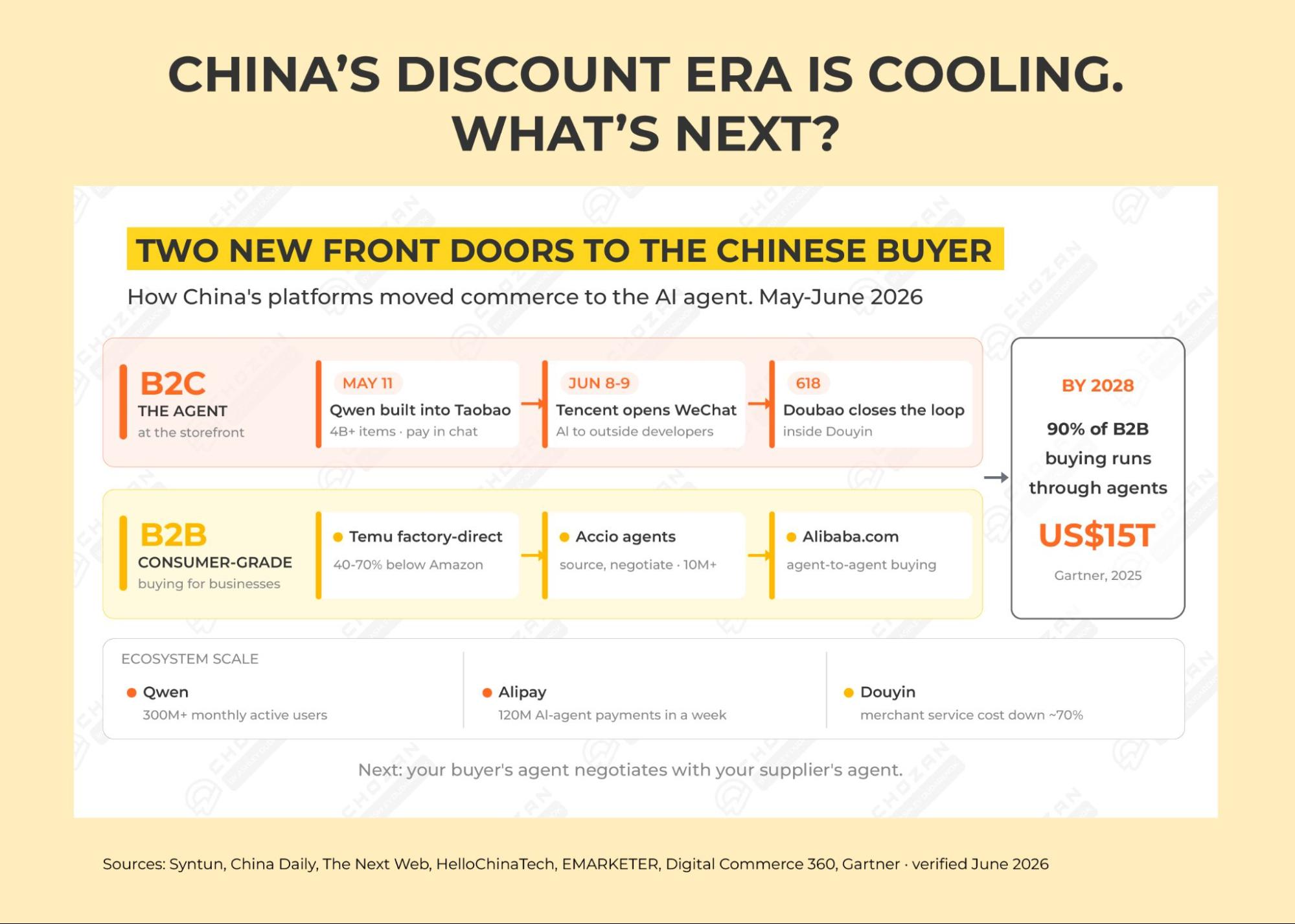
How China’s platforms moved commerce to the AI agent, May–June 2026. Sources: Syntun, China Daily, Gartner.
New to agentic commerce? Start with the Pillar A guide: what a China AI shopping agent is and how it works.
At a glance
- China’s 618 shopping festival grew 4.0% in 2026, down from 15.2% a year earlier (Syntun, June 2026).
- Alibaba’s Qwen shopping assistant has passed 300 million monthly active users (Alibaba FY2026 filing).
- Alipay processed 120 million AI-agent transactions in a single week in February 2026.
- Gartner expects 90% of B2B buying to run through AI agents by 2028, moving over US$15 trillion (Gartner, October 2025).
Is China's 618 shopping festival losing momentum?
China’s 618 shopping festival grew just 4.0% in 2026, its slowest on record. Buyers kept spending, but the growth came from a new place. Deeper discounts stopped moving them, so momentum shifted to the AI agent at the front of the store (Syntun, June 2026). The US$138 billion total compares with 15.2% growth a year earlier.
The shift shows underneath the headline number. Comprehensive e-commerce grew 0.9%, instant retail rose 112.3%, and community group-buying fell 39.6%, with Meituan closing its group-buy arm entirely.
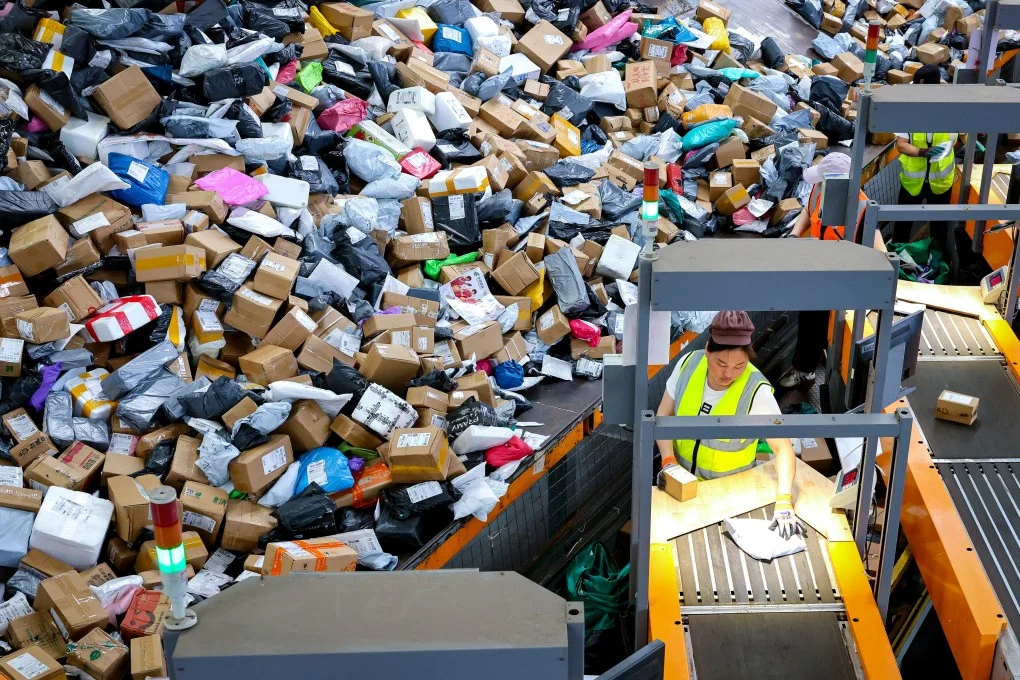
As AI agents increasingly pick and order products for Chinese shoppers, fulfilment volumes surge at sorting centres — the brands the agent names are the ones that ship. Photo: Xinhua.
In June, regulators summoned the major platforms over inflated “original prices,” the second straight year of pressure on festival pricing. Two years of slowing or regulator-checked growth point to a lasting change in how Chinese commerce works. The question for a brand is no longer how deep to discount. It is who does the recommending when the discount stops working.
How are AI agents replacing search in Chinese e-commerce?
The keyword search box is being replaced by a conversation. On May 11, 2026, Alibaba built its Qwen assistant into Taobao (its main marketplace), so shoppers now search, compare, order, and pay in natural language across more than 4 billion products, with Alipay settling the purchase inside the chat. Qwen’s consumer interface has passed 300 million monthly active users (Alibaba FY2026 filing).
A shopper who types “a light sunscreen that won’t clog pores in humid weather” gets one ranked recommendation instead of a grid of results. There is no second page to rescue a product that misses the answer.
The behavior predates the 618 festival. During Spring Festival, Qwen handled more than 200 million orders placed by single-sentence command. Payment is already at scale: Alipay processed 120 million AI-agent transactions in a single week in February 2026, the first AI-native payment product to reach that volume. The merchant floor moved too. Douyin’s AI service cut merchant labor costs about 70% during 618, and ByteDance’s Doubao assistant and Tencent’s WeChat opened comparable agent flows in June.
Alibaba is repricing its own model to match. It removed paid ranking from Qwen’s Taobao search, even though keyword advertising supports roughly 70% of its core China-commerce profit. China’s generative-engine-optimization market, the work of shaping what these assistants say, grew 215% year-on-year in Q2 2025 as brands moved to keep up.
How is China selling to business buyers like consumers?
Chinese platforms now sell to business buyers with the same consumer-grade buying they built for shoppers. A small contractor reorders supplies the way a shopper buys sneakers: swipe a feed, tap once, ship direct from a factory.
Temu removed the distributor markup, pricing its factory-direct model 40-70% below comparable Amazon listings on an estimated US$20-25 billion in 2025 sales across more than 80 countries. TikTok Shop is reaching retail scale, projected at US$23.4 billion in US sales in 2026, up 48% year-on-year, on track to outsell Target and Costco. Sourcing is becoming a conversation: Alibaba.com’s Accio agents source by text, image, or sketch and run multi-round supplier negotiations. Accio passed 10 million monthly users by March 2026 and lifted European orders 57%. (China’s retail playbook is shifting fast.)
The contrast with Western B2B is wide. Many US distributors still run on phone, email, and quote forms, while the Chinese platform compresses discovery, comparison, and order into a feed and a chat. If you sell through distributors, hardware stores, or service pros, the buyer’s habits are being rebuilt around someone else’s app.
Why is China ahead of the US in AI shopping?
China is ahead because its platforms close the entire buying loop — discovery, recommendation, payment, fulfillment — inside a single app, while Western commerce stays split across separate sites. The gap showed in early 2026: OpenAI pulled its in-chat checkout in March, and Amazon folded its Rufus shopping assistant after analysts flagged its recommendations as self-serving. (See the full US-vs-China breakdown.)
Chinese ecosystems run the loop end to end. Alibaba pairs Taobao, its Qwen assistant, and Alipay; ByteDance pairs Douyin (China’s TikTok) with its Doubao assistant. A shopper never leaves the app to compare, pay, or track delivery.
The edge is structural: one app that owns the whole loop. Standalone strategies are penalized in it. Nike’s app-first approach contributed to a 17% revenue drop to US$1.73 billion in Greater China for fiscal Q3 2025. For a Western brand, the takeaway is less about building a better model and more about being present where the loop already closes.
See how China’s AI storefront actually works up close on our China Innovation Tour.
What does this mean for global brands?
- Agent legibility. Run 10 natural-language queries against Taobao’s and Douyin’s assistants for your top products, without naming your brand. If you are not in the answer, structured product data is the fix, and someone needs to own it.
- Reorder friction. Count the clicks and days a small buyer needs to reorder from you against one tap on a platform feed. Map the gap on your single most exposed SKU and run that as a pilot.
- The data green lane. Under China’s 2024 Free Trade Zone rules, data not on a published “negative list” can leave the country without the full security review, across 17 sectors today, including automobiles, medicine, and retail (DLA Piper, 2026). Bayer cleared its Beijing filing in about five working days (Beijing E-Town, 2024). Name one dataset that would sharpen your global R&D and decide whether to file. (Talk to our China team about market entry.)
What is coming next is agent-to-agent buying: your buyer’s AI negotiating terms directly with your supplier’s AI. Alibaba.com already runs it (Fortune, March 2026), and Gartner expects 90% of B2B buying to move through AI agents by 2028, worth more than US$15 trillion (Gartner, October 2025). Regionally, 62% of organizations are testing AI agents but only 23% have scaled them (SCMP, June 2026). The discount door is closing on schedule. The brands that win this cycle are the ones whose products an agent can recommend, whose buyers can reorder in a tap, and whose R&D draws on data competitors cannot legally reach.
Want your team ahead of this shift? Bring Ashley Dudarenok in as a keynote speaker.
FAQ About AI Shopping Agents
How much did China's 618 shopping festival grow in 2026?
It grew 4.0% year-on-year to US$138 billion in network-wide sales, the slowest growth on record, down from 15.2% a year earlier (Syntun, June 2026).
Are Chinese shoppers still spending during the 618 festival?
Yes. Spending held, but the growth moved from discounts to AI-agent-led buying. Comprehensive e-commerce rose only 0.9% while instant retail jumped 112.3% (Syntun, June 2026).
Why did 618 growth slow in 2026?
Deeper discounts stopped moving buyers, and regulators capped price-cutting, summoning platforms over inflated “original prices” for the second straight year. Growth shifted to conversational AI agents.
What is a China AI shopping agent?
A conversational assistant, such as Alibaba’s Qwen or ByteDance’s Doubao, that finds, compares, and buys products in natural language inside a single app. See the Pillar A guide for the full explainer.
Sources: Syntun (June 2026) · Alibaba FY2026 filing · Fortune (March 2026) · Gartner (October 2025) · SCMP (June 2026) · DLA Piper (2026) · Beijing E-Town (2024) · China Daily · The Next Web · HelloChinaTech · EMARKETER · Digital Commerce 360.