CONTENT

XtalPi is a Shenzhen-based research technology company that combines AI, physics-based modeling, and laboratory robotics to discover and develop drug candidates. Its approach links digital predictions with physical experiments, letting results inform the next research cycle.
The business sells discovery services and laboratory infrastructure while developing assets for licensing. That combination makes it a useful case study of China’s use of AI in scientific work.
The commercial question is how much of the research process the system can reliably complete, what customers will pay for, and how experimental progress translates into viable medicines.
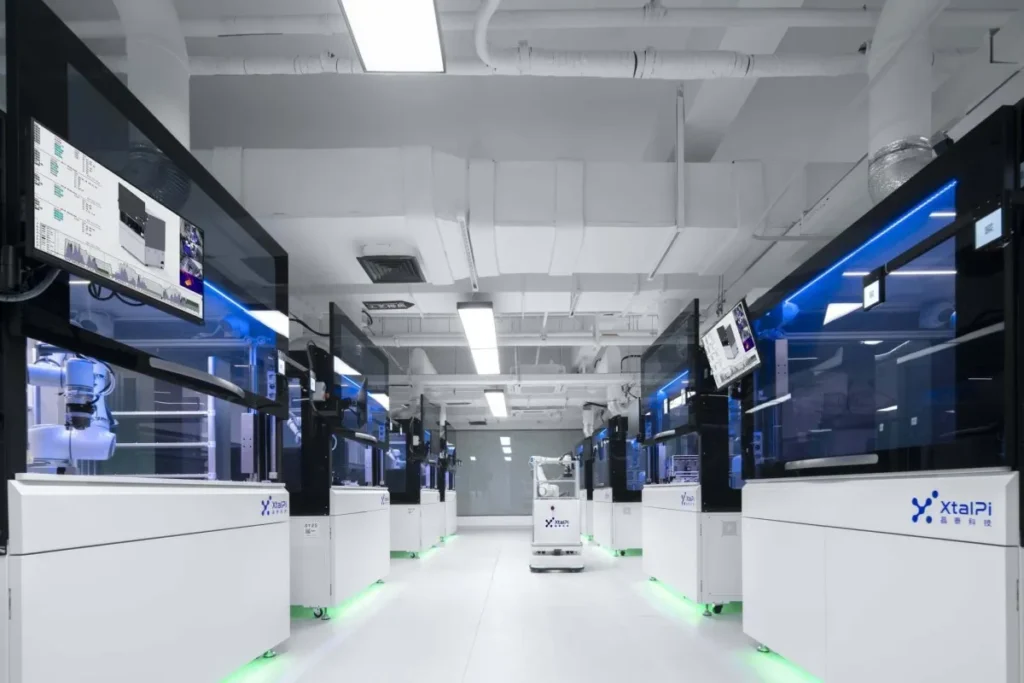
The company’s technology architecture combines scientific models, an agent system that coordinates tasks, and laboratory automation. This creates a design-make-test-analyze cycle.
AI generates or prioritizes candidate structures. Computational chemistry evaluates properties such as molecular interactions and binding affinity. These calculations guide molecular design before researchers commit laboratory capacity to synthesis and testing.
The next requirement is execution. Robots prepare samples, dispense materials, run reactions, and assist with analysis. The company describes this connection between models and laboratory equipment as physical AI.
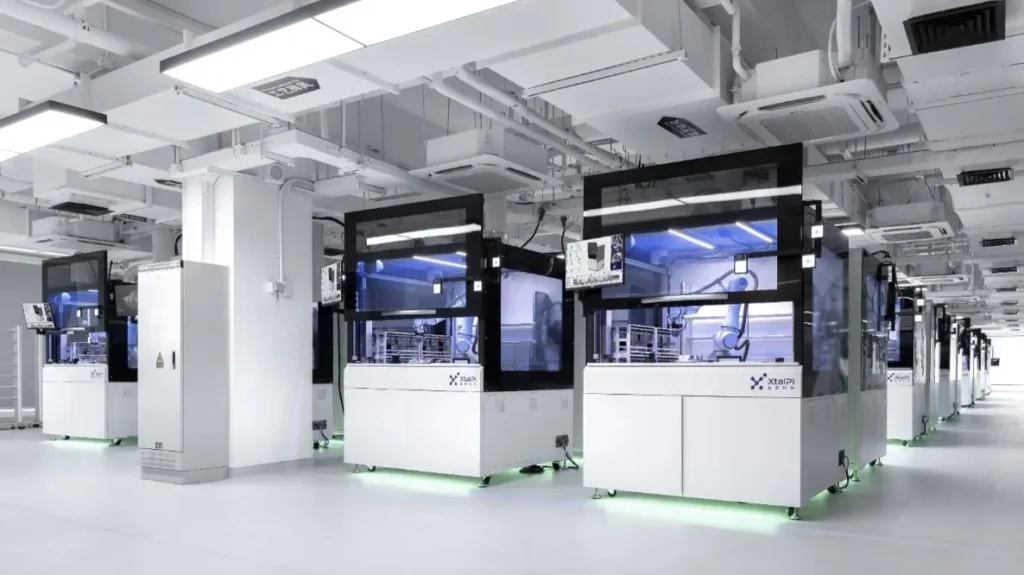
The agent system manages task plans, calls specialized models, and coordinates equipment. In autonomous experimentation, it also interprets results and selects the next experiment within an assigned scope.
A practical assessment should therefore examine complete research cycles. A robot’s dispensing speed says little about its ability to recover from an unsuccessful reaction or recognize an unreliable measurement.
The August 2026 results announcement identifies customer deployments with different completion stages:
| Customer project | Reported status in the first half of 2026 |
| Eli Lilly compound management system | Delivered to its Shanghai R&D center |
| Eli Lilly high-throughput experimentation system | Completed factory acceptance testing and user training |
| JW Pharmaceutical synthesis and process R&D system | Fully delivered in April |
These distinctions matter. A signed agreement, factory acceptance, installation, and sustained operation represent separate milestones. Procurement teams should request evidence for the stage relevant to their decision.
The same announcement says Agentic HTE shortened a conventional experimental iteration from three to four weeks to approximately six days. This company-reported result measures an experimental workflow, with clinical development outside that comparison.

An October 12, 2026 open-source announcement offers a less discussed view of XtalPi’s technical priorities.
LCMS2Yield estimates correction factors that researchers combine with liquid chromatography and ultraviolet measurements to calculate reaction yields. It removes the need for a pure reference standard for each target compound within the method’s applicable conditions. The public repository provides code, model resources, and datasets for evaluation.
The strategic implication is straightforward: an autonomous laboratory needs dependable measurements to decide which experiment to run next. Faster synthesis has limited value if the system misreads how much product a reaction produced.
This release gives potential users a concrete component to inspect and test. It does not validate the entire laboratory platform. Its applicability depends on the compounds’ ultraviolet absorption and analytical conditions, which users must check against their own chemistry.
The August 2026 disclosure adds a related detail: approximately 80% of more than 500,000 experimental records were negative results from failed experiments. Those records may reveal unproductive conditions. Their value depends on consistently recording failures and distinguishing chemical outcomes from equipment or measurement errors, a useful test for any proposed research database.
On October 6, 2026, the company announced Kodexia, a platform that combines generative AI, biological modeling, and automated experiments for small interfering RNA (siRNA).
An siRNA sequence must silence the intended gene, chemical modifications must preserve useful properties, and delivery must reach the relevant tissue. Success in one dimension does not guarantee success in the others, so experimental feedback is important throughout development.

The company reported six proprietary preclinical programs spanning metabolic, renal, respiratory, and central nervous system diseases. Its lead IgA nephropathy program generated nonhuman primate efficacy data approximately seven months after initiation.
On October 15, 2026, XtalPi announced the nomination of its first internally developed siRNA preclinical candidate for the disease, completing that development milestone within nine months. These remain preclinical achievements, not evidence of efficacy in humans.
Those results describe progress before human trials. They provide a specific example of the platform’s extension into another therapeutic modality, while leaving clinical safety, efficacy, and eventual approval unresolved.
The commercial test is repeatability across programs. A platform becomes more valuable when partners can establish which parts of its methods transfer to a new target and which require additional biology, delivery technology, or experimental development.
The DoveTree collaboration illustrates why AI drug discovery requires careful financial interpretation. The August 2025 announcement described a potential aggregate value of up to US$5.99 billion and an initial US$51 million payment.
In a May 2026 update, the company confirmed receipt of a second US$19 million payment. It also reported that one preclinical candidate had entered studies supporting an investigational new drug application.

The potential agreement value depends on future achievements. Payments already received provide a firmer basis for assessing near-term commercialization.
The interim financial disclosures add another distinction: total revenue fell 23.9% year over year, while revenue excluding the specified pipeline licensing project rose 73.8%. AI for Science intelligent solutions, covering laboratories and services, grew 136.4%. The group recorded a net loss.
These figures make revenue composition and payment timing central to evaluating the business.
The company’s international activity challenges a purely domestic reading of China’s research capabilities. In June 2025, the University of Liverpool confirmed that XtalPi had acquired Liverpool ChiroChem, a university spinout specializing in automated chiral chemistry and molecular building blocks.
The strategic significance lies in combining complementary capabilities: chemical expertise, automated execution, and computational prediction. The acquisition shows that technology development can integrate specialized international research assets.
For global partners, the useful question is where this combination solves a defined research constraint. A synthesis bottleneck, difficult measurement task, or shortage of suitable building blocks offers a clearer starting point than a broad commitment to adopting AI.
A 2025 Nature Computational Science commentary highlights the role of human expertise in autonomous synthesis laboratories. A procurement assessment should make that relationship explicit.
Ask a prospective supplier to demonstrate:
The most useful pilot sets acceptance criteria before work begins and compares results against the laboratory’s existing workflow. That makes autonomy measurable at the level where a research organization can act.
ChoZan’s China research services and customized learning expeditions help teams examine how Chinese companies apply technology in practice. Use XtalPi as a starting point for a focused brief on R&D automation, potential partners, and lessons relevant to your business. Explore ChoZan’s China reports to broaden that research.
The listed company trades on the Hong Kong Stock Exchange under stock code 2228. Its investor relations website provides financial reports, announcements, and presentations. Check those disclosures for current company information and reporting dates.
The company uses that name in corporate communications. Current listed-company disclosures identify the issuer as XtalPi Holdings Limited. Use the formal entity name in contracts and distinguish the listed parent from any operating subsidiary.
Its references to quantum physics describe scientific modeling methods. The published architecture discusses physics-based calculations, AI models, and cloud computing. Those descriptions do not show that the platform requires quantum-computer hardware to operate.
Existing equipment may require interface development, consistent sample identifiers, and instrument scheduling. Ask the supplier to map those requirements before agreeing on scope. A standalone workstation demonstration does not establish compatibility with your laboratory’s full workflow.
The contract should specify ownership of raw measurements, experimental protocols, trained models, and resulting inventions. Agree on permitted reuse, confidentiality, access rights, and deletion obligations before work starts, particularly when partners operate across jurisdictions.
A smaller biotech should ask about a project focused on one target or compound series. Confirm minimum scope, required starting data, agreed deliverables, and access to specialist biology expertise before committing to a broader engagement.
A practical team needs chemistry or biology expertise, automation engineering, analytical science, and data management. Assign clear responsibility for experimental design, instrument reliability, result review, and software changes so technical problems reach the right specialist quickly.
Yes. An October 2026 announcement describes a jointly developed model operating within Fangda Carbon’s graphite electrode production workflow. It ranks formulation candidates before physical trials, illustrating an application in industrial materials rather than therapeutic development.
Search the candidate code and sponsor in clinical trial registries, then compare the record with dated company and regulatory disclosures. Distinguish application submission, permission to begin testing, patient enrollment, trial results, and marketing authorization.
Yes. In September 2026, XtalPi submitted a U.S. investigational new drug (IND) application for KQTD-126, a candidate targeting chronic intestinal pain.
On October 28, 2026, the company announced that it had received FDA clearance to proceed with clinical testing. Human trials were planned but had not yet been reported as initiated. This clearance does not constitute marketing approval.