CONTENT

The most important story around Galbot G1 is operational fit. The ChoZan humanoid robotics report places Galbot inside the 2026 shift from demos to commercial deployment, with emphasis on wheeled mobility, item handling, uptime, and service environments. That framing matters because operations teams buy reliability before spectacle.
A Beijing humanoid robot that moves on wheels tells us something practical about China’s direction in robotics. The goal is not to copy human walking in every setting. The goal is to deploy robotic labor in pharmacies, retail aisles, logistics sites, and structured indoor facilities, where movement, reach, and manipulation determine value.
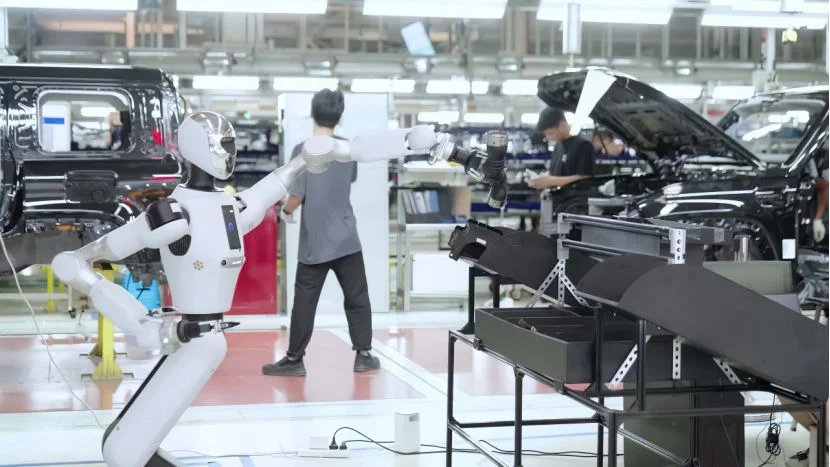
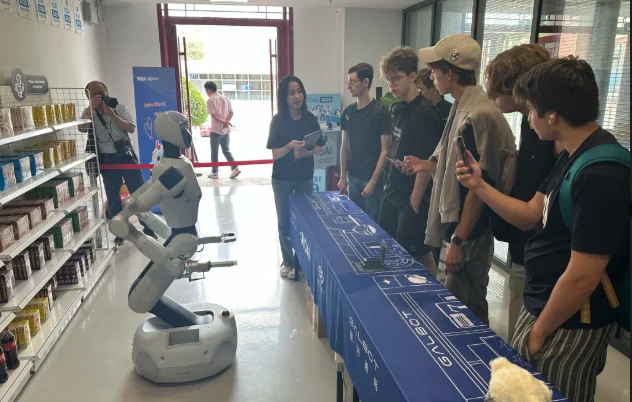
Galbot G1 follows a semi-humanoid architecture. It keeps a human-scale upper body for shelves, counters, cartons, cabinets, and tools. Then it uses a wheeled base for indoor navigation. This structure gives the robot a more stable operating profile in spaces with smooth floors and predictable routes.
That design choice matters for a humanoid service robot because most indoor service jobs do not require stairs or outdoor terrain. Pharmacies, convenience stores, malls, hospitals, and hotel backrooms require safe movement around people, high repeatability, and controlled stopping. Wheels support those needs better than legs in many structured settings.
The legs-versus-wheels trade-off also changes the maintenance logic. Bipedal robots need complex balance recovery, heavy joint control, and strong fall protection. A wheeled humanoid design reduces that risk in controlled commercial spaces. As a result, Galbot G1 can devote more engineering effort to upper-body manipulation, item recognition, and order execution.
The operational question is simple. Can the robot recognize an item, reach it, grip it, move it, and place it correctly many times per day? Galbot G1 matters because it focuses on manipulation dexterity rather than stage movement.
Its technical profile describes Galbot G1 as a human-scale robot around 173 centimeters tall and 85 kilograms, with a reach of up to 2.4 meters. Its arms support loads up to 5 kilograms per arm. It also highlights GraspVLA, a grasping foundation model designed for handling complex objects, such as fragile packages and irregularly shaped items.
This makes Galbot a compelling case study in embodied AI robotics. A robot that picks packaged medicines, sealed products, bottles, boxes, and uneven objects must deal with variation. Product shapes change. Shelf placement shifts. Packaging materials reflect light differently. A scripted machine struggles when those details move outside the expected pattern.
That is why the idea of a programmable humanoid robot needs a practical definition. It should mean a robot whose workflows can be configured, tested, and refined without rebuilding the entire system.
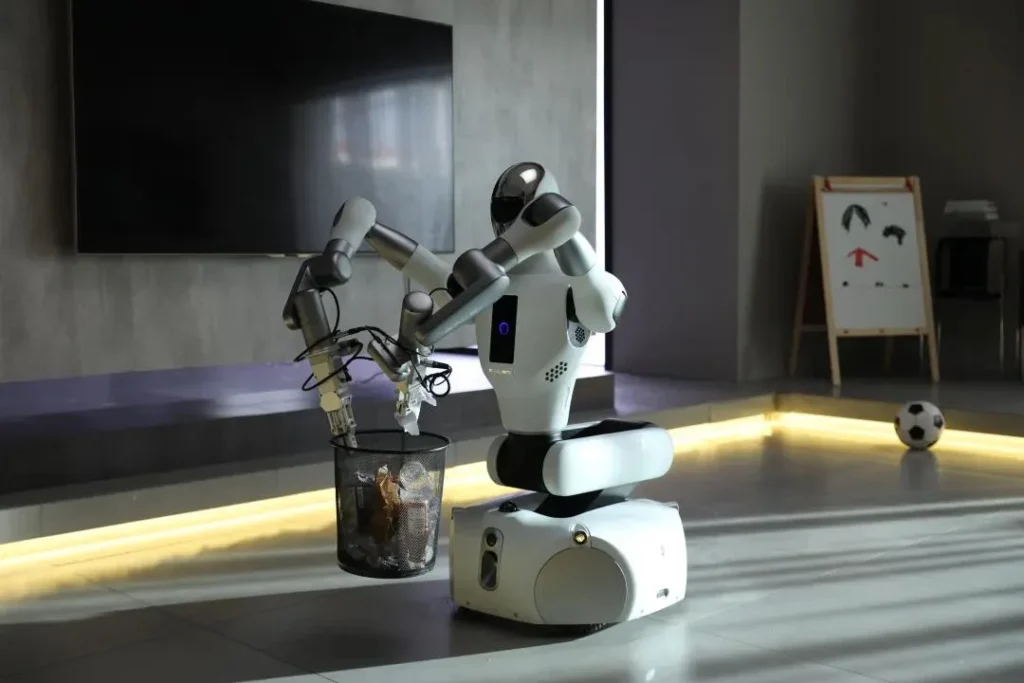
Galbot positions AstraBrain as an embodied large model that links perception, task plans, and control. That matters because service work unfolds across sequences. A pharmacy robot receives an order, locates the shelf, checks the item, picks it, packages it, and sends it for pickup.
This is where embodied AI robotics becomes commercially meaningful. Physical AI must translate language, vision, and task intent into action. Galbot’s profile states that AstraBrain translates natural language into physical actions in real time and supports autonomous task execution without fixed scripts.
A fixed pharmacy dispenser can handle a narrow workflow, yet it usually requires controlled storage. A wheeled humanoid with upper body manipulation can work across more familiar layouts.
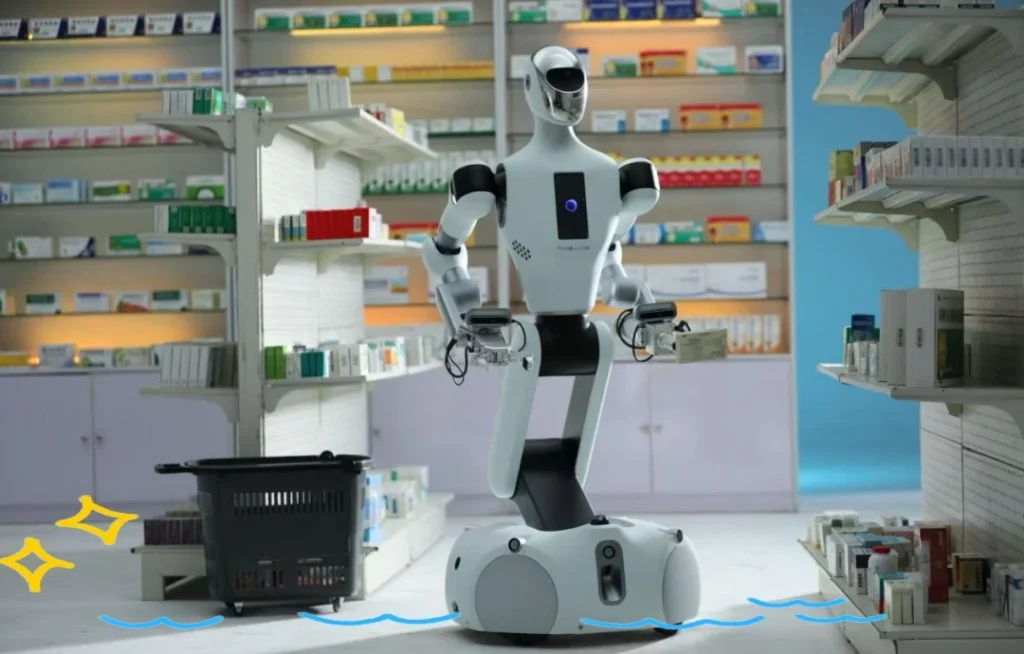
The strongest evidence for Galbot G1 comes from pharmacy retail. CGTN said in March 2026 that Galbot G1 had entered service in Beijing’s Haidian District. The robot can locate medicines on shelves, pick them up, package them, and place orders into a smart pickup cabinet.
The same CGTN article said the system supports medicines, medical devices, and packaged health products. It can automate inventory checks, replenishment, item pickup, and package preparation. CGTN also cited a grasping success rate of about 99.5 percent for materials such as fragile and irregular packages.
Haidian District’s official site adds useful operating details. It says the pharmacy robot can provide 24-hour service in a standard 70-square-meter pharmacy. The same article cites up to 5,000 pharmaceutical SKUs, a daily peak processing capacity of 370 orders, and more than 50 percent reduction in labor input per store.
This is why Galbot G1 should be understood as a signal of service-sector automation. The pharmacy use case is small enough to control, yet complex enough to matter. It combines stock checks, item pickup, package preparation, traceability, and customer handoff inside a licensed retail environment.
The same logic can extend into industrial settings. TechNode said in March 2026 that Galbot had secured cumulative orders totaling several thousand units from clients such as CATL, Bosch, Toyota, BAIC Group, and SAIC Motor. It also cited deployment across industrial manufacturing, retail, and healthcare scenarios.
For industrial humanoid robots, the first useful tasks are often modest. Battery handling, line-side material movement, inspection support, component picking, and repetitive sorting create clearer value than broad claims about general labor replacement. Galbot G1 fits this path because its manipulation stack is designed for repeatable item handling.
This makes the robot a platform for practical, bounded workflows. Galbot belongs in the same operational conversation as last-mile service robots, mobile manipulators, and robot-enabled smart retail systems.
Public information around the Galbot G1 price remains limited because enterprise robotics pricing changes with configuration, software, service scope, site preparation, maintenance, and deployment volume. The Guardian said in March 2026 that Galbot robots deployed in Beijing pharmacies cost about 700,000 yuan. The same source also references a 630,000 yuan model sold through JD.com after a Spring Festival Gala appearance.
That pricing context matters because buyers should not treat Galbot G1 like consumer electronics. The true cost includes workflow design, data collection, site integration, support, and uptime planning.
Galbot sits inside the Beijing robotics ecosystem, close to research universities, AI talent, policy support, and pilot environments. That setting enables rapid feedback among software, hardware, and commercial trials.
A Beijing humanoid robot company also benefits from local demand for smart service pilots. Haidian’s pharmacy deployment shows how regulation, retail operations, and embodied AI can meet inside a high-value scenario.
This matters to global executives because China’s robotics ecosystem is increasingly treating pilots as learning infrastructure. The Guardian’s 2026 field coverage described China’s robotics boom as supported by major city investment, many humanoid firms, and dense hardware ecosystems that shorten iteration cycles.
Executives should evaluate Galbot G1 through operational questions, not demo videos.
Data readiness matters as much as the machine. A programmable humanoid robot needs clean product data, store maps, shelf logic, task rules, and workflow boundaries.
Role design also matters. A humanoid cleaning robot may automate floor care, but Galbot points to object-level work across shelves, packages, cabinets, counters, and service windows.
Finally, leaders should track the maturity of humanoid robot development through commercial proof, not online attention. The most important signals are repeat orders, measurable labor impact, lower error rates, easier integration, and narrower deployment packages that scale across sites.
Galbot G1 shows how embodied AI robotics may move from broad ambition into repeatable operations. Its strongest use cases do not require a robot to behave like a person in every context. They require the robot to handle structured tasks with enough flexibility to survive normal workplace variation.
That is the real strategic lesson. The near future of humanoid robot development may be led by systems that combine operational stability, human-scale reach, manipulation dexterity, and commercial integration.
For businesses, Galbot G1 points toward a practical adoption pathway. Start with structured indoor tasks. Define the workflow tightly. Measure accuracy, labor savings, uptime, and exception handling. Then expand to adjacent tasks only after the robot has proven its value under daily operating conditions.
In that sense, Galbot’s wheeled humanoid design offers a clear message. The next phase of industrial humanoid robots will be won by robots that fit real facilities, reduce friction, and convert embodied AI into measurable operational performance.
China’s humanoid robotics market is moving fast, and headlines rarely explain the operating logic behind companies like Galbot. ChoZan helps global leadership teams understand logic through China innovation tours, executive briefings, custom research, and expert dialogues with people close to the ecosystem.
Its Beijing program focuses on applied AI, robotics, enterprise adoption, policy, research, commercialization, and real-world tech deployment. For executives tracking embodied AI, service automation, and the next wave of Chinese robotics, ChoZan turns market noise into practical insight.
Work with ChoZan to benchmark China’s innovation models, meet relevant experts, and identify what these deployment patterns could mean for your own operations, strategy, and growth plans.
Galbot G1 is made by Beijing Galaxy General Robot Co., Ltd., also known as Galbot or Galaxy General Robotics. The company positions G1 as a general-purpose operational large-model robot for complex service and industrial scenarios.
Yes. RobotATTA lists Galbot G1 as available to purchase or lease in China, with pricing available through the manufacturer contact. Robotics Center also lists the robot through a quote-based request process.
Public pricing varies by source and configuration. RobotATTA advises contacting the manufacturer for details, while the Robotics Center lists quote-based availability. This means the final cost may depend on the scope of deployment and support needs.
The official Galbot G1 page lists one binocular camera in the head, two wrist depth cameras, two six-axis force sensors, speakers, WiFi, and Bluetooth. These systems support perception and interaction.
The official Galbot G1 page lists a full charge runtime of 10 hours and charging specifications of 54.6V 6A. Actual runtime can vary by task load and site conditions.
Yes, Galbot G1 can be considered a programmable humanoid robot because it supports configured task execution through robotic systems, AI models, perception hardware, and scenario-specific deployment workflows.
Galbot G1 is not mainly presented as a humanoid cleaning robot. Public materials emphasize manipulation, service work, retail, manufacturing, hospitality, public services, and household-related applications instead of dedicated cleaning tasks.
RobotATTA lists Galbot G1 for manufacturing, retail, hospitality, public services, personal wellness, and household services. That range reflects its role as a humanoid service robot with adaptable indoor functions.
Galbot G1 matters because it combines mobile manipulation, embodied AI, tactile sensing, and commercial deployment pathways. The Robot Report said Galbot raised major funding to commercialize G1 and scale mobile manipulator deployments.
Galbot G1 relates to embodied AI robotics because It describes its system as a generalized operational, large-model robot. Its public profile also highlights Vision-Language-Action models and scalable robotic solutions.