CONTENT

Huawei news has dominated global tech headlines for years, but most Western coverage stops at sanctions, geopolitics, and smartphone bans. That misses the bigger story. Huawei is not just surviving external pressure.
It is using that pressure to build something structurally different from anything the West has seen: a vertically integrated, domestically rooted technology ecosystem that is quietly reshaping industries from smart cities to AI infrastructure.
For business leaders trying to understand where China is headed, Huawei is not simply a telecom company to watch. It is a live case study in how Chinese firms build, compete, and scale under constraints that would have shuttered most multinationals.
This article unpacks Huawei’s innovation model, its latest product and enterprise moves, and what it all signals for global business strategy.
Huawei was founded in Shenzhen in 1987 by Ren Zhengfei, a former officer of the People’s Liberation Army Engineering Corps.
Today the company operates across five major business segments: ICT infrastructure, consumer devices, cloud computing, digital energy, and intelligent automotive solutions. With revenue of CNY 880.9 billion (USD 126 billion) in 2025, it is one of the largest technology companies in the world by revenue.
But size alone is not why business leaders should follow the latest Huawei news. What matters is what Huawei represents at a strategic level. It is the clearest example of how China’s technology sector is not simply catching up to Western standards.
It is building a parallel technology stack, on its own terms, with its own chips, operating systems, cloud platforms, and developer ecosystems.
For executives visiting China or advising on China market strategy, understanding Huawei is understanding the direction of travel for the entire Chinese tech sector.
The foundation of Huawei’s model is a commitment to research and development that goes beyond capital expenditure. In 2025, Huawei invested CNY 192.3 billion (USD 27.5 billion) in R&D, setting a new internal record and representing 21.8% of its annual revenue.
Over the past decade, cumulative R&D investment has reached CNY 1.382 trillion (USD 190.6 billion). Approximately 114,000 employees, representing 53.7% of the total workforce, are dedicated to R&D.
The result is a patent portfolio of over 165,000 active granted patents globally as of year-end 2025. These are not defensive patents. They represent the building blocks of Huawei’s own hardware and software stack, developed specifically because external supply chains became unavailable.
What makes this model structurally interesting is that it is not purely about spending more. Huawei’s innovation approach is embedded in its management architecture. The company operates a rotating chairmanship system, where the role of Rotating Chair cycles among a small group of designated senior executives in six-month terms.
The corporate culture is shaped in part by 华为的冬天 (Huawei de dōngtiān), or “Huawei’s Winter,” the title of a widely circulated internal essay written by Ren Zhengfei in 2000. In it, he warned that Huawei must always prepare for hard times, even during periods of success.
That crisis-awareness mindset became embedded in how the company plans and invests. When U.S. sanctions arrived, Huawei had spent years building contingency capacity. That preparedness is now a demonstrated structural advantage.
The most important Huawei news in recent years is not about any single product. It is about the emergence of a complete, domestically built technology ecosystem. Three components define this ecosystem: HarmonyOS, the Kirin chip series, and the Ascend AI platform.
HarmonyOS (鸿蒙, Hóngméng) is Huawei’s proprietary operating system. Its current iteration, known as HarmonyOS NEXT, was built from the ground up without reliance on Android’s open-source codebase (AOSP), distinguishing it from both Android and iOS.
By the end of 2025, more than 36 million devices ran HarmonyOS 5 or 6, with over 10 million developers registered globally and AppGallery exceeding 350,000 apps and services. HarmonyOS 6 brought a 15% performance improvement over HarmonyOS 5, and a 40% improvement over HarmonyOS 4.
The AI assistant integrated into HarmonyOS 6, called Xiao Yi, now supports complex cross-app workflows in a single command, from booking travel to scheduling medical appointments. It supports 16 dialects and includes proactive security features that detect potential scams during incoming calls in real time.
On the chip side, the return of Kirin processors marks a significant milestone. The Mate 80 Pro Max, Huawei’s flagship smartphone launched in late 2025, is powered by the Kirin 9030 Pro and runs HarmonyOS 6.0, with a display reaching 8,000 nits peak brightness.
Key components are produced in-house or via domestic partners, without reliance on Qualcomm or TSMC.
Beyond mobile, Huawei’s wholly owned semiconductor subsidiary HiSilicon has developed the Kirin X90, a 10-core SoC built on SMIC’s 7nm process, now powering Huawei’s MateBook Pro.
With a dual Da Vinci architecture NPU delivering 40 TOPS of AI compute, the Kirin X90 is capable of running large AI models such as DeepSeek directly on the device.
The Ascend AI chip roadmap is where Huawei’s enterprise ambitions are most visible. At Huawei CONNECT 2025 in Shanghai, then-Rotating Chair Eric Xu revealed a multi-year chip roadmap beginning with the Ascend 950PR (Q1 2026) and running through the Ascend 960 (2027) and Ascend 970 (2028), with each generation doubling compute capacity.
Huawei plans to manufacture approximately 600,000 units of its Ascend 910C in 2026, roughly double the output of the prior year.
The Atlas 950 SuperPoD cluster, combining 8,192 Ascend chips into what Xu described as “a single logical machine,” is designed to deliver large-scale AI computing performance through chip clustering and high-speed interconnects.
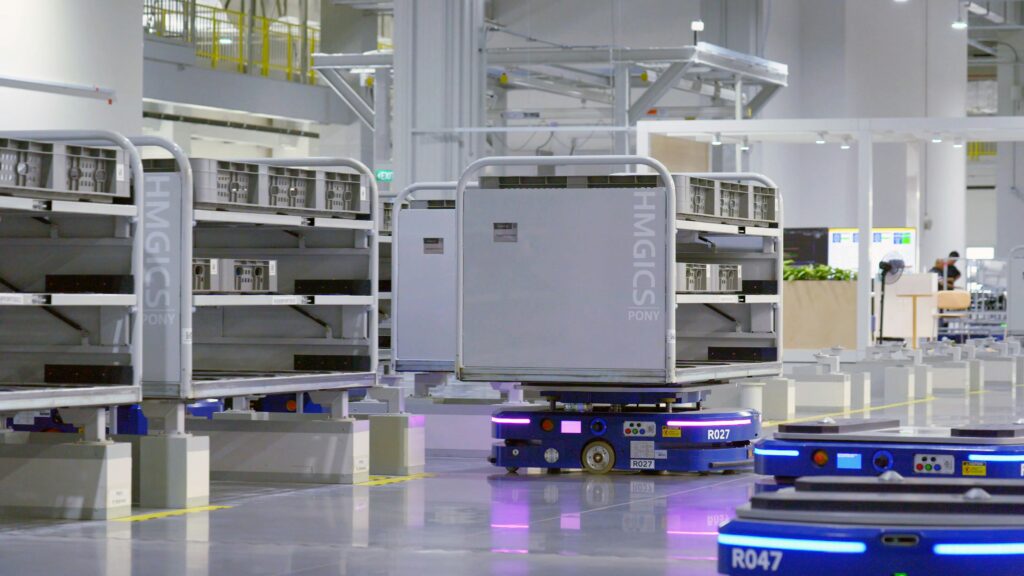
The latest Huawei news is not just about hardware specs. It is about how Chinese enterprises are deploying this infrastructure at scale, right now, across every major industry.
China Southern Power Grid partnered with Huawei to build an AI model called “MegaWatt,” running on Huawei’s Ascend computing platform and MindSpore AI framework.
The model combines computer vision and natural language processing to support intelligent power line inspections. Since deployment, defect and risk identification efficiency has improved by five times, with image recognition accuracy exceeding 90%. This is a live deployment at national infrastructure scale.
Runda Medical deployed Huawei’s Ascend inference servers to create an AI-powered medical record solution. At West China Hospital, one of China’s largest hospitals, the system reduced medical record generation time to approximately one second per record.
Consultation efficiency improved significantly, and the deployment is cited by Huawei as a reference case for healthcare AI adoption.
Huawei has established deep partnerships with several of China’s largest automakers, providing intelligent vehicle solutions through its Harmony Intelligent Mobility Alliance. In 2025, 589,100 vehicles were delivered under this alliance, a 32% year-over-year increase, according to Huawei’s official 2025 annual report.
The Huawei-powered vehicle lineup spans mid-range to premium segments, all running Huawei’s in-house navigation, cockpit AI, and driver assistance systems.
Huawei, Shenzhen Metro Group, and Vanke Group signed a strategic cooperation agreement in 2025 covering digital transformation, joint innovation, and urban smart infrastructure.
The collaboration focuses on using AI to improve urban transportation efficiency and real estate development, integrating Huawei’s cloud and sensing platforms across one of China’s busiest transit systems.
At Huawei Global Financial Partners Week, ChinaSoft partnered with Thailand’s SVOA for smart insurance applications. Separately, Chinese partners expanded Huawei-backed solutions to Brazil and Indonesia.
These partnerships signal that China’s enterprise AI ecosystem, built on Huawei’s infrastructure, is extending beyond China’s borders.
Most Western analysis of Huawei focuses on what the company cannot access. The more important question is what it is building instead.
Huawei’s response to sanctions has not been to find workarounds. It has been to eliminate the need for the components it was cut off from. This is a fundamentally different strategy from what most companies would pursue.
The result is a technology stack that operates largely outside Western supply chains: domestic chips, a domestic OS, domestic cloud infrastructure, and domestic AI training frameworks.
During her tenure as Rotating Chair (October 2025 to March 2026), Sabrina Meng Wanzhou outlined that HarmonyOS devices would feature unique AI capabilities not currently offered by platforms like iOS or Android, and pushed forward the company’s open-source ecosystem strategy.
Huawei has committed CNY 15 billion annually over five years to ecosystem development and open-source computing, with the CANN programming environment and MindSpore AI framework progressively opened to the global developer community.
The strategic logic is vertical integration combined with long-horizon thinking. Huawei does not compete chip-by-chip or product-by-product. It builds systems where the value comes from the whole stack working together. That is a different game, with different rules, and it is producing different results than most observers expected.
For business leaders, the lesson is not to copy Huawei. It is to understand that when Chinese firms say they are building “self-reliant” technology, they mean something structurally serious. And Huawei is the most advanced example of what that looks like in practice.
Understanding Huawei from the outside is difficult. Understanding it from the inside is transformational.
ChoZan’s China Learning Expeditions and China Innovation Tours take business leaders directly into the ecosystems shaping China’s technology future. These are not conference tours. They are immersive, curated visits to the companies, campuses, and innovation hubs where decisions like Huawei’s are being made every day, giving participants the ground-level insight that no report can replicate.
For teams that need structured knowledge rather than direct visits, ChoZan offers China Tech Trend Research, Digital Transformation Training, and On-Demand Expert Calls with specialists who track developments like Huawei’s ecosystem strategy in real time.
If your organization is asking what China’s technology direction means for your industry, your supply chain, or your competitive landscape, ChoZan helps you move from headline awareness to actionable strategy.
Huawei reported revenue of CNY 880.9 billion (USD 126 billion) in 2025, with net profit of CNY 68 billion (USD 9.7 billion). R&D investment reached a record CNY 192.3 billion, equal to 21.8% of annual revenue. These figures are sourced from Huawei’s official 2025 Annual Report, released March 31, 2026.
HarmonyOS (鸿蒙, Hóngméng) is Huawei’s proprietary operating system. Early versions (1 through 4.x) incorporated elements of Android’s open-source codebase. The current version, HarmonyOS NEXT, was rebuilt without reliance on AOSP, making it a fully independent platform.
It is designed as a distributed OS connecting smartphones, tablets, PCs, TVs, and smart home devices in a unified ecosystem, without Google services.
The Ascend series are Huawei’s in-house AI accelerator chips, designed by HiSilicon and manufactured with domestic partner SMIC.
They are used for large-scale AI training and inference by Chinese enterprises including China Southern Power Grid, ByteDance, and Alibaba, and form the backbone of Huawei’s Atlas SuperPoD AI computing clusters.
Yes. Huawei remains subject to U.S. export controls that restrict access to advanced foreign semiconductors and chip design tools. The company has responded by accelerating domestic alternatives, including Kirin and Ascend chips built with SMIC, alongside its independent HarmonyOS software stack.
Huawei’s enterprise deployments are most active in smart energy and power grids, healthcare AI, intelligent automotive systems, smart city infrastructure, and financial services.
These sectors are seeing live, at-scale deployments of Huawei’s Ascend AI chips, MindSpore AI framework, and cloud platforms. ChoZan’s China market research covers these sectors in depth for teams building their China strategy.