CONTENT

China’s warehouse automation sector has moved past the experimental phase. Walk into any major fulfillment hub across the Yangtze River Delta or the Pearl River Delta today, and you will find fleets of mobile robots working alongside human operators, not as a novelty but as core infrastructure. The AGV vs AMR question has become one of the most consequential procurement decisions a supply chain leader will make this year because the wrong choice can lock a facility into rigid infrastructure or lead to unnecessary overspending for years.
This is not a technical footnote buried in an engineering spec sheet. It is a boardroom conversation now. Chinese robotics manufacturers, including Geek+, Quicktron, and Hikrobot, have scaled aggressively through 2025 and into 2026, exporting both hardware and operating philosophy to warehouses in Southeast Asia, Europe, and North America.
Understanding the difference between AGV and AMR is no longer optional knowledge for operations executives. It shapes capital allocation, labor strategy, and the speed at which a facility can respond to demand volatility.
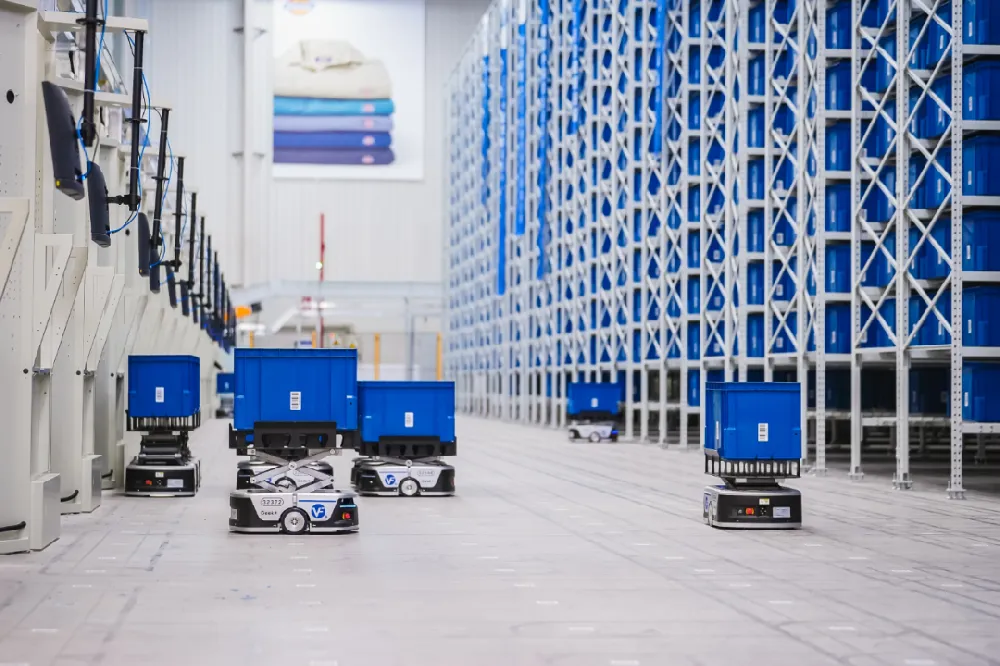
An AGV follows predetermined paths using magnetic tape, embedded wires, or floor sensors. Every movement is scripted in advance. This is the original automation model that Chinese manufacturing parks adopted at scale during the earlier phases of factory digitization, and it remains dominant in facilities where the workflow itself rarely changes.
The strength of AGVs lies in fixed routes. When a production line moves the same components between the same two points thousands of times a day, an AGV performs that task with mechanical consistency that few dynamic systems can match in cost per cycle. Automotive assembly plants across Guangdong and Jiangsu continue to rely on AGV corridors for exactly this reason.
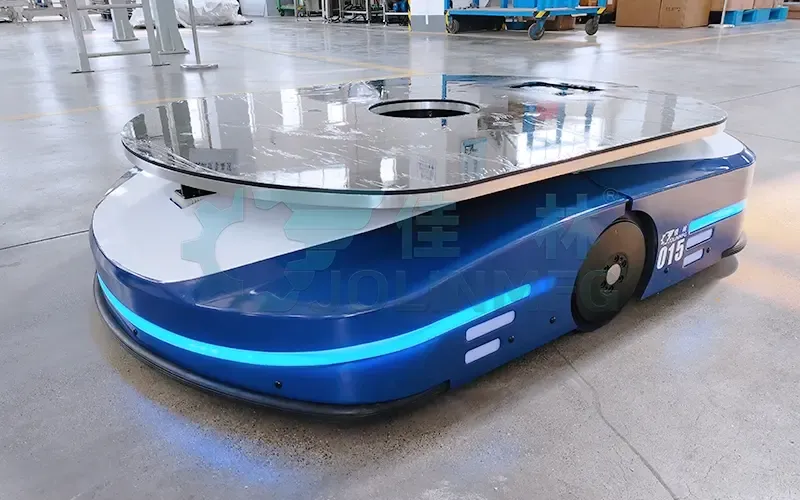
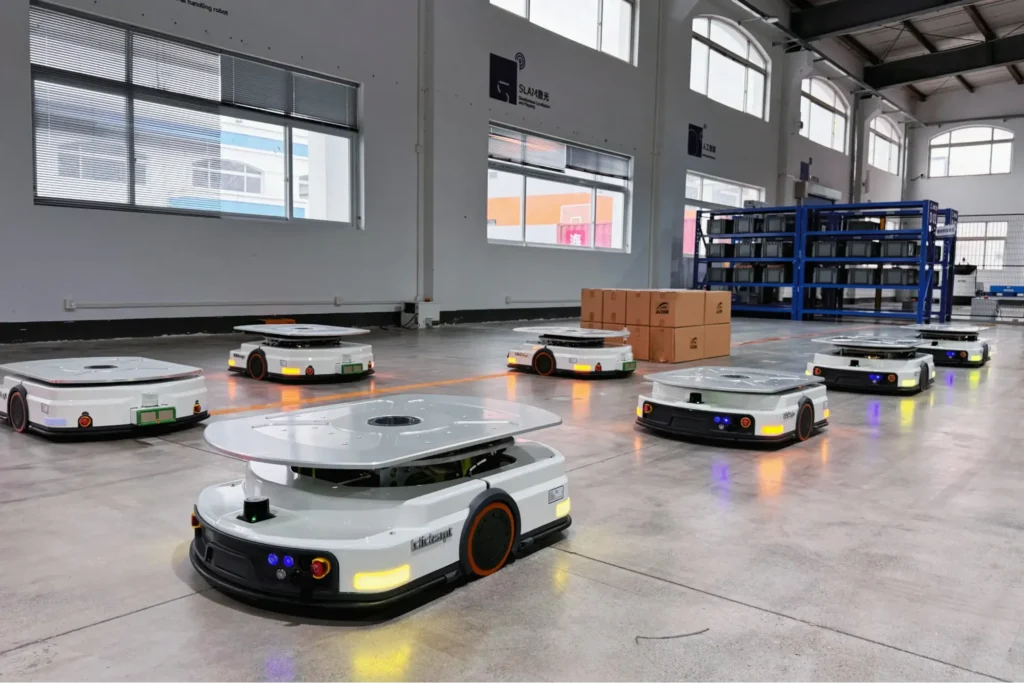
An AMR navigates using onboard sensors, cameras, and mapping software rather than fixed guides. This is dynamic navigation in practice; the robot builds an understanding of its environment and recalculates its path in real time when a pallet is left in the aisle or a human worker crosses its route
The distinction here is not simply technical sophistication for its own sake. It reflects a fundamentally different philosophy about how a warehouse should operate. An AMR robot vs. AGV comparison ultimately comes down to whether your facility values predictability or responsiveness more, and increasingly, Chinese e-commerce fulfillment operators are choosing responsiveness.
The difference between AGV and AMR becomes most visible during deployment. AGVs can carry heavy loads and run with high predictability, but their infrastructure requirements can add cost and delay. Floor preparation, route markers, traffic control points, and physical changes must be planned before launch. If a warehouse later changes its layout, the route infrastructure may need to be reworked.
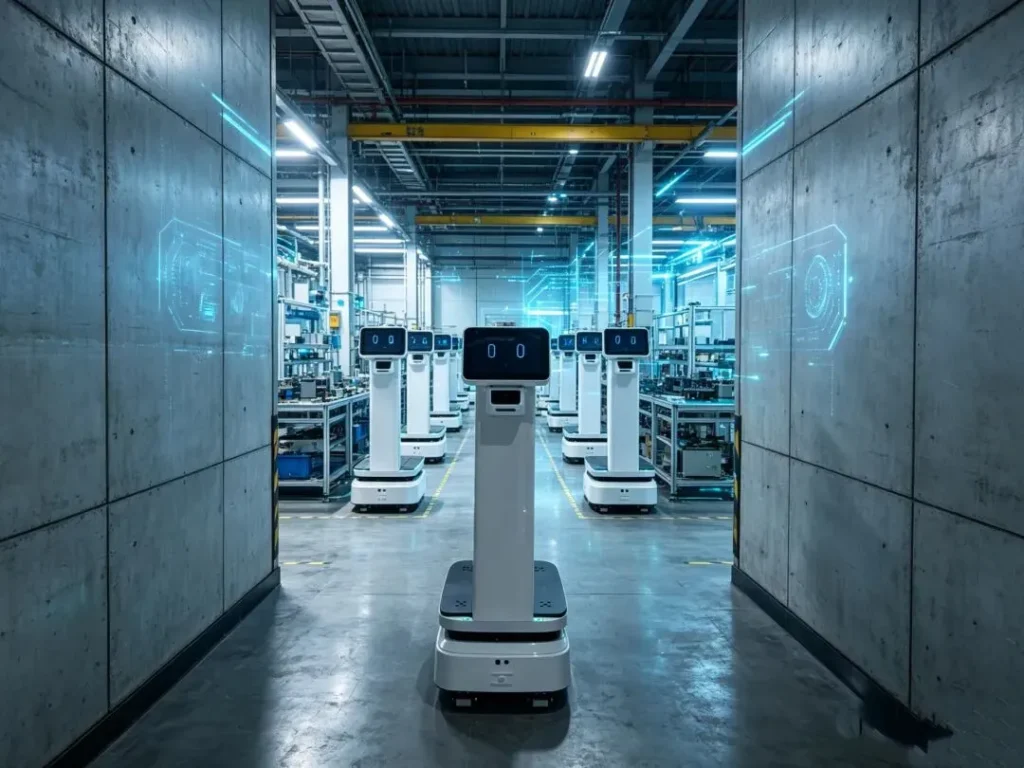
AMRs usually reduce fixed infrastructure needs. They still require mapping, Wi-Fi quality checks, integration with doors or lifts, safety validation, a charging strategy, and process redesign. The cost shifts from physical guidance to software, fleet coordination, data mapping, and change management.
This is why Chinese warehouse automation buyers increasingly evaluate total deployment costs rather than the unit price of robots. A low-cost AGV fleet can make sense in a stable factory line. A higher-priced AMR fleet can produce stronger ROI in a warehouse where aisles, order profiles, and labor allocation change every quarter.
Payload capacity remains a genuine differentiator, though the gap has narrowed considerably as Chinese manufacturers have matured their AMR product lines.
Heavy industrial AGVs still hold an edge in raw load capacity for certain manufacturing applications, particularly in steel, automotive, and heavy equipment sectors where single loads can exceed several tonnes.
AMRs have closed much of this gap for standard logistics payloads, and mixed fleets combining both are increasingly common in large distribution centers.
Safety zones function differently across the two systems. AGVs typically operate within clearly demarcated, physically separated zones where human traffic is restricted or entirely excluded. This reduces collision risk through spatial separation rather than intelligent detection.
AMRs are designed for shared-space operation, using sensor fusion to dynamically detect and respond to human presence. This capability has become increasingly important as Chinese labor costs rise and facilities move toward collaborative human-robot workflows rather than fully segregated automation zones.
The flexibility this enables extends beyond navigation into how facility managers design entire operational layouts.
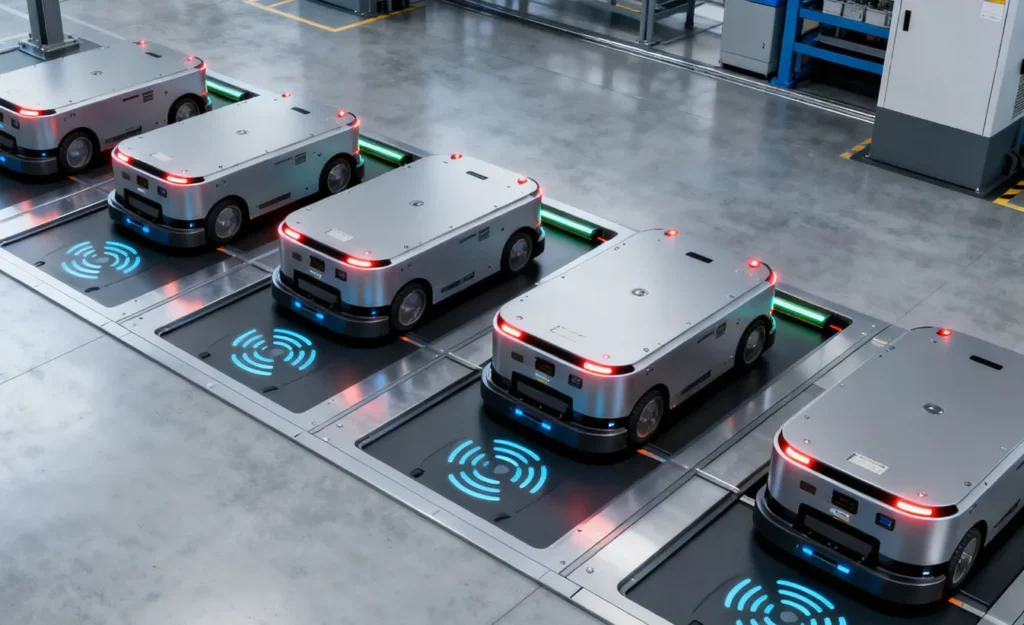
Fleet scaling is where many projects win or lose. One robot may look efficient in a pilot. Fifty robots create a traffic system. The warehouse then needs mission assignment, congestion rules, charging schedules, exception handling, and integration with WMS or WES.
Geekplus, a China-born warehouse robotics company, listed on the HKEX in July 2025 and positioned the IPO as a milestone in the commercialization of AMR warehouse robotics. Its official materials describe robot families for shelf, tote, pallet, sorting, and transport workflows, supported by WES, RMS, integration tools, ERP, WMS, and MES connections.
Hai Robotics shows the same shift from single robot selection to system design. In 2026, Dematic and Hai Robotics signed a Europe-wide integration agreement for flexible AMR robotics solutions in warehouse automation. Hai Robotics also upgraded HaiPick Climb in 2026 to support up to 45,000 totes within 1,000 square meters.
For global business leaders, this points to a key procurement lesson from China: robot hardware matters, but orchestration decides scale.
A serious procurement process should start with process economics, not vendor demos.
Use AGVs when routes are stable, traffic is controlled, payloads are heavy, and the ROI case depends on predictable trips. Automotive parts delivery, line-side replenishment, and repetitive pallet transfer are good examples.
Use AMRs when the warehouse layout changes, order profiles shift, labor needs move by season, and software orchestration is central to the operating model. AMRs are stronger for e-commerce logistics, 3PL networks, dynamic replenishment, and sites that need gradual fleet scaling.
The strongest Chinese operators also evaluate supplier depth.
The AGV vs AMR choice is not a race between old and new technology. It is a fit decision between fixed process automation and adaptive warehouse orchestration.
China’s logistics automation market shows why this matters. Warehouses and factories now need systems that can scale, integrate, and absorb operational change. AGVs still have a clear role where routes are repetitive and controlled. AMRs create stronger value where flexibility, fast deployment, and software-led coordination matter more than route discipline.
The best decision is rarely about the robot alone. It is about how the robot changes warehouse layout, labor planning, systems integration, and ROI. That is the lens global executives should bring to every AGV vs AMR procurement discussion.
Understanding warehouse automation trends is only part of navigating China’s fast-moving industrial and digital landscape. ChoZan helps global business leaders understand China’s automation, robotics, logistics, and smart manufacturing ecosystems with clear research, executive workshops, expert calls, and China learning programs.
If your team is assessing AGVs vs AMRs for warehouse automation, ChoZan can help you benchmark suppliers, evaluate procurement criteria, and translate China’s deployment lessons into a practical strategy.
Book a consultation with ChoZan to explore the right automation path for your business.
AGVs follow guided paths, while AMRs navigate more independently. The practical difference is flexibility. AGVs suit stable routes, while AMRs suit changing layouts, mixed traffic, and warehouse operations that need faster process adjustments.
AMRs usually fit brownfield warehouses better because they need fewer fixed-route changes. The final decision depends on floor quality, Wi Fi coverage, traffic density, payload needs, safety validation, and system integration requirements.
A 3PL should compare contract volatility, SKU churn, peak volumes, and the frequency of layout changes. AMRs fit multi-client flexibility, while AGVs can work well for dedicated contracts with repeatable transport routes and stable volumes.
AGVs can have lower robot unit costs, but infrastructure can raise total deployment cost. AMRs may cost more per robot, yet they can reduce route modification work and support easier fleet changes over time.
Yes, mixed fleets can work when traffic rules, safety zones, and software coordination are well designed. Many sites use AGVs for predictable heavy transport and AMRs for flexible movement between storage, picking, and packing areas.
Teams need travel paths, order profiles, peak hour volumes, payload data, floor maps, aisle widths, labor costs, downtime history, and WMS task data. These inputs help calculate ROI and avoid overbuying automation.
Warehouse layout affects route discipline, turning space, charging points, and human traffic. AGVs prefer clean, fixed corridors. AMRs handle changing zones better, but they still need safe paths, reliable maps, and clear operating rules.
Buyers should ask about spare parts, battery life, software updates, sensor calibration, local service response, safety checks, and uptime reporting. Maintenance quality can decide long-term ROI as much as robot performance.
China matters because its factories and logistics operators deploy robotics at scale. This gives global buyers practical lessons in supplier selection, rapid iteration, integration depth, and the economics of automation under real-world operating pressure.
The biggest mistake is buying robots before redesigning the workflow. A strong procurement process maps tasks, exceptions, labor roles, software integration, and safety zones before selecting AGVs, AMRs, or a hybrid fleet.