CONTENT
Robotics in manufacturing has moved from a competitive advantage to an operational baseline. Nowhere is that shift more visible than in China. Lead with the record stat According to the IFR World Robotics 2025 Report, China set a new record with 295,000 industrial robots installed in a single year, accounting for 54% of all new global installations and an operational stock surpassing 2 million units.
That momentum has only accelerated since, with domestic robot production surging 35.6% year on year in the first half of 2025 alone, already surpassing the prior year’s full output in under nine months. Morgan Stanley projects China’s robotics market will more than double, from $47 billion to $108 billion by 2028. For global business leaders, what China is building on its factory floors is no longer a distant trend. It is the new benchmark.
For global business leaders, understanding what China has built, how fast it scaled, and what technologies are driving it is no longer optional. It is foundational to staying competitive in any industry that touches physical production.
Robotics in manufacturing today is not the robotic arm of a decade ago. Modern industrial automation encompasses AI-powered control systems, autonomous mobile robots (AMRs), machine vision, IoT sensor networks, and real-time data analytics working together as an integrated system.
The old model was a robot performing a single pre-programmed task on a fixed line. The new model is a smart factory (智能工厂, zhìnéng gōngchǎng), where machines perceive their environment, adapt in real time, and continuously self-optimize based on production data.
At the extreme end of this evolution is the “dark factory” (黑灯工厂, hēidēng gōngchǎng). These are fully automated facilities that operate without human workers on the floor and, because no humans are present, without lighting. These are not science fiction. They are operating in China right now, across industries from electronics to electric vehicles.
China’s automation surge did not happen by accident. It was built through deliberate policy, massive capital deployment, and structural pressures that made automation economically unavoidable.
The strategic foundation is Made in China 2025 (中国制造2025), launched in 2015, which identified robotics as one of ten national priority sectors. Under this framework:
Robot density has climbed from 49 robots per 10,000 workers in 2015 to over 400 per 10,000 in 2025. That surpasses Germany and leaves the United States, at roughly 295 per 10,000, well behind.
Two structural forces push this further.
First, China’s labor costs have risen significantly, eroding the cost advantage of manual production.
Second, China’s working-age population is shrinking, and younger generations are increasingly unwilling to work in traditional factory environments. For many manufacturers, automation is no longer just a growth strategy. It is the only viable path forward.
The companies below represent the front line of robotics in manufacturing in China today. Each shows how different industries are applying automation at scale, and what the results look like.
Changan’s Digital Intelligence Factory in Chongqing opened in 2024 as the world’s largest 5G-connected car factory. The facility runs 1,400 robots, 650 intelligent AGVs, and over 800 intelligent devices across 410,000 sqm, with 100% automation of all key manufacturing processes.
Key results verified by Changan and China Unicom:
Also based in Chongqing, Seres Group operates a super factory housing over 3,000 robots and 1,600 intelligent devices, with 100% automation across all key processes. At peak capacity, a new vehicle rolls off the line every 30 seconds. The facility produces the AITO M9, a luxury EV developed in partnership with Huawei, and uses a digital twin system to simulate and monitor the entire production floor in real time.
Gree Electric’s Gaolan smart manufacturing facility in Zhuhai partnered with China Unicom Guangdong and Huawei to build the world’s largest 5.5G native lights-out factory. Results of the upgrade:
Gree’s approach shows how communications infrastructure, not just robotics hardware, is a critical lever in the smart factory stack.
Headquartered in Nanjing, Estun Automation (埃斯顿自动化) has ranked first among domestic Chinese enterprises in industrial robot shipments for seven consecutive years, according to Frost & Sullivan. In Q1 2025, Estun became the first Chinese brand to top the overall Chinese industrial robot market by shipment volume, surpassing all foreign competitors.
Its 700 kg payload heavy-duty robot, launched in 2024, received over 100 orders within the year. By 2025, Estun introduced a 1,000 kg payload model. Strategic acquisitions of Germany’s Carl Cloos Schweisstechnik (welding) and UK-based Trio Motion Technology have built a global R&D network that feeds directly into its China manufacturing operations.
Headquartered in Shenyang, SIASUN (新松机器人) is one of China’s foundational industrial robotics companies. It provides end-to-end robotic production lines across automotive, logistics, semiconductor, and new energy battery sectors.
SIASUN’s welding robots complete a single weld point in 2.2 seconds. Its iMRS 2.0 mobile robotics platform targets advanced manufacturing in EVs, semiconductors, and photovoltaics. SIASUN has received over 588 million yuan in government subsidies over three years, reflecting its strategic national importance.
Beijing-based Geekplus (极智嘉) is a global leader in warehouse and factory mobile robotics. In one documented deployment, 700 AMRs across a 20,000 sqm warehouse process over 350,000 items per day, with each workstation handling up to 500 items per hour.
Geekplus has deployed fleets of over 5,000 robots through a single swarm intelligence system and has built more than 10 smart warehouse demonstration projects globally, each running over 1,000 robots. It is collaborating with Siemens and CATL to advance intelligent factory logistics.
Founded in 2007 and based in Hefei, EFORT (埃夫特) specializes in six-axis industrial robots for welding, painting, and assembly. Where traditional vehicle painting lines take three to five days, EFORT’s automated systems handle color mixing, switching, spraying, and cleaning in a single continuous cycle.
EFORT’s sales have grown eightfold in four years, with growth projected to exceed 25% annually, driven by rapid expansion into automotive and home appliance manufacturing. Its heavy-duty robot model crossed the 100-order milestone shortly after launch, and a new super plant is now under development to meet surging demand that its current capacity of 10,000 units per year is expected to be unable to sustain within three to five years.
Internationally, EFORT has built a broad European footprint through acquisitions of five Italian firms, including CMA Robotics, EVOLUT, WFC Group, Robox, and Webb Robotica, with overseas sales now accounting for 55% of total robot revenue. Its clients include Stellantis, Volkswagen Group, Toyota, and Airbus.
Shenzhen-based Inovance (汇川技术) is a leading provider of industrial automation components and full-stack robot solutions, widely used in lithium battery manufacturing, electronics, and photovoltaics. Its rotor production line in Yueyang operates at full automation, while the stator line runs at 70% automation.
For the first time, Chinese domestic robot brands collectively hold more than 57% of China’s industrial robot market, with Inovance rising to become the second-largest domestic robot manufacturer and posting 40–50% order growth as recently as early 2026.
The company commands 27.3% of all SCARA robot sales in China and has expanded its European presence through offices in Germany, France, Spain, Italy, and Turkey, with its full articulated and SCARA robot range now actively distributed across the EMEA region following its European market debut at SPS Nuremberg.
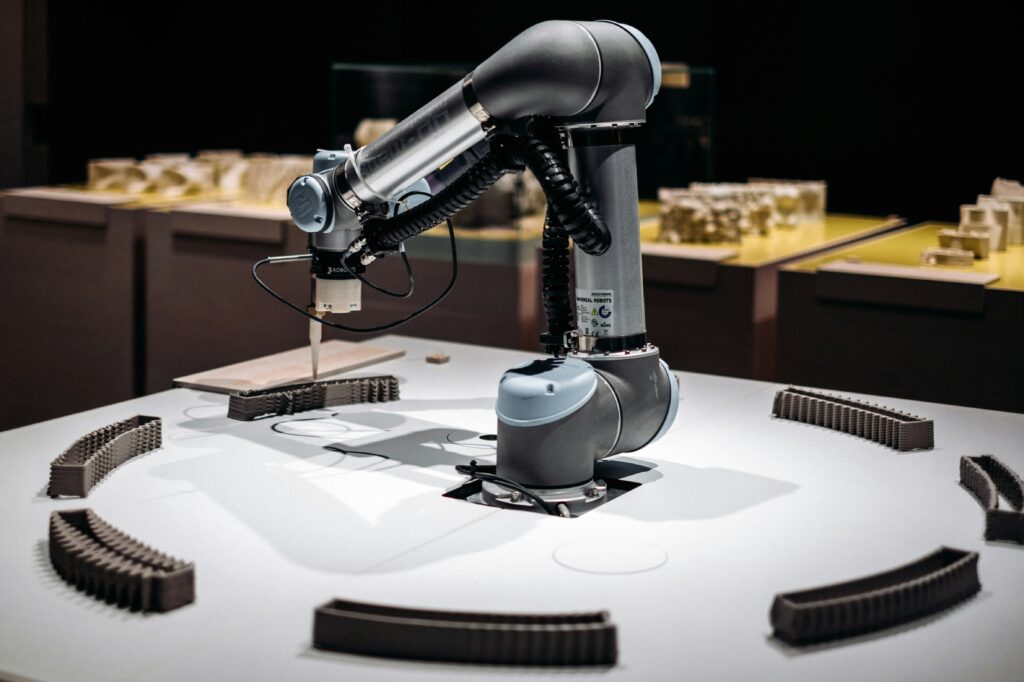
The physical robots are only part of the story. What makes China’s smart factories function is the convergence of several enabling technologies operating together.
AI serves as the factory brain. It directs robot movement, processes sensor data in real time, and continuously adjusts production parameters. Without AI, a collection of robots is just hardware. With it, a factory becomes a self-regulating system.
Machine vision and deep learning have replaced human quality inspection on most high-volume lines. Camera systems paired with neural networks identify defects at speeds no human team can match. In semiconductor and pharmaceutical manufacturing, this capability is not optional. It is a requirement.
AGVs and AMRs handle the physical movement of materials across factory floors. At Jetour Auto’s Fuzhou facility, autonomous mobile robots manage all internal logistics along intelligent preset paths. The factory produces one completed vehicle every 100 seconds with minimal human intervention on the floor.
5G connectivity is the nervous system binding everything together. Real-time machine coordination, remote monitoring, and predictive maintenance all depend on low-latency, high-bandwidth connectivity. Gree’s 86% efficiency gain was built on this foundation.
IoT sensor networks create a data layer across every machine, conveyor, and storage system in the facility. This feeds the AI, powers predictive maintenance, and allows managers to oversee thousands of machines from a single control room.
China’s automation story is not just a competitive threat. It is a playbook. The insights are directly transferable for global leaders.
Speed and scale of deployment is the first lesson. Chinese manufacturers test, iterate, and scale automation in weeks, not months. This is partly due to China’s clustered manufacturing ecosystems in the Yangtze River Delta and Greater Bay Area, where suppliers, integrators, and manufacturers are co-located. Tight proximity compresses feedback loops dramatically.
Government-industry alignment is the second. China’s policy environment is structured to reduce the risk and cost of automation investment. Subsidies, pilot zones, and preferential financing have lowered the barrier to adoption. Foreign businesses can still learn from the strategic sequencing China’s companies used, particularly around which processes to automate first.
Cross-sector knowledge transfer is the third and most underappreciated lesson. Precision manufacturing competencies from China’s smartphone supply chain fed directly into EV robotics and battery automation. The capabilities compound over time.
The most important insight cannot be delivered in a report. Visiting China’s automated factories in person offers comprehension that secondhand analysis cannot replicate. Seeing a Xiaomi facility turn out a flagship smartphone every few seconds, or walking through a BYD chassis assembly line with no workers in sight, recalibrates what executives believe is possible.
If your team needs to understand where manufacturing is heading, and you want to see it from the ground up, book a consultation with ChoZan.
China has already achieved global leadership in robotics in manufacturing. With over 2 million industrial robots deployed, a robot density surpassing Germany and nearly double that of the United States, and companies like Foxconn, Xiaomi, BYD, and Midea operating at full commercial scale, the gap is not narrowing. It is widening.
The technologies enabling this shift are mature and converging. AI, 5G, machine vision, AMRs, and IoT sensor networks are deployed across thousands of Chinese facilities. The dark factory is no longer a concept. It is a business model.
For global executives, the question is no longer whether to pay attention. It is how quickly you can extract the right lessons and apply them. ChoZan’s Innovation Tours and research services exist precisely for that purpose. The best way to understand what China has built is to go and see it.
Electronics, automotive and EV manufacturing, home appliances, battery production, and logistics lead adoption. These sectors account for the majority of China’s 295,000 annual robot installations.
A dark factory (暗黑工厂) is a fully automated facility that operates without lighting because there are no human workers on the floor. AI, robots, and sensors manage every aspect of production around the clock. China currently operates some of the most advanced dark factory facilities in the world.
China accounts for 54% of global new robot installations and operates over 2 million industrial robots. Its robot density of 470 per 10,000 manufacturing workers surpasses Germany and is approximately 1.6 times that of the United States.
Yes. The core principles, including ecosystem clustering, rapid iteration, and AI-hardware integration, are transferable. ChoZan’s expeditions and research services help foreign businesses extract and apply those insights.
Reports can convey data, but they cannot replicate the experience of seeing full-scale automation in operation. Visiting smart factories in China recalibrates what executives believe is possible. ChoZan’s China Innovation Tours are designed to deliver exactly that.