CONTENT

In China, brands do not build trust first and sell later. They earn trust at the exact moment a consumer decides to buy. That decision is often shaped by a KOL who has already tested, explained, compared, and validated the product inside a platform the consumer uses every day.
This is why KOL marketing sits at the core of market performance from 2025 to 2026. It is where discovery, credibility, and conversion merge into one continuous action. Douyin drives instant demand through demonstration. RedNote answers the question of whether the product is worth it through lived experience. WeChat turns buyers into repeat customers. Bilibili and Kuaishou reinforce decisions within highly engaged communities.
For companies entering China and for teams seeking stronger results, understanding KOL marketing means understanding how influence actually moves revenue.

China’s KOL market continues to expand, but growth now reflects discipline rather than unchecked acceleration. Brands are maintaining investment while redirecting budgets toward influence that can shape product evaluation and deliver measurable returns.
Research projects that China will account for about 58 percent of global influencer marketing investment in 2025. Growth is expected to moderate to roughly 1 percent in 2026, followed by a projected rebound of about 6 percent in 2027, signaling consolidation as the sector matures.
Advertising confidence remains steady. A 2026 industry survey summarized by China Daily shows 30 percent of advertisers plan to increase marketing budgets, up from 22 percent in 2025, while overall marketing expenditure is forecast to rise by approximately 10 percent in 2026.
Where budgets are going is more revealing than how much is spent. More than 70 percent of advertisers plan to increase investment in seeding platforms and mid-tier creators, while 67 percent intend to raise spending on KOL collaborations specifically. Short video environments remain a priority, with 56 percent of advertisers increasing allocations to these channels.
Performance-driven formats are also gaining ground. About 46 percent of advertisers are increasing performance advertising, and 40 percent are expanding content placement budgets. Experimental formats are entering the mix as well, with 31 percent investing in event-related collaborations and 30 percent exploring micro short drama integrations.
Industry investment patterns show that digital native sectors are moving fastest.
The share of IT and internet companies allocating spend to social and KOL marketing has risen from 24 percent to 31 percent, indicating early adoption of influence-driven demand generation models.
Beauty and personal care brands remain among the most active participants, relying heavily on long tail creator ecosystems to sustain continuous evaluation and recommendation cycles.
The 3C digital category similarly favors specialist creators on Douyin and Bilibili who can deliver technical explanations and product testing rather than broad promotion.
The market is not slowing. It is reallocating toward structures that produce repeatable commercial impact.
KOL marketing in China cannot follow a single model because each platform’s engineers influence differently. The same creator strategy will produce completely different outcomes depending on where it is deployed. Understanding platform logic is, therefore, more important than selecting big names.
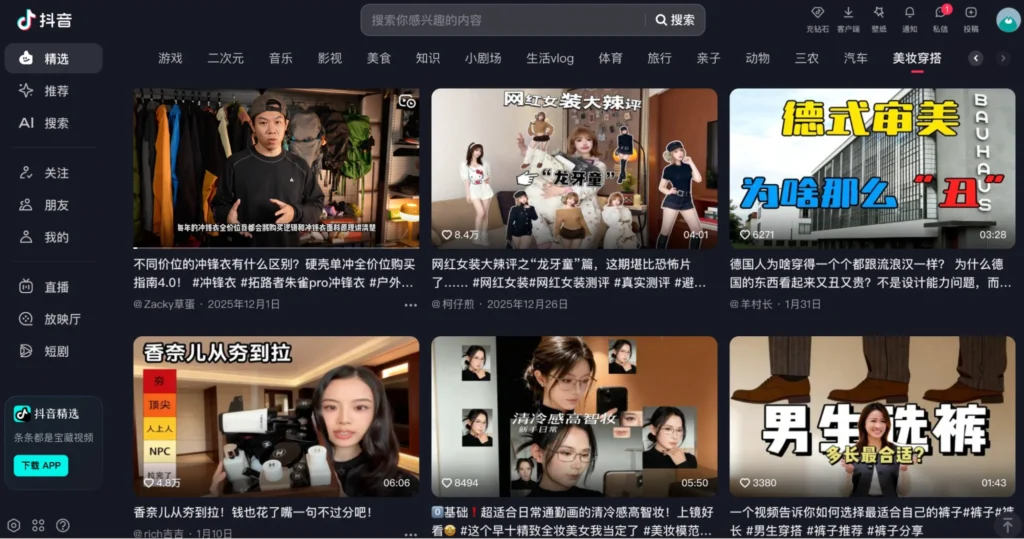
Douyin operates as an acceleration engine. Its algorithm favors content that shows products in action, which compresses the time between discovery and purchase. Live commerce, scenario-based videos, and creator demonstrations stimulate impulse-driven demand and rapid transaction cycles.
Data shows that Douyin maintains a DAU-to-MAU ratio of about 76.3 percent, reflecting extremely high daily engagement. This level of activity allows products to gain momentum quickly, but it also shortens the lifespan of content. Brands must plan for continuous activation rather than one-time exposure.
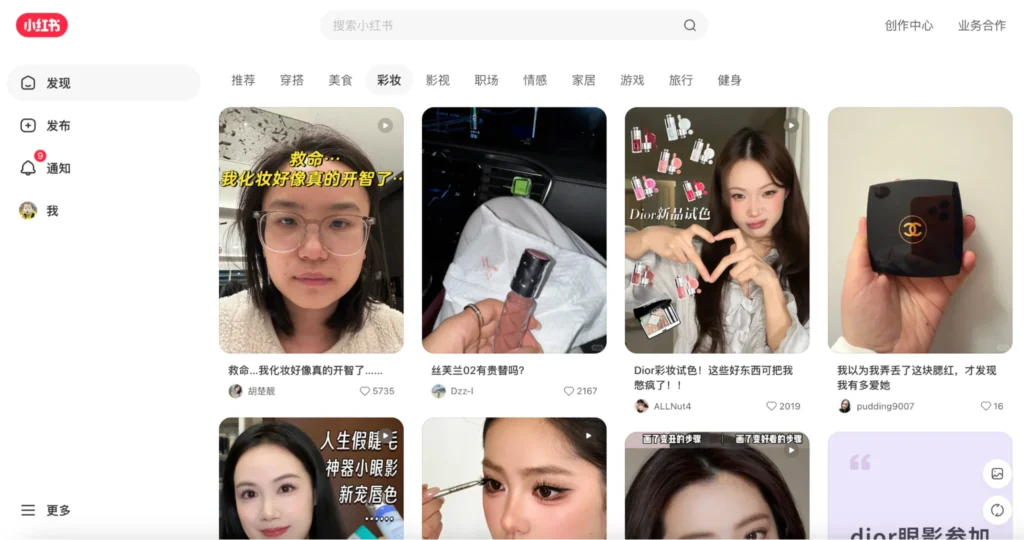
RedNote functions as an evaluation environment where consumers investigate claims before committing to purchase. Users treat posts as reference material, saving and revisiting them during research. The platform reports a user base composed of roughly 70 percent women aged 18 to 35 in higher-tier cities, making it particularly influential in beauty, health, and lifestyle categories.
Engagement has been steadily rising, with the platform’s DAU-to-MAU ratio increasing from 32.4 percent to 39.1 percent by 2024. This growth reflects a deeper reliance by users on peer documentation rather than on advertising signals.
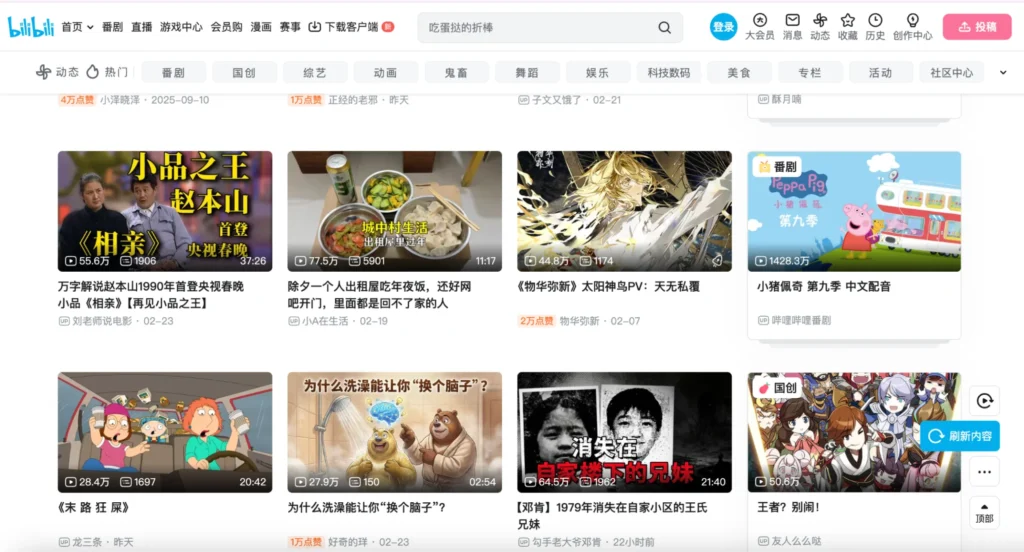
Bilibili attracts younger audiences in higher-tier cities who expect detailed explanations and long-form content. Users spend more than 100 minutes per day on the platform, indicating deep engagement with knowledge-driven creators, especially in technology, gaming, and specialist interests.
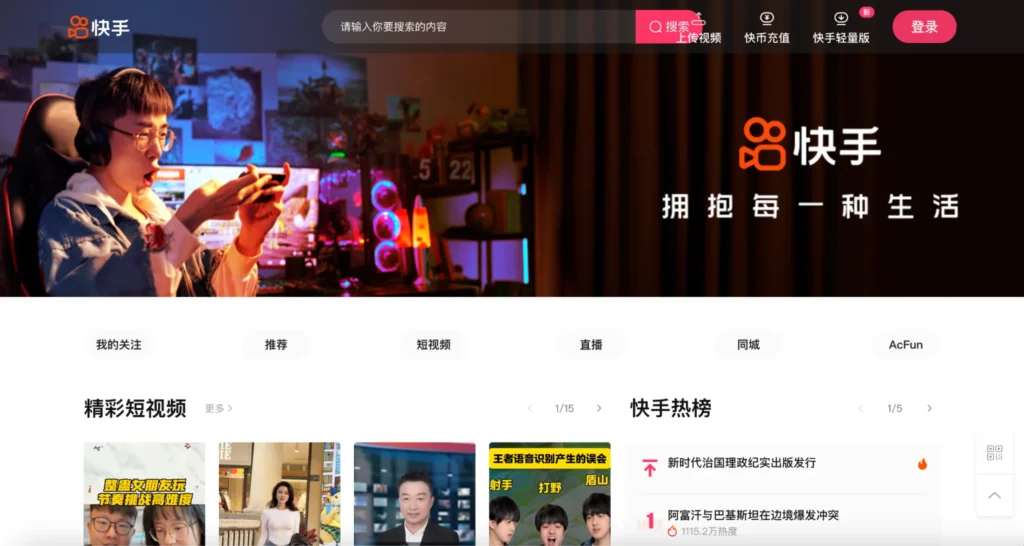
Kuaishou, by contrast, reaches broader audiences in lower-tier cities and rural markets, with a higher share of users aged 36 or older. Its emphasis on familiarity and everyday practicality makes it effective for mass-market adoption and for building localized trust.
KOL marketing in China no longer functions as a sequence of isolated collaborations. Leading brands now design influence systems that guide consumers from discovery to validation and finally to retention across connected platforms. The objective is to manage decision flow rather than schedule promotional bursts.
Execution begins by identifying how a category is evaluated. Products that require explanation, comparison, or proof must appear first in environments where users actively research. Everyday goods can enter through demonstration-led channels that trigger faster purchase behavior.
This shift changes creator selection criteria. Relevance to the evaluation moment carries more weight than audience size. Brands look for creators who repeatedly influence how products are judged within a category, not those who generate temporary spikes of attention.
Performance assessment now focuses on observable consumer actions that indicate movement toward purchase. Brands track increases in platform searches, saved content, repeat-viewing patterns, and participation in discussions that indicate audiences are entering evaluation mode.
These signals often appear before direct sales data, providing early validation that influence is working. Companies connect them to their WeChat or CRM environments to understand how creator activity contributes to customer lifetime value rather than short campaign windows.
Sustained partnerships have proven more cost-efficient than repeated influencer sourcing. Brands maintain smaller groups of specialized creators who continuously engage audiences, allowing influence to compound over time and remain searchable long after initial publication.
This operational model reflects the broader maturation of the market. KOL marketing is becoming an always-on commercial infrastructure embedded within digital ecosystems rather than a promotional layer added after strategy is defined.
Artificial intelligence is changing how brands identify and structure influence before campaigns launch. Instead of relying on manual discovery, companies are using data modeling to predict which creators can shift evaluation within specific categories.
Industry trend reporting shows 85 percent of advertisers consider AI adoption in marketing an urgent priority, yet the transition remains cautious. About 42 percent report a lack of proven implementation cases, while roughly 33 percent express distrust in AI-generated output. More than one-third cite concerns related to data security and system compatibility.
This tension reflects a market moving from experimentation toward operationalization.
AI systems are increasingly used to analyze creator content histories, audience behavior patterns, and historical conversion signals to recommend partnerships aligned with demand conditions. They also help identify high value customers who can evolve into KOC contributors, blending customer data with influence networks.
The result is a shift from reactive campaign design to predictive influence planning, where partnerships are modeled and tested before deployment.

KOL marketing in China is moving toward industrialisation, where influence is organised as a repeatable growth engine rather than a creative experiment. The next phase will focus on integration, where commerce, content, and customer management operate as a single environment across platforms.
Brands are expected to combine professional creators with knowledgeable consumers who already use their products. These hybrid ecosystems enable companies to scale credible content while maintaining subject-matter depth. The model reduces reliance on celebrity influence and strengthens category authority over time.
As platforms deepen connections between content, payment, and data environments, brands will gain clearer visibility into how influence drives retention and lifetime value. WeChat, in particular, will remain central to this process because it links exposure directly to private domain relationships and repeat transactions.
AI-generated avatars and synthetic presenters will expand in controlled use cases such as product education, customer service, and standardized demonstrations. Adoption will remain measured as advertisers balance efficiency gains against trust and compliance considerations.
Influence will increasingly be embedded in interactive formats such as micro-dramas, live demonstrations, and community events that merge digital discovery with real-world participation. These formats extend the lifespan of content and encourage audiences to treat creator material as an ongoing reference rather than as disposable media.
The trajectory suggests that success in China will depend less on mastering individual platforms and more on building coordinated influence infrastructures that align creators, data systems, and commerce pathways into a continuous operating model.
Understanding China’s KOL ecosystem is only the first step. Execution requires localized insight, platform expertise, and the ability to translate market intelligence into operational strategy. ChoZan is a China-focused consulting and digital transformation firm that helps global companies understand Chinese consumers, platforms, and innovation models, and applies those lessons to real business growth.
ChoZan’s core services include:
If your organization is evaluating how to approach China’s KOL-driven market, you can schedule a consultation with ChoZan to discuss your objectives, challenges, and potential strategic pathways.
Book a session to explore how these insights apply to your business context and market goals.
Budget requirements for China influencer strategy depend on category complexity and content depth, not follower size. Many firms begin with focused pilot programs to understand platform behavior, cost structure, and realistic conversion timelines.
Yes, companies must consider data rules, advertising standards, and contracting practices when planning cross-border marketing initiatives in China. Local compliance review helps avoid delays while ensuring that creator partnerships, content approvals, and reporting processes comply with domestic regulations.
Results rarely appear instantly. ROI from KOL campaigns often develops over several weeks as audiences research, revisit content, and compare options. This gradual build reflects how Chinese consumers validate decisions before committing to purchase.
Both play important roles in KOL vs KOC China strategies. KOLs provide structured expertise and visibility, while KOCs contribute relatable usage experiences that strengthen trust signals during evaluation and encourage more confident purchasing behavior.
Content should be adapted to platform culture, language nuance, and usage scenarios when planning localization for Chinese social media. Direct translation rarely works because audiences expect demonstrations, context, and explanations that reflect local consumption habits.
There are manageable risks in China influencer compliance, especially around disclosure rules and data handling. Working with experienced local advisors helps brands structure contracts, review messaging, and maintain transparency while protecting both reputation and operational continuity.
Preparation usually takes several months for firms entering the Chinese market because partner selection, platform setup, and regulatory review require coordination. Early planning allows smoother campaign activation and prevents costly adjustments after launch.
Many sectors benefit from industries well-suited to KOL marketing in China, particularly those that require education or demonstration. Healthcare, technology, beauty, and food brands use trusted voices to explain usage, safety, and performance in ways traditional advertising cannot.
Successful companies treat integrating China's digital strategy as part of global planning rather than a separate experiment. Aligning insights from China with wider operations often improves innovation, customer engagement models, and data-driven decision-making.