
CONTENT

In 2026, the most useful lesson for marketers comes from a new generation of consumer brands in China built on tight feedback loops, platform-native execution, and sharper commercial judgment. This is not a hype cycle. It reflects market discipline, where product design, content, conversion, and iteration connect early.
China’s scale reinforces this shift. Online retail sales reached 15.97 trillion yuan in 2025, with physical goods accounting for 13.09 trillion yuan, or 26.1 percent of total retail. At the same time, consumption shows K-shaped patterns, stronger platform concentration, and more deliberate trade-offs between utility and emotional value.
This article focuses on what marketers can apply. The advantage is not speed alone. It comes from turning consumer signals into decisions faster than legacy systems allow.

Many rising consumer brands in China start with a specific moment of demand rather than a broad audience definition. They focus on where repeat purchases begin, what triggers them, and how the product fits into daily life. This creates tighter product logic from the outset.
In 2026, brands will build around routines such as commuting, desk life, sleep, hydration, gifting, pet care, and family wellness. Linking products to visible use cases makes positioning clearer and easier to repeat. Spending increasingly reflects a balance between practical relevance and emotionally meaningful routines.
Growth is concentrating in narrow lifestyle categories. Products that fit a defined part of life are easier to understand, recommend, and repurchase. Every day utility, self-care, and small quality upgrades continue to gain traction.
For marketers, this means starting with a repeatable demand moment. Clear usage logic strengthens positioning and builds a stronger foundation for retention.
Many strong consumer brands in China build around platform logic from the start. They do not treat platforms as a later-stage distribution. They treat them as part of product design, pricing, merchandising, and conversion planning. That matters in 2026 because growth is concentrating within specific commerce systems rather than being evenly distributed across the market.
WPIC’s 2026 report says Douyin has overtaken Tmall as a key driver of discovery and conversion in several sectors. It also reports $92.3 billion in beauty ecommerce, $330.2 billion in fashion ecommerce, 14.1 percent growth in outdoor and sport ecommerce, and 20.4 percent growth in pet care ecommerce in 2025.

Douyin Ecommerce GMV grew 34 percent year on year from August 2024 to July 2025, while shelf ecommerce GMV rose 49 percent. Shelf scenarios accounted for about 40 percent of GMV in 2024 and reached the 50 percent target during the 2025 mid-year promotion period.
These shifts change product requirements. Packaging must perform inside the feed, naming must remain clear on small screens, and pricing must support both entry purchase and bundle expansion. Product pages still need to convert after content exposure, so optimization cannot focus on a single format.

RedNote plays a different role. It helps consumers decide if a product deserves trust. Reuters reported in May 2025 that Alibaba and RedNote formed a partnership to connect RedNote content more directly with Taobao and Tmall shopping links, with early focus on fast-moving consumer goods and healthcare products.
That makes evaluation content more important. Claims need proof. Review assets need to help with comparison. A product that cannot generate credible review content will struggle here, even with paid traffic.
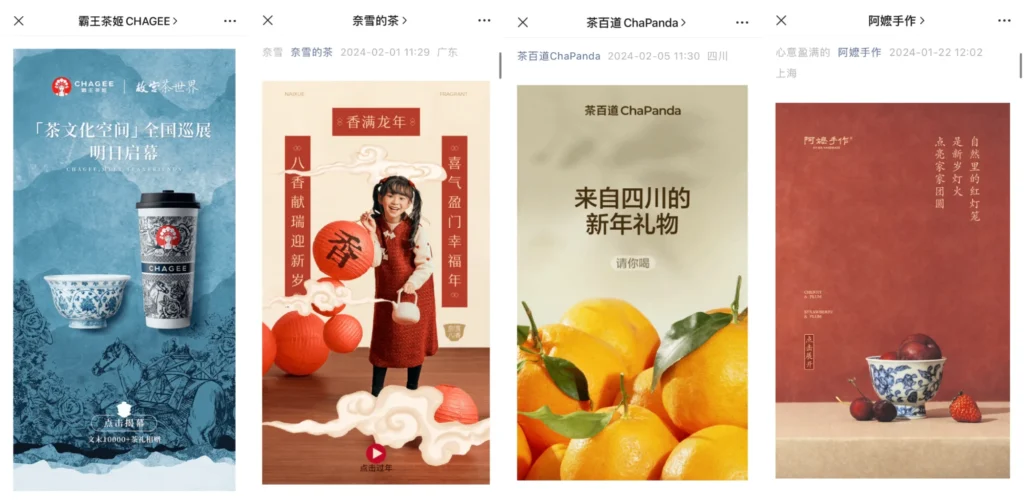
WeChat still matters because it holds the customer relationship after the first purchase. TMO Group’s 2026 analysis says WeChat has over 1.4 billion monthly active users and positions Mini Programs as a core tool for discovery, retention, and re-engagement across touchpoints such as QR codes, Official Accounts, group sharing, and subscription messages.
This makes WeChat valuable for loyalty, service, and repeat purchase. It is less about first-wave excitement and more about keeping the customer inside the brand ecosystem.
The lesson is simple. Platform behavior should shape product planning early. Stronger Chinese brands are showing that channel logic belongs inside the product system, not after it.

Content in China’s consumer ecosystem no longer sits at the top of the funnel. It operates inside the transaction flow. Platforms have tightened the connection between discovery, evaluation, and checkout, requiring brands to design content with direct commercial intent.
Product evaluation increasingly occurs within content environments. On RedNote, where user-generated reviews and shopping functions are tightly integrated, more than 300 million monthly active users engage with content that blends recommendation and transaction. The distinction between browsing and buying continues to narrow.
Each format carries a defined role within this system. Short video generates initial interest. Review content reduces uncertainty. Livestreaming accelerates decision-making. WeChat content supports retention and repeat purchase. These functions now operate as a coordinated sequence rather than separate stages.
Review content has become especially critical. Consumers expect visible proof of use, value, and real-life fit. Products that cannot generate credible evaluation content struggle to scale, regardless of advertising investment.
The shift is clear. Content is no longer supportive. It is part of the commercial mechanism that drives conversion.
Trust depends on signals that consumers can verify quickly. As spending becomes more selective, credibility relies on consistent proof across multiple touchpoints.
Consumers expect repeated validation. Creator content, customer feedback, store pages, and post-purchase experience must reinforce the same conclusion. One exposure is rarely enough.
The creator market reflects this shift. In 2025, only 5.8 percent of advertiser spend went to top-tier KOLs, with more activity moving toward mid-tier and long-tail creators. Relevance and category fit now outweigh reach alone.
Service quality directly affects credibility. Delivery accuracy, refund handling, response speed, and visible problem resolution shape perception. Weak follow-through damages trust quickly.
Trust builds when proof holds across the full customer journey.
Leading brands grow faster by reducing the gap between signal and action. Product, pricing, creator mix, and merchandising adjust quickly when systems support it.
This shift is now structural. China’s digital environment enables faster response through integrated ecosystems and AI-driven execution.
ChoZan’s 2026 analysis of China’s AI shopping race points to the same shift. It highlights Alibaba’s January 2026 rollout of Qianwen, which offers more than 400 capabilities, including ordering, payment, delivery coordination, and purchase-related tasks within a large platform environment. That kind of integration reduces the delay between user intent, platform action, and brand response.
A broader creator ecosystem adds more signals. In 2025, China had nearly 2.4 million commercial creators across major platforms. This expands testing capacity and speeds up adjustment.
Slower teams lose relevance before demand fully forms. Faster learning has become a core growth advantage.
Growth is not driven solely by discounting. Brands succeed through clearer value design that balances practical utility with emotional payoff.
Value needs to be immediately clear. Consumers want to understand what improves, why it matters, and why the price is justified.
Premium demand still exists but under stricter conditions. In beauty, preference for Chinese high-end brands rose to 46.5 percent in 2025, exceeding European and American brands at 31.7 percent. Consumers still pay more, but only with clear justification.
Leading brands make the value equation easy to understand through formulation, design, packaging, or clear use cases. The product does not need to appear expensive. It needs to feel justified.
The market rewards clarity of value, not low prices alone.
The key takeaway is not speed, but how tightly systems are connected. Strong brands link demand, content, trust, and conversion into a single operating model.
For marketers, this means starting with a clear demand moment, building with platform logic early, and treating content as part of the commercial system. Trust must be designed through visible proof, not messaging alone.
At the same time, faster feedback loops are becoming easier through integrated ecosystems. Brands that respond quickly maintain relevance while demand is still forming.
Value design also requires more precision. Consumers are becoming more selective, rewarding products that combine function, emotional payoff, and clear price logic.
The opportunity is not to copy tactics. It is to adopt the operating principles that improve decision speed and commercial clarity.
The lesson from this article is practical. Stronger consumer brands in China win through sharper market reading, better platform logic, and faster adaptation.
ChoZan helps brands turn that complexity into a clearer strategy. The firm positions itself as a China research and digital transformation consultancy that helps global businesses succeed in China and learn from China.
How we help
Go deeper
You can explore more of our work through ChoZan’s China consumer and retail trends, and digital marketing resources, or book a consultation to discuss a specific market question.
Most brands need one full test cycle of about eight to twelve weeks. That period gives enough time to assess conversion quality, repeat interest, customer feedback, and operational friction before scaling the budget or expanding product variation.
In most cases, yes. A local team improves decision speed, language precision, cultural reading, creator management, and response quality. Without local judgment, even well-funded campaigns often misread signals that Chinese consumers find obvious.
The most useful research is behavioral, not only demographic. Teams need evidence on purchase triggers, platform habits, price tolerance, search language, review behavior, and service expectations. That kind of research improves execution more than broad audience summaries.
Start with city clusters that match category demand, not prestige alone. A product may gain stronger traction in selected second-tier or new first-tier cities if the consumer base, channel economics, and lifestyle fit are more favorable.
The biggest mistake is translating positioning without rebuilding relevance. Chinese consumers respond to local context, daily routines, and category-specific expectations. Surface adaptation often looks acceptable internally but feels distant and unconvincing in the market.
It is critical. Consumers often judge brand quality by delivery accuracy, service response time, refund handling, and problem resolution. A weak after-sales experience can damage retention, review quality, and platform visibility far faster than many teams expect.
Early-stage brands should watch both, but retention usually reveals the stronger truth. Revenue can be pushed through incentives. Retention shows product fit, satisfaction, and repeat demand. That makes it a more reliable signal for long-term growth.
They should examine category fit, local competition, operating readiness, service capability, and decision-making speed. China rewards disciplined execution more than excitement. A sober operating review is far more useful than top-line market size alone.
Customer service data is one of the clearest sources of product truth. It reveals confusion, friction, unmet expectations, and feature gaps in plain language. Strong teams treat service logs as product intelligence, not only support documentation.
A strategy is too slow when teams cannot update product pages, offers, creative, or service responses quickly in response to new evidence. In China, delayed action usually means missed relevance, weaker learning, and rising acquisition costs.