CONTENT
What are dark factories is one of the most searched questions in global manufacturing strategy right now. The answer reveals something far bigger than a technology trend.
A dark factory is a fully automated production facility that runs without human workers. The lights are off because no one needs them. Robots and AI handle every step, every hour, every day.
China has not just adopted this model. It has industrialised it. And what is happening inside these facilities is rewriting the rules of global competition.
The term “dark factory” (黑灯工厂, hēidēng gōngchǎng) entered global manufacturing vocabulary through China. It describes a fully automated facility where production runs continuously with no human workers on the floor.
No lighting is needed for people. Robots assemble, inspect, and package. China artificial intelligence systems make real-time adjustments to every production variable. Automated guided vehicles move materials without human instruction.
China’s Ministry of Industry and Information Technology (MIIT) has formalised this through a four-level smart factory grading system. Lights-out, fully automated production sits at the top tier. It is not a future classification. It is the benchmark China is actively building factories to reach.
The concept has roots elsewhere. Japan’s Fanuc ran lights-out robot manufacturing lines as early as 2001. What is new is China’s scale, speed, and the national policy commitment behind it.
China’s dark factory build-out has accelerated sharply since 2022. The results are visible in 2025 data. China’s manufacturing workforce fell below 85 million in 2025, down from 115 million in 2013. Manufacturing output and exports hit record highs in the same period. Fewer workers, more output. That is what dark factories deliver at national scale.
Zeekr’s dark factory in northeast China represents one of the sector’s landmark milestones. The facility produces 300,000 electric vehicles per year with zero human hands touching the cars. Robots weld, paint, install batteries, and run quality inspection at every stage. It is one of the most comprehensive lights-out automotive factories in operation globally.
Robot deployment has reached record levels. China installed 295,000 industrial robots in 2024, representing 54% of the global total. By 2025, China’s robot density exceeded 400 per 10,000 manufacturing workers. It surpassed Germany and is closing in on South Korea and Japan. China operates over 2 million active industrial robots, the largest stock in the world.
Domestic production is deepening the advantage. China now manufactures 57% of its own industrial robots, up from roughly 25% a decade ago. Factories can deploy automation at lower cost and greater speed than any other market. This is a compounding structural edge, not a one-cycle gain.
Policy investment continues at scale. The government invested $1.4 billion in robotics R&D in 2023 alone. MIIT’s smart factory grading system now covers over 30,000 factories across China. All are benchmarked against the lights-out ideal at the top.
The following high tech companies are not in pilot mode. They are running dark factory models at production scale.
Changying Precision Technology replaced 90% of its workforce with automated systems. Output quality improved while unit costs fell. China Daily documented it as a defining example of the dark factory model applied to component manufacturing. Changying’s approach is studied globally as proof that full automation in precision components is commercially viable.
Zeekr operates a lights-out factory in northeast China producing 300,000 electric vehicles per year. No human hands touch the cars from entry to exit. Robots weld, paint, install batteries, and run quality inspection at every stage. The facility is one of the most comprehensive lights-out automotive operations globally.
Jetour’s Fuzhou SUV facility runs over 300 robots across welding, painting, windshield bonding, and tire installation. Automated guided vehicles manage all logistics between stations. Jetour’s AI platform reduced downtime by more than 60% and improved assembly accuracy across all lines.
Gree Electric partnered with China Unicom and Huawei to upgrade its Gaolan plant in Zhuhai. Industry observers have called it the world’s largest 5.5G native lights-out factory. The upgrade delivered a production efficiency gain of 86%. Gree is one of the world’s largest air conditioning manufacturers. Its Greater Bay Area location keeps it close to suppliers and enables rapid system iteration.
Understanding the definition is step one. Understanding the strategic implications is where the real work begins.
The labor cost equation has changed permanently. For decades, companies moved production to China for lower wages. Dark factories eliminate that logic entirely. The new competitive variable is automation depth, AI quality control, and supply chain integration.
China’s advantage is structural and compounding. More factories deployed means more operational data. Better data improves AI systems. Better AI deepens the lead. The robot stock, domestic robot industry, and policy framework all reinforce each other. This is not a temporary gap.
Global supply chains are already affected. Companies sourcing from China are benefiting from dark factory efficiency, often without knowing it. Companies competing with Chinese manufacturers face a cost structure that labor arbitrage cannot close.
The workforce shift mirrors a broader transformation. This goes beyond job losses on the factory floor. High-value roles now involve AI programming, systems integration, and real-time data management. It mirrors the digital transformation journey that every forward-looking organization now faces, applied directly to production.
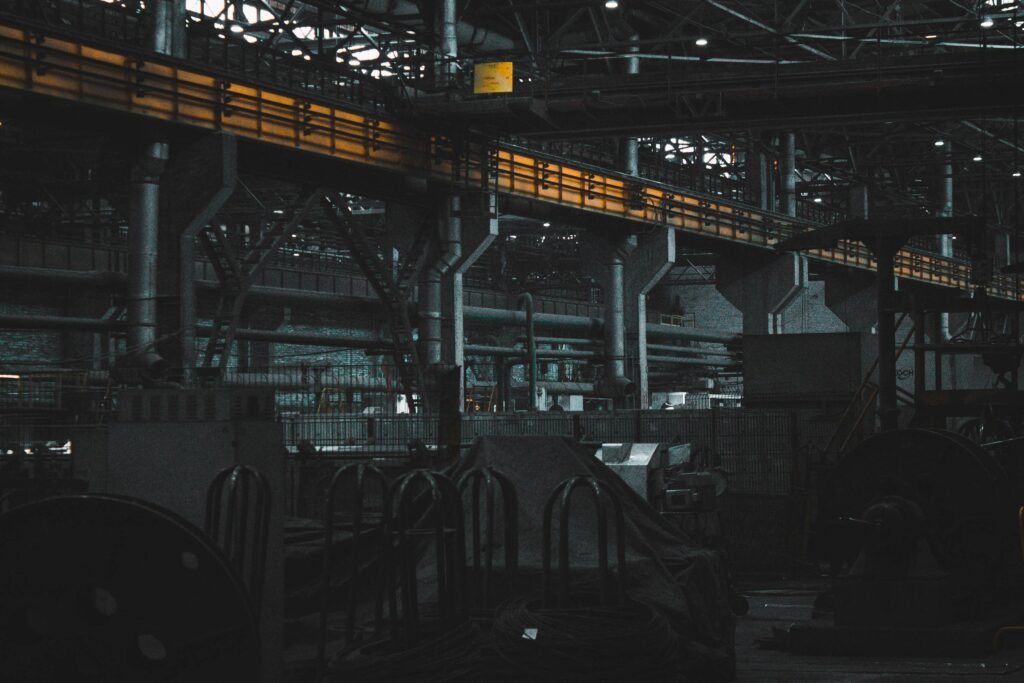
Reading about dark factories is useful. Walking through one is transformative.
ChoZan’s China Innovation Tours take business leaders into smart manufacturing facilities, tech hubs, and company headquarters across China. Participants meet the practitioners running these systems and leave with insights grounded in ground-level reality.
Book a consultation with ChoZan and start learning from China’s manufacturing innovation frontier today.
Dark factories are not a concept on the horizon. They are running right now in China, producing smartphones, EVs, appliances, and batteries. No workers. No breaks. No limits.
For global executives, the question is not whether to pay attention. It is how quickly they can understand what these facilities mean for their own industries.
China is not waiting. ChoZan is the bridge.
Dark factories are fully automated production facilities that run without human workers. Robots and AI systems handle all production tasks, operating 24 hours a day in complete darkness.
In 2024, Xiaomi launched an 81,000 sq meter dark factory in Beijing. It produces 10 million smartphones per year with zero human presence. It signals that dark factories have moved from pilots to mainstream deployment.
Not entirely. Human roles shift away from the production floor. Workers move into AI programming, systems monitoring, maintenance, and process optimization instead.
Several Chinese companies run these models at scale. They include Xiaomi, Zeekr, Foxconn, Gree Electric, BYD, Changying, CATL, and Jetour.
ChoZan’s China Innovation Tours offer structured visits to smart factories and dark factory facilities across China. Expert sessions with on-the-ground practitioners are included.