CONTENT
The race to build safe humanoid helpers has moved from futuristic demos to early trials in real homes. 1X Technologies, a Norway‑founded robotics company with operations in the United States, is at the forefront of this transition.
Unlike heavy industrial robots designed for factories, 1X’s NEO home robot was conceived for living rooms, kitchens, and corridors. The ChoZan report on emerging humanoid leaders notes that 1X focuses on safe general‑purpose robots for everyday environments.
This article explores how NEO evolved from a prototype to a platform capable of learning household chores, why its artificial intelligence matters, and how 1X plans to scale deployments into homes and workplaces.

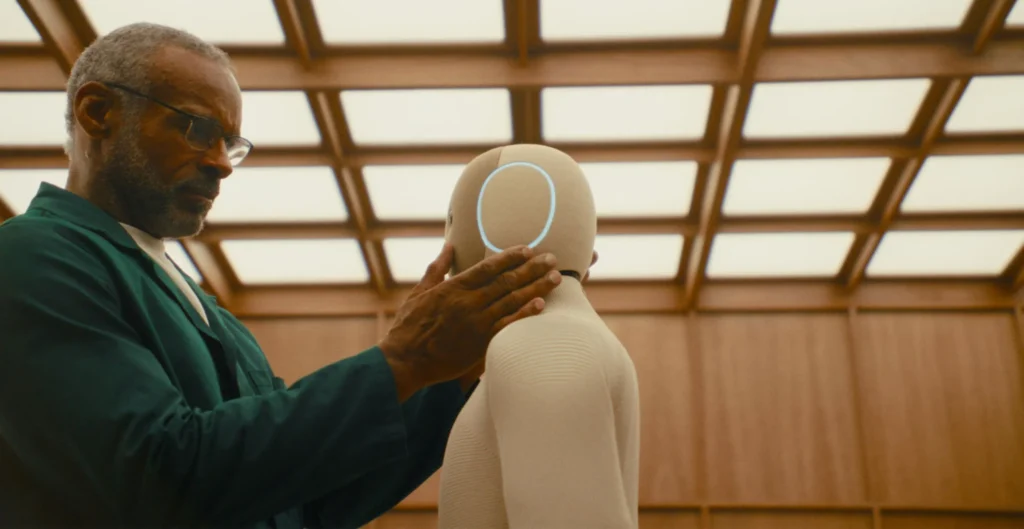
1X describes itself as a company obsessed with safety. Its prototype 1x NEO humanoid robot—known as NEO Beta—was built specifically for domestic spaces. The ChoZan report emphasizes that NEO Beta avoids rigid industrial mechanics, using bio‑inspired motion and soft physical interaction to work closely with people.
It is engineered to navigate human‑designed environments and is manufactured at 1X’s facility in Norway. Safety takes precedence over speed or payload: the prototype deliberately eschews aggressive motion or heavy tasks.
Domestic robotics requires delicate handling. NEO’s design wraps hardware in a custom lattice polymer for cushioning and uses low‑energy tendon drives to create gentle movements. Its joints are covered to make the surface pinch‑proof. The robot reads body language and responds to human gestures. These decisions make it feel less like a machine and more like a polite helper.
Early testers have noted that NEO’s soft suit and shoes are machine washable, a small but practical feature. These design choices signal a product meant to live alongside people rather than in sealed labs.
Hardware alone does not make a robot useful. Redwood AI gives NEO the intelligence to move, learn, and respond inside real homes. 1X introduced Redwood in June 2025, a vision-language transformer built specifically for humanoid robots.
Its role is practical. Redwood helps NEO retrieve objects, open doors, and navigate domestic spaces. It also allows the robot to handle unfamiliar objects in new locations, which matters because homes rarely stay arranged the same way twice.
Redwood also improves NEO’s coordination of movement. Instead of treating walking and hand control as separate systems, it predicts body movement, arm motion, and posture together. This helps NEO bend, brace, reach, and grasp with more natural control.
The model runs on NEO’s onboard GPU, with 160 million parameters operating at around 5 hertz. This gives the robot greater independence in homes with weak internet connections and reduces reliance on constant cloud access.
Redwood also learns from successful tasks and failed attempts. Over time, this learning loop helps NEO understand where its hands, objects, and obstacles are during real chores. That is why Redwood matters strategically. It turns NEO from a remote-controlled machine into a learning home platform.
1X trained Redwood on data collected from offices and employees’ homes, helping the system adapt to cluttered, constantly changing environments.

When NEO opens for pre-orders, customers can either buy or subscribe. The NEO home robot price for Early Access ownership is $20,000, with a three-year warranty, premium support, and priority delivery.
Buyers can reserve a unit with a refundable $200 deposit, while U.S. deliveries are scheduled to start in 2026. 1X also offers a $ 499-per-month subscription with a starter productivity package and standard delivery.
NEO arrives with basic autonomy powered by Redwood AI, then improves as it learns from use. For complex chores, Scheduled Expert Mode lets a remote 1X specialist guide the robot at planned times. This matters because early home robots still need human support when they face unfamiliar tasks.
Owners can speak to NEO via a voice interface, while the mobile app manages chore schedules, facilitates remote communication, and monitors. NEO also manages its own battery and plugs itself in when needed. For manual control, users can pilot the robot through a mobile app and a VR device.
The design focuses on safe daily interaction. NEO has a soft 3D-lattice polymer body, low-energy tendon drives, covered, pinch-proof joints, and machine-washable suit materials. It stands 5 feet 6 inches tall, weighs 66 pounds, and carries up to 55 pounds. Its 842 Wh battery supports up to four hours of runtime, while onboard AI handles conversation, memory, visual input, and navigation.
1X is moving NEO from prototype visibility toward early commercial deployment. Its OpenAI partnership addresses one of the hardest problems in home robotics: helping robots understand unstructured spaces and turn natural language prompts into physical actions.
In January 2026, 1X announced a World Model that enables NEO to learn from internet videos and convert natural-language instructions into actions without task-specific programming. This matters because home robots cannot rely on fixed scripts. They need to interpret changing rooms, objects, and user requests in real time.
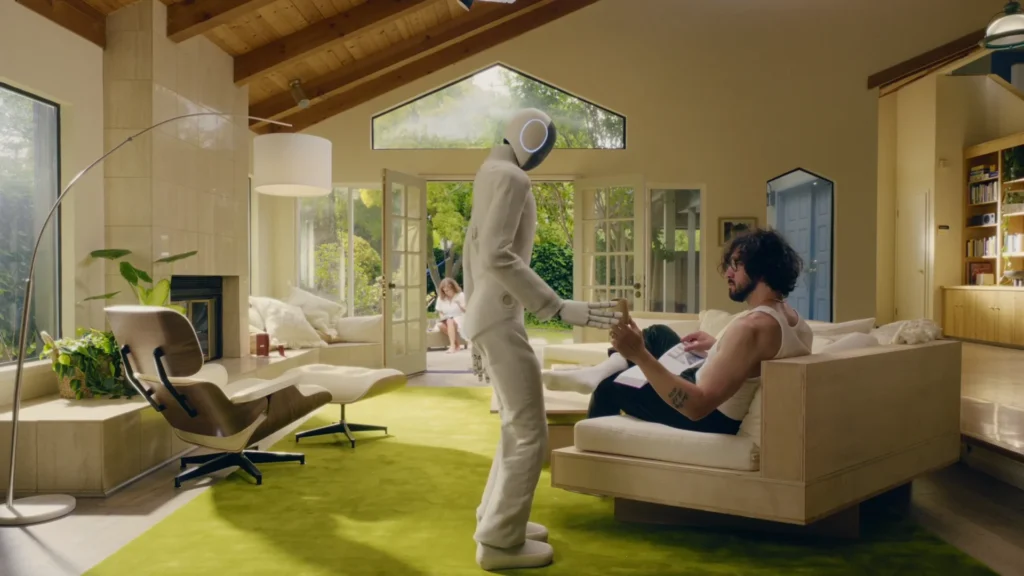
1X plans limited in-home trials and deliveries in 2026. That makes NEO important beyond consumer robotics, since private homes create the hardest testing ground for safe physical interaction.
The company is also building enterprise traction. In December 2025, 1X announced a strategic partnership with EQT to deploy up to 10,000 NEO robots across EQT portfolio companies between 2026 and 2030. These deployments will focus on facility operations, logistics, warehousing, manufacturing, and healthcare.
This gives 1X two learning environments. Homes can improve safety, interaction, and adaptability. Workplaces can test uptime, repeatable tasks, and operational ROI. Together, these deployments move NEO closer to a scalable humanoid platform rather than a single consumer device.
NEO points to a practical future for home-first humanoids. Its soft body addresses safety, while Redwood AI supports learning, movement, and task adaptation inside human spaces.
The January 2026 World Model adds another layer. It helps NEO learn from online videos and respond to natural-language commands without task-specific programming. That matters because home robots need flexibility, not fixed instruction sets.
1X is also preparing for scale. Its Hayward factory gives the company more control over production as it moves from early units to larger deployments. At the same time, the EQT partnership gives NEO a pathway into facility operations, logistics, warehousing, manufacturing, and healthcare.
The next test is execution. 1X must prove that NEO can operate safely, learn reliably, and deliver value beyond early adopter curiosity. Its advantage will come from real-world data, not public demonstrations.
Humanoid robotics is moving from research labs into homes, warehouses, hospitals, and real operational environments. China is becoming one of the most important markets shaping this shift across embodied AI, automation, and robotics infrastructure.
ChoZan helps executives and innovation teams understand these changes through:
Led by China expert Ashley Dudarenok, ChoZan connects emerging technologies to practical business strategy. The focus is not only on what is happening in China but also on why it matters for global companies preparing for the next phase of AI adoption.
If your team wants to understand where humanoid robotics and embodied AI are heading next, book a consultation with ChoZan.
NEO can carry items, retrieve objects, open doors, and navigate around the house. Powered by Redwood AI, it learns new chores over time, and 1X experts can teach it more complex tasks remotely.0
Early Access ownership costs $20,000 and includes a three‑year warranty and premium support, while the $499/month subscription offers a starter productivity package. A $200 deposit secures your unit, with U.S. deliveries scheduled for 2026.
Yes. NEO’s soft body uses a custom lattice polymer, its joints are pinch‑proof, and it employs low‑inertia tendon drives for gentle movement.
NEO comes with basic autonomy but also offers a Scheduled Expert Mode, allowing remote specialists to teach it new abilities when needed.
Data collected during operation helps improve Redwood AI, and owners control when remote experts can connect. 1X’s FAQ clarifies how data is used and offers guidance on privacy settings.
The NEO home robot can run core Redwood AI functions onboard, which allows it to operate even in homes with weak or unstable internet connections. Cloud connectivity mainly supports updates, remote features, and advanced assistance tools.
Yes. The 1x NEO humanoid robot uses onboard AI systems for voice, visual, and contextual recognition. Over time, it can personalize interactions, routines, and responses based on household behavior and usage patterns.
Redwood AI trains on real-world household data rather than on fixed room layouts. This helps the NEO Humanoid robot adjust to furniture being moved, clutter, pets, and changing object locations in daily living spaces.
Most companies developing home humanoids position them as support systems rather than replacements. The 1x NEO robot is designed to assist with repetitive physical tasks while humans still handle judgment, care, and supervision.
Beyond residential use, the 1x NEO robot pricing strategy and subscription model position NEO for logistics, warehousing, manufacturing, healthcare, and facility operations, where adaptable physical automation is increasingly valuable.
Homes are among the hardest environments for robotics because their layouts, objects, and human behavior constantly change. A successful NEO home robot could later adapt more easily to workplaces and commercial environments.