CONTENT

AI predictive analytics in healthcare is no longer a future concept. It is a live, operational force reshaping how hospitals diagnose, treat, and manage patient care at scale. The global AI healthcare market was valued at USD 39.34 billion in 2025 and is projected to reach over USD 1 trillion by 2034, growing at a compound annual rate of nearly 44%.
That trajectory is being driven, in large part, by what is happening on the ground in China. China has become the world’s most advanced proving ground for healthcare AI.
With over 38,000 hospitals, a population of 1.4 billion, and government mandates pushing digital health infrastructure at a national scale, the country has moved faster and further than any other market. For global healthcare providers, what China’s companies are building and deploying today is a direct preview of where the industry is heading.
AI predictive analytics in healthcare refers to the use of machine learning, deep learning, and natural language processing (NLP) to analyze large volumes of medical data and generate actionable predictions. These predictions can relate to patient outcomes, disease progression, hospital readmissions, staffing needs, or fraudulent claims.
The data sources driving these systems include electronic health records (EHRs), diagnostic imaging, lab results, wearables, insurance claims, and real-time patient monitoring feeds. Rather than reacting to problems after they occur, predictive analytics allows providers to anticipate them before they become critical.
The three core application areas are:
Each of these is now being deployed at scale in China.
China’s scale creates conditions for healthcare AI that no other country can fully replicate. Over 90% of Chinese healthcare institutions have adopted electronic health records, generating an enormous, unified pool of patient data.
Combined with a 1.4 billion-person population, a growing elderly demographic, and a severe shortage of specialist doctors in rural areas, the pressure to deploy AI solutions quickly has been immense.
China’s AI healthcare market is projected to grow from USD 900 million in 2020 to USD 18.88 billion by 2030, at a CAGR of 42.5%. In the AI-enabled medical devices segment, China leads the world with a projected CAGR of 52%, outpacing the US (32.7%), Germany (44.3%), and India (48.1%).
The Chinese government has positioned AI as a core pillar of national healthcare strategy. The Healthy China 2030 initiative and the New Generation AI Development Plan both include explicit mandates for AI integration across the healthcare system.
At the local level, Shanghai launched a dedicated Work Program for the Development of Artificial Intelligence in Medicine (2025-2027). Suzhou released its own implementation plan for accelerating AI adoption in healthcare.
The AI Application Scenarios Reference Guide and the 2025 Innovation Task Notice set out scenario-based regulatory frameworks that speed up the pathway for companies to bring AI tools into clinical use.
These are not loose guidelines. They are coordinated, funded rollouts that have created a uniquely enabling environment for companies to deploy and scale.
China’s health data infrastructure sets it apart globally. With over 90% of institutions on unified EHR systems, AI models can be trained on datasets that simply do not exist elsewhere at this scale or standardization level.
China’s national 5G rollout has accelerated real-time data transmission between hospitals, remote clinics, and centralized AI systems. This makes telemedicine and remote diagnostics viable even in rural regions.
Free trade zones in Shanghai, Beijing, and Hainan offer regulatory sandboxes where companies can test AI tools in real clinical environments before national deployment.
China’s healthcare AI leaders are not running pilots. They are deploying at hospital scale, integrating across clinical, administrative, and insurance systems, and producing measurable outcomes. Here is what the leading companies are building.
Ping An Health has built one of the most comprehensive AI-assisted healthcare platforms in China. Its AI Doctor system handles initial patient triage and symptom screening before escalating to a human physician.
With this model, in-house doctors handle consultation volumes that would be unmanageable in traditional care. The company reports that AI assistance enables doctors to handle 600 to 700 patient interactions per day.
The platform’s “One-Minute Clinic” (一分钟诊所) is an unstaffed booth where patients consult an AI Doctor, receive a diagnosis plan, and collect medication from a smart cabinet, all without seeing a physician in person. As of Q1 2025, the platform connects users with over 50,000 in-house and contracted doctors across 29 specialties. Ping An Health has also integrated DeepSeek into its systems to improve diagnostic accuracy.
AliHealth has deployed its AI triage and follow-up management system in partnership with the Second Affiliated Hospital of Zhejiang University, covering patient routing, post-consultation tracking, and risk flagging. Its AI Medical Assistant is integrated into public clinic platforms, guiding patients through symptom assessment and directing them toward appropriate care.
AliHealth operates within the broader Alibaba ecosystem, connecting health data with Alipay for seamless payment and insurance integration. Tens of millions of users interact with AI-enabled health services through platforms they already use daily.
Baidu’s Melody AI chatbot handles patient triage queries within Baidu’s own health platforms, helping users navigate care before specialist attention is required. Baidu has also developed a multi-modal foundation model for clinical decision-making in partnership with China-Japan Friendship Hospital, one of China’s leading public institutions.
Baidu formed an AI hospital consortium with Shenzhen South Hospital and other partners, exploring multi-agent AI architectures. In these setups, different AI models collaborate on complex diagnostic and treatment tasks within the same clinical workflow.
Tencent Healthcare partnered with Jiangsu Provincial People’s Hospital to launch an AI imaging and virtual doctor system covering patient engagement, diagnostic support, and follow-up care.
WeDoctor, the Tencent-backed telemedicine platform, uses NLP and machine learning to deliver virtual health assistants supporting patient self-diagnosis and remote consultations.
The platform is particularly impactful for elderly patients and those in rural areas where specialist access is limited. WeDoctor has grown into one of China’s most extensive digital healthcare networks, with hospital partnerships across the country.
JD Health operates a large-scale telemedicine platform powered by NLP and ML, delivering virtual consultations and follow-up management across China. Its strategic partnership with DeepBI focuses on integrating advanced AI analytics into rural telemedicine workflows, extending predictive health tools beyond urban centers.
JD Health benefits from JD.com’s logistics infrastructure, enabling rapid medication delivery after AI-assisted consultations and building closed-loop healthcare journeys within a single ecosystem.
SenseTime built one of China’s most capable medical imaging AI platforms, covering detection of cancer, lung nodules, and stroke across radiology, endoscopy, pathology, and dermatological imaging. Its joint lab with West China Hospital of Sichuan University accelerated clinical validation of its imaging models.
SenseTime’s healthcare imaging work has contributed to a growing body of AI-validated diagnostics across China’s hospital networks. The sector has since seen consolidation, with capabilities being absorbed into broader healthcare AI ecosystems as the industry matures.
China has approximately one radiologist per 70,000 people, according to a peer-reviewed study published in the Korean Journal of Radiology. This acute shortage forced rapid development of AI imaging tools that could operate at scale without proportional headcount growth.
The result is a generation of AI tools that match or exceed human performance in screening for lung nodules, breast cancer, and stroke. For global providers facing similar resource pressures, AI-assisted imaging reduces diagnostic error, accelerates read times, and lets specialists focus on the cases that genuinely require their judgment.
AI predictive analytics in healthcare is showing measurable impact on hospital operations in China. Studies on AI-optimized resource allocation systems show average length of stay reductions of approximately 8%, a meaningful gain across systems managing millions of admissions annually.
Key operational applications include:
For global hospital administrators facing budget pressure and capacity constraints, these tools offer near-term, quantifiable returns.
China’s telemedicine platforms have demonstrated that AI can extend specialist-level care to populations that would otherwise have none. Platforms serving rural and elderly populations have scaled to tens of millions of users. They do this by embedding AI triage, symptom checking, and follow-up management into apps those users already rely on.
This model transfers directly to markets where healthcare resources are unevenly distributed. Emerging markets in Southeast Asia, Africa, and Latin America face structural access challenges that China’s AI-enabled telemedicine approach is already built to address.
China’s National Healthcare Security Administration (NHSA) has made AI-driven fraud detection a national enforcement priority, with results now operating at a scale that few other health systems can match.
On March 16, 2026, the NHSA reported that 3,776 medical insurance fraud cases were jointly investigated with police in 2025, resulting in 10,357 criminal suspects arrested and 1,626 hospitals and pharmacies confirmed to have engaged in fraud. A total of RMB 34.2 billion (approximately USD 4.75 billion) in medical insurance funds were recovered. The Supreme People’s Court separately reported that 1,433 criminal cases relating to medical insurance fraud were adjudicated in 2025, a year-on-year increase of 24%.
AI data processing sits at the center of this enforcement capacity. The NHSA’s intelligent supervision systems automatically flag suspicious claim patterns, including falsified prescriptions, mismatched diagnoses, abnormal prescribing behaviors detected through drug traceability codes, and billing irregularities that no manual review team could catch at this volume.
For global payers and healthcare administrators, this is the clearest proof of what AI-driven claims review can deliver at scale. The volume of claims processed daily makes manual review impossible. AI systems operating on that same data can flag anomalies at a speed and scale no human team can approach.
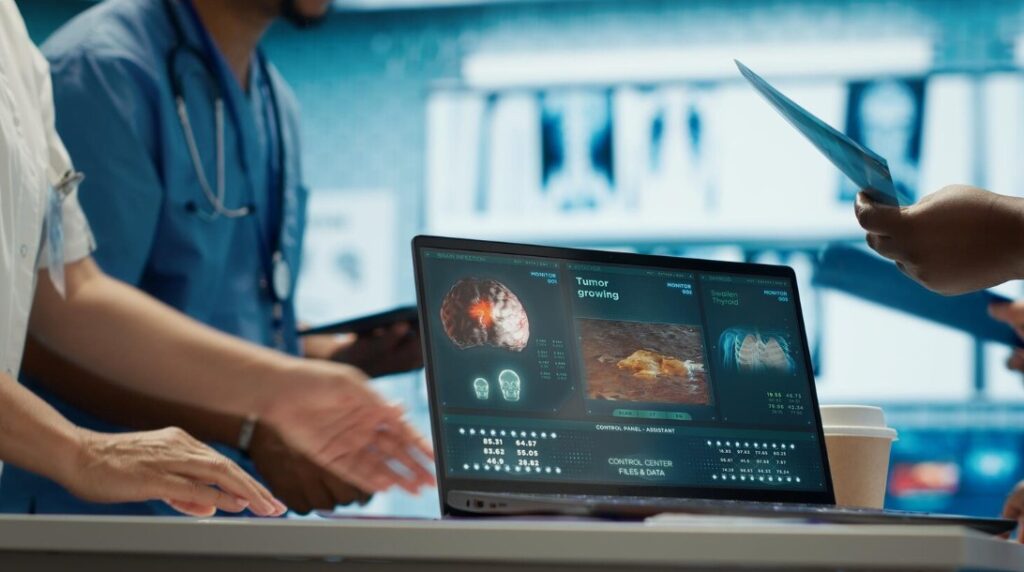
AI predictive analytics in healthcare only reaches its full potential when it operates across large, unified datasets and is integrated into real clinical workflows. China’s market structure, with national EHR standardization, government coordination, and concentrated data flows, has created exactly these conditions.
China’s AI-enabled medical device market is growing at a 52% CAGR, the highest globally. The global healthcare predictive analytics market is projected to grow from USD 16.7 billion in 2025 to USD 50.4 billion by 2030.
These figures reflect what happens when policy, infrastructure, and investment align. Global providers should benchmark their adoption pace against this trajectory.
China’s NMPA approved 9 AI medical devices in 2020 and 59 by 2023. That is not incremental progress. It is a structural shift in how quickly AI tools move from development into clinical deployment.
Health systems that build internal knowledge and partnerships now will have a clear advantage. Those that wait for AI adoption to arrive in their own market before engaging are already behind.
Understanding China’s healthcare AI ecosystem from reports alone only goes so far. The real competitive insight comes from seeing these systems in operation, meeting the teams building them, and understanding how policy, data, and industry have combined to produce outcomes at this scale.
ChoZan helps global executives and healthcare leaders learn from China through:
AI predictive analytics in healthcare uses machine learning and data analysis to forecast patient outcomes, disease risk, hospital resource needs, and administrative anomalies. It draws on EHRs, imaging, lab data, and claims data to generate actionable predictions before problems occur.
China deploys AI across medical imaging, clinical decision support, hospital operations, telemedicine, and insurance fraud detection. Companies like Ping An, AliHealth, Baidu, and Tencent have integrated AI into platforms serving hundreds of millions of users.
Key benefits include earlier and more accurate disease detection, reduced hospital stay lengths, improved care access for underserved populations, and significant gains in fraud detection and administrative efficiency.
Leading companies include Ping An Health, Alibaba Health, Baidu Health, Tencent Healthcare (WeDoctor), JD Health, SenseTime, iFLYTEK, Huawei Cloud, Yitu Technology, and Neuro-Weave.
The most effective approach is direct exposure: visiting hospitals, companies, and innovation hubs in China. ChoZan’s China Learning Expeditions, Innovation Tours, and Expert Calls provide structured, firsthand access to these developments.