CONTENT
Corporate innovation strategy has a new global benchmark, and it is not Silicon Valley. It is China. While Western companies debate AI adoption roadmaps, Chinese enterprises are already running fully automated factories and deploying humanoid robots on live production lines.
The question for global executives is no longer whether to pay attention. It is how fast they can learn from what China is building.
China’s rise as the world’s leading AI deployment environment is not accidental. It is the product of coordinated policy, massive capital investment, and a private sector built to move fast.
In August 2025, China’s State Council issued a directive on the “AI+” initiative. It sets a target for the penetration of intelligent terminals and AI agents to surpass 70% across six key fields by 2027.
Those fields cover science and technology, industrial development, consumer services, public welfare, governance, and international cooperation. The directive targets 90% penetration by 2030 and a fully “intelligent economy” by 2035.
China’s 14th Five-Year Plan (2021-2025) designated AI as core national infrastructure. The incoming 15th Five-Year Plan (2026 onward) goes further. It frames AI, robotics, and quantum computing as the primary drivers of “新质生产力 (xīn zhì shēngchǎn lì),” or “new quality productive forces.”
The deployment numbers reflect this ambition:
Backing this up is significant capital. The government committed an $8.2 billion AI startup fund and a $70 billion chip sector incentive package in 2025.
The “Eastern Data, Western Computing” initiative further distributes AI computing capacity across the country. These are not isolated grants. They form a coordinated policy stack designed to make AI adoption the industrial default.
What sets China’s corporate innovation strategy apart is not the technology. It is how deeply that technology is embedded into operations from day one.
In most Western organisations, AI arrives as a project. A pilot in one department, a proof of concept for one workflow. In China’s leading companies, AI is infrastructure. It runs across procurement, manufacturing, R&D, sales, and after-sales at once.
Speed-to-scale is a core principle. Chinese companies deploy quickly, accept early imperfection, and iterate using real-world data. This creates compounding advantages that slower, more cautious competitors struggle to close.
Government-industry alignment makes this faster still. When Beijing signals a priority, capital, talent, and regulatory support move in the same direction.
Open-source AI models have lowered the barrier further. DeepSeek-V3, Alibaba’s Qwen, and ByteDance’s Doubao are free to use and customise. DeepSeek disclosed that its base model DeepSeek-V3 required approximately $5.58 million for the official training run, using 2,048 Nvidia H800 GPUs over roughly 55 days.
Analysts note this excludes broader infrastructure and R&D costs. Even so, the model’s algorithmic efficiency was widely seen as a breakthrough. Combined with open-source access, it has made enterprise-grade AI tools reachable for mid-sized manufacturers.
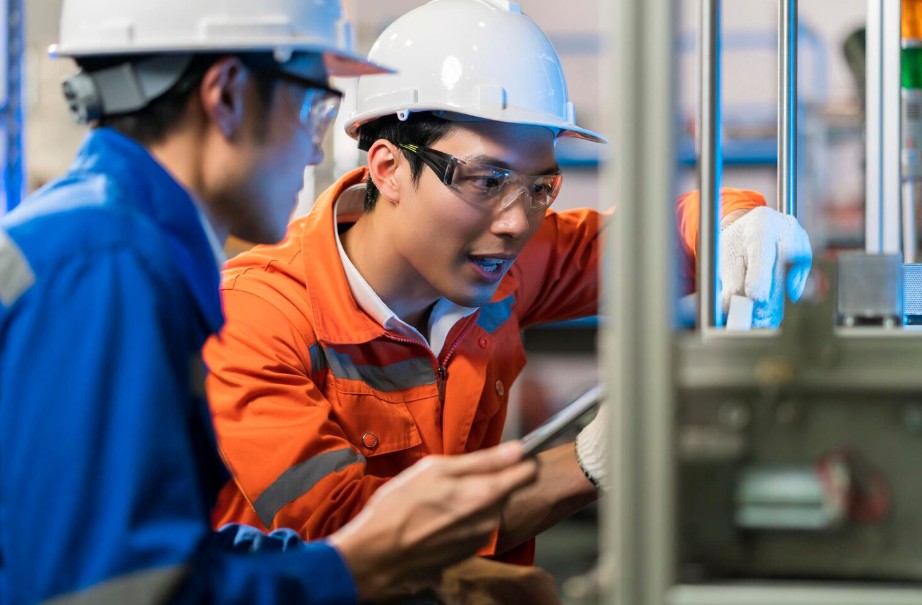
China accounts for over half the world’s industrial robot installations and more than 90% of humanoid robot shipments in 2025. The companies below show what AI-driven manufacturing looks like in practice.
Xiaomi’s EV factory in Beijing produces an SU7 sedan every 76 seconds at full capacity. The facility runs AI-powered die casting, real-time quality control, and integrated supply chain management.
Consumer electronics production across Xiaomi’s facilities similarly relies on high levels of automation. In 2025, Xiaomi ranked as the world’s third-largest smartphone brand with a 13% global market share, per Counterpoint Research, holding the second spot in several regional markets including parts of Europe.
BYD has embedded AI across its entire EV manufacturing ecosystem. This covers battery production, defect detection, and supply chain optimisation. In 2025, BYD surpassed Tesla in annual BEV sales for the first time.
BYD reported approximately 2.26 million BEVs sold versus Tesla’s 1.64 million, a 27.9% year-on-year increase, according to CnEVPost, Electrek, and CNBC. BYD is one of the clearest examples of how AI-driven manufacturing can redefine an industry’s competitive order.
Shougang, one of China’s largest steelmakers, deployed an AI-powered visual inspection system to shift its process from labour-driven to model-driven.
The system was recognised as one of China’s top 10 benchmark AI applications at the 2025 Global Digital Economy Conference. Per a July 2025 Xinhua report, Shougang recorded a production efficiency gain of over 20% and a 35% reduction in defects.
BOE is the world’s largest display panel manufacturer. The company built its own AI decision-making system for production quality, covering data labelling, model training, and real-time defect detection.
This marks a shift from reactive inspection to predictive quality control. Senior Vice President Jiang Xingqun described the initiative publicly at the 2025 Global Digital Economy Conference in Beijing.
Haier has integrated AI across manufacturing, R&D, sales, procurement, and after-sales service. It is also combining AI models with home service robots and smart terminals. CEO Zhou Yunjie stated publicly that this integration represents Haier’s next major global growth lever, placing it at the intersection of industrial AI and the consumer smart home market.
Unitree, based in Hangzhou, builds agile humanoid robots that have appeared at CES and performed at the 2025 Spring Festival Gala, China’s most-watched broadcast. Its robots use AI-driven locomotion and are being piloted in industrial and logistics environments. Unitree’s cost-efficient model is actively reshaping global pricing expectations for humanoid robots.
AgiBot deploys AI-powered robots on production lines and in warehouses, generating real-world data that feeds China’s embodied AI ecosystem. The company releases open training datasets to accelerate the broader robotics industry. AgiBot completed multiple funding rounds in 2025 and is a key node in China’s AI robotics data flywheel.
ESTUN is one of China’s leading domestic manufacturers of industrial robots and AI-integrated motion controllers. Its controllers serve as the core intelligence of factory robots. ESTUN is expanding internationally, benefiting from China’s push for domestic robotics self-reliance in automotive and electronics manufacturing.
Mech-Mind provides AI-powered 3D vision and robotic picking systems for automotive, electronics, and photovoltaic manufacturers. Its recent release of Mech-GPT, a multimodal LLM for industrial tasks, extends its offer further. The company’s plug-and-play architecture makes adoption accessible for factories of all sizes.
Inovance makes industrial automation controllers and servo systems, the hardware intelligence behind factory robots. As scrutiny of foreign suppliers grows in China, Inovance is gaining domestic market share. It is also extending its footprint across Southeast Asian manufacturing markets.
China’s model offers four transferable lessons for global business leaders:
Reading about China’s corporate innovation strategy is one thing. Seeing it firsthand is another.
ChoZan’s services are built to bridge that gap:
If your organisation is serious about where industrial AI is heading, the most direct path is to see it in action. Book a consultation or explore ChoZan’s China Innovation Tour.
China’s corporate innovation strategy is not a future projection. It is a present reality, running at scale across thousands of factories and boardrooms right now.
The companies in this article are not outliers. They are the new baseline for what a globally competitive, AI-native enterprise looks like. The principles they apply, treating AI as infrastructure, moving fast, and building physical AI capacity, are transferable to any organisation.
China is the destination. The innovation is already there.
China integrates AI at the national policy level and the enterprise level at the same time. This enables faster, more coordinated adoption. Western companies tend to treat AI as a departmental initiative rather than company-wide infrastructure.
Manufacturing, EVs, logistics, and consumer electronics lead. Steel, healthcare, and retail are following, driven by the State Council’s AI+ directive targeting 70% penetration across six key sectors by 2027.
Yes. The core principles, speed to scale, AI as infrastructure, and open-source adoption, apply regardless of geography or industry.
ChoZan’s China Innovation Tours offer expert-guided access to leading Chinese companies, smart factories, and technology hubs across China’s most advanced regions.
Yes. Open-source models like DeepSeek-V3 and Qwen, combined with government subsidies for SMEs, have made enterprise-grade AI accessible well beyond large corporations.