CONTENT

China’s automation market has entered a deployment cycle. Factory owners are asking how quickly robots can stabilize quality, reduce process variance, and support greater product complexity in real production lines. This is why Estun Robotics matters now.
The company sits at the junction of two Chinese priorities: domestic substitution in core automation and scalable smart manufacturing for advanced industries. In 2025, China’s industrial robot output reached a new high, while Estun reported strong growth in robots and intelligent manufacturing.
For global executives, the company is a useful lens into how Chinese automation firms compete. Hardware is only the visible layer. The deeper advantage lies in servo systems, motion control, robot controllers, application software, and factory integration.
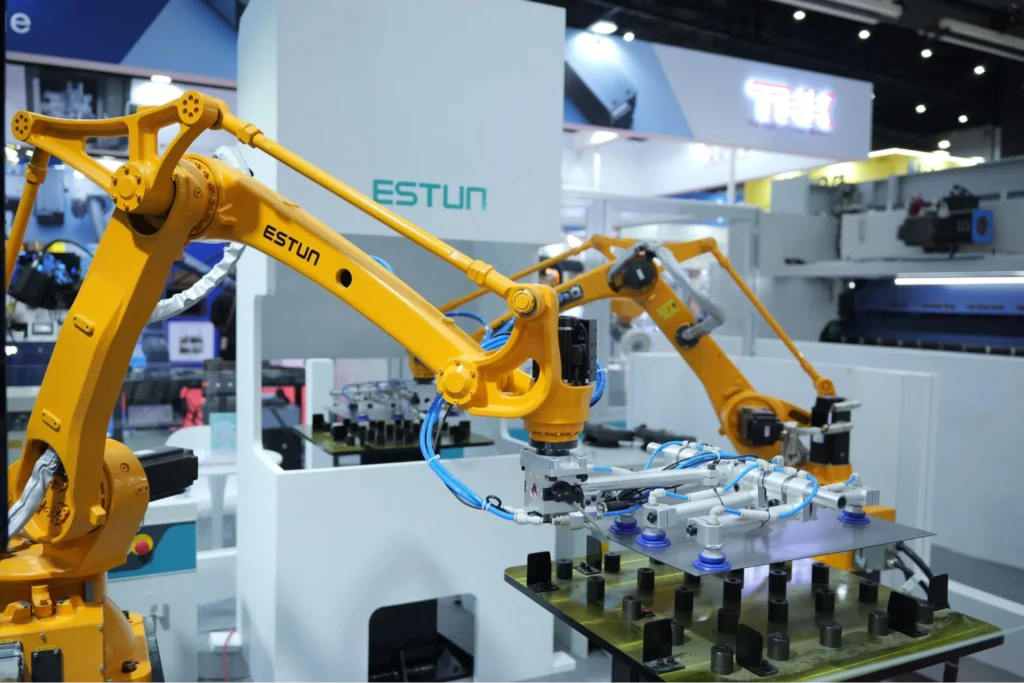
The journey of Estun Robotics started on the factory floor of motion control. Unlike assemblers who buy third party parts, Estun built its reputation on the estun servo drive and estun servo motor. This foundation in precision control allowed the company to avoid the margin traps of pure integrators.
In 2025, that strategy paid off definitively. According to MIR Databank, Estun Robotics captured 10.5% of the Chinese industrial robot market, ranking first among all brands, foreign or domestic . The company recorded over 25% year on year growth in shipments, pushing the total domestic substitution rate in China past the 56% threshold
The relevance of Estun comes from vertical depth. A robot arm is only as strong as the control architecture behind it. A plant manager wants uptime, repeatability, fast commissioning, and service access. A procurement leader wants lower exposure to imported parts. A strategy team wants suppliers that can scale from a single workstation to a factory line.
Domestic substitution has become a procurement issue. It now touches imported drives, imported controllers, imported software, and imported engineering support. That makes Chinese robotics companies more important for multinationals operating in China and for overseas factories studying the economics of Chinese manufacturing.
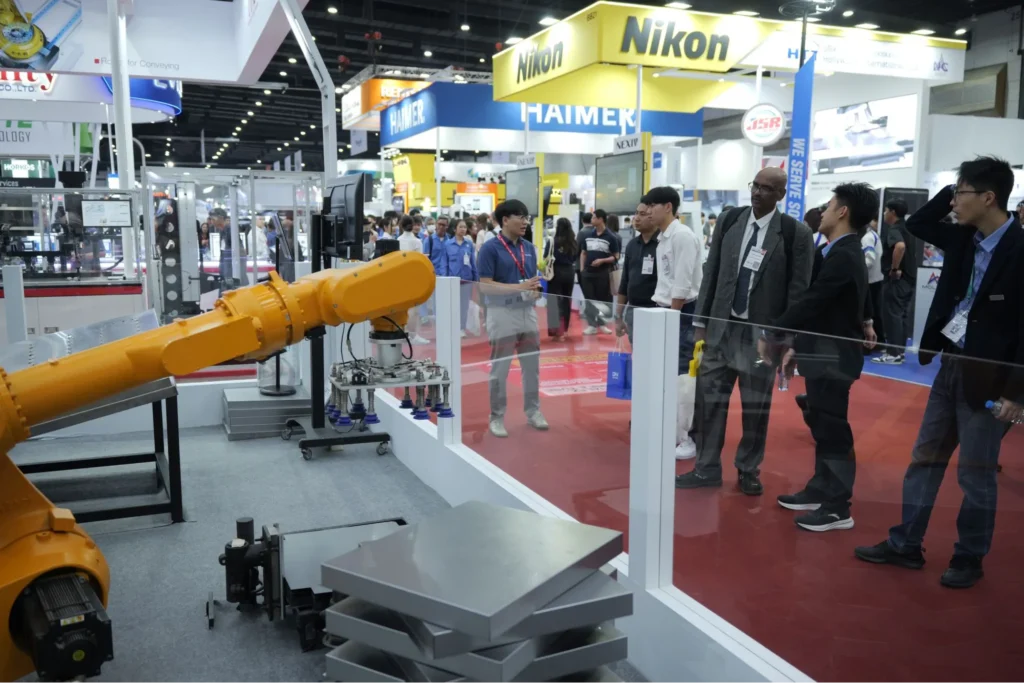
Estun Automation operates through two connected business modules. The first is the automation of core components and motion control systems. The second is industrial robots and intelligent manufacturing systems.
In 2025, Estun Automation reported US$721.5 million in revenue, up 21.93 percent. Industrial robots and intelligent manufacturing systems reached US$590.0 million, equal to 81.77 percent of revenue. Core components and motion control systems reached US$131.5 million.
This mix shows where market demand is strongest: packaged robot solutions for high-value factory scenarios.
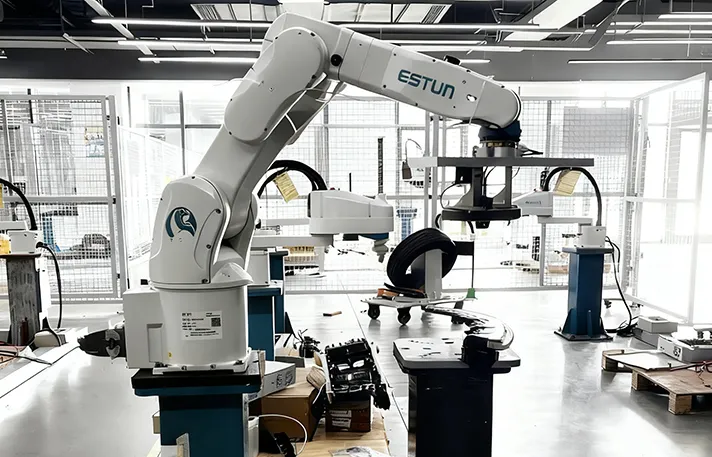
A factory buyer sees robots. The technical team sees axes, drives, motors, controllers, PLCs, HMI, I/O, fieldbus timing, safety, and service tools.
An Estun servo drive and an Estun servo motor matter because precision, torque response, and repeatability sit underneath visible robot motion. An Estun controller matters because plant engineers need the robot to communicate with sensors, tooling, machine vision, safety systems, and line control logic.
This is the strategic layer that separates a robot supplier from a full automation player. Motion control turns component substitution into process control. It also gives factories more flexibility when product design, cycle time, or inspection rules change.
An Estun robot should be read as part of a work cell, a production line, and a plant data flow. The company’s official product spectrum includes ER series robots, collaborative robots, specialized robots, workstations, and robot accessories. Its 2025 annual report lists a payload range of 3kg to 1,200 kg across 96 industrial robot products.
For buyers, this breadth matters because no two factory problems look the same. A photovoltaic line needs delicate handling and high throughput. A welding cell needs stable path control. A heavy equipment plant needs payload, rigidity, and safety. The supplier that can connect these use cases into repeatable solutions has a stronger commercial position.
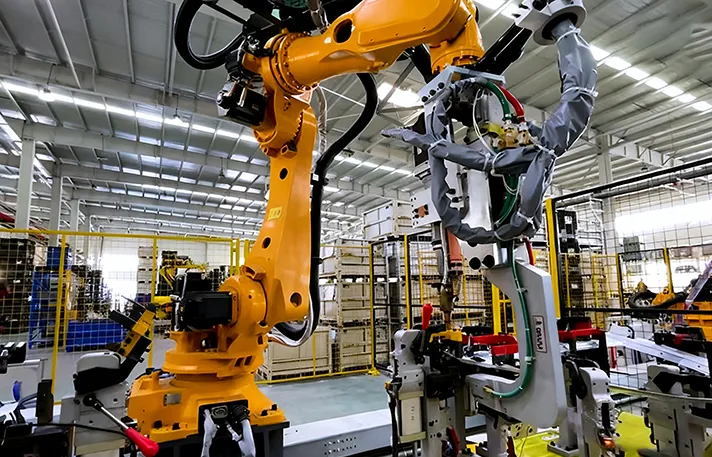
Estun is most relevant where process knowledge matters as much as the robot body.
Estun gained attention in 2026 with a large automotive parts welding line using more than 200 robots, according to company materials. The project covered spot welding, dispensing, riveting, screwing, handling, and arc welding.
This matters because automotive automation demands process repeatability, payload coverage, tool integration, and rapid commissioning. Welding robots must deliver stable paths, accurate synchronization, and strong fault recovery. For new energy vehicle supply chains, local robotics capability can shorten development cycles and reduce integration friction.
Photovoltaic automation is a strong fit for Chinese robot suppliers because China’s solar manufacturing base demands scale, speed, and process specialization. The company site lists applications across silicon wafer, cell, and module manufacturing, including silicon rod handling, basket handling, layout, framing, and chip insertion.
For solar manufacturers, the issue is not simply labor replacement. It is throughput, breakage control, traceability, and fast line reconfiguration during product change. That is why photovoltaic automation has become a test of the depth of robotics in China.
Metal processing, bending, grinding, stamping, die casting, and welding remain important because they involve variable parts and tough environments. Estun 2025 materials highlighted explosion-proof robots, heavy payload robots, and functional safety solutions.
These categories matter for factories that want to automate dirty, heavy, or hazardous work without relying fully on imported robot brands. They also show how Chinese suppliers are moving into tougher process categories, not only simple handling tasks.
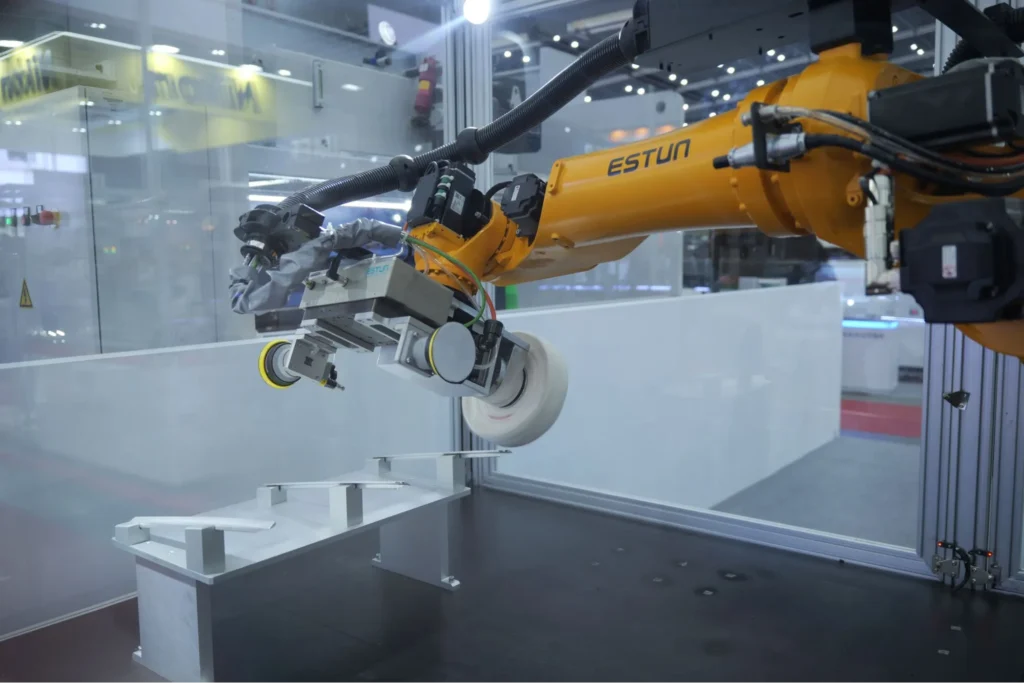
China’s automation story is moving from robot installation to robot intelligence. For Estun, the strategic question is how the physical robot connects to software, data, and AI-assisted commissioning.
The company described its NGC control platform and ERI execution control platform in 2025, with API, SDK, and real-time interaction capabilities. In early 2026, it introduced iER.OS and RoboBase for industrial robots plus AI applications.
These moves matter because factories do not buy AI as a slogan. They buy shorter commissioning cycles, easier programming, better fault prediction, and lower dependence on scarce robot engineers.
TRIO controller tools shown at CIIF 2025 focused on natural-language access to documentation, model selection, code generation, simulation, and real-machine validation.
For users searching for Estun automation, the larger business story is clear. The most valuable supplier owns the control layer, not only the visible machine.
Estun’s value proposition strengthens when buyers need localized service, component access, and cost control. This does not remove the need for vendor due diligence. It changes the shortlist.
Any global brand manufacturing in China should track which local robotics suppliers win in EVs, solar, lithium batteries, electronics, and metal processing. Supplier adoption often signals where Chinese production economics are moving before balance sheets make it obvious.
The Hong Kong listing in 2026 and the global service network show a stronger international posture. For overseas factories, the questions are practical: service depth, safety certification, software localization, cybersecurity review, and integration support.
Domestic substitution has shifted from replacing imported machines to replacing imported control capability. This is where motion control, servo systems, and robot controllers become board-level topics.
Estun Robotics matters because it reflects the shift in Chinese industrial automation from low-cost equipment toward full-stack factory capability. Its strength lies in the connection between core components, robots, software, and process solutions.
For investors, the signal is revenue mix and cash flow improvement. For manufacturers, the signal is application maturity. For competitors, the warning is the speed of iteration inside China’s manufacturing clusters. For strategy teams, Estun Robotics is a practical case of how China’s smart manufacturing ecosystem is moving from installation volume to controlled deployment.
Understanding Estun Robotics requires more than company facts. It requires context on China’s automation supply chain, industrial policy, deployment culture, and buyer behavior.
ChoZan helps leadership teams turn China innovation signals into practical strategy through research, briefings, workshops, learning expeditions, and expert calls.
Book a consultation to explore what China’s robotics and smart manufacturing shift means for your business.
You can program Estun robots offline using Estun Editor, a desktop tool for robot programming, simulation, and command editing. This helps engineers test paths virtually before uploading programs to the robot controller.
Yes, Estun offers a remote operation and maintenance app that supports controller access, troubleshooting, program upload and download, backups, and version upgrades through VNC, SSH, and cloud-based equipment management.
Estun supports international buyers through delivery training, installation and debugging, preventive maintenance, extended warranty, upgrades, repairs, spare parts, and buy-back services. The company says its global service network covers 75 outlets.
Yes, Estun robots can connect to vision systems via standard interfaces. Mech-Mind’s integration guide shows how to load Estun robot files and establish communication between the robot and the vision platform.
Estun SCARA robots are better suited to fast horizontal handling, assembly, and packaging tasks, while six-axis robots offer more flexible motion for welding, handling, machining, and complex part orientation.
Yes, Estun collaborative robots can suit smaller factories when tasks need compact automation, lower payloads, and easier human-robot interaction. Estun’s cobot range includes 3 kg, 5 kg, 10 kg, and 20 kg models.
Buyers should check payload, reach, axis count, IP rating, repeatability, mounting position, end-effector needs, safety requirements, and software compatibility. Estun’s product pages list these specifications by robot family and model.
Yes, some Estun robot models are supported by third-party simulation tools such as RoboDK. This can help teams simulate cells, create robot paths, and test programs outside the production environment.
Engineers can find Estun robot manuals on the company’s official user manual pages, including documents for ER series robots, collaborative robots, specialized robots, workstations, and robot accessories.
Communication options matter because cobots often need to connect with PLCs, sensors, grippers, and line equipment. Estun CoDroid materials list interfaces including analog, digital, Modbus RTU, Modbus TCP, CAN, and RS485.